
The World Economic Forum (WEF) Annual Meeting in Davos, Switzerland, has long been a bellwether for global trends, bringing together leaders from politics, business, and civil society. The 2026 edition, held from January 18 to 24 under the theme “A Spirit of Dialogue,” was no exception, but it stood out for its intense media and social media footprint.
Drawing on the comprehensive “Media & Social Media Impact Analysis” report by Onclusive, alongside broader insights from recent coverage, this post dissects how WEF 2026 reverberated across digital and traditional media landscapes. With over 6.8 million mentions collected, the event generated unprecedented buzz, dominated by geopolitical tensions, high-profile speeches, and a surprising pivot away from perennial favorites like climate change. Let’s break down WEF 2026 media impact.
6 Key takeaways about WEF 2026 media impact
- Geopolitics Overwhelmed Other Themes: Discussions on Greenland, tariffs, Ukraine, and Europe dominated social media, accounting for the majority of mentions and eclipsing traditional WEF focuses like climate change.
- U.S. Leaders Drove the Narrative: Donald Trump led with 48.94% SOV, followed by figures like Gavin Newsom and Scott Bessent, highlighting U.S. political influence and controversies such as event exclusions.
- Trump’s Initiatives Sparked Buzz: The launch of the Board of Peace was a highlight, but it also fueled debates on multilateralism, with Trump’s speech capturing 46% of conference-related mentions.
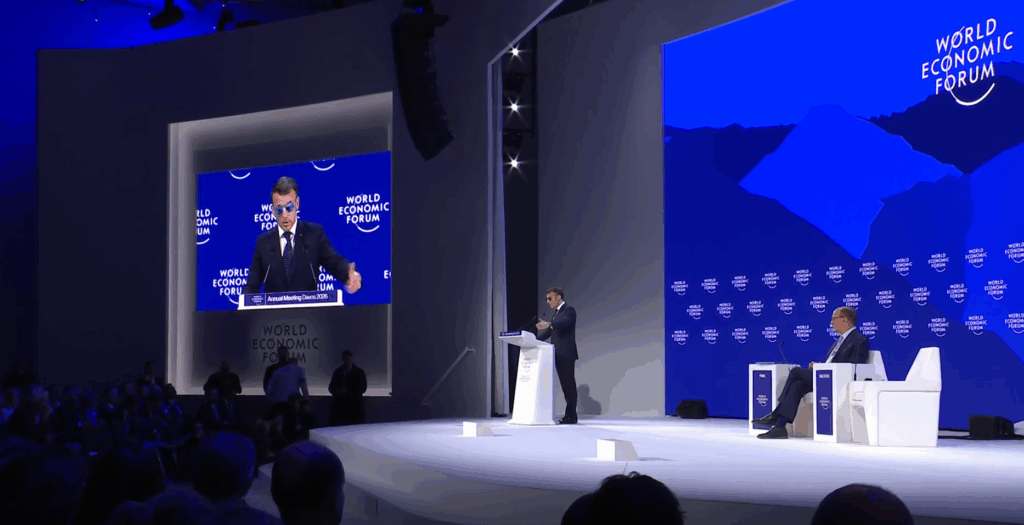
- European Responses Went Viral: Emmanuel Macron’s address, complete with aviator glasses and memes around “For Sure,” symbolized pushback against U.S. policies, boosting European visibility.
- Tech and AI Maintained Niche Appeal: Leaders like Elon Musk, Alex Karp, and Demis Hassabis gained traction in sessions on AGI and innovation, but overall tech buzz was secondary to politics.
- Climate Visibility Declined: Compared to prior years, climate topics had lower SOV, signaling a short-term shift toward immediate geopolitical risks amid global tensions.
Understanding the data: Onclusive’s methodology
Onclusive’s report provides a robust foundation for analyzing WEF 2026’s impact. The study spanned January 18 to 24, focusing on mentions related to the forum across accounts, keywords, and hashtags. It amassed 6,834,210 mentions from diverse sources: X (formerly Twitter) posts, articles, comments, and more. This included earned media conversations on social platforms, blogs, forums, and discussion areas, as well as mainstream media coverage from TV, radio, podcasts, print, and digital outlets.
Peaks in engagement
The analysis highlights peaks in engagement, with social media accounting for 6.833 million mentions and reaching 333.9 million people, while traditional media added 289,692 mentions with a staggering 262.1 billion reach. A key visualization in the report shows mention volumes spiking dramatically on January 21, coinciding with major events like:
- U.S. President Donald Trump’s speech on trade tariffs and Greenland acquisition
- French President Emmanuel Macron’s critique of “bullies” in trade practices
- Canadian Prime Minister Mark Carney’s address on global order
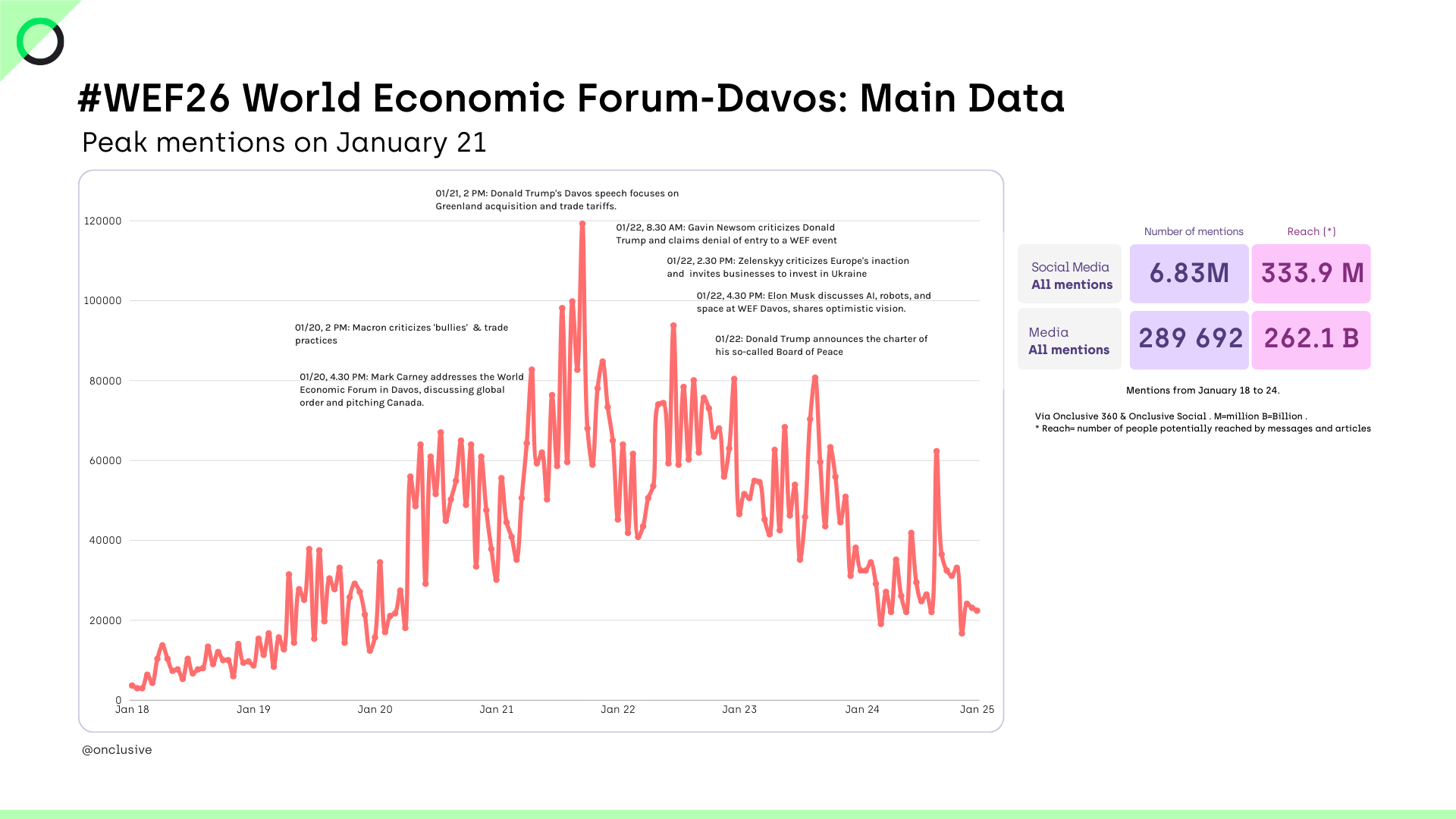
These peaks underscore how real-time events drove viral amplification, far surpassing quieter days.
Overall media surge: A tale of peaks and politics
WEF 2026 media impact shattered records for media attention, with mentions tripling from 2023 levels according to some estimates. The Onclusive graph illustrates a rollercoaster: low activity on January 18-19 ramped up to over 120,000 mentions per hour by January 21, fueled by Trump’s announcements and responses from world leaders. Subsequent days saw declines but sustained interest around AI discussions and closing sessions.
This surge reflects a broader trend: geopolitics overshadowed economics. As one WEF recap noted, the forum became “a tale of two Davoses”, insulated dialogues inside versus external protests and online debates. Trade tensions, particularly U.S. proposals on tariffs and acquisitions like Greenland, dominated headlines, with 10 key insights from Davos emphasizing how “geopolitical complexity is accelerating trade deals.”
Dominating Topics: Geopolitics over everything
According to Onclusive, politics and geopolitics reigned supreme on social media. The word cloud and list of top topics paint a clear picture:
- Greenland and Denmark: Topping discussions, this stemmed from Trump’s renewed push for U.S. acquisition of Greenland, framing it as a strategic move for security and resources. Social media erupted with debates on sovereignty, with hashtags like #GreenlandDeal trending.
- Donald Trump: Ubiquitous, linked to tariffs, peace initiatives, and clashes with other leaders.
- Mark Carney: Canada’s PM criticized U.S. dominance, sparking transatlantic friction.
- Emmanuel Macron: His speech on European resilience went viral.
- Gavin Newsom: California’s governor drew attention amid U.S. internal politics.
- Europe and European Leaders: Focus on unity against tariffs and external pressures.
- India: Emerging as a counterweight in global economics.
- Scott Bessent: U.S. Treasury Secretary’s talks on fiscal policy.
- Peace Council, Charter: Tied to Trump’s announcements.
- Howard Lutnick: Commerce Secretary’s controversial remarks.
- Javier Milei: Argentina’s president on free markets.
- Ukraine and Zelenskyy: Ongoing conflict discussions.
- Climate Officials: Notably lower, signaling a shift.

These rankings are based on share of voice (SOV) in mentions, where geopolitical terms like “deal,” “charter,” and “treasury” clustered heavily. Compared to past years, environmental topics like “energy transition” and “climate elite” appeared but with diminished prominence, as global risks reports noted a short-term deprioritization of climate issues.
Top discussed topics
The Onclusive word cloud and list highlight these as the most buzzed-about subjects, dominated by geopolitics. I’ve ranked them approximately by apparent size/prominence in the visualization for the top 15.
| Rank | Topic | Key Associations |
| 1 | Greenland and Denmark | U.S. acquisition talks, sovereignty debates |
| 2 | Donald Trump | Tariffs, Board of Peace, speeches |
| 3 | Mark Carney | Critique of great powers, Canada-U.S. relations |
| 4 | Emmanuel Macron | European response, trade “bullies” |
| 5 | Gavin Newsom | U.S. politics, event controversies |
| 6 | Europe and European Leaders | Unity, NATO, EU policies |
| 7 | India | Economic growth, third-largest economy push |
| 8 | Scott Bessent | Treasury insights, fiscal deals |
| 9 | Peace Council/Charter | Gaza and global peace initiatives |
| 10 | Howard Lutnick | Commerce critiques, dinner uproar |
| 11 | Javier Milei | Free market advocacy, Argentina’s reforms |
| 12 | Ukraine and Zelenskyy | Conflict resolution, aid discussions |
| 13 | Climate Officials | Environmental policies, but lower visibility |
| 14 | Larry Fink | BlackRock’s role in global finance |
| 15 | Elon Musk | AI, space, and tech optimism |
This political tilt amplified controversies, such as Trump’s irritation with Carney’s speech, where he retorted that “Canada lives because of the United States,” leading to Carney’s viral pushback. Similarly, Newsom’s conference was highly visible but marred by a refusal of access to a U.S.-hosted dinner, which he blamed on White House pressure, escalating partisan tensions. Lutnick’s dinner, hosted by BlackRock’s Larry Fink, turned chaotic with heckling and ECB President Christine Lagarde walking out amid his Europe-bashing remarks.
Star Power: Top personalities in the spotlight
Onclusive ranked 559 visible speakers by SOV in mentions. Political leaders claimed the lion’s share, with Trump at nearly 50%:
Top political leaders
Ranked by SOV in mentions among 559 speakers.
| Rank | Name | Country/Role | SOV (%) |
| 1 | Donald J. Trump | USA President | 48.94 |
| 2 | Gavin Newsom | USA (California Governor) | 9.09 |
| 3 | Mark Carney | CAN Prime Minister | 6.63 |
| 4 | Emmanuel Macron | FRA President | 5.74 |
| 5 | Scott Bessent | USA Treasury Secretary | 3.81 |
| 6 | Volodymyr Zelenskyy | UKR President | 2.70 |
| 7 | Howard Lutnick | USA Commerce Secretary | 2.67 |
| 8 | Javier Milei | ARG President | 1.77 |
| 9 | Ursula von der Leyen | EUR (EU Commission President) | 1.16 |
| 10 | Ashwini Vaishnaw | IND (Minister) | 0.76 |
| 11 | Mark Rutte | NATO Secretary-General | 0.58 |
| 12 | Friedrich Merz | GER Chancellor | 0.50 |
| 13 | Alexander Stubb | FIN President | 0.30 |
| 14 | Isaac Herzog | ISR President | 0.29 |
| 15 | Rachel Reeves | UK Chancellor | 0.23 |
Trump’s dominance reflects his announcement of the “Board of Peace,” a new initiative for Gaza and beyond, ratified in a historic Davos ceremony.
This body, seen by some as rivaling the UN, aimed at global challenges but drew fears of undermining multilateralism.
Top business and expert speakers
Ranked by SOV in mentions among 559 speakers.
| Rank | Name | Affiliation | SOV (%) |
| 1 | Laurence Larry Fink | WEF/BlackRock | 2.94 |
| 2 | Elon Musk | xAI/SpaceX/Tesla | 1.47 |
| 3 | Bill Gates | Gates Foundation | 1.05 |
| 4 | Christine Lagarde | ECB President | 0.95 |
| 5 | Al Gore | Generation Investment Management, ex-US VP | 0.82 |
| 6 | Brian Armstrong | Coinbase | 0.42 |
| 7 | Brad Garlinghouse | Ripple Labs | 0.37 |
| 8 | Eric Schmidt | Relativity Space | 0.33 |
| 9 | Albert Bourla | Pfizer | 0.32 |
| 10 | Gita Gopinath | Harvard University/IMF | 0.31 |
| 11 | Jamie Dimon | JP Morgan Chase | 0.26 |
| 12 | David Sacks | White House “Czar” | 0.17 |
| 13 | Alex Karp | Palantir Technologies | 0.13 |
| 14 | Kristalina Georgieva | IMF | 0.11 |
| 15 | Demis Hassabis | Google DeepMind | 0.11 |
Business leaders like Musk maintained visibility through AI-focused conversations, but politics eclipsed them.
Headline-grabbing addresses and conversations
Single-guest sessions drove the most buzz, per Onclusive’s Top 15 (out of 178 visible conferences):
Ranked by SOV among 178 conferences.
| Rank | Session | Speaker | SOV (%) |
| 1 | Special Address | Donald J. Trump (USA President) | 46.00 |
| 2 | Special Address | Mark Carney (CAN Prime Minister) | 13.15 |
| 3 | Conversation | Alex Karp (Palantir CEO) | 9.32 |
| 4 | Special Address | Emmanuel Macron (FRA President) | 5.07 |
| 5 | Conversation | Elon Musk (xAI/Tesla/SpaceX) | 3.24 |
| 6 | Special Address | Volodymyr Zelenskyy (UKR President) | 1.33 |
| 7 | Conversation | Scott Bessent (US Treasury Secretary) | 0.40 |
| 8 | Special Address | He Lifeng (CHN Vice-Premier) | 0.39 |
| 9 | Special Address | Friedrich Merz (GER Chancellor) | 0.32 |
| 10 | Conversation | Jensen Huang (NVIDIA CEO) | 0.29 |
| 11 | Conversation | Satya Nadella (Microsoft CEO) | 0.27 |
| 12 | Special Address | Javier Milei (ARG President) | 0.23 |
| 13 | Conversation | Gavin Newsom (California Governor) | 0.23 |
| 14 | Conversation | Jamie Dimon (JPMorgan Chase Chairman/CEO) | 0.23 |
| 15 | Special Address | Prabowo Subianto (Indonesia President) | 0.12 |
Trump’s address, announcing the Board of Peace, captured nearly half the SOV, emphasizing aid and security. Macron’s speech, delivered in aviator sunglasses to hide an eye injury, symbolized “European response” to U.S. aggression but spawned memes likening him to “Top Gun” or “Terminator.”
Social media amplified this, with phrases like “For Sure” (his emphatic closer) becoming viral fodder.
Thematic sessions: Future-focused but under the radar
Thematic conferences had lower overall visibility:
Ranked by SOV among 178 conferences.
| Rank | Session Title | SOV (%) |
| 1 | “Is Tokenization the Future?” | 3.06 |
| 2 | “Future of Inclusion” | 2.23 |
| 3 | Can India Become the Third Largest Economy in the World? | 1.41 |
| 4 | Water in the Balance | 1.41 |
| 5 | “Redefining Europe’s Place in the World” | 1.25 |
| 6 | Path to Peace in Ukraine: By Might or by Accord? | 0.97 |
| 7 | “Global Economic Outlook” | 0.93 |
| 8 | “Africa’s Job Engine” | 0.81 |
| 9 | Energy: The Great Funding Gap | 0.64 |
| 10 | “New Era for Finance” | 0.51 |
| 11 | “Closing Remarks” | 0.49 |
| 12 | “The Day After AGI” | 0.48 |
| 13 | “Preventing Jobless Growth” | 0.36 |
| 14 | “Can Europe Defend Itself?” | 0.33 |
| 15 | “Cybercrime Has Real Victims” | 0.18 |
AI sessions like “The Day After AGI” featuring Demis Hassabis and Dario Amodei gained traction, discussing post-AGI worlds. Musk’s conversation on AI, robots, and space shared optimism but warned of institutional stress tests.
Karp’s session ranked high, emphasizing AI’s role in exposing inefficiencies.
Notably, climate sessions like “Water in the Balance” appeared but with far less buzz than in prior years. Reports indicate environmental risks fell in short-term rankings, with leaders prioritizing geopolitics amid U.S. policy shifts. This “silence on climate” at Davos risks long-term oversight, as 5 of the top 10 decade-long risks remain environmental.
Why Macron’s ‘For Sure’ became the ultimate meme
The Context: What happened in the speech?
Macron’s address, titled something along the lines of a “Special Address by Emmanuel Macron, President of France,” focused on Europe’s role in a turbulent world. He criticized aggressive trade practices (think U.S. tariffs and Greenland talks) and emphasized Europe’s predictability and loyalty.
Key lines included: “Having a place like Europe which sometimes is too slow for sure and is to be reformed for sure. But which is predictable, loyal…” He repeated “for sure” multiple times, emphasizing points with a confident flair.
The sunglasses added intrigue, they were reportedly worn to hide an eye injury (rumors swirled about everything from a minor accident to playful jabs at “domestic violence” from his wife Brigitte, though that’s unsubstantiated satire).
This visual quirk, combined with his dramatic delivery in English, turned a serious geopolitical moment into meme fodder. According to media reports, the clip amassed millions of views within hours, peaking during the WEF’s high-visibility day on January 21.
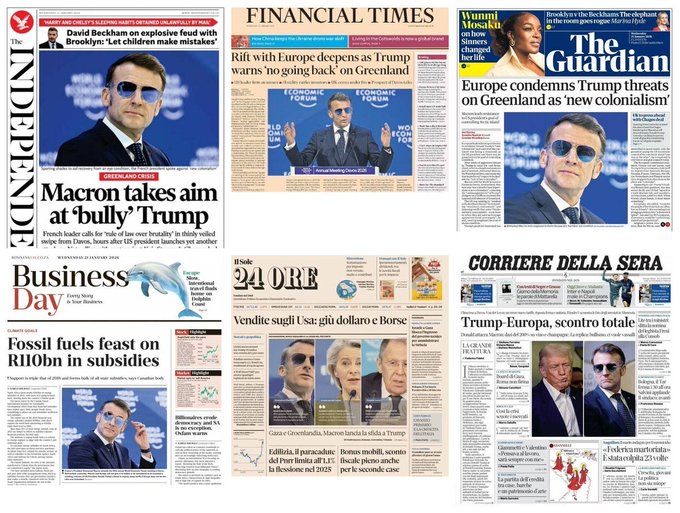
Why did it become the “ultimate meme”?
Several factors converged to make “for sure” an internet sensation:
The accent and repetition: Macron’s French-inflected English made “for sure” sound exaggerated and endearing, or mockable, depending on your view. It was repeated emphatically, like a verbal tic, which meme creators latched onto for loops, remixes, and parodies. One early X post called it “the meme of 2026” due to its instant quotability.
The sunglasses factor: The aviators gave him a “Top Gun” or “cool guy” vibe, clashing with the formal Davos setting. Memes often zoomed in on this, joking that he was hiding from “bullies” or channeling movie stars. It even boosted sales for the brand (Maison Henry Jullien’s Pacific model), causing their website to crash from traffic.
Geopolitical timing: Amid WEF tensions, like Trump’s dominance and U.S.-Europe clashes, the phrase symbolized European defiance with a touch of awkwardness. Social media amplified it as a lighthearted counterpoint to heavy topics, with users remixing it into music (e.g., hard techno tracks) or coding jokes (like defending a bad algorithm).
Social media virality: On X (formerly Twitter), hashtags like #ForSureMeme and #MacronGlasses trended, with top posts garnering thousands of likes. French outlets like La Dépêche du Midi noted how internautes (netizens) were amused, turning it into global fun. Even Trump remarked on the glasses, adding fuel. The Onclusive report highlights Macron’s 5.07% share of voice in special addresses, but the memes pushed his overall mentions higher.
In short, it was the perfect storm: relatable awkwardness, visual flair, and timely satire in a high-stakes event.
The lasting impact
By January 25, the meme had evolved into merchandise ideas (e.g., “For Sure” T-shirts) and even influenced pop culture references. While some saw it as distracting from Macron’s message on European reform, others appreciated the humanizing humor. In a WEF dominated by serious geopolitics, it provided comic relief, proving even world leaders aren’t immune to the meme machine. If you’re spotting any fresh ones in Paris, they’d make for great local twists!
Wrapping up: A politicized forum with lasting ripples
WEF 2026 media impact was profound, with politics, fueled by U.S. figures like President Trump, Bessent, Newsom, and Lutnick, eclipsing other themes. Controversies amplified reach, from dinner walkouts to meme-worthy moments, while tech leaders like Karp, Hassabis, Amodei, and Musk provided counterpoints on innovation. Yet, the subdued climate discourse signals a troubling shift, especially as global risks evolve.
As one takeaway put it, Davos exposed “tension between systemic fault lines and geopolitical noise.” Whether this “spirit of dialogue” yields action remains to be seen, but the social media echo chamber ensures these conversations will linger.
6 FAQs about WEF 2026 media impact
1. What was the most discussed topic at WEF 2026 on social media?
Geopolitics dominated, with Greenland and Denmark topping the list due to U.S. acquisition proposals, followed closely by Donald Trump and trade tariffs.
2. Who were the top speakers by social media mentions at Davos 2026?
Donald Trump led political figures with 48.94% SOV, while Laurence Fink topped business experts at 2.94%. Tech icons like Elon Musk also ranked high.
3. How did WEF 2026 media impact compare to previous years?
Mentions tripled from 2023, reaching over 6.8 million on social media alone, driven by real-time events and controversies, with a peak on January 21.
4. Why was climate change less visible at WEF 2026?
Geopolitical urgencies like Ukraine and trade wars overshadowed it, though sessions like “Water in the Balance” still appeared in the top 15 with 1.41% SOV.
5. What controversies arose during WEF 2026?
Key ones included Howard Lutnick’s divisive dinner leading to walkouts, Gavin Newsom’s event exclusion, and Trump’s clashes with leaders like Mark Carney.
6. How was AI featured in WEF 2026 discussions?
Sessions like “The Day After AGI” (0.48% SOV) with Demis Hassabis and Dario Amodei, plus Elon Musk’s