


Whitepapers


Team
Onclusive
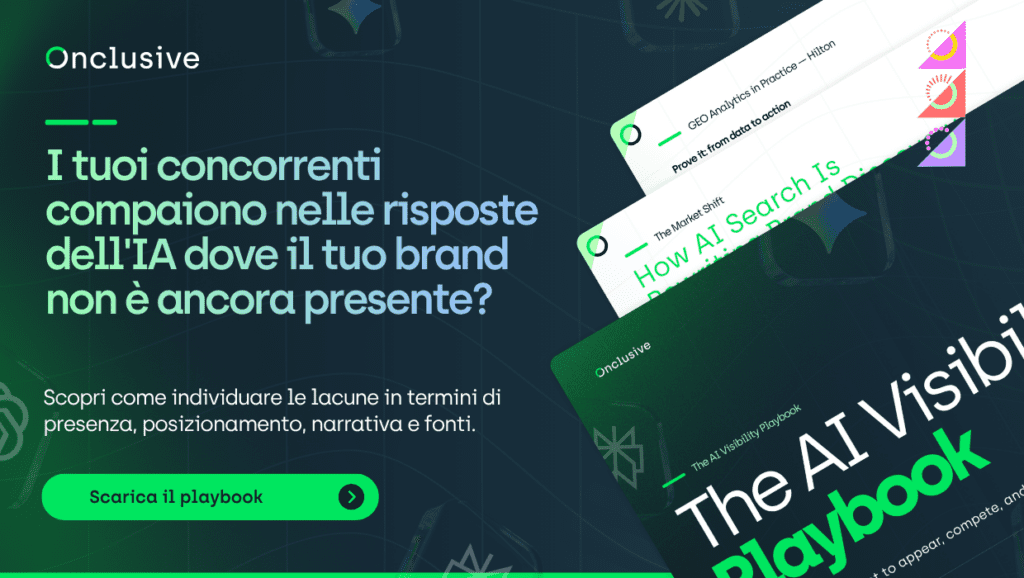
GEO Playbook – Guida alla visibilità dell’IA
For brands that want to appear, compete, and win in AI search
AI engines are already shaping how people discover, compare, and choose brands. But most teams still can’t measure how their brand appears in AI-generated answers or take action to improve it.
Download the playbook to learn how to measure your brand’s AI visibility, diagnose the gaps affecting your performance, and prove the impact of your work to leadership with confidence.
[Download the Playbook] →
Inside the playbook
A practical framework for PR, comms, and marketing teams, with expert perspectives from leaders across PR, SEO, digital marketing, and comms measurement.
Measure It
Understand what shapes AI answers
See how sources, competitors, earned media, content, and social signals influence how your brand appears.
Measure your brand’s AI visibility
Understand where, how often, and how prominently your brand appears across AI-generated answers.
Track the metrics that matter
Learn how to use visibility, share of voice, average position, win rate, and sentiment.
Diagnose It
Identify the gaps affecting performance
Spot presence, position, narrative, and source gaps that could be limiting your visibility.
Turn data into a clear action plan
Move from baseline measurement to practical next steps your teams can act on.
Prove It
Report AI visibility with confidence
Use the five-step action plan to bring clear, measurable insight to leadership.
Turn AI visibility insight into action
Knowing your AI visibility gaps is the first step. The next is measuring them consistently, tracking competitor performance, and understanding which sources are shaping AI-generated answers in your category.
Onclusive GEO Analytics helps PR, comms, and marketing teams monitor brand visibility across ChatGPT, Gemini, Grok, Claude, and Perplexity, without adding another reporting silo to the stack.
Team
Onclusive
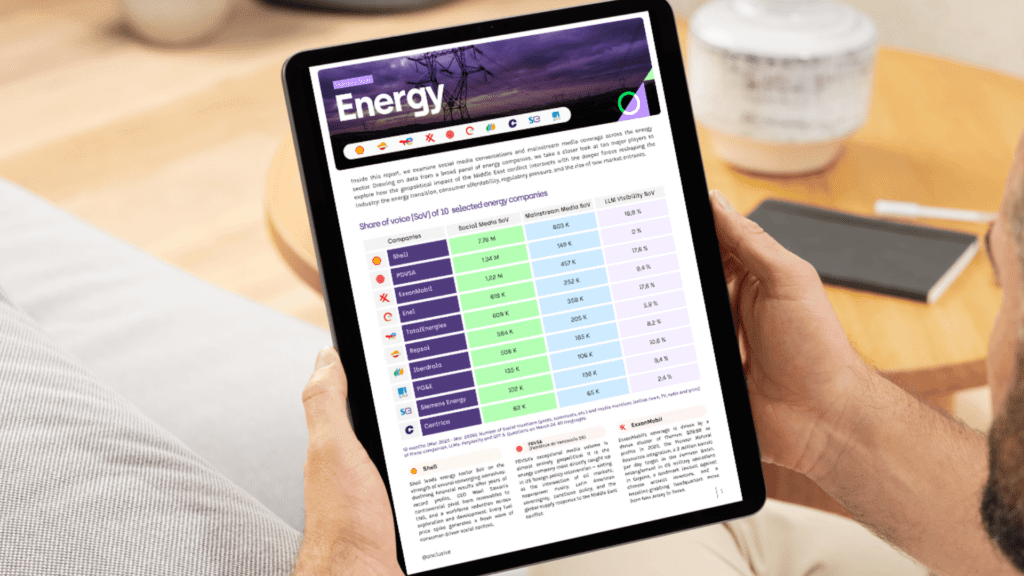
Energy Industry Trends 2026: A Media & Social Media Intelligence Report
Who’s dominating energy media & social conversations, and who’s falling behind?
Discover how Centrica, Shell, ExxonMobil, and 7 other global energy leaders are navigating the Iran conflict, the AI demand shock, the energy transition, and rising consumer pressure.
Get exclusive insights from 16.6M+ social and media conversations. Discover which companies dominate online discussions, how CEOs shape industry narratives, and why LNG, BESS, and nuclear SMRs are reshaping energy visibility. Download the full report to see the rankings, challenges, and strategies you need to know.
Download the full report
Key insights
• 7.76M social mentions for Shell – the most mentioned energy company on social media over 12 months, with simultaneous narratives across LNG, renewables retreat, and fuel price spikes.
• 35% of all Iran conflict media coverage focused on energy commodities and markets from February 27 to March 31, 2026 – not a side story, but a constitutive dimension of how the war is narrated, present every single day.
• $166/bbl the highest crude oil price on record, reached by Dubai crude on March 19, 2026, triggered a simultaneous explosion of content across financial media, X/Twitter, TikTok, and LinkedIn.
• 44.1% of consumer social media conversations about energy products focused on gas supply – massively amplified by Iranian strikes on QatarEnergy’s Ras Laffan facilities, the world’s largest LNG export hub.
• 54.7% of energy tech earned media on LinkedIn is positive sentiment – the highest of any category – with virtually no price or safety friction. Third-party authors frame it exclusively around innovation and project milestones.
• 0% LLM visibility for PDVSA – the second most mentioned company on social media (1.34M mentions over 12 months) – revealing a growing gap between earned media volume and AI search presence that traditional monitoring cannot detect.”
• 9/10 growth trajectory for Nuclear SMR developers and retail energy challengers – new entrants winning the narrative in categories incumbents did not create and cannot easily enter with credibility.
• 22.4% of mainstream media energy coverage now focuses on financial results combined with stock market and shareholder payouts – more than one in five articles about the sector.
Primary research report: Energy industry scan
What you’ll discover:
• Share of voice rankings across 10 leading global energy companies, with social media, mainstream media, and LLM visibility (GPT-5, Perplexity) compared side by side
• LinkedIn strategy analysis: what energy brands publish vs. what industry professionals discuss – including top earned media rankings, segment-level sentiment, and the 4 400+ posts from 86 companies analysed
• Top 15 challenges facing the industry in 2026 – from Trump’s deregulation and the Iran-Hormuz crisis to AI in operations, M&A consolidation, Russia’s LNG role, and critical minerals
• Hashtag performance by company and engagement drivers, including brand, geopolitics, energy transition, and sports sponsorship typologies
• Consumer conversation trends: gas supply, oil products, fuel prices, EVs, supply reliability, climate accountability, and rising energy bills
• New entrants and disruptors: Nuclear SMR, green hydrogen, retail challengers, EV charging, battery storage – who’s winning the narrative and who’s invisible
• CEO visibility rankings: the 15 most influential energy CEOs, the 10 most addressed topics in media, and the Iran conflict’s effect on every ranking
• Energy transition focus: sustainability vs. profitability, BESS deployment, renewables investment matrix by company, and the fossil-to-renewables backtracking story
• Electrification and AI demand shock: hyperscaler electricity appetite, nuclear as clean power, anti-nuclear sentiment, and grid capacity as the real bottleneck
• Most visible articles in mainstream media for each company, with reach scores and the event-driven spikes that explain every coverage surge
Team
Onclusive
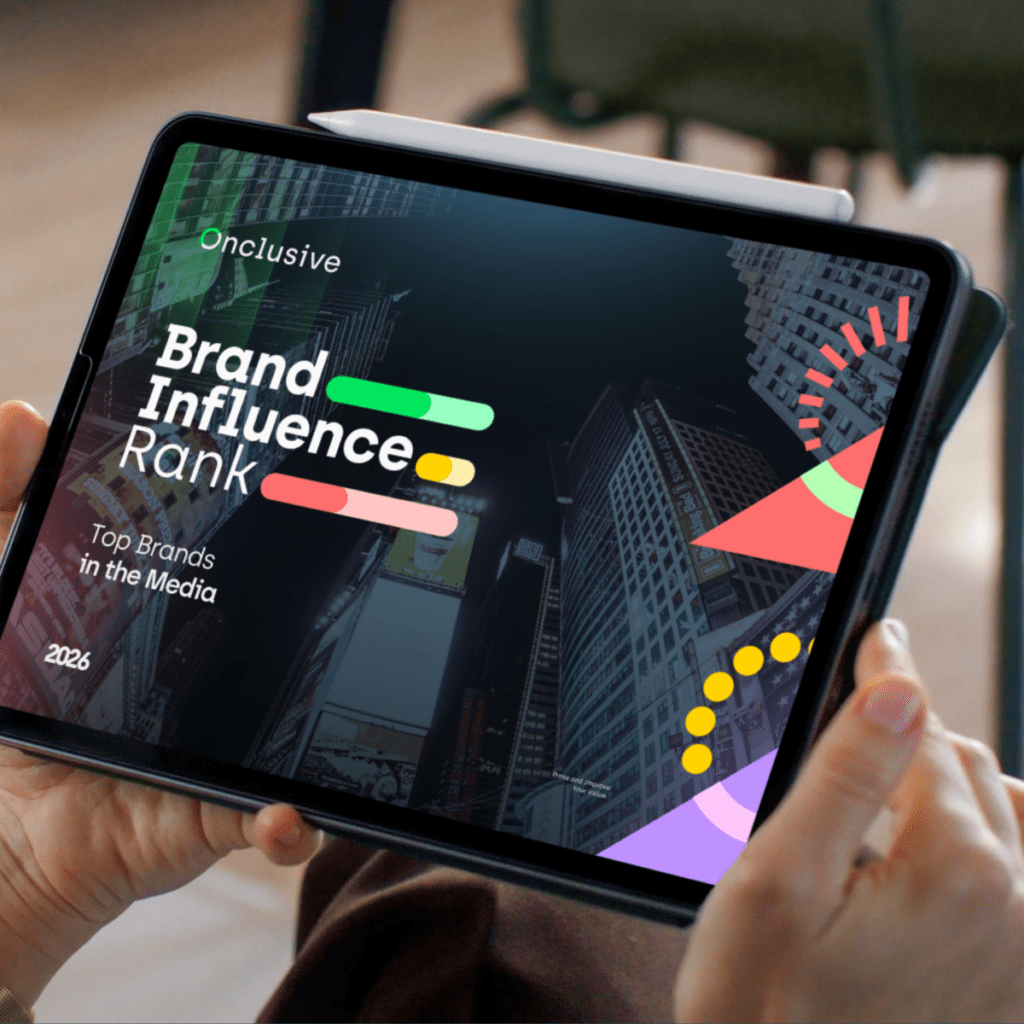
Classifica dell’influenza dei brand 2026: i brand più influenti nei media
50 brands. One score. Who really dominates global media?
Media influence has a new rulebook. In 2026, the brands shaping public perception are winning through earned, structural dominance across mainstream media and social conversation.
The Brand Influence Rank 2026 analyzes 50 global brands by combining mainstream media and social media performance into a single, unified Global Media Influence Score, revealing which companies truly dominate public perception, and why.
[Download the Report]
What You’ll Learn
- Top 50 brands
Which brands generate the greatest influence across media coverage and social conversations combined - Why tech platforms dominate
How YouTube, Google, and Meta benefit from structural advantages across media and social ecosystems - CEO visibility and brand influence
Why executives like Elon Musk, Sam Altman, and Jensen Huang generate extraordinary media reach - AI’s role in brand visibility
How artificial intelligence is reshaping media coverage and public discussion - GEO metrics for the AI search era
How Share of Voice, Average Prominence, and Visibility Gap measure brand presence in AI-generated answers
[Download the Report]
Key statistics on global media influence
- YouTube is the most influential brand in global media, with a Global Media Influence Score of 328
- All top 10 brands are technology or digital platform companies, and at least 8 are heavily associated with AI
- LinkedIn ranks 5th despite lower mention volumes than Facebook or Instagram, driven entirely by positive media sentiment
- L’Oréal records the highest positive media sentiment in the entire ranking at 83%, proof that sentiment quality can outperform volume.
- ChatGPT entered the global top 10 with a Media Score of just 27/200, showing that narrative strength can outperform legacy and scale.
- American Express leads AI Share of Voice in its competitor set at 38.9%, but its Visibility Gap reveals a dependency on training data rather than cited sources.
[Download the full ranking]
AI search visibility: a new frontier for brand influence
From AI-powered search to large language models, the way people discover and evaluate brands is changing fast. For the first time, the Brand Influence Rank measures this emerging frontier using three new GEO metrics: Share of Voice, Average Prominence, and Visibility Gap.
The findings reveal a new competitive dynamic: high AI visibility doesn’t always reflect strong source coverage — and the gap between the two is where brand influence is won or lost.
Team
Onclusive
Mobile World Congress 2026: insight e trend del Media Report
Il Mobile World Congress 2026 ha generato un’enorme copertura globale su media e piattaforme social, confermandosi uno degli eventi tech più rilevanti dell’anno. Durante l’evento, la conversazione ha raggiunto numeri record: oltre 63.000 menzioni, 1,7 milioni di interazioni e una reach potenziale superiore a 3,6 miliardi di persone in tutto il mondo. Il nostro Media Evaluation Report analizza come il MWC 2026 è stato raccontato dai media globali, evidenziando i brand, le tecnologie e i trend che hanno catturato maggiore attenzione. Tra i principali insight, Huawei emerge come lo sponsor e l’espositore più citato, grazie alla sua forte presenza nelle infrastrutture di rete mobile e nelle innovazioni AI, incluso il lancio del Mate 80 Pro. Grazie alle funzionalità avanzate di GEO tracking (Generative Engine Optimization) di Onclusive, il report esplora anche la visibilità dei brand nelle risposte dell’intelligenza artificiale, identificando Honor, Qualcomm e Samsung come gli espositori più frequentemente citati dai sistemi AI.
Chi ha davvero dominato la conversazione globale al MWC 2026?
Compila il form qui sotto per scaricare il report completo e accedere a tutti gli insight, i dati e le analisi strategiche.
Team
Onclusive
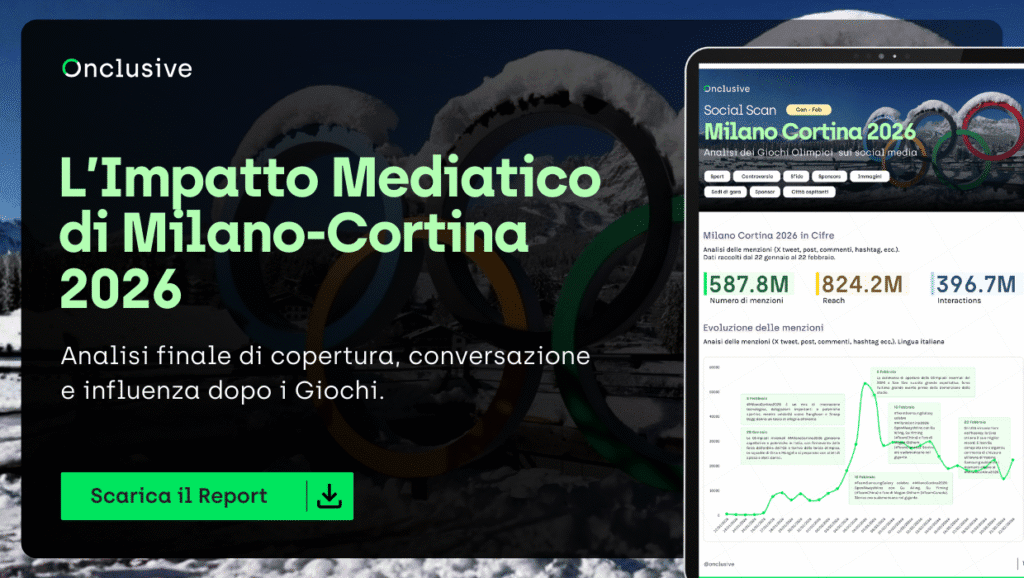
Milano-Cortina 2026: la gara mediatica si è giocata (e vinta) anche con i dati
Per chi si occupa di comunicazione e media, le Olimpiadi Invernali di Milano-Cortina 2026 non sono state solo sport, ma anche un vero banco di prova per la comunicazione globale.
La manifestazione ha generato:
Oltre 587.800 menzioni dirette
Un reach potenziale di 824,2 milioni di contatti
396,7 milioni di interazioni
Non si tratta solo di popolarità: questi dati mostrano come la narrazione dei Giochi si sia costruita in tempo reale, con un impatto concreto sulla reputazione di partner e territori.
L’attenzione online non è stata costante: alcune giornate hanno acceso la conversazione più di altre, spinte non solo dalle gare ma anche da cerimonie, organizzazione e temi di sostenibilità.
E a guidare il dibattito non sono stati soltanto i fan, ma un pubblico giovane e professionale – giornalisti, creator, comunicatori – capace di amplificare e orientare la percezione collettiva oltre il risultato sportivo.
In questo scenario, leggere correttamente i dati ha fatto la differenza: per intercettare trend emergenti, prevenire rischi reputazionali e misurare il valore reale generato dall’evento.
E tu, vuoi sapere chi ha vinto davvero la gara mediatica?
Scarica il report completo, una risorsa fondamentale per esperti di sport marketing, brand leader e comunicatori che puntano a trasformare radicalmente la propria strategia competitiva.
Perché scaricare questo report
Milano-Cortina 2026 non è solo una competizione sportiva: è un laboratorio di comunicazione data-driven in cui reputazione, percezione pubblica e narrative digitali si costruiscono in tempo reale.
Comprendere pattern, trend e dinamiche di attivazione significa poter:
- Anticipare criticità reputazionali
- Ottimizzare contenuti e timing
- Allineare attivazioni e valori
- Trasformare i social data in vantaggio competitivo

Elisa Anta García
Field Markteting Lead
