


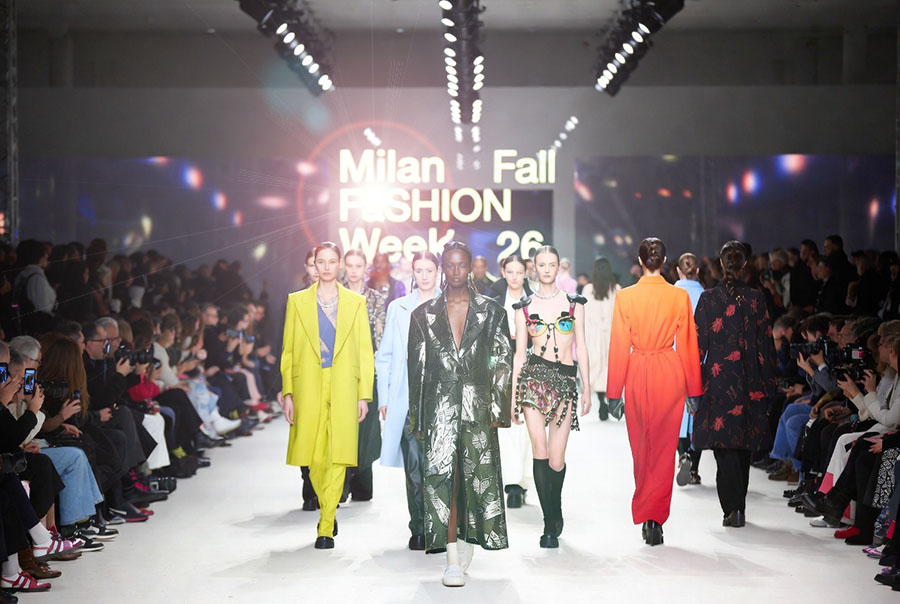
Opening: what just happened in Milan?
What if the most powerful runway in Milan this season was not made of catwalk boards and spotlights, but of smartphones in Bangkok, Seoul, and Beijing?
What if the brand that generated the loudest social conversation was not the one with the longest heritage or the biggest advertising budget, but the one that understood something most luxury houses still underestimate: that a single well-placed celebrity in the front row can move millions of people within minutes?
And what if, for the first time at a major European fashion week, it was not K-pop that led the charge, but Thai entertainment?
A note on data and methodology
All figures in this analysis are sourced from two Onclusive platforms: Onclusive Monitor, the media monitoring tool covering mainstream media across print, digital, television, radio, and podcasts, and Onclusive Social, the social media listening tool tracking conversations across X (formerly Twitter), Instagram, TikTok, Facebook, Threads and additional platforms. Data collection covers 23 February to 2 March 2026, with the monitoring window opening on 23 February to capture pre-show activity ahead of the official MFW opening on 24 February. A total of 153 fashion brands and 173 ambassadors and celebrities were tracked across both platforms throughout the week.
Table of Contents
Milan Fashion Week FW26 by the numbers
Brand power at MFW FW26: the tightest race of the season
The Asian celebrity effect: Thailand takes the front row
Hashtag intelligence: Thai script, Hangul, and English in one conversation
The media landscape: which outlets led MFW FW26 coverage
Implications for PR, communications, and marketing professionals
Looking ahead to Paris
Frequently asked questions: Milan Fashion Week FW26
Milan Fashion Week FW26 by the numbers
Between 23 February and 2 March 2026, Milan Fashion Week FW26 generated one of the largest social media footprints of any fashion week this season. The figures below are sourced from Onclusive Social, covering X (formerly Twitter), Instagram, TikTok, Facebook, Threads and additional platforms tracked during the data window.
| Social media metric | Figure |
| Total social media mentions | 4.97 million |
| People talking about MFW | 2.91 million |
| Social media reach | 127 million |
| Peak moment | Gucci show, 27 February, 2 PM – 1.77 million mentions |
| Mainstream media mentions | 9,864 |
| Fashion brands analyzed | 153 |
| Ambassadors and celebrities tracked | 173 |
Reading the numbers
The 4.97 million social mentions figure is notably higher than London Fashion Week FW26, which recorded 1.30 million mentions across the same platforms. This reflects both Milan’s greater number of participating brands and the size of the fan communities mobilised by its ambassador strategies, particularly those activated by Thai and Korean entertainment stars.
The 2.91 million people talking figure represents unique accounts that generated at least one mention during the data window, while the 127 million reach figure captures the total potential audience exposed to those conversations, including reshares, quote posts, and algorithmic distribution across platforms.
On the mainstream media side, 9,864 mentions across print, digital, television, radio, and podcasts reflects sustained editorial interest from fashion, lifestyle, and general news outlets spanning Italy, the United Kingdom, the United States, Spain, and Asia-Pacific.
Brand power at MFW FW26: the tightest race of the season
Among 153 fashion brands analyzed during Milan Fashion Week FW26, the top of the share of voice ranking was more competitive than at any other fashion week this season. Unlike London, where Burberry absorbed 91.10% of all brand conversation, Milan’s top five brands were separated by comparatively narrow margins, with celebrity strategy, cultural alignment, and show-day timing all playing decisive roles.
| Rank | Brand | Share of voice (%) Data by Onclusive |
| 1 | Tod’s | 19.11% |
| 2 | Gucci | 18.82% |
| 3 | Moschino | 16.67% |
| 4 | Ferrari | 9.08% |
| 5 | Onitsuka Tiger | 8.10% |
| 6 | Boss | 8.02% |
| 7 | Ferragamo | 4.65% |
| 8 | Prada | 3.97% |
| 9 | Diesel | 2.68% |
| 10 | Fendi | 2.64% |
| 11 | Roberto Cavalli | 1.81% |
| 12 | Dolce & Gabbana | 1.61% |
| 13 | Blumarine | 1.15% |
| 14 | Bottega Veneta | 0.96% |
| 15 | Marni | 0.14% |
| 16 | GCDS | 0.10% |
| 17 | Brunello Cucinelli | 0.09% |
| 18 | Emporio Armani | 0.08% |
| 19 | Fila | 0.04% |
| 20 | Dsquared2 | 0.04% |
The 20 most prominent brands at MFW FW26 by share of voice. Among 153 fashion brands analyzed.
What the ranking reveals
The margin between Tod’s (19.11%) and Gucci (18.82%) is the smallest gap between first and second place seen at any fashion week this season. Both brands deployed high-profile Asian celebrity strategies, and the outcome is a statistical near-draw that reflects the underlying parity of their respective fan communities’ mobilisation capacity.
Tod’s edge over Gucci is attributable in large part to the sheer volume of Thai fan activity generated by Pond Naravit and his fandom, whose hashtag #ppnaravit was the single most-used hashtag of the entire week with 1,826,585 mentions. Gucci, meanwhile, registered the most intense single-moment peak of MFW – 1.77 million mentions at 2 PM on 27 February – but this burst did not translate into a higher weekly SOV total.
Moschino‘s third-place position (16.67%) is the clearest illustration of what a dual Thai ambassador strategy looks like when fully activated. Keng Harit and Namping Napatsakorn together generated fan activity that placed a brand historically associated with Italian camp and pop culture references directly behind two of Italy’s most iconic luxury houses.
Prada‘s 3.97% SOV, below Ferrari and Onitsuka Tiger, is notable given the brand’s historical status at MFW. Its ranking reflects a relatively restrained celebrity strategy compared to the fan-activation approaches deployed by Tod’s, Gucci, and Moschino. Prada’s #pradafw26 hashtag (1,506,686 mentions) and #PradaFW26xPond (1,066,094 mentions) indicate that the brand did activate a fan community, but the concentration of its celebrity placement was less broad than its competitors in the top three.
A note on methodology: SOV and EMV (earned media value) are two fundamentally different ways of measuring the impact of ambassadors and celebrities. SOV measures conversation dominance, while EMV assigns monetary value to media exposure. Both are valuable but answer different questions. Asian Entertainment and Culture channel posted an hour-long video explaining the differences between SOV and EMV (Starting at 7 min 30 sec).
The Asian celebrity effect: Thailand takes the front row
If New York and London established that Asian entertainment stars are the dominant force driving fashion week social amplification, Milan FW26 added a new chapter to that story. For the first time in the fashion weeks tracked this season, Thai celebrities did not just compete with K-pop, they led it.
Among the 173 ambassadors and celebrities tracked during MFW FW26, the top ten were all from Asia. The top three were all Thai. This is not a statistical anomaly or a consequence of bot activity – the data reflects genuine, large-scale fan mobilisation across X, Instagram, and TikTok, operating with the same organisational sophistication that K-pop fandoms have demonstrated since at least 2022.
Celebrity share of voice: top 25 at MFW FW26
The top 25 most mentioned ambassadors and celebrities on social media during Milan Fashion Week FW26. Share of voice among 173 analyzed.
| Rank | Celebrity / Ambassador | SOV (%) Data by Onclusive |
Category |
| 1 | Keng Harit ฤษฎ์ บัวย้อย | 20.4% | Thai |
| 2 | Namping Napatsakorn นภัสกร ปิงเมือง | 13.7% | Thai |
| 3 | Becky Armstrong รีเบคก้า แพทรีเซีย อาร์มสตรอง | 11.4% | Thai |
| 4 | Pooh Krittin กฤติน กิจจารุวรรณกุล | 7.3% | Thai |
| 5 | S.Coups (Seventeen) 에스쿱스 | 5.9% | K-pop |
| 6 | Gulf Kanawut กลัฟคณาวุฒิ | 5.5% | Thai |
| 7 | Hirunkit ‘Nani’ Changkham หิรัญกฤษฎิ์ จังคาม | 5.3% | Thai |
| 8 | Faye Peraya เฟย์ เพอราย่า วงศ์กระจ่าง | 3.7% | Thai |
| 9 | Lee Know (Stray Kids) 이민호 | 3.5% | K-pop |
| 10 | Pavel Naret พาเวล นเรศ | 3.2% | Thai |
| 11 | Xiao Zhan (X Nine) 肖战 | 2.6% | Chinese |
| 12 | Ningning (Aespa) 宁艺卓 | 2.1% | K-pop |
| 13 | Yunho (ATEEZ) 정윤호 | 2.1% | K-pop |
| 14 | Pond Naravit ณราวิชญ์ เลิศรัตน์โกสุมภ์ | 1.4% | Thai |
| 15 | Bang Chan (Stray Kids) 방찬 | 1.4% | K-pop |
| 16 | Olandria Carthen | 1.3% | Western |
| 17 | San (Ateez) 산 | 1.3% | K-pop |
| 18 | Huh Yunjin (LE SSERAFIM) 허윤진 | 1.1% | K-pop |
| 19 | Jung Eun-chae 정은채 | 1.1% | Korean |
| 20 | Wooyoung (Ateez) 우영 | 0.9% | K-pop |
| 21 | I.N Yang Jeong-in (Stray Kids) 아이엔 | 0.7% | K-pop |
| 22 | Karina (Aespa) 유지민 | 0.7% | K-pop |
| 23 | Namtan ทิพนารี วีรวัฒโนดม | 0.5% | Thai |
| 24 | David Beckham | 0.5% | Western |
| 25 | Cocona (XG) | 0.5% | J-pop |
Most mentioned ambassadors and celebrities in social media during Milan Fashion Week FW26. Share of voice among 173 analyzed.
Keng Harit: 20.4% SOV – Milan’s most talked-about celebrity
Keng Harit topped the celebrity share of voice ranking at MFW FW26 with 20.4% of all celebrity mentions. His presence at Ferrari’s show generated significant fan mobilisation, reflected in the #FERRARIXKENGHARIT hashtag (528,695 mentions). Beyond the brand pairing, Keng Harit’s social footprint benefited from deeply organised Thai fan communities operating across X and Instagram, generating content, coordination, and amplification at a pace that rivals even the most structured K-pop fandom operations.
For luxury brands looking to expand their presence in Southeast Asia and among global Thai diaspora communities, Keng Harit’s Milan performance offers a data point that is difficult to ignore.
Namping Napatsakorn and the Moschino effect: 13.7% SOV
Namping Napatsakorn’s 13.7% share of voice is inseparable from the Moschino partnership she shared with Keng Harit. Together, the two Thai celebrities account for over 34% of all celebrity mentions at MFW FW26, a combined footprint that gave Moschino its 16.67% brand SOV and placed it firmly in third position behind Tod’s and Gucci.
The hashtag #KENGNAMPINGWITHMOSCHINO (761,721 mentions) and #MOSCHINOXKENGNAMPING (614,180 mentions) functioned as twin amplification engines, operating simultaneously with Keng and Namping’s individual fan hashtags to create a layered, high-volume conversation architecture. This dual-ambassador activation is a replicable model that communications professionals should note: two complementary celebrities with overlapping but distinct fan communities can generate additive rather than competing amplification.
Becky Armstrong: 11.4% SOV – the Tod’s multiplier
Thai singer and actress Becky Armstrong (Pitchapa Nampan) contributed 11.4% of all celebrity SOV at MFW FW26, driven primarily by her presence at the Tod’s show. The hashtag #BeckyxTodsFW26 generated 558,892 mentions, while the broader #TodsFW26 tag reached 745,887 mentions – the 15th most-used hashtag of the entire week. Becky’s contribution was structural to Tod’s 19.11% brand SOV, the highest of any brand at MFW FW26.
Her performance at Milan represents the latest chapter in a growing pattern: Thai actress-singer-model celebrities, often with dual or triple creative careers, generating fashion week social engagement that is fully comparable to K-pop idol placements.
K-pop at Milan: still powerful, but no longer first
K-pop remained a significant force at MFW FW26. S.Coups of Seventeen (5.9%), Lee Know of Stray Kids (3.5%), Ningning and Karina of Aespa, Yunho, Wooyoung, and San of ATEEZ, Huh Yunjin of LE SSERAFIM, and Bang Chan and I.N of Stray Kids all placed in the top 25. Chinese star Xiao Zhan (X Nine) ranked 11th with 2.6% SOV, demonstrating that Chinese celebrity placements in Italian fashion remain commercially and culturally significant.
But for the first time this season, no K-pop act reached the top four celebrity positions. S.Coups at 5.9% was the highest-placed Korean idol, more than 14 percentage points behind Keng Harit. This is not a signal that K-pop influence is diminishing. It is a signal that Thai entertainment has reached a structural parity with K-pop in its capacity to generate mass social engagement at European fashion weeks.
Western and global celebrities: present, but peripheral
Beyond the Asian entertainment ecosystem, a handful of Western and globally recognised celebrities attended MFW FW26, but their collective social footprint tells its own story. Olandria Carthen placed 16th with 1.3% SOV, and David Beckham 24th with 0.5%, making them the two highest-placed non-Asian celebrities in the entire ranking. Below them, the list extends to Megan Thee Stallion (27th, 0.3%), Caitlin Clark (30th, 0.1%), Coco Jones (34th, 0.04%), Shawn Mendes (35th, 0.04%), Kendall Jenner (36th, 0.03%), Madonna (38th, 0.02%), and Demi Moore (40th, 0.02%).
These are, by any conventional measure, some of the most famous people on the planet. Kendall Jenner alone commands tens of millions of followers across platforms. Madonna is a cultural institution. David Beckham has been a luxury brand partner for decades. And yet, at Milan Fashion Week FW26, none of them generated more than 1.3% of celebrity share of voice. Megan Thee Stallion, one of the most-streamed artists in the world, registered 0.3%.
The gap is not a reflection of these celebrities’ global reach or media value. It is a reflection of a structural difference in how fan communities operate. K-pop and Thai entertainment fandoms are organised, coordinated, and activated around fashion week moments in ways that Western celebrity followings, however large, currently are not. A Beyoncé fan and a Stray Kids fan may both love their artist with equal intensity, but the Stray Kids fan is far more likely to be part of a coordinated network that generates hashtags, organises posting schedules, and floods timelines within minutes of a front-row appearance.
For PR and competitive intelligence professionals, this is perhaps the most strategically significant data point in the entire MFW FW26 celebrity ranking. The presence of Western A-list names in the lower half of the table is not a failure of their star power. It is a benchmark that illustrates exactly how much the social media dynamics of fashion week have shifted, and how far Western celebrity strategy still has to travel to match the organic amplification infrastructure that Asian entertainment fandoms have built.
Hashtag intelligence: Thai script, Hangul, and English in one conversation
The hashtag landscape at MFW FW26 is a multilingual, multi-community system operating across Thai, Korean, and English simultaneously. The top 20 hashtags by usage volume, excluding those massively generated by bot accounts, reveal the underlying mechanics of fashion week amplification in 2026.
| Hashtag | Mentions Data by Onclusive |
| #ppnaravit | 1,826,585 |
| #KengNamping | 1,692,879 |
| #mfw | 1,656,922 |
| #pradafw26 | 1,506,686 |
| #prada | 1,344,133 |
| #MoschinoFW26 | 1,147,873 |
| #MilanFashionWeek | 1,141,908 |
| #PradaFW26xPond | 1,066,094 |
| #Moschino | 1,051,531 |
| #GucciPrimavera | 927,365 |
| #KengHarit | 914,641 |
| #hirunkit_ | 836,072 |
| #beckysangels | 782,916 |
| #KENGNAMPINGWITHMOSCHINO | 761,721 |
| #TodsFW26 | 745,887 |
| #nampingster | 673,530 |
| #gucci | 672,534 |
| #MOSCHINOXKENGNAMPING | 614,180 |
| #BeckyxTodsFW26 | 558,892 |
| #FERRARIXKENGHARIT | 528,695 |
Top 20 hashtags at Milan Fashion Week FW26. By usage volume. Excludes hashtags massively generated by bot accounts.
Three patterns that define the MFW FW26 hashtag ecosystem
The fan community, not the brand, led the week. This hashtag – the name of Thai actor Pond Naravit rendered as a fan handle – was the single most-used hashtag of the entire Milan Fashion Week, ahead of #mfw (1,656,922), #pradafw26 (1,506,686), and every official brand hashtag. This mirrors the pattern observed at LFW FW26, where #bbrightvc (178,116 mentions) was the second most-used hashtag behind #burberry. Fan infrastructure is consistently outperforming official brand communication.
Of the top 20 hashtags, at least 12 are celebrity-brand combinations or celebrity fan tags, not brand-only tags. #KengNamping (1,692,879), #PradaFW26xPond (1,066,094), #KENGNAMPINGWITHMOSCHINO (761,721), #BeckyxTodsFW26 (558,892), and #FERRARIXKENGHARIT (528,695) all outperformed standalone brand hashtags. For brands developing hashtag strategies, the lesson is clear: co-branded celebrity tags generate more volume than single-brand tags.
While the MFW top 20 hashtags are predominantly in Roman script, this reflects the Thai and Korean communities’ tendency to use romanised fan tags on X. On Instagram and TikTok, native script Thai names and Korean Hangul terms generate substantial additional volume that English-only monitoring configurations will miss entirely.
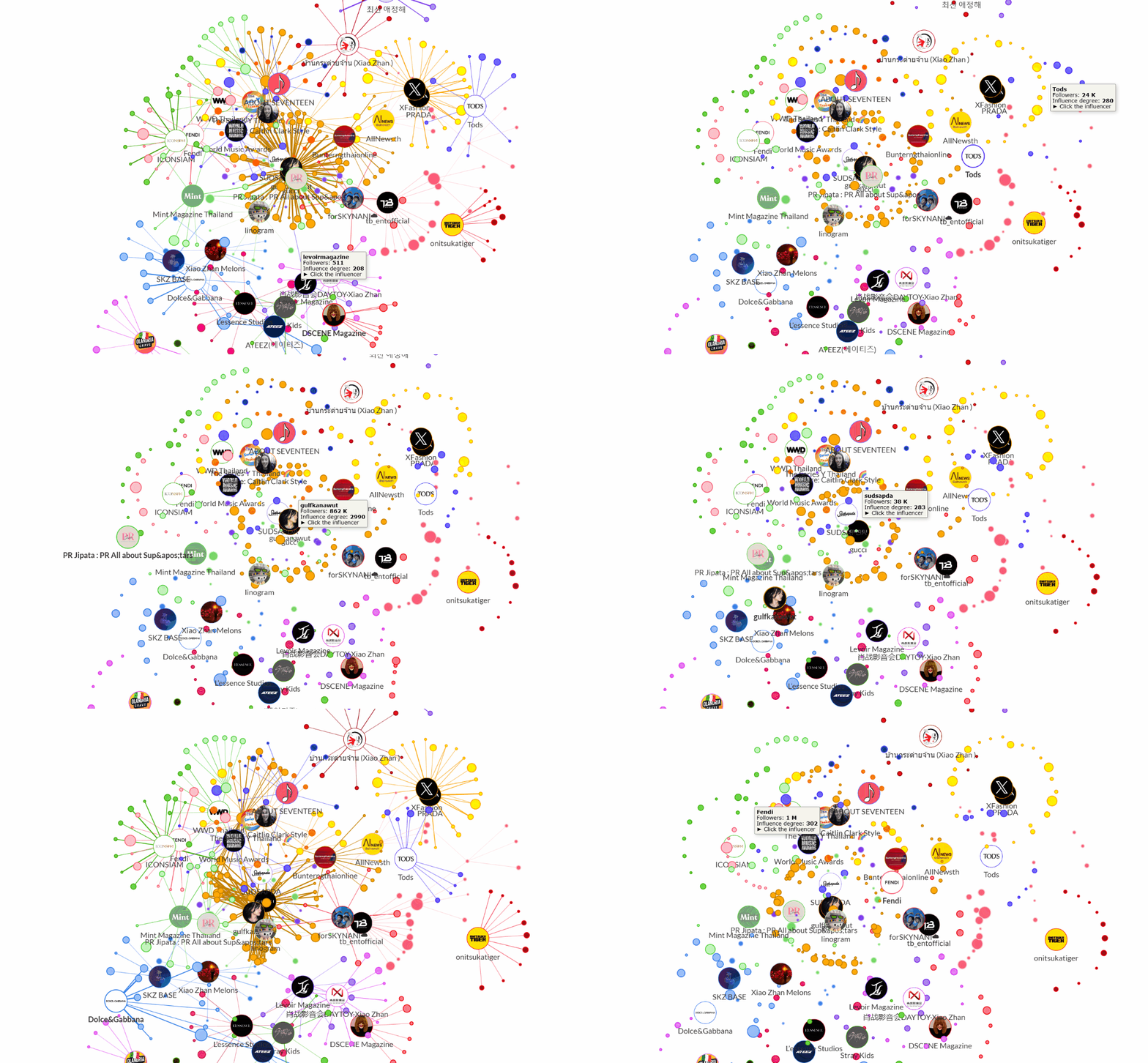
At Milan Fashion Week FW26 , the network map of high-influence accounts tells a familiar story with a new twist: a dense, self-organising fan ecosystem driving organic amplification at scale, this time with Thai communities at its centre. Prada, Moschino, Gucci, and Tod’s are the primary beneficiaries of this fan army infrastructure. Dataviz by Social Media Listening platform.
The media landscape: which outlets led MFW FW26 coverage
Beyond social media, Milan Fashion Week FW26 generated substantial mainstream media coverage across Italian, British, American, and international outlets. The influence score below is based on ranking, audience size, and number of mentions, providing a composite view of each outlet’s editorial impact on the MFW conversation.
| Media outlet | Influence score | Country |
| dailymail.co.uk | 530 | United Kingdom |
| harpersbazaar.com | 450 | Spain |
| hola.com | 288 | Spain |
| ansa.it | 171 | Italy |
| aol.com | 150 | United States |
| elle.com | 144 | Taiwan |
| hypebeast.com | 144 | United States |
| vogue.com | 126 | United States |
| marieclaire.com | 96 | United States |
| timesofindia.indiatimes.com | 80 | India |
| corriere.it | 80 | Italy |
| instyle.com | 80 | United States |
| ilfattoquotidiano.it | 72 | Italy |
| gmanetwork.com | 72 | United States |
| infobae.com | 60 | Argentina |
| pagesix.com | 54 | United States |
| hellomagazine.com | 54 | United States |
| tg24.sky.it | 54 | Italy |
| nypost.com | 40 | United States |
| thecut.com | 40 | United States |
Top 20 web outlets covering Milan Fashion W eekFW26 by influence score. Influence score based on ranking, audience, and number of mentions.
Daily Mail topped the influence ranking with a score of 530, nearly 18% ahead of Harper’s Bazaar in second place (450). This reflects Daily Mail’s combination of very high audience reach and consistent high-volume MFW coverage, including celebrity front-row reporting and show reviews. The Italian press – ANSA (171), Corriere della Sera (80), Il Fatto Quotidiano (72), and Sky TG24 (54) – maintained a strong collective presence, reflecting the domestic importance of Milan Fashion Week to Italian media.
The appearance of Times of India (80) in 10th place and Infobae (60) – an Argentine digital news site – in 15th underlines MFW’s genuinely international media footprint, extending well beyond traditional European and North American fashion media. For PR professionals, this is a reminder that pitching MFW coverage should encompass South.

Implications for PR, communications, and marketing professionals
For PR and communications teams
Milan FW26 reinforces a lesson that began at New York and was confirmed at London: the most impactful lever in fashion week communications is no longer the collection itself, but the celebrity strategy surrounding it. Tod’s, Gucci, and Moschino collectively demonstrated three different executions of the same underlying logic: identify a celebrity with a large, organised, and globally active fan community; build a credible brand-celebrity partnership over time; and design show moments that give fan communities a reason to activate.
The Thai entertainment dimension adds a new variable for PR teams to plan around. Until recently, the strategic question for brands preparing for fashion week was primarily: which K-pop artist? At MFW FW26, the question has expanded: which K-pop artist, and which Thai celebrity, and from which other Asian entertainment markets? Thai fandoms have demonstrated at scale that they operate with the same sophistication, discipline, and global reach as K-pop fan communities. Brands that have not yet developed relationships in Thai entertainment are entering a competitive space where early movers already have multi-season track records.
For communications professionals working with brands outside the top five SOV positions, the strategic challenge is acute. At MFW FW26, Prada generated 3.97% of SOV despite being one of the most prestigious fashion houses in the world. Brands at 0.10% or below are, in social media terms, largely absent from the global conversation during the week that defines their autumn/winter market positioning. The cost of that invisibility is difficult to quantify in the short term but compounds across seasons.
For competitive intelligence professionals
The near-parity between Tod’s (19.11%) and Gucci (18.82%) is a signal worth monitoring closely. Both brands are investing heavily in Asian celebrity strategies, and their competition for SOV at MFW reflects a deeper competition for market share in Asian luxury consumer segments. Tracking the ambassador portfolios of both brands in the months before MFW SS27 will provide early indicators of which direction each is moving.
The hashtag data also offers a competitive intelligence resource. #ppnaravit at 1.83 million mentions and #KengNamping at 1.69 million are not just vanity metrics – they are indicators of community scale, engagement depth, and potential mobilisation capacity. Monitoring the size and activity of fan communities around specific celebrities before a fashion week can help anticipate which brands will likely dominate SOV, and by how much.
For social media professionals
Multi-language, multi-script query configuration is now non-negotiable for fashion week monitoring. At MFW FW26, the Thai fan communities generated massive volume in romanised Thai names and hybrid hashtags, while Korean communities operated in Hangul, and Chinese celebrity fans used Chinese characters across Weibo and Douyin as well as X. A monitoring configuration that covers only English-language terms will produce data that significantly underestimates the true volume and reach of the celebrity-driven conversation.
For platforms such as Onclusive Monitoring or Onclusive Social, this means building query sets that include: celebrity names in Roman script and native script; group affiliations in native script; fan community handles; and brand-celebrity hybrid hashtags in all relevant languages. Building these queries before a fashion week, using the six-to-eight weeks of pre-show ambassador announcement activity as a signal, allows monitoring teams to be fully configured before the peak conversation window opens.
Additionally, fan account handles and community hashtags should be tracked alongside official brand and celebrity accounts. At MFW FW26, #ppnaravit – a fan-constructed hashtag, not an official tag – was the most-used hashtag of the entire week. Missing this kind of signal produces a systematically incomplete picture of the conversation.
As the fashion calendar moves to Paris, the patterns established across New York, London, and Milan provide a clear strategic picture. Asian celebrity strategy is now the primary driver of social media share of voice at the world’s major fashion weeks. Thai entertainment has joined K-pop as a first-tier mobilisation force. And the brand that invests most credibly in multi-celebrity, multi-community ambassador ecosystems will own the digital conversation.
The question for Paris is whether the major French houses, from Chanel and Dior to Saint Laurent, Loewe, and Valentino, will match the scale of what Tod’s, Gucci, and Moschino achieved in Milan, or whether their existing ambassador ecosystems generate a different kind of social gravity. We will be tracking the data across Paris Fashion Week. Stay tuned.
The cover image (cover, above) was generated by a generative AI tool for illustrative purposes.
Data sourced from Onclusive Monitor and Onclusive Social, February 2026.
Frequently asked questions: Milan Fashion Week FW26
| Question | Answer |
| When did Milan Fashion Week FW26 take place? | MFW FW26 ran from 24 February to 2 March 2026. Data collection covers 23 February to 2 March 2026. |
| Which brand dominated MFW FW26? | Tod’s led with 19.11% share of voice, narrowly ahead of Gucci (18.82%) and Moschino (16.67%), among 153 brands analyzed. All three benefited significantly from Asian celebrity ambassador strategies. |
| Why did Thai celebrities dominate MFW FW26? | Thai entertainment stars such as Keng Harit, Namping Napatsakorn, and Becky Armstrong have deeply organised, globally distributed fan communities that activate rapidly around brand and fashion week moments. At MFW FW26, their combined mobilisation outpaced even the most active K-pop fan communities in terms of total mention volume. |
| How does Milan compare to London Fashion Week FW26? | Milan generated significantly higher social volume: 4.97 million mentions versus 1.30 million at LFW FW26. Milan also featured a more competitive brand SOV distribution, with the top three brands holding 19.11%, 18.82%, and 16.67% respectively, compared to Burberry’s near-total 91.10% dominance at LFW. |
| What was the peak moment of MFW FW26? | The Gucci show on 27 February at 2 PM generated 1.77 million mentions in a single hour – the highest single-show peak of the entire week. |
| What does share of voice (SOV) mean? | SOV measures the proportion of total conversation a brand or celebrity commands relative to peers tracked in the same dataset. It reflects real-time cultural relevance and audience attention, and is distinct from earned media value (EMV), which assigns monetary value to media exposure. |
| How many brands and celebrities were tracked? | Onclusive monitored 153 fashion brands and 173 ambassadors and celebrities across social media and mainstream media during MFW FW26. |
| What tools were used for this analysis? | Data was sourced from Onclusive 360 for mainstream media monitoring and Onclusive Social for social media listening and analytics. |
| What is the influence score for media outlets? | The influence score is based on ranking, audience size, and number of mentions. It indicates the relative influence of a media outlet on a specific topic. |