

How Jennie, Kazuha, and a new wave of Asian celebrities turned New York Fashion Week front rows into global media events, and what it means for brands navigating fashion’s evolving influence economy.
After our blog about NYFW SS26 Women in September, here is our analysis of NYFW AW26 Women. New York Fashion Week Fall/Winter 2026 ran from February 10 to 16, firing the starting gun on the industry’s most consequential month.
Over six days, more than 100 designers unveiled their autumn/winter collections, but the real story played out far beyond the runway. This season confirmed a structural shift that has been building for several years: the celebrities sitting front row now generate more measurable media impact than the clothes walking past them.
See also:
Milan Fashion Week FW26
London Fashion Week FW26
Paris Fashion Week FW26
Key takeaways from New York Fashion Week FW26
- Calvin Klein’s sustained dominance: For the second consecutive women’s season, Calvin Klein captured over half of all brand mentions (52.67%), proving that its celebrity-first strategy is not a one-season anomaly but a repeatable playbook.
- The Asian celebrity supercycle continues: Seven of the top 20 most-mentioned celebrities are from Asia (South Korea, Thailand, and China), collectively accounting for over 73% of all celebrity share of voice.
- Khaite’s breakout moment: Rising from 0.18% SOV last September to 15.13% this season, Khaite’s partnership with Le Sserafim’s Kazuha catapulted the brand into the conversation’s second spot.
- Multilingual hashtag ecosystems: Top hashtags now span English, Korean, Chinese and Thai scripts, reflecting the truly global composition of fashion week audiences.
- Fan armies as media multipliers: Dedicated K-pop and Thai entertainment fandoms generated organic amplification at volumes that paid media struggles to match, making fan mobilization a critical variable in fashion PR strategy.
- Mainstream media remains substantial: With 11,146 mentions across print, digital, TV, radio, and podcasts, traditional outlets continue to provide depth and credibility alongside social media’s velocity.
New York Fashion Week FW26 by the numbers: a media snapshot
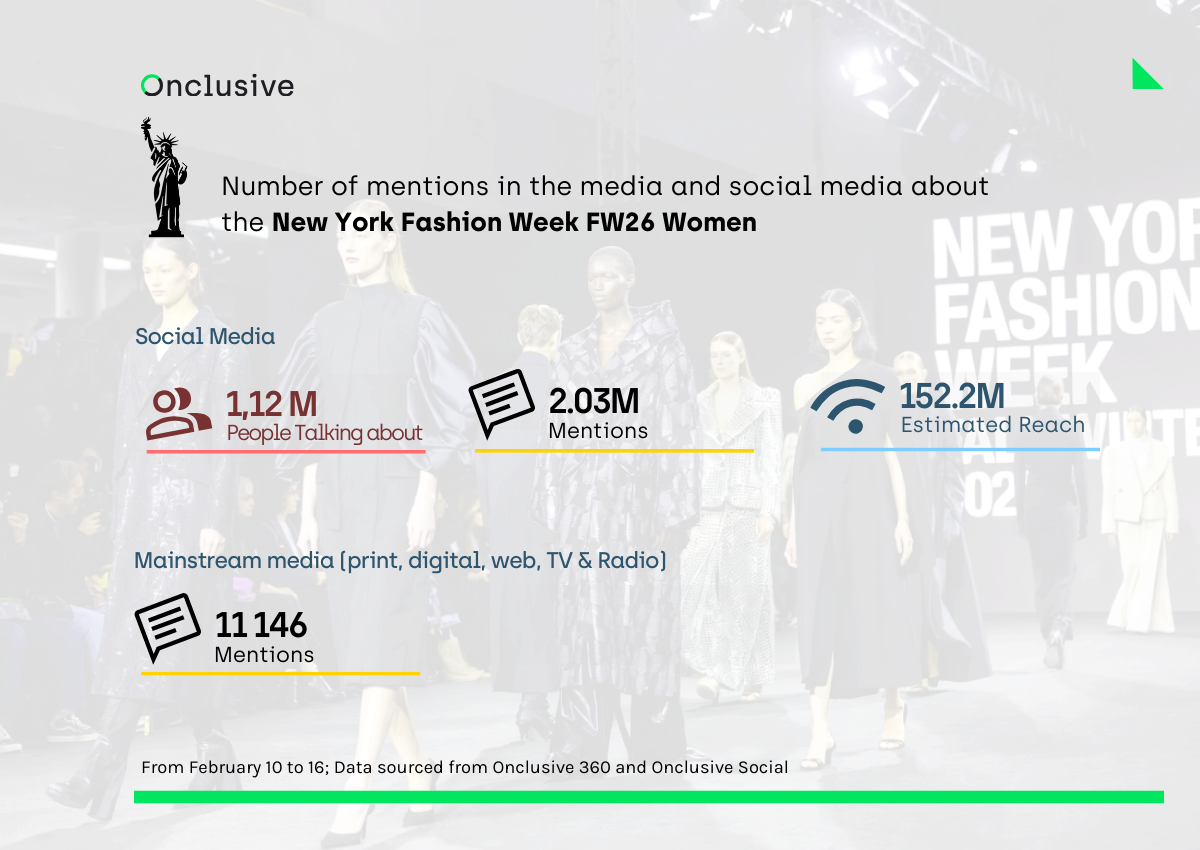
Between February 10 and 16, New York Fashion Week FW26 generated a formidable media footprint across both social and mainstream channels.
Social media
2.03 million mentions were recorded across social platforms, driven by 1.12 million people talking about fashion week topics. These conversations achieved a combined reach of 152.2 million.
Mainstream media
On the traditional media side, New York Fashion Week generated 11,146 mentions across print, digital outlets, television, radio, and podcasts.
Compared to September’s SS26 edition (2.71 million social mentions, 17,927 mainstream articles), the February numbers tell an interesting story. While social mentions decreased by 25%, the mainstream media footprint also contracted somewhat, from 17,927 to 11,146 articles. This reflects the natural asymmetry between September (which also covers men’s shows and pre-fall content) and February’s more focused women’s ready-to-wear calendar. Yet the level of celebrity-driven amplification remained extraordinarily concentrated, as we will see in the sections below.
The brand power ranking: who owned the New York Fashion Week conversation
Among 119 fashion brands analyzed during New York Fashion Week FW26, the distribution of share of voice reveals a strikingly top-heavy landscape.
| Rank | Brand | Share of Voice (%). Data by Onclusive |
| 1 | Calvin Klein Collection | 52.67% |
| 2 | Khaite | 15.13% |
| 3 | Ralph Lauren | 7.31% |
| 4 | Coach | 5.50% |
| 5 | Christian Siriano | 3.22% |
| 6 | Tory Burch | 2.18% |
| 7 | Jane Wade | 1.92% |
| 8 | Michael Kors Collection | 1.48% |
| 9 | Carolina Herrera | 1.48% |
| 10 | Kim Shui | 0.98% |
| 11 | Marc Jacobs | 0.89% |
| 12 | Cult Gaia | 0.70% |
| 13 | Elena Velez | 0.52% |
| 14 | Prabal Gurung | 0.40% |
| 15 | Proenza Schouler | 0.34% |
| 16 | LaQuan Smith | 0.33% |
| 17 | Christian Cowan | 0.32% |
| 18 | Bach Mai | 0.31% |
| 19 | Diotima | 0.30% |
| 20 | Alice + Olivia | 0.25% |
The 20 most prominent fashion brands at New York Fashion Week FW26, ranked by share of voice (SOV) among 119 fashion brands analyzed.
What the ranking reveals
Calvin Klein Collection once again dominated the conversation with 52.67% share of voice. While this represents a decline from its near-monopoly of 69.58% in September (when Jung Kook’s partnership drove an extraordinary spike), it still means the brand commanded more than half of all fashion-week brand discussion. The sustained dominance across two consecutive seasons confirms that Calvin Klein’s celebrity-centric approach under creative director Veronica Leoni is not a flash in the pan, but a strategic moat.
The most remarkable shift this season belongs to Khaite, which surged from 0.18% SOV in September to 15.13%, a staggering 84x increase. The catalyst was its partnership with Le Sserafim’s Kazuha, whose dedicated fanbase propelled #KAZUHAxKHAITE and related hashtags to tens of thousands of mentions. For competitive intelligence professionals, Khaite’s trajectory is a textbook case of how a single strategic ambassador can redefine a brand’s media position overnight.
Ralph Lauren (7.31%) benefited from its star-studded off-calendar show featuring Anne Hathaway, Lana Del Rey, and Kim Do-yeon, while Coach (5.50%) continued to leverage its cultural relevance through partnerships with younger talent. Further down the ranking, newcomers like Cult Gaia (0.70%) and Diotima (0.30%) registered meaningful mentions for first-time or emerging NYFW presences, suggesting that smaller brands can still break through when paired with the right cultural moment.
A note on methodology: SOV and EMV (earned media value) are two fundamentally different ways of measuring the impact of ambassadors and celebrities. SOV measures conversation dominance, while EMV assigns monetary value to media exposure. Both are valuable but answer different questions. Asian Entertainment and Culture channel posted an hour-long video explaining the differences between SOV and EMV (Starting at 7 min 30 sec).
The Asian celebrity effect: the engine behind New York Fashion Week’s numbers
If NYFW SS26 in September was the proof of concept, FW26 confirmed the thesis: Asian entertainment stars are now the single most powerful driver of New York Fashion Week media impact. This season, seven of the top 20 most-mentioned celebrities are from Asia, and together they accounted for more than 73% of all celebrity share of voice.
| Rank | Celebrity / Ambassador | Share of Voice (%) Data by Onclusive |
| 1 | Jennie (Blackpink) | 45.30% |
| 2 | Kazuha (Le Sserafim) | 13.76% |
| 3 | Milk Pansa | 12.56% |
| 4 | Huda | 3.35% |
| 5 | Dakota Johnson | 2.39% |
| 6 | Soyeon (I-dle) | 2.10% |
| 7 | Song Yuqi (I-dle) | 2.09% |
| 8 | Post Malone | 1.41% |
| 9 | Lana Del Rey | 1.37% |
| 10 | Hudson Williams | 1.27% |
| 11 | Cheng Xiao | 1.24% |
| 12 | Francois Arnaud | 0.83% |
| 13 | Naomi Watts | 0.82% |
| 14 | Elle Fanning | 0.76% |
| 15 | Amanda Seyfried | 0.74% |
| 16 | Anne Hathaway | 0.70% |
| 17 | Rihanna | 0.68% |
| 18 | Brooke Shields | 0.60% |
| 19 | Krystal Jung (f(x)) | 0.55% |
| 20 | Anna Wintour | 0.49% |
The top 20 most mentioned ambassadors and celebrities in social media during New York Fashion Week FW26. Share of voice among 175 analyzed. Bold highlighted rows indicate Asian celebrities
Jennie (Blackpink): the undisputed queen of New York Fashion Week, 45.30% SOV
Blackpink’s Jennie alone commanded nearly half of all celebrity conversation. Her presence at Calvin Klein, reinforced by the viral #JennieWearsCalvin hashtag (65,270 mentions), created a media event that transcended fashion circles and penetrated mainstream pop culture. For Calvin Klein, Jennie is the successor to the Jung Kook partnership that dominated September, maintaining the brand’s grip on K-pop fandom.
Kazuha (Le Sserafim): the breakout star, 13.76% SOV
Le Sserafim member Kazuha’s appearance at Khaite generated a tidal wave of fan-created content. The #KAZUHAxKHAITE ecosystem (combining English, Korean, and transliterated hashtags) collectively surpassed 170,000 mentions. Crucially, Kazuha’s impact is what propelled Khaite from relative social media obscurity to the second-most discussed brand of the season. This is a case study in how a single ambassador can transform a brand’s competitive position.
Milk Pansa: Thai star power, 12.56% SOV
Thai celebrity Milk Pansa’s partnership with Calvin Klein continued to deliver extraordinary results. The #calvinkleinXMilk hashtag led all hashtags this season with 358,133 mentions, surpassing even Jennie’s branded tags. This demonstrates the scale of Thai entertainment fanbases and their willingness to engage in brand-specific content creation. With hashtags appearing in Thai script alongside English, Milk Pansa’s impact reflects a truly multilingual, multi-market amplification strategy.
The I-dle factor and Cheng Xiao
K-pop group I-dle placed two members in the top 20: Soyeon (2.10%) and Song Yuqi (2.09%), collectively accounting for over 4% of celebrity SOV. Meanwhile, Chinese performer Cheng Xiao (1.24%) and f(x)’s Krystal Jung (0.55%) further diversified the Asian celebrity presence, spanning Korean, Chinese, and Thai entertainment industries.
What this means for brands
The data presents a clear conclusion for PR and marketing professionals. Asian celebrity partnerships are no longer an experimental tactic; they are the primary lever for generating outsized media impact at fashion week. However, the strategy requires genuine cultural alignment rather than superficial endorsement. The most successful partnerships this season, Jennie at Calvin Klein and Kazuha at Khaite, worked because the brand aesthetic and the celebrity’s personal brand were credibly connected.
Hashtag intelligence: mapping the New York Fashion Week conversation in four languages
The hashtag landscape at New York Fashion Week FW26 reveals how fashion week conversations now operate across linguistic and cultural boundaries simultaneously. Here are the top 20 hashtags by usage volume:
| Hashtag | Mentions |
| #calvinkleinXMilk | 358,133 |
| #MilkPansa | 208,624 |
| #CALVINKLEIN | 172,327 |
| #JENNIE | 133,044 |
| #NYFW | 98,798 |
| #nyfw26 | 76,059 |
| #JennieWearsCalvin | 65,270 |
| #kazuha | 58,800 |
| #milklove | 53,678 |
| #มิ้ลค์เลิฟ (MilkLove) | 51,231 |
| #LE_SSERAFIM (Kazuha) | 45,322 |
| #ร้เซราฟิม (Kazuha) | 44,874 |
| #มิ้ลค์พรรษา (milkpansa) | 41,473 |
| #KazuhaxKhaite | 37,261 |
| #KazuhaForKhaite | 34,751 |
| #hudaxnyfw | 21,648 |
| #ChengXiao | 19,871 |
| #krystal | 19,073 |
| #카즈하 (Kazuha) | 18,588 |
| #Mimiv | 17,500 |
Top 20 hashtags by usage volume. Excludes hashtags massively generated by bot accounts.
Several patterns emerge from this data. First, brand-celebrity hybrid hashtags dominate over generic event tags. The #NYFW hashtag (98,798 mentions) was outperformed by multiple celebrity-brand combinations, including #calvinkleinXMilk (358,133) and #MilkPansa (208,624). This inversion tells us that audiences engage with fashion week through their relationship with specific celebrities, not the event itself.
Second, the multilingual hashtag ecosystem is a feature, not a bug. Thai-script hashtags for Milk Pansa and Korean-script hashtags for Kazuha appear alongside their English equivalents. For social media monitoring professionals, this means that English-only tracking will miss a substantial portion of the conversation. Effective monitoring now requires multi-script keyword configuration.
Third, the Kazuha-Khaite hashtag constellation is particularly instructive. Rather than one dominant hashtag, the conversation fragmented across #KazuhaxKhaite, #KazuhaForKhaite, and Korean-script variations. Combined, these exceeded 130,000 mentions, showing how fan communities organically create multiple entry points into the same conversation.
Note: The first hashtag in Chinese is in 21st place: it is #程潇 (Cheng Xiao).
Season-over-season: what changed at New York Fashion Week from September to February
Comparing New York Fashion Week FW26 (February 2026) with NYFW SS26 (September 2025) reveals both continuity and evolution in the fashion week media landscape.
What stayed the same
- Calvin Klein maintained its position as the dominant brand, though its SOV decreased from 69.58% to 52.67% as other brands invested more aggressively in celebrity partnerships.
- Asian celebrities continued to dominate the top positions in celebrity SOV, confirming this is a structural trend rather than a seasonal fluctuation.
- Celebrity-brand hybrid hashtags outperformed generic fashion week hashtags.
What changed
- Khaite’s explosive growth (0.18% to 15.13% SOV) represents the most dramatic brand repositioning between seasons, driven entirely by the Kazuha partnership.
- COS, which held 19.42% SOV in September through Thai celebrity partnerships, did not appear in the February top 20, suggesting its NYFW strategy may be season-specific.
- The celebrity landscape diversified beyond K-pop and Thai entertainment to include Chinese star Cheng Xiao and a broader mix of Western celebrities like Post Malone, Lana Del Rey, and Rihanna.
- Jennie replaced Jung Kook as Calvin Klein’s primary celebrity driver, showing the brand’s ability to rotate ambassadors while maintaining dominance.

Contact us today to learn how Onclusive’s platform can help you track, analyse, and respond to media coverage with precision and ease.
Strategic implications for communications professionals
NYFW FW26’s data delivers actionable intelligence for several professional audiences.
For PR and communications teams
The concentration of media impact around a small number of celebrity-brand partnerships means that traditional show coverage is no longer sufficient to generate breakthrough visibility. Brands that fail to secure strategic celebrity attendance risk being invisible in the conversation, regardless of the quality of their collections.
For competitive intelligence professionals
The Khaite case study demonstrates that fashion week SOV can shift dramatically in a single season. Monitoring quarter-over-quarter changes in celebrity partnerships provides early signals of competitive repositioning. Brands that suddenly appear in celebrity-brand hashtag clusters are likely executing deliberate ambassador strategies that will impact their market position.
For social media professionals
Multi-script monitoring is now essential, not optional. Brands with Asian celebrity partnerships must configure social listening tools to capture Thai, Korean, and Chinese-character hashtags. Additionally, the fragmentation of fan-created hashtags (as seen with Kazuha and Khaite) means that aggregating related hashtag clusters provides a more accurate picture than tracking any single tag.
Frequently asked questions for New York Fashion Week
FW26 Women
| Question | Answer |
| When did NYFW Fall/Winter 2026 take place? | NYFW FW26 ran from February 10 to 16, 2026, with off-calendar shows from Marc Jacobs and Ralph Lauren kicking off on February 9 and 10 respectively. |
| Which brand dominated social media at NYFW FW26? | Calvin Klein Collection led with 52.67% share of voice, driven largely by its partnership with Blackpink’s Jennie, who alone generated 45.30% of all celebrity mentions. |
| Why are Asian celebrities so influential at fashion week? | K-pop and Asian entertainment stars bring massive, highly engaged global fanbases that generate organic amplification at scale. Their dedicated fan communities create branded hashtags and content that traditional Western celebrities rarely match in volume. |
| What is share of voice (SOV) and why does it matter? | Share of voice measures how much a brand or celebrity dominates the conversation relative to peers. It reflects real-time cultural relevance and consumer attention, making it a key metric for PR and communications professionals evaluating campaign impact. |
| How is SOV different from EMV? | SOV measures the proportion of total conversation a brand commands, while EMV (earned media value) assigns monetary value to organic media exposure. A high SOV means dominance in conversation, while high EMV reflects estimated advertising equivalence. |
| How many brands and celebrities were tracked? | Onclusive monitored 119 fashion brands and 175 ambassadors and celebrities across social media and mainstream media during the NYFW FW26 period. |
| What tools were used for this analysis? | Data was sourced from Onclusive 360 for mainstream media monitoring and Onclusive Social for social media listening and analytics. |
As the fashion calendar moves to London, Milan, and Paris, the patterns established at New York Fashion Week FW26 will provide a benchmark for comparison. Will the Asian celebrity effect replicate in European fashion capitals? Can other brands follow Khaite’s playbook and transform their competitive position through a single strategic partnership? We will be tracking the data across all four fashion weeks, so stay tuned for our London Fashion Week analysis.
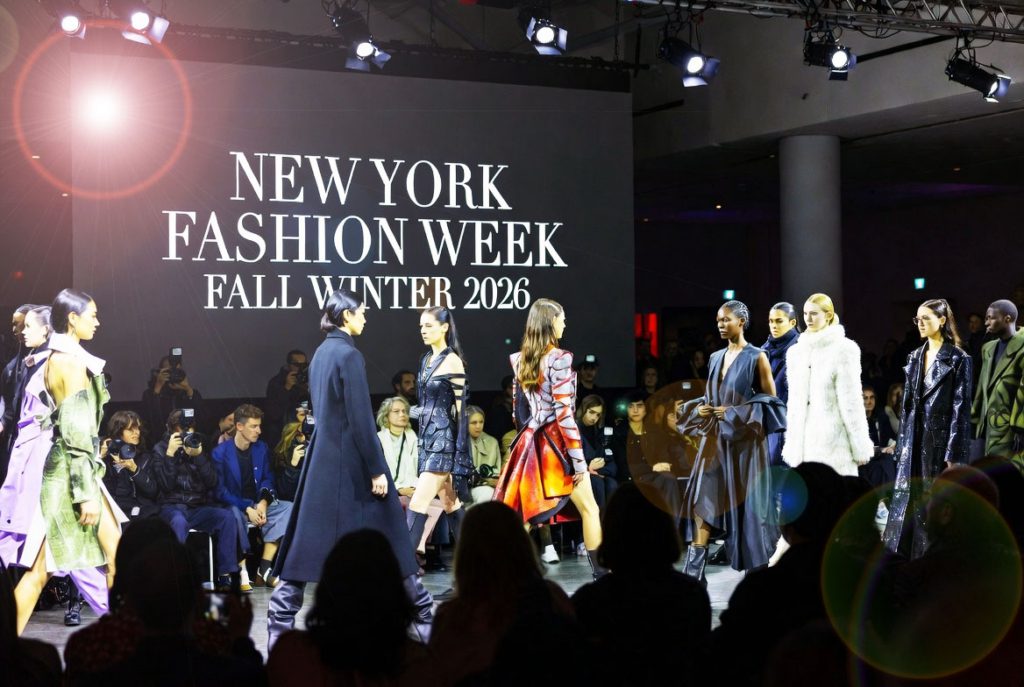
The cover image (above) was generated by a generative AI tool for illustrative purposes.