






What is social listening?
Social listening is the process of tracking and analyzing public online conversations about your brand, competitors, and industry across social media and the wider web to uncover insights you can act on.
In simple terms, social listening helps organizations understand what people are saying online, why they are saying it, and how those insights should shape strategy.
As digital channels continue to multiply, understanding what audiences are saying online has become essential for organizations that want to stay competitive. Customers, stakeholders, and communities now share opinions openly across social platforms and the wider web, often in real time. Social listening tools make it possible to capture and analyze these conversations at scale, helping PR and marketing teams understand sentiment, identify emerging trends, and detect potential risks early.
Imagine being able to hear thousands of conversations about your brand, products, or industry at the same time, without manually searching each platform. That is what modern social listening tools enable. To understand their full value, it is important to explore how they work, what they are used for, and how to choose the right solution for your organization.
Table of Contents
What Is Social Listening?
How Social Listening Tools Work with Artificial Intelligence
Why Social Listening Tools Have Become Essential
Comprehensive Coverage of Information Sources
What Are the Benefits of Social Listening for Your Organization
Industries That Benefit Most from Social Listening
Top 5 Social Listening Use Cases
The Three Maturity Levels of Social Listening
Difference Between Social Listening, Analytics, and Management
Choosing the Right Social Listening Tools
Key Metrics to Track with Your Social Listening Tools
What Are the Best Social Listening Tools?
Real-World Examples of Social Listening Tools in Action
Conclusion and Future Perspectives
FAQ: Questions About Social Listening Tools
Key Takeaways About Social Listening
- Social listening goes far beyond simple social media monitoring. This strategic approach encompasses listening to and analyzing all public conversations across the web, including forums, blogs, review sites, and comment sections, extending well beyond Facebook, Instagram, or LinkedIn.
- Modern tools leverage artificial intelligence, machine learning, and deep learning to automatically categorize mentions, detect emerging crises, generate personalized daily summaries, and identify emerging topics in real time. These technologies transform massive volumes of unstructured data into actionable insights.
- To choose your tool, focus on three fundamental criteria: the most comprehensive source coverage, rich functionality, and quality support. Avoid tools with limitations too significant for serious professional use. Select three to four key indicators per phase of your conversion funnel rather than drowning in dozens of metrics.
- Remember that social listening tools only create value when you transform insights into concrete actions. Establish clear processes so that information genuinely influences your strategic decisions regarding products, marketing, communication, and customer service.
What Is Social Listening?
Social listening, also known as social media listening, represents much more than simple mention monitoring. It is a strategic approach that consists of identifying, collecting, and analyzing all public conversations concerning your company, your products, your competitors, or your industry across the entire web.
Contrary to what its name might suggest, social listening is not limited solely to social networks like Facebook, Instagram, or LinkedIn. This practice actually encompasses the entire digital ecosystem where consumers and stakeholders express themselves. We are talking about discussion forums, spaces like Reddit, specialized blogs, consumer review sites; but also YouTube comments, emerging platforms like Bluesky or Threads, and even traditional media present online.
The richness of social listening tools lies in their ability to transform this colossal mass of unstructured data into actionable information. Think about the astronomical quantity of messages published every second on the Internet. Without an intelligent collection and analysis system, this precious information would remain scattered and unusable. Social listening tools act as sophisticated filters that capture only what is relevant to your organization and present it to you in a comprehensible and actionable form.
How Social Listening Tools Work with Artificial Intelligence
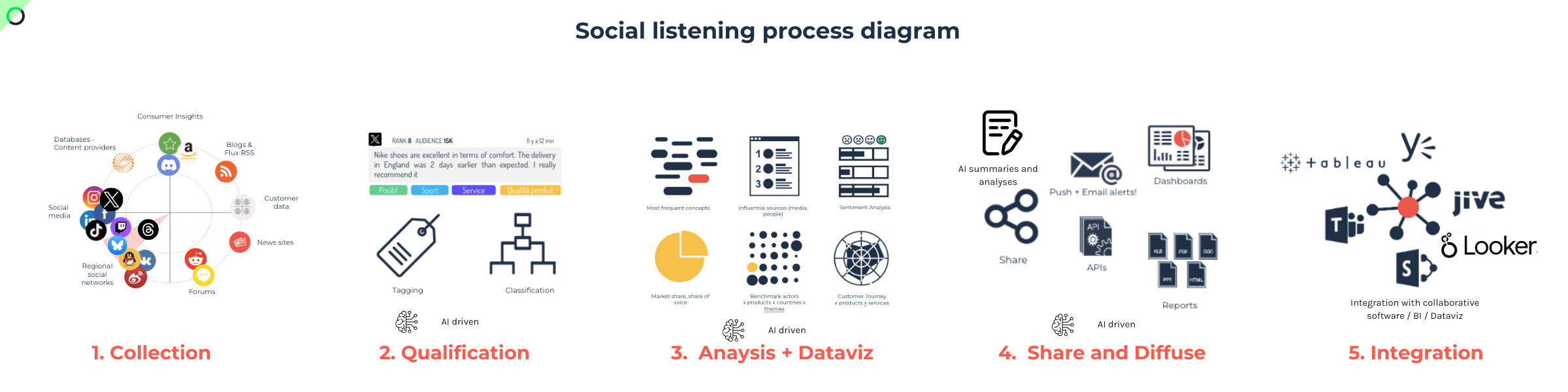
To understand social listening tools, we must examine their distinct yet interconnected phases. Additionally, we’ll explore how AI revolutionizes each stage.
1. Collection
First, collection forms the foundation of the entire system. Your tools continuously scan the web for mentions matching your defined criteria. These criteria include brand keywords, product names, hashtags, or industry expressions.
Furthermore, powerful tools employ sophisticated AI technologies, particularly machine learning, to refine collection. Consequently, this technology acts like an intelligent filter that learns from experience. The more data collected, the better it distinguishes relevant mentions from digital noise.
For example, if your brand is “Target,” machine learning progressively learns your interest. Specifically, it determines whether you mean the retail chain or military targets. This happens through contextual analysis of surrounding words.
2. Qualification
Next, qualification represents where AI proves absolutely crucial. Imagine collecting one hundred thousand mentions monthly. How could you sort complaints, compliments, and questions without spending weeks?
This is where machine learning and deep learning truly shine. Modern tools employ artificial neural networks inspired by human brain functions. As a result, they automatically qualify each mention with remarkable precision.
These algorithms trained on millions of labeled message examples recognize complex language patterns. They automatically assign labels across multiple dimensions:
- Sentiment expressed (positive, negative, neutral, frustrated, enthusiastic, disappointed, satisfied)
- Content type (complaint, praise, question, recommendation)
- Subject discussed (product quality, customer service, price, delivery)
- Author’s intention (buy, complain, recommend, inquire)
- Other criteria relevant to your analysis
Consequently, this automated categorization saves colossal time while maintaining consistency. Indeed, human analysis struggles to guarantee this at high volumes.
Detecting Spikes
Beyond basic categorization, advanced AI capabilities enable previously impossible analytical tasks. One valuable feature automatically detects reputation risks and unusual conversation spikes. Initially, machine learning algorithms establish a baseline by analyzing normal mention patterns. They understand your typical volumes, timing, and tones.
Once established, the system constantly monitors deviations from this norm. For instance, if negative mentions triple within two hours, AI detects it immediately. Subsequently, it triggers an alert.
This early detection gives you crucial time to react before crises escalate. Moreover, the system analyzes message propagation velocity and identifies influential participants. Additionally, it evaluates emotion levels to determine real urgency.
Automatic Summaries
Sophisticated tools also integrate automatic summarization powered by generative AI. Each morning, you receive a daily summary synthesizing essential information. This covers what was said about your brand, products, or sector recently.
This functionality relies on advanced natural language processing models capable of reading thousands of messages. Subsequently, it extracts salient information and reformulates it concisely. The summary highlights emerging trends, rapidly growing conversations, and critical topics requiring attention.
Think of this as a personal assistant reading the entire Internet nightly. Then, they present you with a perfectly structured memo upon waking.
Analysis of Emerging Topics
Automatic analysis of emerging topics represents another powerful machine learning application. Unsupervised learning algorithms identify conversation clusters sharing common themes despite different keywords.
For example, discussions about “disappointing battery life,” “battery drains quickly,” and “constantly recharging” group automatically. This occurs even when “battery” doesn’t appear in all mentions. This deep semantic understanding presents conversations organized by coherent themes rather than chronologically.
Furthermore, the algorithm evaluates each topic’s growth velocity to identify rapidly important ones. Consequently, you focus on conversations truly mattering to your organization.
Deep Learning
Deep learning-powered summarization helps identify current trends and emerging themes simultaneously. These algorithms analyze hundreds of in-depth conversations from forums and extended comments. Then, they extract essential ideas in clear sentences.
Even more impressive, these systems detect subtle changes in product category discussions. For instance, if sustainability emphasis progressively increases, AI identifies this shift early. Therefore, you receive alerts about emerging trends before they become obvious market-wide.
This anticipation capability allows strategic adaptation of products, communication, and positioning. As a result, you respond to changing expectations before competitors do.
3. Analysis and Data Visualization
The analysis and visualization phase also benefits considerably from AI. Good tools don’t simply show endless message lists or generic charts. Instead, they transform raw data into intelligent visualizations highlighting important information.
Algorithms automatically generate weighted keyword clouds and influencer relationship maps. Additionally, they create temporal evolution charts identifying abnormal periods and dynamic contextual dashboards. Moreover, AI suggests which visualization types best answer your specific questions. Thus, it guides your analysis toward actionable insights.
4. Sharing and Distribution
Finally, sharing and distribution allow users to create auto-updating reports, alerts, and dashboards. These distribution channels communicate with colleagues, managers, and clients effectively. Each recipient receives relevant information for their role in suitable formats. Furthermore, delivery occurs at optimal times for informed decision-making.
The combination of AI, machine learning, and deep learning profoundly transforms social listening capabilities. AI now provides instant insights with impossible precision and comprehensiveness through human means alone. Consequently, this democratization allows small organizations to access analytical capabilities previously reserved for large companies.
5. Bonus: Integrating Social Listening with Other Tools
Your Company’s Other Systems
Integrating social listening tools with other company systems represents a crucial yet underestimated aspect. To understand this importance, imagine your tool as part of a larger technological ecosystem. In this ecosystem, precious information constantly circulates between systems.
Other Third-Party Tools
Concretely, your tools must communicate easily with other third-party tools you use daily. This bidirectional communication allows social listening data to feed other systems effectively. Thus, it creates genuine synergy between different information sources.
High-performing software transmits two complementary data types to other platforms. First, quantitative data includes key performance indicators like mention volume and share of voice. Second, qualitative data consists of messages, social posts, and articles mentioning your brand.
This data can be directed to different software according to your needs. For instance, collaborative tools like Slack receive automatic alerts when critical situations arise. Meanwhile, your CRM system enriches with social conversations for complete contact views.
Additionally, business intelligence platforms like Tableau integrate social metrics into global dashboards. Similarly, visualization tools like Looker Studio create representations combining social data with other company sources.
Beyond technical exploitation, this integration presents an often overlooked organizational advantage. When social listening insights appear in tools colleagues already use daily, visibility increases significantly. Consequently, this enhances the work of people handling social listening and competitive intelligence.
Their contribution becomes visible throughout the organization rather than remaining confined to specialized tools. Therefore, this increased visibility reinforces strategic monitoring legitimacy and facilitates widespread insight adoption.
Why Social Listening Tools Have Become Essential
Marketing professionals who use social listening tools have a considerable competitive advantage. This technology addresses four fundamental needs that are at the heart of any modern marketing strategy.
Understanding Your Customers
First, social listening tools allow you to truly understand your customers and their real needs. Your consumers express themselves spontaneously online, without the filter of a satisfaction questionnaire or formal market study. They share their frustrations, expectations, desires, and experiences without pretense. This authenticity makes data collected through social listening an incomparable source of insights. You can discover how your customers actually use your products, which features they appreciate most, what problems they encounter, and even how they compare your offering to that of your competitors.
Trend Detection
Second, social listening tools excel at early detection of opportunities and threats. Trends often emerge on social networks well before becoming visible in traditional media or market research reports. By actively monitoring conversations in your sector, you can identify new unmet needs, spot emerging market segments, detect the arrival of new competitors, or anticipate regulatory changes that will affect your industry. This anticipation capability can make the difference between a company that undergoes changes and one that anticipates them.
Strategic Information
Third, your social listening tools constitute an inexhaustible source of strategic information. Analysis of conversations online reveals the perceived strengths and weaknesses of your products and those of your competitors. You better understand your customers’ lifestyles, their values, their current concerns. And then, you measure the real effectiveness of your communication campaigns by observing how they are received and discussed online. Finally, you identify thought leaders and influencers who shape perceptions in your domain.
Customer Relationships
Fourth, social listening tools significantly strengthen your customer relationships. By capturing your consumers’ messages on all their channels of expression, you demonstrate that you truly listen to them. You can respond quickly to their concerns, even when they are not directly addressing you. This responsiveness and attention create a bond of trust that builds customer loyalty. Moreover, the collaborative features of your tool allow you to instantly transmit a customer’s message to the most appropriate service to respond, ensuring optimal handling.
Comprehensive Coverage of Information Sources
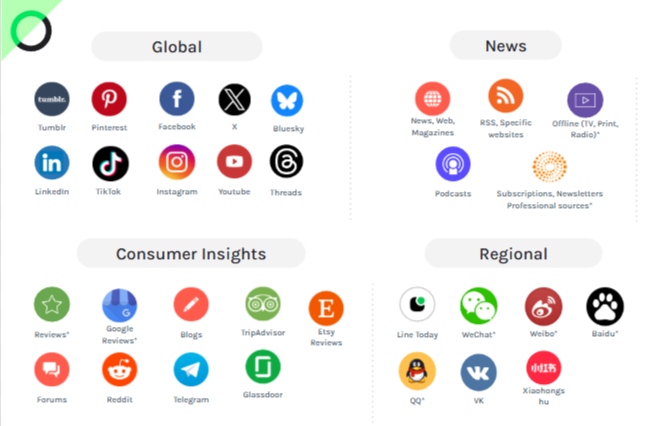
An often underestimated but absolutely crucial aspect of social listening tools concerns the extent of sources they can monitor. Many mistakenly think that social listening is limited to major social networks like Facebook, Instagram, or what was formerly Twitter (X). In reality, comprehensive social listening tools must cover a much broader spectrum.
LinkedIn, Tiktok
Western social networks obviously constitute an important part of monitoring. Your tool must be able to monitor Facebook with its various features (posts, comments, groups), Instagram and its stories, LinkedIn for professional conversations, Pinterest and TikTok for visual trends and consumption, and platforms like Threads or Bluesky that are rapidly gaining importance. Each social network has its own codes and specific audience, and your social listening tools must adapt to these particularities.
But monitoring does not stop there. Discussion forums and online communities like Reddit host conversations often more in-depth and specialized than those on mainstream social networks. Blogs, whether personal or professional, publish detailed analyses and valuable experience feedback. Consumer review sites concentrate essential information on customer satisfaction and improvement points. Comment spaces under YouTube videos or on streaming platforms reveal spontaneous reactions and rich discussions.
News and press
Truly high-performing social listening tools must also be able to integrate more traditional but still relevant sources. News sites and press (print, TV, Radio, online, podcasts) allow you to track how your sector is covered by media. Transcriptions of television and radio programs capture discussions that may not exist online. Podcasts, a rapidly expanding format, host long and in-depth conversations on specialized topics.
Finally, the best social listening tools allow you to integrate your own internal data sources. You can incorporate results from your satisfaction surveys, data from your CRM, transcriptions of your exchanges with customer service by email or chat. This integration creates a truly holistic vision of what your customers think and say, combining public web data with your private information.
The reason why the most comprehensive coverage possible is so important is simple. Your customers do not all express themselves in the same place. Some prefer to tweet their frustrations, others leave detailed reviews on specialized sites, still others share their experiences on niche forums. If your social listening tools only monitor the main social networks, you potentially miss the richest and most instructive conversations about your brand and products.
What Are the Benefits of Social Listening for Your Organization
When you deploy social listening tools in your company, you unlock a series of tangible advantages that directly impact your results.
Understanding Your Customers and Your Competition’s Customers
Deep understanding of your clientele represents the first major benefit. Thanks to your social listening tools, you capture your customers’ real expectations as they spontaneously express them, without the bias of a formatted questionnaire. You discover what they truly like about your products, what frustrates them, how they use your services daily, and what improvements they would like to see.
But the tool goes further by also allowing you to understand your competitors’ customers. What do they appreciate about the competition? What are their disappointments? This information helps you optimally position your offering and identify differentiation opportunities.
Identifying Opportunities
Identification of development opportunities constitutes another considerable asset. By monitoring suppliers, innovative startups, potential prospects, new technologies, and emerging processes in your sector, your social listening tools help you detect growth opportunities. You can generate sales leads by spotting companies expressing needs you can satisfy. You identify potential partners who would complement your offering. And also, you discover product development ideas by observing innovations that generate enthusiasm in your target market.
Improving Customer Service
Customer service improvement benefits enormously from high-performing social listening tools. By capturing your customers’ messages on all channels where they express themselves, you no longer miss any request. Complaints formulated on an obscure forum or in an unanswered tweet are treated the same as those sent directly to your customer service. This comprehensiveness considerably improves customer satisfaction. Moreover, by analyzing recurring themes in received messages, you can anticipate topics that will generate the most contacts and adapt your resources accordingly.
Strengthening Editorial Marketing Strategy
Strengthening your content marketing strategy naturally flows from using social listening tools. Finding relevant content ideas that truly resonate with your audience represents a constant challenge for marketing teams. Your social listening tools solve this problem by showing you exactly which topics excite your target, which questions come up regularly, which content formats generate the most engagement. You can also analyze the performance of content published by your competitors or thought leaders in your sector, and draw inspiration for your own editorial strategy.
Protecting brand reputation
Protection of your online reputation perhaps represents the most critical application of social listening tools. Your online reputation can shift in a few hours. A dissatisfied customer whose complaint goes viral, a communication error that triggers a wave of indignation, a coordinated attack by detractors—all these scenarios can cause considerable damage to your brand image.
Good social listening tools continuously monitor mentions of your brand, measure the sentiment associated with these mentions, detect abnormal spikes of negative activity, and immediately alert you when a potentially problematic situation develops. This early detection gives you time to react before a crisis becomes uncontrollable.
Industries That Benefit Most from Social Listening
Although any industry can benefit from social listening tools, certain industries derive particularly significant advantages due to their specificities.
Pharmaceutical industry
The pharmaceutical industry faces unique challenges that make social listening absolutely essential. Competition is fierce, research and development cycles span years and cost fortunes, and public health stakes are colossal. Patients and medicine consumers increasingly express themselves freely on social networks and specialized forums about their pathologies, treatments, side effects they experience, and their quality of life.
Social listening tools allow pharmaceutical laboratories to monitor these conversations to understand the real patient experience, identify unmet medical needs, quickly detect potential safety issues, and evaluate the perception of their products compared to competitors.
Food & Beverage
The food and beverage sector finds in social listening a valuable ally to stay in phase with changing consumer expectations. Eating habits evolve rapidly under the influence of health, environmental, and ethical concerns. Thanks to social listening tools, food brands better understand the types of products their customers seek, the tastes and flavors that please, preferred packaging formats, favored purchase locations, consumption moments, and even recipes consumers create with their products. Also, these insights directly feed new product development and marketing strategies. The concerns of other consumer packaged goods industries (e.g., hygiene and cosmetics) are very similar.
Technology
The technology industry relies heavily on social listening to maintain its lead in an ultra-competitive environment. Tech companies use their social listening tools to understand consumer expectations regarding services associated with their products, to analyze consumption trends among specific segments like younger generations or professionals, to conduct in-depth competitive intelligence on strategies and positioning of major players, and to conduct financial monitoring to understand capital movements and fundraising that reshapes the industry.
Banking
The banking, insurance, and financial sector exploits social listening to navigate a highly regulated and rapidly transforming environment. Financial institutions use their social listening tools to better understand the expectations of their clients and policyholders, to identify specific needs of savers and investors, to understand consumption and financial management styles of different customer segments, to detect strategies of new entrants disrupting the sector with their digital offerings, and to analyze multiple risks and opportunities related to their activity, whether competitive, regulatory, economic, environmental, climate, energy, or geopolitical.
Public Sector
Local authorities and the public sector are progressively discovering the value of social listening tools to improve citizen services. Public administrations can use social listening to measure needs, expectations, and satisfaction of citizens regarding public services and infrastructure, to understand the evolution of lifestyles and consumption patterns of the populations they serve, to anticipate the evolution of regulations and standards, to measure their reputation with the public, and to analyze trends related to emerging risks that could affect their territory.
Top 5 Social Listening Use Cases
Real-world applications demonstrate how strategic social listening transforms communications and marketing effectiveness across diverse industry scenarios. These examples illustrate practical intelligence gathering and strategic response approaches.
1. Campaign Message Alignment and Optimization
A major pharmaceutical company launching a new treatment utilized social listening to optimize messaging strategy throughout their campaign lifecycle. Initially, listening revealed that healthcare professional conversations focused primarily on efficacy data rather than the company’s emphasis on convenience features.
Consequently, the communications team adjusted messaging hierarchy, leading with clinical results while positioning convenience as secondary benefits. Real-time sentiment tracking showed improved engagement rates and reduced skeptical commentary as messaging aligned with stakeholder priorities.
2. Crisis Prevention and Reputation Management
When new financial regulations created industry uncertainty, a major bank employed social listening to monitor stakeholder sentiment and identify optimal response strategies. Listening revealed that customer conversations focused on account security concerns rather than regulatory compliance details.
Subsequently, communications teams developed customer-focused messaging that addressed security questions directly while demonstrating regulatory compliance through transparent policy explanations. Real-time sentiment tracking confirmed reduced negative conversation themes and improved customer confidence indicators.
3. Competitive Intelligence and Market Positioning
A software company facing competitive pressure used social listening to identify messaging differentiation opportunities. Analysis revealed that competitor conversations consistently highlighted technical capabilities while stakeholder discussions expressed concerns about implementation complexity and support quality.
Therefore, the marketing team developed messaging that emphasized ease of implementation and comprehensive support services. Listening tracked sentiment improvements and increased consideration mentions as the differentiated positioning gained traction in industry conversations.
4. Executive Reputation Monitoring
A major corporation announced a CEO transition amid market uncertainty, utilizing social listening to monitor stakeholder reactions and optimize communications throughout the leadership change process. Listening revealed that investor conversations expressed concerns about strategic continuity rather than individual leadership capabilities.
Therefore, communications emphasized strategic plan consistency and leadership team stability while highlighting the incoming CEO’s relevant experience. Sentiment tracking showed improved investor confidence and reduced uncertainty discussions.
5. Product Launch Intelligence
Following a product recall announcement, a consumer goods company used social listening to monitor executive communications effectiveness and stakeholder response patterns. Analysis revealed that formal corporate statements generated skeptical responses while executive interviews demonstrating personal accountability improved sentiment significantly.
Consequently, the communications strategy increased executive visibility through media interviews and direct stakeholder engagement rather than relying primarily on corporate announcements. Real-time listening confirmed improved trust indicators and reduced negative conversation volume.
The Three Maturity Levels of Social Listening
Not all social listening tools are equal, and not all organizations use them with the same degree of sophistication. We can distinguish three levels in social listening practice, each corresponding to a different stage of maturity and type.
Basic Social Listening
This social listening represents the first level. At this stage, you mainly focus on listening to your own audience, that is, people and communities who already follow you on social networks and interact with your content. Your social listening tools monitor publications containing your brand hashtags, mentions of your official accounts, and pages devoted to your company. This approach, though limited, already allows you to understand how your existing community perceives your content and messages, and to dialogue directly with them.
In-Depth Social Listening
An In-depth social listening constitutes the intermediate level and represents the most common practice among mature organizations. At this stage, your social listening tools monitor a much broader universe of conversations on social media, websites, blogs, forums, and review sites. You no longer limit yourself solely to direct mentions of your brand, but you monitor numerous themes related to your company.
You analyze conversations about your finances, your competitors, your economic environment, your marketing, the regulatory framework that concerns you, social and societal aspects relevant to your activity, as well as your research, innovation, and development initiatives.
This advanced form of social listening allows you to discover hundreds of relevant conversations on topics that directly impact your organization.
Combined Social Listening
A Combined social listening represents the expert level that integrates the benefits of quantitative monitoring and qualitative listening. Social media monitoring provides you with precise metrics on your social accounts, the size and evolution of your communities, your interaction rates, your share of voice compared to competitors. This quantitative data constitutes an essential first step to understand your performance and that of your competitors on social media.
Your social listening tools then use these indicators to more precisely define your listening objectives, in terms of channels to monitor as priorities, themes to explore in depth, and analysis axes to favor. This combined approach offers the best of both worlds: the rigor of numerical data and the richness of qualitative insights.
Difference Between Social Listening, Analytics, and Management
Terminology around social can sometimes be confusing. It is important to clearly understand the distinctions between three often confused concepts that cover different realities.
Social Media Listening
Social media listening, which we have extensively explored, consists of actively searching for conversations on specific topics using social listening tools. You define queries in the form of keywords, phrases, or expressions in a given language, and your tool collects all corresponding mentions from multiple sources that are not limited solely to social networks but also include blogs, press articles, forums, and other conversational spaces. These tools exploit data from general sources to find what people are talking about online.
Moreover, Social listening collects this data in real time, allowing you to receive aggregated results at any time to make informed decisions quickly.
Social Media Analytics
Social media analytics delves deeper into analyzing engagement levels specifically on your owned media. This involves interpreting important data on your brand’s performance on social networks, interactions with your audience, and online trends in relation to your marketing and communication strategies. You track the evolution of your communities, your engagement rates, your share of voice by social media channel, your content performance.
These tools help you understand how your audience specifically interacts with your brand, which can prove difficult to grasp without the right tools and appropriate expertise.
Finally, Social media analytics is particularly crucial for companies that make social media a central pillar of their marketing and e-commerce strategy, where evaluating the success of your brand content is critical.
Social Media Management
Social media management, meanwhile, refers to the operational management of a brand’s social presence. This encompasses analysis, creation, and scheduling of content published on your social accounts. A social media manager ensures that their brand’s channels remain active, interact with their audience, and moderate exchanges.
These tools constitute an essential aspect of daily social media use, as most allow scheduling content in advance, so your publication flows can be organized weeks or even months ahead. This considerably improves efficiency and time management in community management work, while consolidating data for reporting and performance analysis.
The difference between social listening and social monitoring also deserves clarification. Social media monitoring represents a more active and reactive process that allows brands to respond quickly to customers based on very quantitative data from social network conversations. Social listening, in contrast, adopts a more proactive approach, providing analytical support to marketing and communication specialists.
It allows them to gather key information through sentiment analysis, keyword research, concept analysis, sender analysis, channel analysis, competitive benchmarking, and trend tracking.
Choosing the Right Social Listening Tools
Faced with the multitude of social listening tools available on the market, how do you make the right choice for your organization? Several essential criteria should guide your decision.
Source Coverage
Source coverage constitutes the first absolutely fundamental criterion. Data represents the fuel of your social listening tools. Without comprehensive coverage of available data on the web, even the most sophisticated and user-friendly tool cannot provide you with relevant information and analyses. You must therefore verify that the tool under consideration correctly covers not only major social networks like Facebook, Instagram, or LinkedIn, but also all social media in the broad sense, meaning all discussion spaces such as blogs, forums, consumer review sites, and comment spaces.
Coverage of media not natively present online such as TV, Radio flows, and Print media (digitized) is also an essential criterion.
Comprehensive social listening tools must also allow you to integrate third-party data from your own organization, such as results from your satisfaction surveys, transcriptions of your chats with customers, emails received by your customer service, or even flows from your CRM. Finally, the ability to add your own customized specialized sources represents a considerable asset for monitoring niche spaces specific to your industry.
Functionality
The functionality offered by the tool constitutes the second major criterion. Source coverage is not enough if you cannot exploit them effectively. The tool must allow you to create sophisticated monitoring queries using keywords, complex expressions, logical operators, and this even on the most recent platforms like TikTok or LinkedIn. Functionality must be powerful while remaining accessible, meaning configurable by the end user without requiring constant intervention from technical experts.
You must be able to easily manage the collection and monitoring phase, configure automatic qualification and categorization of mentions, access intuitive data analysis and visualization tools, and have robust sharing, distribution, and reporting capabilities.
Support
Support offered by the supplier represents a third criterion often underestimated but absolutely crucial for the success of your project. Not everyone has the time, skills, or desire to devote themselves to deploying and configuring social listening tools, however ergonomic they may be. Personalized support by a dedicated account manager, an expert consultant, and potentially a qualified analyst proves essential to guarantee your satisfaction and success with the tool.
This support must cover initial onboarding, ongoing training for your teams, rapid integration of new features constantly appearing on social media, and evolution of your tool use over time to follow the maturation of your needs.
Your Budget
Your available budget obviously influences your choice. Free or very inexpensive social listening tools exist, like Google Alerts or InoReader, but they present significant limitations. They only cover a limited number of sources, you can only create a limited number of monitoring queries, and they essentially focus on the collection phase without offering you real analysis or reporting capabilities. These tools may be suitable for an initial exploratory approach to social listening, but they will quickly show their limits as soon as you want to derive real strategic value from them.
Comprehensive social listening tools, on the other hand, cover the entire process from mention collection to generating sophisticated reports, including automatic qualification, in-depth analysis, and data visualization. Advanced platforms like Onclusive Social (formerly Digimind), Facelift, or Clarabridge offer very comprehensive source coverage and a suite of functionalities allowing you to analyze, categorize, and visualize all collected mentions. These tools certainly represent a more substantial investment, but they deliver incomparable value for organizations that take their social listening strategy seriously.
Key Metrics to Track with Your Social Listening Tools
To derive maximum value from your social listening tools, you must clearly define the performance indicators you will track. These KPIs must be aligned with your business and marketing objectives.
It is tempting to want to track a large number of indicators, but this approach proves counterproductive. You should instead select a limited number of KPIs, typically three to four per phase of your conversion funnel, to ensure effective operational tracking, potentially daily.
Awareness
For the awareness phase, relevant indicators include the total number of mentions of your brand over a given period, your share of voice compared to your main competitors, and the number of unique people talking about you. These metrics indicate whether your visibility is progressing and how you stand in the competitive landscape.
Acquisition
For the acquisition phase, you must monitor the share of voice of your different social communities, the distribution of these shares of voice by social media channel, and the evolution of your audiences on each platform. This data reveals which channels work best for attracting new audiences to your brand.
Interaction
The interaction phase requires tracking the performance of your different types of interactions (likes, retweets, comments, shares), the evolution of these interactions over time, and the content that generates the most engagement. These indicators help you understand which content resonates best with your audience and elicits their active participation.
Satisfaction
To measure satisfaction, your social listening tools must provide you with an analysis of the perception of your brand in terms of sentiments (positive, negative, neutral), the evolution of this perception over time, and ideally a net sentiment score that summarizes the general tone of conversations about you. These metrics constitute leading indicators of customer satisfaction well before it is reflected in your sales.
Conversion
Finally, for the conversion phase, you must track the number of leads from social media by channel over a given period, the proportion of these leads that become marketing qualified leads (MQLs) then sales qualified leads (SQLs), and the growth of these social-origin leads over time.
What Are the Best Social Listening Tools?
Selecting the right social listening platform directly impacts strategic intelligence quality and organizational communications effectiveness. Professional-grade tools must deliver comprehensive capabilities that support enterprise-level decision-making rather than basic monitoring functions.
Essential Platform Capabilities
Advanced Sentiment Analysis: Leading platforms analyze emotional intensity, sentiment drivers, and contextual factors beyond simple positive/negative scoring. These tools identify specific emotional states and sentiment triggers that influence stakeholder perceptions.
Real-Time Alert Systems: Professional platforms provide automated spike detection for unusual conversation volume, sentiment shifts, and emerging narrative themes requiring immediate attention.
Comprehensive Platform Coverage: Enterprise tools monitor conversations across social media, news outlets, forums, blogs, podcasts, and digital publications through unified dashboards that eliminate platform blind spots.
Competitive Intelligence Features: Advanced platforms include built-in competitive analysis, share of voice tracking, sentiment comparison, and message positioning analysis across industry players.
Top Social Listening Platform Categories
- Enterprise Media Intelligence Platforms: Comprehensive solutions like Onclusive that integrate social listening with traditional media monitoring, providing unified stakeholder intelligence across all communication channels.
- Social-First Listening Tools: Platforms specializing in social media conversation analysis with advanced sentiment capabilities and influencer identification features.
- Industry-Specific Solutions: Specialized tools designed for particular sectors like healthcare, financial services, or technology that include industry-relevant terminology and compliance features.
- AI-Powered Analytics Platforms: Next-generation tools leveraging artificial intelligence for predictive analysis, emotion detection, and automated insight generation.
- Integrated Communications Suites: Platforms combining social listening with campaign management, crisis response, and stakeholder relationship management capabilities.
Platform Selection Criteria
Communications teams should evaluate platforms based on sentiment analysis sophistication, real-time alerting capabilities, competitive intelligence features, integration possibilities with existing tools, and scalability for organizational growth rather than focusing primarily on pricing considerations.
Real-World Examples of Social Listening Tools in Action
To fully understand the practical value of social listening tools, let us examine some real use cases from different industries.
Construction equipment and tools
A company in the construction equipment and tools industry wanted to identify customer purchase criteria to detect opportunities to improve their products. The company used its social listening tools to create market analysis reports and in-depth performance comparisons based on consumer insights collected on social media and conversational web spaces. It monitored different product lines such as cordless power tools, hammers, and saws, while simultaneously analyzing competitors’ products.
This monitoring revealed which attributes professionals and amateurs valued most when making purchases, which features were missing from existing products, and how the brand was perceived compared to the competition. This information directly fed product development and marketing positioning decisions.
High Tech
A high-tech company preparing to launch a new smartphone line illustrates another relevant use case. Writers and the marketing team wanted to nourish their marketing strategy and communication campaign by drawing from current trends. The content creation team needed rapid access to the latest trends in varied areas like Generation Y, lifestyles, fashion, and gastronomy. They sought to find bridges between their technology and some of the most discussed online trends. The team decided to use its social listening tools to listen to conversations from a list of five hundred qualified influencers.
They analyzed their publications by trends, then mapped them by thematic axes. This pool of new ideas fed “fashion tech” trends and proposed new content ideas for campaigns, particularly around wearable technologies and virtual reality, to increase brand awareness among fashion and lifestyle communities.
Dating
The case of Meetic Europe, one of the global leaders in dating platforms with a presence in twenty-one countries, offers a particularly instructive example of strategic use of social listening. The group operates brands like Meetic, Match, Lexa, and LoveScout24 in a highly competitive and rapidly evolving environment.
Some challenges Meetic faced included translating its brand platform into a content strategy capable of delivering the right message, in the right place, and at the right time to its target. This company also needed to analyze the impact of its own campaigns as well as competitors’ performance.
The implemented solution included social listening tools monitoring and analyzing a broad spectrum of social media, including TikTok to track emerging trends. Sentiment analysis around brand campaigns and competitors constituted a key element of the strategy. Generation of customized reports for marketing teams in different European regions allowed communication of data and reporting homogeneously across the organization.
Key performance indicators tracked by Meetic included share of voice for its brands and those of competitors via automated dashboards, reach of conversations, and net sentiment score. The platform also collected insights on consumer and client opinions in Europe for its brands and those of competitors. This systematic approach to social listening allowed Meetic to continuously optimize its social media strategy and maintain its leadership position despite intense competition.
Conclusion and Future Perspectives
Social listening tools represent much more than simple social network monitoring technology. They are a window open to the thoughts, desires, frustrations, and expectations of your customers and your market. In a world where consumers freely and publicly express themselves on practically all aspects of their experience with brands, ignoring these conversations amounts to piloting your company blindfolded.
Organizations that excel today are those that have understood that social listening is not a one-time project but a continuous practice that must be inscribed in the company’s DNA. They have invested in social listening tools adapted to their needs, trained their teams to exploit them effectively, and integrated generated insights into their decision-making processes at all levels.
Predictive analysis
The future of social listening looks exciting with the constant evolution of technologies. Artificial intelligence and machine learning make tools increasingly precise in their sentiment analysis, detection of emerging trends, and identification of weak signals heralding major changes. Image and video recognition now allows monitoring not only what is written but also what is visually shown on social networks. Predictive analysis begins to enable anticipation of crises and opportunities even before they fully manifest.
Choose
To choose your social listening tools, start by clarifying your objectives. What are you seeking to accomplish? Improve your customer service? Protect your reputation? Nourish your product innovation? Optimize your content strategy? Monitor your competitors? Your objectives will determine the functionalities you need and the appropriate investment level.
Coverage
Next, rigorously evaluate available options by focusing on three fundamental criteria: source coverage, richness of functionality, and quality of support. Do not hesitate to request in-depth demonstrations and trial periods to concretely test tools on your own use cases.
People
Finally, remember that social listening tools, however powerful, do not do all the work. They provide you with data and analyses, but it is up to you to transform them into concrete actions that will improve your organization. Success in social listening depends as much on technology as on the people who use it and the processes that allow translating insights into decisions and actions.
FAQ: What Is Social Listening? Common Questions Answered
What is social listening?
Social listening is the process of tracking and analyzing public online conversations about your brand, competitors, and industry across social media and the wider web. It helps organizations understand sentiment, identify trends, detect risks early, and make better-informed decisions across PR, marketing, and customer experience.
What is the difference between social listening and social media monitoring?
Social media monitoring focuses on tracking and responding to mentions in real time. Social listening analyzes conversations across social media and the wider web to understand sentiment, trends, and insights that inform strategy.
What is the difference between free and professional paid tools?
Free tools like Google Alerts only monitor a very limited number of sources and allow only five to ten maximum queries, without any analysis or categorization. Professional tools cover hundreds of millions of sources. They allow unlimited and sophisticated queries, and offer artificial intelligence that categorizes, analyzes sentiments, detects trends. They alsgenerates visual dashboards in real time.
How long does it take to see concrete results?
Initial results appear within the first weeks with immediate identification of ignored conversations and commercial opportunities. The first two to three months constitute a learning phase to refine your queries and train your teams. After three to six months, you will observe patterns in accumulated historical data. Beyond six months, social listening should be integrated into your processes with measurable return on investment.
How can social listening prevent a reputation crisis?
A well-configured tool constantly monitors several critical indicators: unusual volume spikes, increase in negative mentions, velocity of message propagation, influencer participation, and use of emotionally virulent terms. By combining these signals, it alerts you within the first hours of an emerging crisis, giving you time to prepare a response before the situation becomes uncontrollable.
Should you monitor all sources or only major social networks?
Each source provides different insights. Social networks capture immediate emotional reactions, forums host in-depth technical discussions. And review sites contain detailed experience feedback, and blogs publish analyses that influence purchase decisions. Your customers do not all express themselves in the same place, so comprehensive coverage is essential for a complete vision.
What team is needed to manage social listening tools?
A small business can manage with a part-time person. A medium-sized company requires at least one dedicated full-time person. A highly visible large company will need a team of three to five people. However, real value is created when the entire organization effectively uses generated insights to make informed decisions.