



315,000 Mentions Later, Here’s What the Internet Actually Cares About
The 2026 Golden Globes nominations dropped on Monday, December 8, and the internet had opinions-205,947 social media mentions worth of opinions on that single day, to be precise. But here’s what’s fascinating: while the Hollywood establishment might have its own ideas about what matters, social media tells a completely different story about which nominees are capturing the cultural zeitgeist.
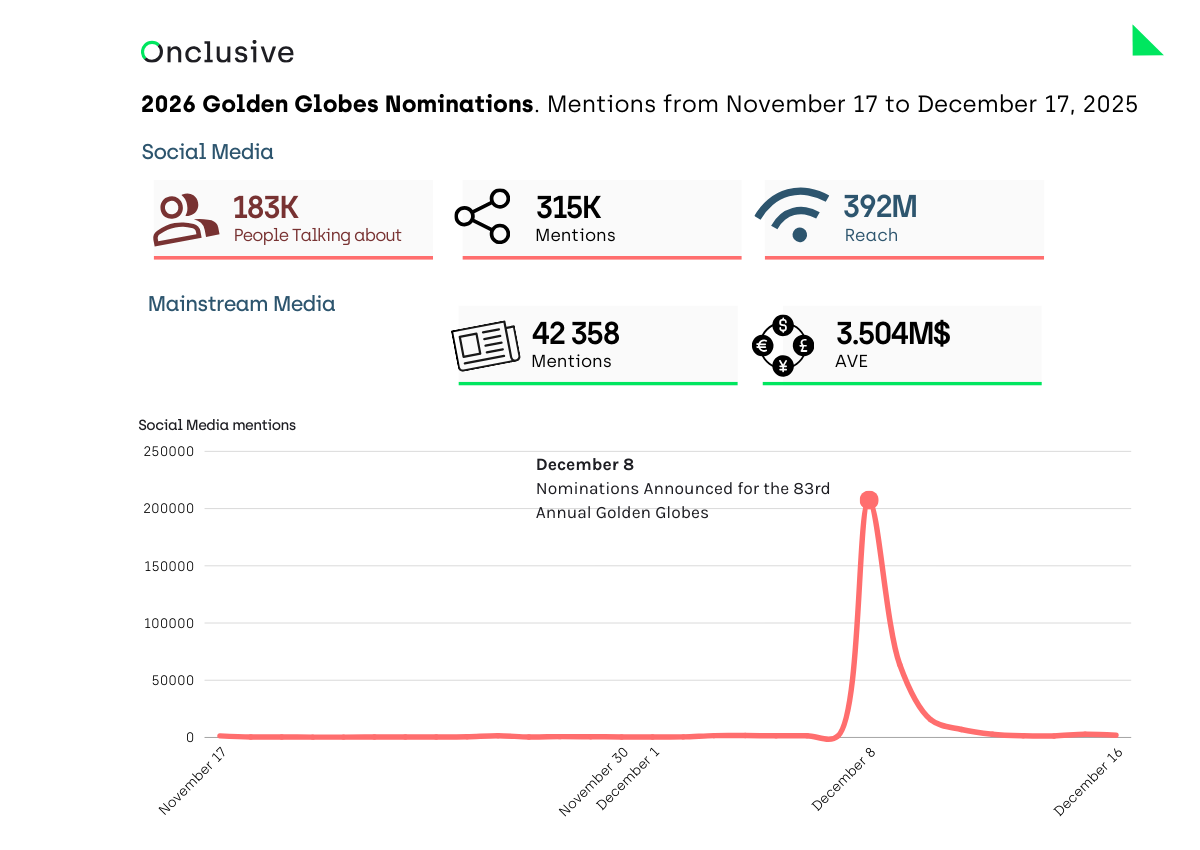
According to data collected by Onclusive using its social and media monitoring tools, the nominations generated 315,000 mentions on social media over the last 30 days, and 42,358 mentions in traditional media (print, digital and television/radio). On the day of the announcement alone, social media generated 205,947 mentions and traditional media 12,191. The awards season is no longer just scrutinised by entertainment journalists and industry insiders. It’s a conversation happening in real time on Twitter, Instagram, TikTok and beyond, where fans are the critics and engagement is the currency.
The Billion-Dollar Conversation: Understanding the Golden Globes’ Commercial Impact
Behind the 315,000 social media mentions and 42,358 traditional media mentions lies an astonishing commercial reality: according to Onclusive measurements, the Advertising Value Equivalency (AVE) of Golden Globes coverage over the last 30 days reached $1.447 billion for web media and $2.057 billion for television. To put this in perspective, that’s $3.5 billion in combined equivalent advertising valu, generated organically through earned media coverage rather than paid advertising.
These numbers reveal why the Golden Globes matter far beyond the trophies themselves. Every mention, every social media post, every television segment discussing the nominations represents what would have cost billions in advertising spend if purchased directly.
Key Takeaways
Social Media Dominates the Conversation: The 2026 Golden Globes generated 315,000 social media mentions over 30 days, with 205,947 and 12,191 mentions in traditional media on announcement day alone
“One Battle After Another” Leads the Pack: Paul Thomas Anderson and Leonardo DiCaprio’s collaboration earned nine nominations and tops social media discussion at 2.31%.
“Wicked” Makes History: Cynthia Erivo and Ariana Grande became the first actresses from the same film to receive two nominations each, collectively dominating 5.16% of social conversation.
Historic Brazilian Recognition: Wagner Moura became the first Brazilian actor nominated for Best Actor in a Drama category, generating significant social media celebration.
K-Pop Conquers Hollywood: Netflix’s “KPOP DEMON HUNTERS” earned three nominations and appears twice in the top 15 most-discussed nominees, while BLACKPINK’s Lisa’s schedule includes the Golden Globes alongside the Met Gala.
Television Holds Strong: “The White Lotus” from HBO Max earned six nominations (most for any series) and ranks fourth in social media discussion, proving TV prestige matches cinema.
Podcasts Enter the Arena: A new Golden Globes category recognizes podcasts, with “Armchair Expert” nominated, though Joe Rogan’s exclusion sparked controversy.
Oscar Predictions Begin: The Golden Globes serve as valuable indicators for March’s Academy Awards, with social media buzz potentially influencing momentum through awards season.
The Real Winners: What Social Media Is Actually Talking About
Out of 170 total nominations across the 2026 Golden Globes, the data reveals a fascinating hierarchy of what’s genuinely resonating with audiences. Let’s break down the top 15 most-discussed nominees, which together paint a portrait of where popular culture and prestige entertainment intersect, and sometimes spectacularly diverge.
| ONE BATTLE AFTER ANOTHER (Warner) | 2,31% |
| FRANKENSTEIN (Netflix) | 2,31% |
| ARIANA GRANDE (WICKED: FOR GOOD) | 1,94% |
| THE WHITE LOTUS (HBO MAX) | 1,86% |
| THE SECRET AGENT (NEON) | 1,75% |
| MICHAEL B. JORDAN (SINNERS) | 1,65% |
| WICKED: FOR GOOD (Universal Pictures) | 1,63% |
| SINNERS (Warner Bros. Pictures) dra | 1,59% |
| CYNTHIA ERIVO (WICKED: FOR GOOD) | 1,59% |
| SENTIMENTAL VALUE (NEON) | 1,58% |
| WAGNER MOURA (THE SECRET AGENT) | 1,57% |
| HAMNET (Focus Features) | 1,53% |
| KPOP DEMON HUNTERS Best motion (Netflix) | 1,50% |
| KPOP DEMON HUNTERS CINEMATIC (Netflix) | 1,49% |
| EMILY BLUNT (THE SMASHING MACHINE) | 1,43% |
Table: The top 15 nominees for the 2026 Golden Globes most discussed on social media (as a percentage of discussions about the 170 nominations)
The Prestige Powerhouses Lead the Pack
“One Battle After Another” from Warner Bros. sits atop both the official nomination count with nine nods and the social media conversation at 2.31% of total discussion. This Paul Thomas Anderson-directed film starring Leonardo DiCaprio represents everything the industry loves: auteur filmmaking, A-list star power, and the kind of serious drama that screams “awards contender.” That it’s leading social media discussion as well suggests this isn’t just industry hype, audiences are genuinely invested in what promises to be a career-defining collaboration.
Tied at the exact same 2.31% discussion level is “Frankenstein” from Netflix, which tells us something important about how streaming has democratized access to prestige content. That a Netflix film can generate identical buzz to a Warner Bros. release would have been unthinkable a decade ago. The enduring appeal of Mary Shelley’s creation, reimagined for 2026, proves that classic stories retain their power to captivate when given contemporary treatment.
The “Wicked” Phenomenon Dominates Individual Conversations
What’s particularly striking is how “Wicked: For Good” from Universal Pictures has essentially hijacked multiple spots in the top 15. Ariana Grande commands 1.94% of the conversation as an individual performer, while Cynthia Erivo captures 1.59%, and the film itself holds 1.63%. Combined, the “Wicked” universe represents roughly 5.16% of all Golden Globes social media discussion, a staggering concentration for a single property.
This isn’t just about musical theater fans celebrating a beloved adaptation. This is about two powerhouse performers, Grande and Erivo, making history as the first actresses from the same film to receive two nominations each for their roles. Social media understands the significance of this moment: it represents a validation that musical performances can be multifaceted enough to warrant multiple recognitions, that singing and acting aren’t separate skill sets but integrated artistic expressions.
The conversation around Grande and Erivo also reflects something deeper about representation and excellence. Erivo, already an EGOT-threatening talent, and Grande, evolving from pop princess to legitimate actress, represent different pathways to recognition. Their dual dominance in both the nominations and the social conversation demonstrates that audiences celebrate artists who refuse to be confined to single lanes.
Television Still Commands Attention
“The White Lotus” from HBO Max earned six nominations (the most of any television series) and claims 1.86% of social conversation, placing it fourth overall in the top 15. This is remarkable for a television show competing for attention with major theatrical releases. The series has become a cultural phenomenon by dissecting wealth, privilege, and human dysfunction through the lens of luxury resort settings, exactly the kind of social commentary that generates both critical acclaim and social media discourse.
That a TV show can hold its own against the biggest film releases in social media conversation demonstrates how thoroughly the lines between prestige television and cinema have blurred. We no longer think in terms of the “big screen” versus the “small screen”, we think in terms of compelling stories well told, regardless of format.
K-Pop Conquers Every Cultural Space, Including Hollywood’s Biggest Night
Just as K-Pop has become an unmissable presence at Fashion Weeks from Paris to New York, it has now firmly planted its flag at the Golden Globes. “KPOP DEMON HUNTERS” from Netflix appears twice in the top 15 most-discussed nominees: once as “Best motion” at 1.50% and again as “CINEMATIC” at 1.49%. The film earned three nominations total, including Best Original Song for “Golden,” making it one of the most-nominated animated films in Golden Globes history.
This isn’t a fluke or a novelty, this is a cultural movement asserting itself on every major stage. K-Pop has evolved from a niche interest to a global force that shapes fashion, music, film, and now awards season conversation. The genius of “KPOP DEMON HUNTERS” is how it synthesizes K-Pop’s visual spectacle, infectious energy, and mythology into an animated adventure that feels simultaneously hyperspecific and universally appealing.
Animation has always been the space where cultural fusion happens most naturally, where creators can build worlds unconstrained by physical reality or production limitations. That Netflix chose to combine K-Pop aesthetics with demon-hunting mythology speaks to how global entertainment has become, how audiences now expect their content to draw from multiple cultural traditions simultaneously.
The film’s success in generating social media conversation, appearing twice in the top 15, demonstrates that K-Pop’s influence extends far beyond music. It’s become a complete aesthetic, a way of packaging entertainment that emphasizes visual maximalism, emotional intensity, and genre-blending innovation.
Lisa’s Golden Globes Moment: When K-Pop Royalty Meets Hollywood Royalty
Speaking of K-Pop’s Hollywood ascendance, the data reveals that Lisa’s schedule for 2026 includes the Golden Globes alongside the Met Gala and a Netflix film project. This is the kind of detail that might seem trivial to industry insiders but is enormously significant to the millions of global fans who track K-Pop stars’ every move.
Lisa, a member of BLACKPINK and a solo artist in her own right, represents K-Pop’s evolution from regional phenomenon to global celebrity ecosystem. That her schedule now includes the Golden Globes, whether as presenter, performer, or attendee, signals that Hollywood understands K-Pop stars bring massive, engaged audiences that transcend traditional demographic boundaries.
Just as Fashion Weeks scramble to feature K-Pop idols in their front rows (knowing they’ll generate more social media engagement than traditional celebrities), awards shows are recognizing that K-Pop represents cultural capital. Lisa’s presence at the Golden Globes isn’t just about diversity optics, it’s about acknowledging where cultural power actually resides in 2026.
The parallel to Fashion Weeks is instructive. When Lisa attends Paris Fashion Week, she doesn’t just generate social media buzz, she moves markets, influences trends, and brings unprecedented attention to the brands and events she graces. The same logic applies to the Golden Globes. Her attendance, combined with “KPOP DEMON HUNTERS” earning multiple nominations, creates a Korean cultural moment within Hollywood’s biggest celebration of itself.
What the Numbers Reveal About Cultural Power
Looking at this top 15 list holistically, several patterns emerge that tell us more than any individual ranking could.:
- Traditional prestige cinema (Anderson, DiCaprio, Moura) coexists with streaming blockbusters (Netflix’s “Frankenstein” and “KPOP DEMON HUNTERS”).
- Musical theater (“Wicked”) commands as much attention as serious drama. Independent distributors (NEON) compete effectively against major studios.
- And K-Pop asserts itself as an inescapable cultural force that belongs in every conversation about entertainment excellence.
The data also reveals something crucial: social media discussion doesn’t perfectly correlate with either critical acclaim or commercial success. It measures something else entirely, cultural resonance, the ability to inspire conversation, debate, and passionate investment. A film can be artistically magnificent but fail to generate social buzz. Conversely, a project might dominate online discourse while critics remain lukewarm.
What’s particularly interesting is how performance-driven the conversation is. The top 15 includes seven individual performers (Grande, Erivo, Jordan, Moura, Blunt) and only eight films/shows. This suggests that in the social media age, audiences connect with people as much as projects. We don’t just watch films, we follow careers, we invest in journeys, we celebrate performers we feel we’ve discovered or championed.
The Predictive Power of Social Buzz
The Golden Globes have long been considered valuable indicators for predicting Oscar nominations and winners in March. But social media conversation adds another layer to this predictive model. High social engagement can create momentum that carries projects through awards season, generating the kind of sustained attention that keeps Academy members watching, rewarding, and ultimately voting for particular films and performers.
However, we should be cautious about equating social media discussion with inevitable victory. The Oscars and social media often value different things. Twitter might celebrate bold, boundary-pushing work while the Academy rewards technical excellence and emotional resonance. The Globe nominations represent an early referendum on what’s worth discussing; the Oscars represent a culmination of what’s worth immortalizing.
Still, ignore social media metrics at your peril. The days when awards were decided by a small group of industry insiders operating in isolation are over. Now, campaigns must navigate both traditional Academy voters and the court of public opinion, where a single viral moment can reshape entire narratives.
Beyond the Top 15: The Stories That Matter
While the data focuses on the most-discussed nominees, some of the most meaningful stories happen below the headline numbers. Miley Cyrus achieving a historic feat with an Oscar shortlist placement, Grammy nomination, and Golden Globes nod in the same year represents cross-platform excellence that’s increasingly rare in our fragmented media landscape.
The introduction of a new podcast category with shows like “Armchair Expert” nominated represents the Golden Globes acknowledging that prestige entertainment no longer lives exclusively in visual media. Though this has already generated controversy (TMZ founder Harvey Levin criticized the exclusion of Joe Rogan), the category’s existence demonstrates that awards shows must evolve with how audiences consume content.
Ricky Gervais celebrating his nomination by making a significant donation to animal welfare reminds us that awards attention can be leveraged for causes beyond personal glory. And the revelation that Golden Globes winners will receive gift bags valued at nearly $1 million tells us that the intersection of art and commerce remains as complicated and extravagant as ever.
The K-Pop Factor: A New Global Standard
Returning to K-Pop’s presence because it deserves emphasis: what we’re witnessing with “KPOP DEMON HUNTERS” and Lisa’s Golden Globes inclusion isn’t an anomaly, it’s a preview of entertainment’s future. K-Pop has demonstrated a blueprint for building global audiences through visual spectacle, emotional authenticity, and relentless engagement with fans across every possible platform.
Hollywood has historically been insular, celebrating primarily American and British talent with occasional nods to international cinema when it feels sufficiently “important.” But K-Pop doesn’t ask for permission or wait for validation, it builds its own infrastructure, cultivates its own massive audiences, and forces traditional institutions to adapt or become irrelevant.
That “KPOP DEMON HUNTERS” can appear twice in the top 15 most-discussed Golden Globes nominees, that Lisa’s schedule makes news, that Korean cultural production is simply assumed to be part of any major entertainment event, this represents a tectonic shift in global cultural power. Just as you can’t have Fashion Week without K-Pop stars in the front row, you increasingly can’t have a legitimate awards season without acknowledging Korean entertainment’s influence.

What It All Means
These 2026 Golden Globes nominations, viewed through the lens of social media conversation, reveal an industry and audience in transition.
Traditional prestige cinema maintains its position but shares space with streaming innovation, musical spectacle, and global cultural forces like K-Pop. Individual performers command as much attention as the projects themselves.
Independent distributors compete with major studios. And historic firsts for underrepresented artists generate the kind of celebratory discussion that suggests we’re slowly, imperfectly expanding who gets recognized at entertainment’s highest levels.
The top 15 most-discussed nominees tell us what’s actually capturing imaginations versus what industry insiders think should matter. They reveal that audiences care about representation, about performers who’ve journeyed from one type of stardom to another, about bold animated films that synthesize global cultural trends, and about television that matches or exceeds cinematic ambition.
Most significantly, these numbers demonstrate that awards season is no longer something that happens to us, it’s something we participate in, shape, and ultimately define through our collective attention and conversation. The 315,000 social media mentions aren’t just noise; they’re the sound of millions of people deciding together what deserves celebration, what merits discussion, and what will be remembered when these particular Golden Globes fade into history.
FAQs: Frequently Asked Questions about the 2026 Golden Globes Nominations
Q: Which film received the most Golden Globes nominations in 2026?
A: “One Battle After Another,” directed by Paul Thomas Anderson and starring Leonardo DiCaprio, leads with nine nominations. The Warner Bros. production also tops social media discussion at 2.31% of total conversation about the nominations.
Q: What makes Cynthia Erivo and Ariana Grande’s nominations historic?
A: Erivo and Grande made Golden Globes history as the first actresses from the same film to receive two nominations each for their roles in “Wicked: For Good.” This unprecedented recognition acknowledges the multifaceted nature of their performances in the musical adaptation.
Q: How does social media engagement compare to traditional media coverage for the Golden Globes?
A: Social media outpaced traditional media with 315,000 mentions over 30 days compared to 42,358 in traditional outlets. On announcement day alone, the ratio was approximately 17-to-1 in favor of social media (205,947 vs. 12,191 mentions).
Q: What is NEON and why is its success significant?
A: NEON is an independent film distributor known for bold, international cinema. Their dominance with 21 nominations across six films marks a watershed moment for independent cinema competing against major studios at prestigious awards shows. Films like “The Secret Agent” and “Sentimental Value” demonstrate that distinctive storytelling can compete with big-budget productions.
Q: How is K-Pop represented at the 2026 Golden Globes?
A: K-Pop makes its presence felt through Netflix’s “KPOP DEMON HUNTERS,” which earned three nominations including Best Original Song for “Golden.” The film appears twice in the top 15 most-discussed nominees on social media. Additionally, BLACKPINK’s Lisa has the Golden Globes on her 2026 schedule, signaling K-Pop’s growing influence in Hollywood.
Q: Who was the first Brazilian actor nominated for Best Actor in a Drama at the Golden Globes?
A: Wagner Moura made history as the first Brazilian actor nominated for Best Actor in a Drama category for his role in “The Secret Agent” from NEON. His nomination generated 1.57% of social media conversation about the Golden Globes.
Q: Which TV show received the most Golden Globes nominations?
A: “The White Lotus” from HBO Max earned six nominations, the most of any television series. The show also commanded 1.86% of social media conversation, placing it fourth overall in the top 15 most-discussed nominees across both film and television categories.
Q: What new category was added to the 2026 Golden Globes?
A: The Golden Globes introduced a new category recognizing podcasts, with shows like “Armchair Expert” receiving nominations. However, the category has already generated controversy, with TMZ founder Harvey Levin criticizing the exclusion of Joe Rogan’s podcast despite its massive audience.
Q: How do the Golden Globes help predict the Oscars?
A: The Golden Globes provide valuable indicators for predicting Oscar nominations and winners because they occur early in awards season. Momentum from Globe nominations can translate into increased Academy member screenings and sustained media attention, creating buzz that influences Oscar voting patterns in March.
Q: What is Miley Cyrus’s historic achievement this awards season?
A: Miley Cyrus achieved a rare trifecta with an Oscar shortlist placement, a Grammy nomination, and a Golden Globes nomination all in the same year. This cross-platform recognition demonstrates her evolution from Disney Channel star to respected artist across multiple entertainment mediums.
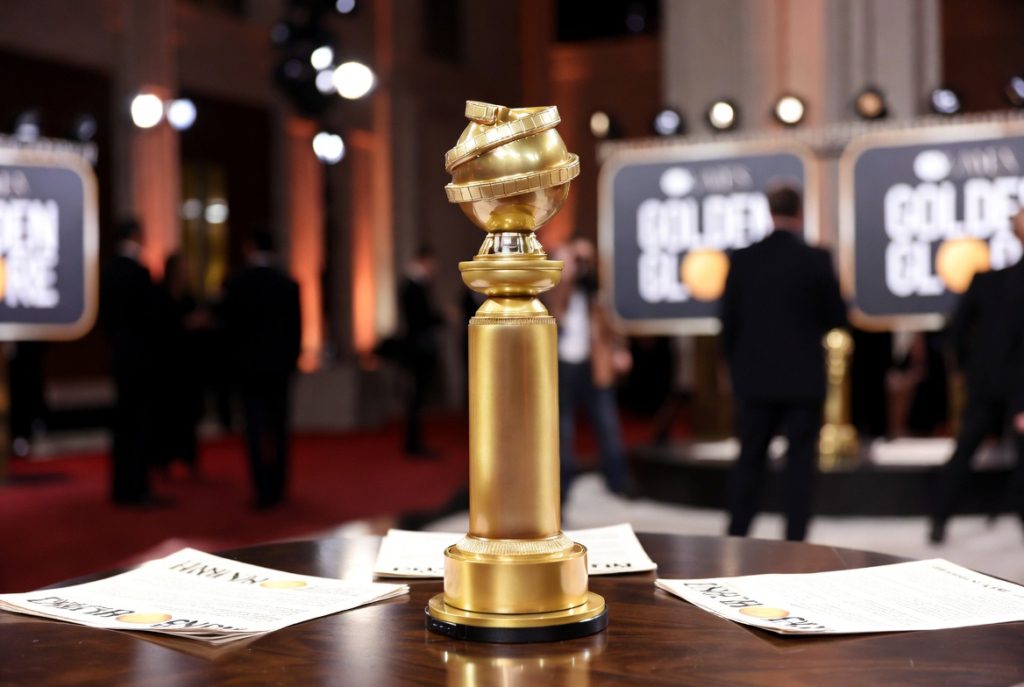
Golden Globes Nominations featured image (cover) was created by a generative AI tool.