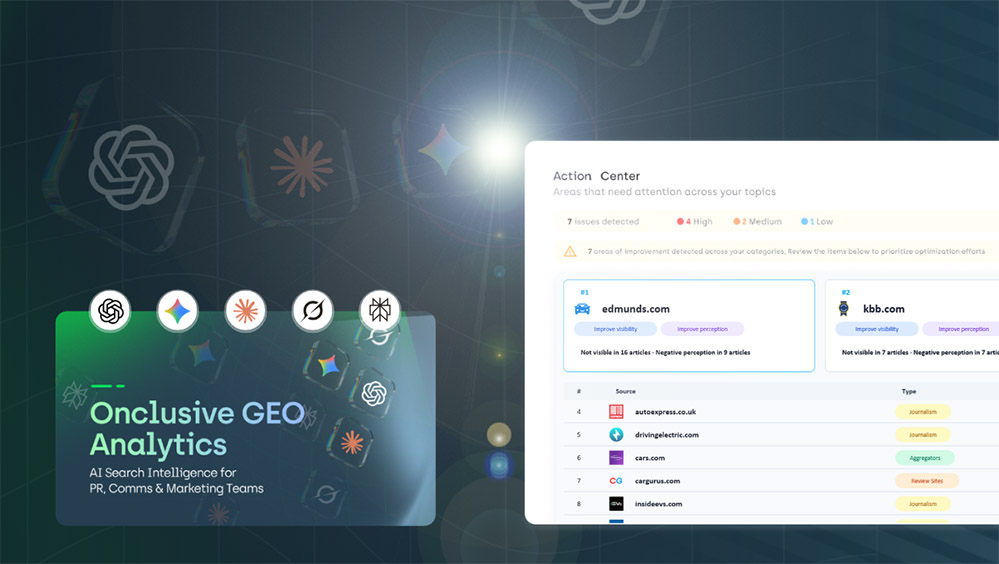
Generative AI engines such as ChatGPT or Gemini are increasingly answering consumer questions about brands, products and services. A brand can have excellent media coverage and still be absent from these answers, or be described unfavourably in them. The challenge is knowing which media influence these answers, and which ones to work on first. That is exactly what Action Center GEO Analytics is designed to show. In this article, we present the feature through the Toyota case.
What is GEO Analytics? The platform behind Action Center
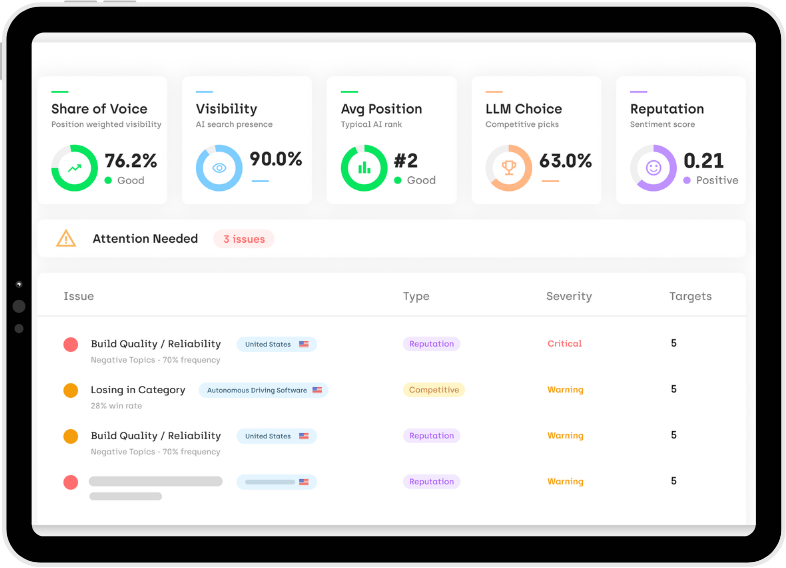
GEO Analytics is a tool built into Onclusive’s Unified Platform. It monitors how a brand appears in the answers of five major AI search engines, across every market and in every language. The results are connected to your traditional media and social media analysis, so you can see whether your press coverage translates into visibility in AI answers.
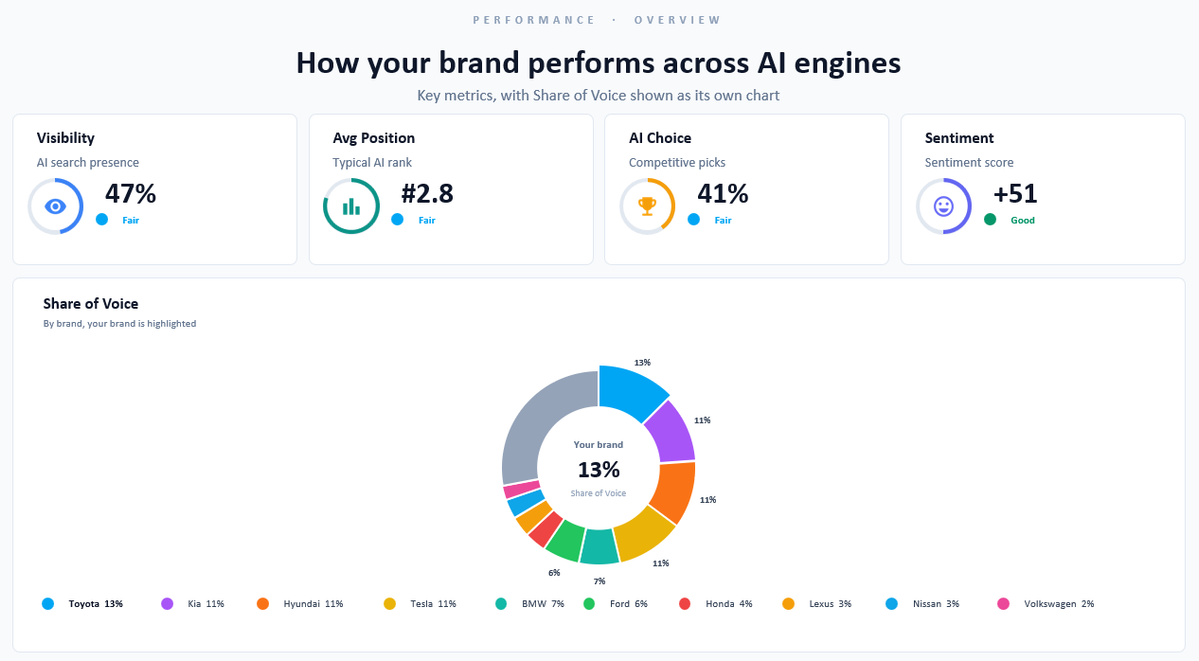
The tool relies on indicators such as Share of Voice (the brand’s share of voice in answers), Visibility (the percentage of answers in which the brand is mentioned), Average Position (the brand’s average ranking), Win Rate (how often the brand outranks its competitors) and Sentiment (the perception score). Action Center GEO Analytics builds on these measurements to tell you what to do next.
Action Center by GEO Analytics: from measurement to action
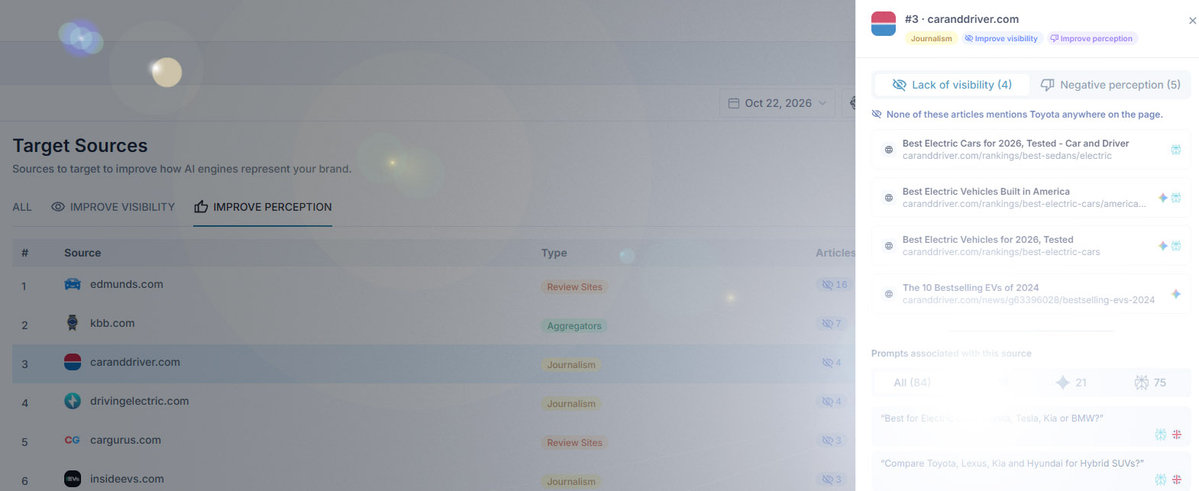
If GEO Analytics answers the question “what is AI saying about my brand?”, Action Center GEO Analytics answers “which media should I contact to change that?”. It presents a ranked list of Target Sources, meaning the media to influence to improve how AI engines represent your brand. They are ranked by the number of articles in which the brand is absent or poorly represented.
These media fall into two categories:
- Improve Visibility: the brand is absent from the media’s articles.
- Improve Perception: the brand is described negatively in the media’s articles.
The same media can appear in both categories. Every source is verified: Onclusive checks the pages that AI engines actually cite, not just the fact that they were cited. Media that cover the brand favourably are automatically placed in a Positive Articles tab, so teams only spend time on real gaps. This verification is what makes Action Center GEO Analytics a shortlist teams can act on, rather than a list of hypotheses.
In practice, the interface lets you switch between a card view and a list view, and filter by tab (All, Improve Visibility, Improve Perception) or by media type (journalism, review sites, social and UGC, aggregators and encyclopaedias). For each media, a detail page groups the key information, a summary, the failing articles, the positive articles and the prompts where the brand is absent or poorly described. If no media poses a problem, Action Center GEO Analytics displays an “All Clear” message indicating that no action is needed.
The benefits of Action Center GEO Analytics for your teams
Action Center GEO Analytics brings three concrete gains:
- Time savings: instead of analysing a raw list of citations, teams receive a list of verified and ranked media.
- Usable evidence: each media comes with the specific article and the passage concerned, so an argument or outreach email can be prepared directly.
- More accurate targeting: media that already cover the brand in a balanced way are filtered out, so journalists are not contacted about problems that do not exist.
The Toyota case: what Action Center GEO Analytics reveals about AI answers
Toyota is pursuing a multi-technology strategy: hybrids as the volume and reference product, and electric vehicles developed progressively. To check whether this strategy appears in AI engine answers, we analysed the “Hybrid SUVs” and “Electric Cars” categories in the United Kingdom and the United States, using five genAI engines (Claude, ChatGPT, Gemini, Grok and Perplexity). The data is a snapshot taken on 22 October 2026, and it shows how Action Center GEO Analytics turns those results into a priority list.
Hybrid SUVs: a confirmed leadership
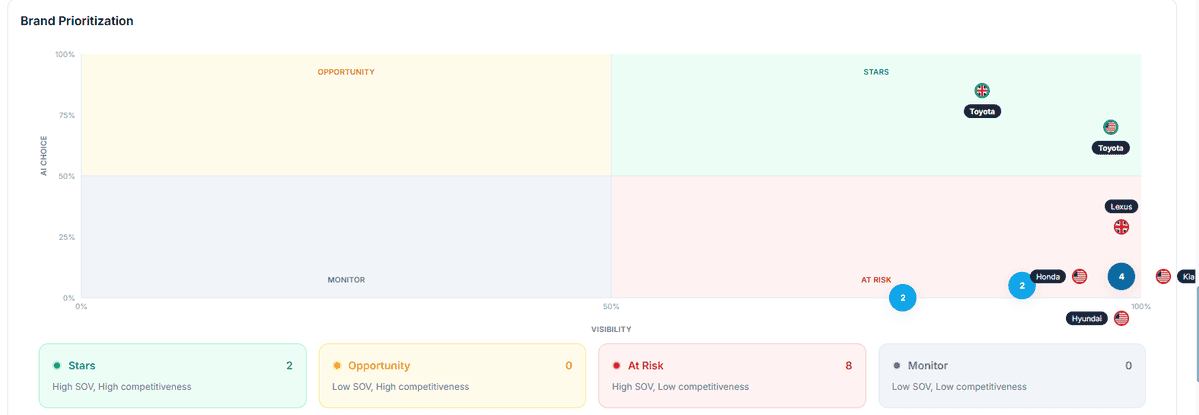
In hybrid SUVs, Toyota ranks first: it holds 24.7% Share of Voice, is visible in 92.5% of answers and is chosen by the engines in 77.5% of cases. Overall sentiment is clearly positive (+71). In the United Kingdom, visibility reaches 85%, and in the United States it reaches 100%.
The concepts associated with the brand reflect Toyota’s own messaging. Fuel efficiency comes up with a frequency of 89%, followed by reliability (65%), family practicality (33%) and cabin comfort (15%). These associations are positive.
Electric cars: a marked absence
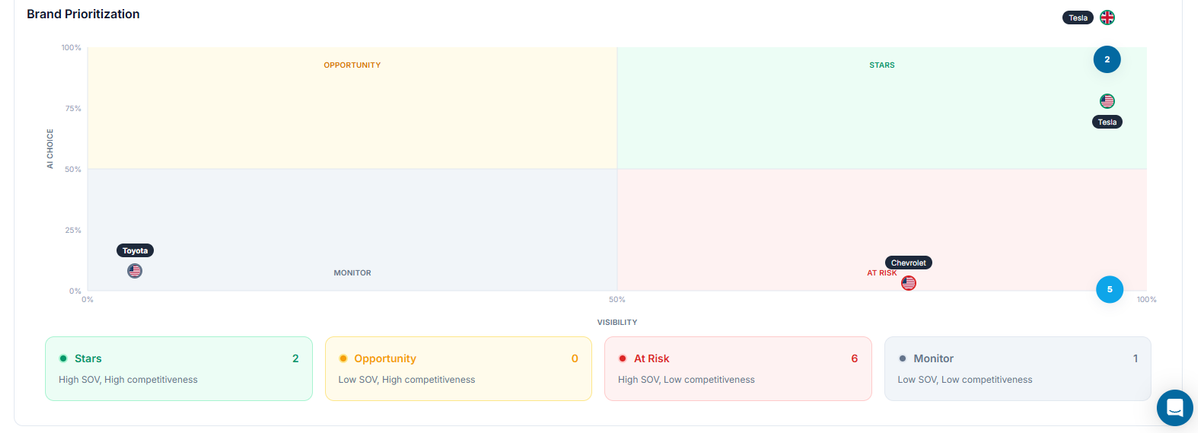
The picture is very different for electric vehicles. Toyota does not appear in the top 10 brands cited in this category. Its Share of Voice is below 1%, its visibility is 1% and its AI choice rate is 4%. In the United Kingdom, visibility is zero, and in the United States it is 3%. Tesla dominates with 95% AI choice, ahead of Hyundai, Kia and BMW.
The concepts associated with electric vehicles are more mixed: range (electric vehicle range) is perceived ambivalently, and the pace of adoption (EV adoption pace) is negative. The positive concepts mainly concern reliability and Toyota’s leadership in hybrids.
Onclusive GEO Analytics
AI Search Intelligence for PR, Comms & Marketing Teams
▪️Monitor AI visibility
▪️Diagnose competitive gaps
▪️Know exactly what to do next
Which media should you work on first, according to Action Center GEO Analytics?
Action Center from GEO Analytics identifies 70 ranked media. They represent 220 failing articles: 138 where Toyota is absent, and 82 where the brand is described negatively. These same media also hold 321 positive articles. Nearly 70% of them are journalism outlets (49 out of 70). In total, 1,826 combinations of prompts, engines and countries lead to a media that does not mention Toyota or describes it negatively. Around 54% concern electric vehicles (978) and 46% hybrids (848).
Improve Visibility: media where Toyota is absent
58 media fall into this category. Some are major influencers where Toyota is absent even though the brand is covered positively elsewhere, which makes them natural targets for Action Center GEO Analytics recommendations.
| Media | Type | Absent | Negative | Positive |
|---|---|---|---|---|
| edmunds.com | Review Sites | 16 | 9 | 19 |
| kbb.com | Aggregators | 7 | 7 | 22 |
| autoexpress.co.uk | Journalism | 7 | 2 | 18 |
| rac.co.uk | Journalism | 4 | 0 | 9 |
| which.co.uk | Review Sites | 4 | 0 | 3 |
| carmagazine.co.uk | Journalism | 3 | 0 | 9 |
Some media do not mention Toyota in any of the articles concerned. This is the case for activate-group.com, best-selling-cars.com and many electric car comparison articles on money.com. For these media, the goal is to get into electric vehicle comparisons.

Improve Perception: media that describe Toyota negatively
39 media fall into this category. The issue is not Toyota’s absence, but how the brand is described. The articles in question mention recalls, reliability problems or software defects. For example, an Edmunds article on the 2023 bZ4X argues that Toyota took a long time to offer a mass-market electric vehicle, and that the model did not live up to expectations.
| Media | Type | Negative | Positive | Comment |
|---|---|---|---|---|
| edmunds.com | Review Sites | 9 | 19 | Several pages on recalls and electric models |
| kbb.com | Aggregators | 7 | 22 | User reviews on reliability and consumption points |
| drivingelectric.com | Journalism | 4 | 3 | Few positive articles, very present electric topic |
| motortrend.com | Journalism | 3 | 15 | Positive overall, a few isolated criticisms |
| thisismoney.co.uk | Journalism | 3 | 2 | Fragile balance |
Priority media
The media that combine both categories are the most urgent. Edmunds (25 failing articles), kbb.com (14), Car and Driver (9), Auto Express (9) and DrivingElectric (8) account for a large share of the gaps. DrivingElectric stands out: it has only 3 positive articles against 8 failing ones, which makes it a priority media to address on electric vehicles.
The actions suggested by Action Center GEO Analytics
Action Center GEO Analytics badges indicate the type of action to take for each media. For Toyota, two types of action stand out:
- Improve visibility: be cited in articles where the brand is absent, particularly comparison reviews, “best electric cars” rankings and buying guides. These are the contents AI engines consult to answer generic queries.
- Improve perception: correct or complement negative narratives with factual evidence (test feedback, responses to recalls, progress on electric models), and secure new test or review articles that are more favourable.
What PR, communications and marketing teams should do with Action Center GEO Analytics
The Toyota case shows a method that applies to any brand. Here is a three-stage plan.
| Period | Action | Team |
|---|---|---|
| Weeks 1 and 2 | Validate the scope (United Kingdom and United States, France, Germany, Spain, Italy… hybrid and electric categories), review the priority media and define key messages | Communications, media monitoring |
| Weeks 3 to 6 | Approach “Improve Visibility” media where the brand is absent, starting with electric vehicle comparisons (RAC, Which?, Car Magazine, Money) | Media relations, product marketing |
| Months 2 and 3 | Address “Improve Perception” media (Edmunds, kbb.com, DrivingElectric) with factual evidence and new test content | Communications, customer relations, product |
| Monthly | Track Target Sources, Share of Voice, visibility and sentiment in Action Center GEO Analytics, then measure the evolution of failing articles | Analysis team, marketing management |
Three principles should guide this work. Start with the media that combine visibility and perception issues, as they have the greatest impact. Address electric and hybrid categories separately, as the gaps are not the same. Finally, link PR actions to indicators: a corrected media should translate into a measurable change in AI answers tracked through Action Center GEO Analytics.
In summary
Action Center GEO Analytics turns a citation analysis into an action plan. For Toyota, it reveals strong leadership in hybrids and a visibility deficit in electric vehicles, with specific media to work on. It also shows the gap between a brand’s strategic message and what AI engines actually restitute. This is precisely the gap that PR, communications and marketing teams can close, by targeting the right media at the right time.