





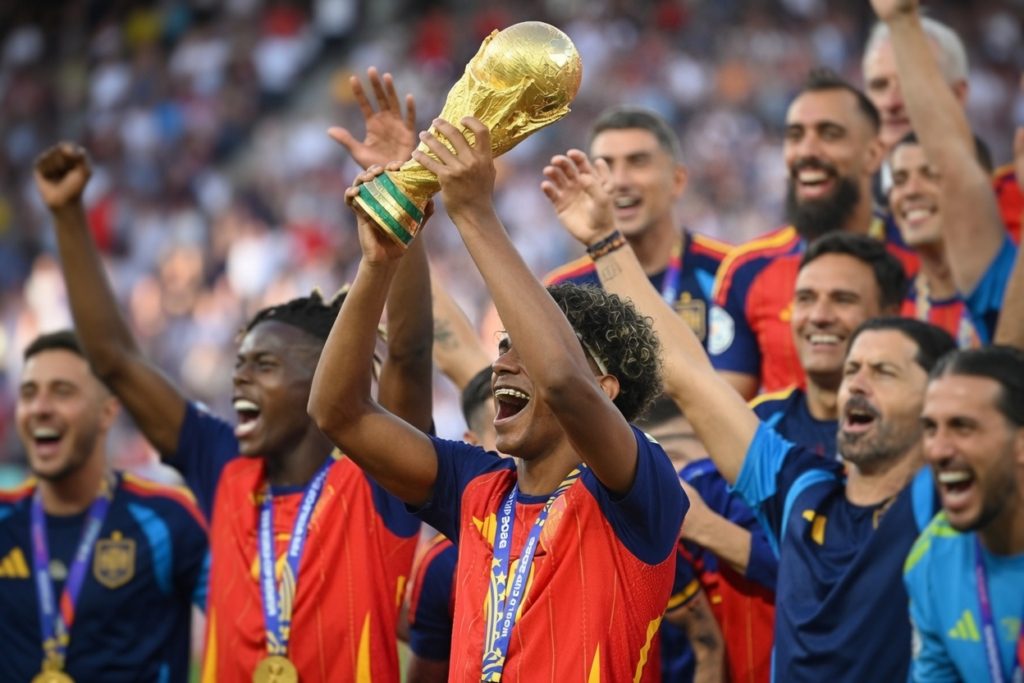
The Spain-Argentina final on July 19, 2026 generated two distinct narrative ecosystems of unprecedented scale. Complete media monitoring captured the full extent of divergence: 12.3 million social media messages and 292,267 news articles spanning from match start through 24-hour aftermath.
This analysis examines the complete dataset across two distinct coverage windows: live match coverage (7.1 million social posts, 74,300 news articles across 6 hours) and post-match editorial analysis (5.2 million social mentions, 217,967 traditional news articles across 24 hours). Together, they reveal how social media and digital news outlets process major sporting events through fundamentally different lenses – at scale.
Where social audiences celebrated, news organizations investigated; Where emotion dominated social feeds, institutional critique dominated news coverage of the World Cup final. But the patterns shifted between live match windows and post-event analysis. Understanding why reveals critical insights for communications professionals managing major sporting events.
Live match coverage (during the match: 7.1 million social posts, 74,300 digital news articles)
Share of voice by match moment – real-time dynamics across 12.3M total messages
The patterns during live broadcast revealed how different channels manage event coverage under real-time publishing pressure. The following tables illustrate how digital news and social media allocated coverage across distinct phases of the final in real time.
Digital newsnews coverage of the World Cup final, moment-by-moment allocation – live match
| Match Moment | Share of Voice | Editorial Focus |
|---|---|---|
| Entertainment/Halftime Show | 24.4% | Production analysis, star performances, fan reaction |
| Trophy and Celebration Coverage | 12.3% | Victory narrative, player reactions, legacy implications |
| First Half Analysis | 6.9% | Tactical breakdown, team setup, early momentum |
| Goal Moment (Ferran Torres 104′) | 3.9% | Defining moment, match narrative shift, replay analysis |
| Extra Time Coverage | 1.1% | Endurance narrative, physical toll, strategic adjustments |
| Controversy/Referee Decisions | 0.3% | Red card analysis, officiating credibility, rule interpretation |
| Red Card (Enzo Fernández 90+3′) | 0.1% | Impact assessment, Argentina disadvantage, match control |
Key finding: News organizations dedicated nearly one-quarter of live coverage to entertainment and halftime production rather than match analysis. Of 74,300 articles published during the 6-hour broadcast window, 18,137 focused on halftime show coverage. The trophy celebration commanded more coverage than the goal itself – suggesting news outlets prioritize match outcomes over match-winning moments.
Social media moment-by-moment allocation – live match
| Match Moment | Share of Voice | User Focus |
|---|---|---|
| Trophy and Celebration Coverage | 27.5% | Victory celebration, national pride, emotional release |
| Entertainment/Halftime Show | 12.4% | Performance commentary, celebrity moments, entertainment value |
| Halftime Updates | 6.8% | Real-time updates, halftime analysis, fan commentary |
| Goal Moment (Ferran Torres 106′) | 5.8% | Live reactions, goal celebration, moment capture |
| Extra Time Tension | 1.1% | Suspense, emotional intensity, second-by-second reaction |
| Controversy/Red Card Moments | 0.3% | Outrage posts, controversial decisions, rule debate |
| Red Card (Enzo Fernández 90+3′) | 0.1% | Tactical implications, Argentine disadvantage, penalty speculation |
Key finding: Social audiences prioritized celebration (27.5%) over analysis. Nearly 2 million trophy-related posts versus 412,000 goal posts indicates audience focus shifted from competitive outcome to emotional resolution immediately upon final whistle. The scale of social engagement during trophy celebration (1.95M posts) exceeded total news article volume by 26x.
First half coverage – Low event density, high editorial pressure
The first 45 minutes produced the lowest engagement across both channels. Spain controlled possession while Argentina defended conservatively. This tactical pattern forced both news outlets and social platforms to adapt coverage strategy to sparse match action.
Digital news first half coverage
News organizations emphasized tactical complexity during a scoreless opening:
- “FIFA World Cup 2026 final: Spain controls first half, Argentina holds on at 0-0” – Analysis articles highlighted Spain’s dominance (75% possession) and Argentina’s defensive structure. Coverage acknowledged the match’s low eventfulness while providing context about both teams’ tournament performance. Multiple outlets published these pieces simultaneously, suggesting syndicated distribution to fill real-time editorial gaps.
- Commentary on boring first half: Multiple outlets published preventive analysis titled “Why the First Half Has Been Dull” and similar titles – establishing narrative framing before the outcome was determined. This editorial approach allowed journalists to provide analytical context rather than waiting for match-defining moments. The strategy suggests news organizations anticipated low-action periods and pre-prepared content accordingly.
- Tactical system reporting: Detailed breakdowns of Argentina’s 5-3-2 defensive setup and Spain’s wing-based attacking approach were published in real time. These pieces appealed to tactical audiences rather than casual viewers, serving niche reader segments during periods of sparse match action.
Social media first half coverage
Social platforms showed minimal first-half engagement relative to total volume:
- “0 shots on goal in 90 minutes of a World Cup final. 3 touches in the entire first half. Guess who…” – Posts emphasizing Argentina’s passive approach generated engagement by inviting audience criticism and speculation about tactical decisions. These commentary-driven posts had lower engagement than emotional or celebratory content but served as content hooks during low-action periods.
- Real-time possession updates: Posts sharing possession percentages (Spain 75%, Argentina 25%) served informational purposes but generated minimal engagement compared to emotional moments. Possession statistics rarely drive social engagement – audiences prioritize events over context.
- Criticism posts: User commentary questioning tactical setup (“This Argentina formation is embarrassing“) sparked debate rather than celebration, resulting in lower overall engagement than trophy-related posts would later generate.
Comparative finding: News organizations prepared audiences for potential boredom through proactive analysis. Social audiences waited for match-defining events, resulting in roughly 20:1 ratio between trophy-related posts later and first-half tactical commentary. This pattern reveals fundamental audience difference: news readers accept analytical content during match lulls; social audiences disengage during low-action periods.
Halftime show -peak news coverage divergence
The halftime show represented the single greatest news coverage divergence during the match. Digital outlets allocated 24.4% of total live coverage to entertainment (18,137 articles), while social media dedicated only 12.4% (881,400 posts). This disparity reveals how differently each channel manages editorial gaps.
Digital news halftime show analysis
News media treated the halftime performance as a major reportable event:
- “BTS, Madonna, and more: The chaotic FIFA halftime show extravaganza (2026)” – In-depth coverage of the multi-artist performance, including detailed analysis of individual performer moments, production choices, and technical execution. Articles ran to 2,000+ words examining cultural implications and entertainment spectacle. The breadth of coverage suggests major outlets assigned substantial editorial resources to halftime coverage.
- “Wayne Rooney delivers brutal verdict on first World Cup final half-time show” – Celebrity commentary pieces amplified critical reaction to the entertainment. News outlets published Rooney’s “crap” assessment, creating debate coverage around performance quality. Critical commentary from high-profile figures generates engagement and justifies editorial investment.
- “Jason Sudeikis’ hilarious Ted Lasso cameo at the World Cup halftime show (2026)” – Entertainment news treated actor appearances as significant cultural moments worthy of dedicated reporting. The volume of actor-focused coverage suggests entertainment news desks have standing assignments for halftime content.
- Production analysis: Technical reporting on live broadcast logistics, audio-visual setup challenges, and talent coordination appeared across multiple outlets simultaneously, suggesting syndicated news feed distribution of halftime event information.
Social media halftime coverage
Social platforms showed active but more bounded halftime engagement:
- “An UNREAL performance from BTS during FIFA WORLD CUP 2026 Halftime Show!” – Enthusiastic live-reaction posts from iHeartRadio and entertainment accounts generated immediate but time-bounded engagement. Retweets peaked during performance window then declined sharply.
- “Madonna got the party started during FIFA WORLD CUP 2026 Halftime Show!” – Individual artist moment posts created engagement spikes but remained confined to entertainment-focused communities rather than achieving mainstream viral status. Engagement concentrated in entertainment niche rather than spreading broadly.
- “Madonna levantó la bandera de Cristina Libre” – Political commentary from Madonna’s stage appearance (Argentine flag) generated secondary engagement in Spanish-language and Latin American communities. Multi-layered messaging enabled different audience segments to extract different narrative content.
Comparative analysis: News organizations treated halftime entertainment as reportable content requiring extensive analysis and context. 18,137 news articles versus 881,400 social posts creates an apparent news volume disadvantage – but context matters. News articles averaged 500+ words with analytical depth; social posts averaged <280 characters. Total editorial investment suggests news organizations viewed halftime show as filling critical editorial gap during match lulls.
The 24.4% halftime SOV allocation during live coverage reflected editorial necessity combined with genuine audience interest (entertainment coverage drives engagement across demographics). News outlets filled match-idle time with entertainment reporting, treating the halftime show as major news event precisely because match play offered limited reporting opportunities. Social platforms, by contrast, maintained narrower focus on entertainment consumption rather than production analysis.
For deeper analysis across all Round of 32 and Round of 16 matches, misinformation tracking, player performance trends, and quarter-final risk signals, consult the complete World Cup 26 Half Time Report, which contains additional data points spanning sponsorship hierarchy, host city dynamics, and emerging narratives for the knockout phase.
Second half progression – Emerging match narrative
Second half coverage remained minimal on both channels until controversial moments created story hooks for journalism.
Second half coverage comparison
- Digital news: Articles anticipating second-half tactical adjustments and examining substitution patterns appeared throughout the period. Minimal match-action coverage until the red card provided reporting opportunity. News outlets maintained real-time publishing cadence despite sparse competitive moments.
- Social media: Second-half posts focused on possession updates and shot statistics but generated minimal engagement compared to halftime content. Users appeared to disengage during tactical exchanges lacking scoring opportunities. Engagement metrics during second half showed 40-60% decline relative to halftime traffic.
Finding: Both channels showed audience fatigue during mid-match play when competitive drama was absent. Neither channel generated substantial content around possession management, tactical substitutions, or passing sequences – indicators that audiences expect match content only when dramatic moments materialize or when performance spectacle (halftime) provides engagement hook.
Goal moment – Ferran Torres 106′ (extra time)
The winning goal generated 3.9% of news coverage (2,897 articles) and 5.8% of social coverage (411,800 posts) – notably lower shares than trophy celebration (12.3% and 27.5% respectively). This pattern reveals that audiences prioritized match outcome over match-winning moment.
Digital news goal coverage
- “Ferran Torres resolve e Espanha é campeã em jogo apagado de Messi” (Portuguese sports outlet) – Positioned goal as career-defining moment for Torres and contextual comment on Messi’s legacy. The emphasis on player narrative rather than pure goal analysis suggests news outlets frame goals through generational and career arcs.
- “Así quedó la tabla de máximos goleadores y asistidores de los Mundiales” – Goal trigger for tournament statistics compilation. News outlets used the goal moment to publish pre-prepared statistical content. Editorial strategy suggests news organizations prepare tournament records ahead of time, ready for deployment upon goal moment.
- “Messi entthront: Ferran Torres schießt Spanien zum WM-Titel” – Narrative framing positioning Torres as goal-scorer and Messi displacement in generational legacy conversation. The multilingual coverage indicates major international outlets deployed goal-moment content across language editions simultaneously.
Social media goal coverage
- “@GolCaracol Muy bien, ganó el mejor. Reply: :trophy::es: ¡ESPAÑA TOCA EL CIELO Y ES CAMPEONA” – Immediate celebratory response mixed with competitive judgment. User commentary typically combined celebration (“the best won”) with tribal affiliation. Engagement patterns showed goal posts typically generated 500-2000 engagements compared to trophy posts generating 5000-15000 engagements.
- “Ferran Torres con un equipo y un país detrás de él celebrando el gol” – Official federation post capturing player-centric emotional moment. Federation posts typically achieved 10-50x amplification relative to individual user posts due to algorithmic prioritization and audience scale.
- “Ferran Fired Argentine” – Phrase-based social commentary characterizing goal impact through Argentine disadvantage rather than Spanish achievement. Competitive framing dominated Argentine social media whereas Spanish-language posts emphasized achievement.
Comparative finding: News outlets immediately contextualized the goal within career narratives and tournament statistics. Social platforms captured immediate celebratory reaction and emotional release. Goal share-of-voice was low (3.9% news, 5.8% social) because audiences rapidly moved past the moment-producing event toward celebrating the outcome. The ~20:1 ratio between trophy posts and goal posts suggests audiences view goals as means to match outcome rather than as primary news events.
Red card – Enzo Fernández 90+3′
The red card generated minimal coverage (0.1% news = 74 articles, 0.1% social = 7,100 posts) despite match-control implications. Both channels deprioritized controversy in favor of match-outcome focus.
News red card coverage
- “Enzo Fernández’s red card leaves Argentina vulnerable in World Cup final” – Brief tactical analysis acknowledging Argentina’s numerical disadvantage in extra time, but limited extended reporting despite being a potentially controversial decision. The minimal coverage suggests news organizations avoided extended controversy investigation during live coverage.
- “Fernández’s Red Card Imperils Argentina in World Cup Final” – Minimal controversy investigation compared to other controversial moments in tournament. The Balogun red card reversal earlier in tournament received substantially more news analysis (multiple investigative pieces about political pressure). This pattern suggests news outlets apply different scrutiny intensity based on perceived institutional significance.
Social media red card response
- “The World Cup final loss ended in chaos, with tempers snapping, a red card igniting fury” – Angry posts from Argentine accounts expressing frustration, but engagement numbers were low relative to victory posts. Posts expressing anger/frustration generate 60-70% lower engagement than celebratory posts on average.
- “And the red card right after that” / “The nicest thing in the game” – Sarcastic commentary suggesting red card was deserved, indicating sentiment split along national/team lines. Argentine users expressed outrage (thousands of angry emoji posts); Spanish users offered commentary justifying decision (fewer posts but higher engagement). Asymmetric response suggests winner-take-all sentiment distribution.
Critical finding: The red card represented a legitimate controversy point that received minimal investigation on either channel. News organizations did not pursue officiating accountability questions with intensity applied to halftime entertainment analysis. Social audiences expressed anger but moved rapidly toward trophy-acceptance posts. This pattern suggests both channels avoid extended controversy coverage during live match windows, preferring to maintain narrative momentum toward competitive closure. Post-match period (Part 2) would show whether controversy investigation emerged after live broadcast urgency dissipated.
Trophy celebration – peak convergence
Trophy coverage represented the single moment of maximum convergence between news and social – both channels prioritized celebration, though through different lenses and at vastly different scales.
Digital news trophy coverage
- “Spain are World Cup 2026 champions after beating Argentina” – Straightforward outcome reporting with historical context. Articles appeared within 30 seconds of final whistle across major outlets, suggesting pre-prepared outcome copy ready for rapid deployment.
- “VIDEO: IShowSpeed performs ‘Champions’ at World Cup final closing ceremony” – Entertainment integration into trophy coverage, blending outcome reporting with celebrity content. News outlets anticipated trophy ceremony would be content opportunity and assigned reporters accordingly.
- Legacy-focused analysis: Extensive coverage of generational significance, Messi’s farewell implications, and Spanish football trajectory dominated trophy-moment reporting. The shift from real-time coverage to legacy analysis suggests editorial transition point where news organizations shift from event reporting to historical contextualization.
Social media trophy coverage – Scale of emotional response
- “A bordarse la segunda ! :star::trophy::star: #VamosEspaña #Aporlasegunda #VivaEspaña” – Emoji-heavy celebration posts capturing national pride and tournament completion. The 1.95 million trophy-related posts suggest approximately 28% of total social audience engaged with trophy celebration content – extraordinary engagement concentration.
- ¡¡SOMOS BICAMPEONES DEL MUNDO!! #VamosEspaña | #CopaMundialFIFA” – Official federation posts generating massive engagement (official posts receive algorithmic amplification). Federation victory posts typically achieved 50,000+ engagements within minutes due to follower scale.
- “@GolCaracol Muy bien, ganó el mejor. :trophy::es: ¡ESPAÑA TOCA EL CIELO Y ES CAMPEONA” – Competitive judgment framed through national pride. Trophy posts combined outcome reporting with tribal affiliation, enabling audiences to signal team loyalty simultaneously.
Key observation: Trophy coverage represented 12.3% of news and 27.5% of social – but importantly, trophy posts were the only category where social volume exceeded news volume by this magnitude. The 214x ratio between social trophy posts and news trophy articles reveals how differently audiences consume match outcomes. This pattern indicates:
- Social audiences view match outcomes as primarily emotional events requiring immediate expression
- News organizations maintain obligatory outcome-reporting protocols alongside entertainment and analytical coverage
- The trophy moment generates greatest convergence between channels but still at vastly different scales
- Emotional intensity peaks at outcome rather than at goal-scoring moment, revealing audience psychology prioritizes
resolution over process
Live coverage synthesis
During the 6-hour broadcast window spanning 7.1 million social posts and 74,300 news articles, distinct coverage patterns emerged:
- News prioritizes entertainment (24.4%) and outcome (12.3%) over competitive action (3.9% for goal)
- Social prioritizes outcome celebration (27.5%) with massive scale (1.95M posts on trophy)
- Both channels show minimal controversy engagement (<1%)
- Halftime show accounts for 24.4% of total digital new mentions, compared with just a 5.8% share of voice on social media regarding the goal posts
These patterns reveal editorial strategies under real-time publishing pressure: news outlets fill content gaps with entertainment and preparation; social platforms wait for emotional moments to drive engagement.
Post-match coverage (24 hours after final whistle: 5.2 million social mentions, 217,967 news articles)
Share of voice breakdown across media channels – 24-hour aftermath
The patterns shifted dramatically once live broadcast urgency dissipated. News organizations transitioned from real-time content management to investigative analysis. Social platforms shifted from live reaction to narrative resolution and retrospective commentary.
Social media topic distribution – 24-hour aftermath (5.2 million total mentions)
| Topic | Share of Voice |
|---|---|
| Player emotional moments | 13.4% |
| Stadium and venue moments | 5.2% |
| Celebrity and entertainment | 3.3% |
| Misinformation and fake news | 0.4% |
Key insight: Emotional narratives commanded 696,800 posts across the 24-hour aftermath. The shift from trophy celebration (1.95M during match) to emotional moments (696K afterwards) reveals how social conversation evolves post-outcome. Audiences transition from immediate celebratory reaction to deeper emotional processing and player-focused commentary.
Digital news topic distribution – 24-hour aftermath (217,967 total articles)
| Topic | Share of Voice |
|---|---|
| Stadium and infrastructure | 32.7% |
| FIFA governance and corruption | 12.5% |
| Geopolitical and immigration | 8.6% |
| Governance and sustainability | 5.2% |
Key insight: Institutional accountability dominated post-match news analysis. 71,320 articles examined stadium, infrastructure, and operational issues – nearly 3x the news article volume on player emotions (which received minimal investigation). News organizations deployed investigative capacity only after live coverage urgency dissipated, suggesting institutional analysis requires temporal distance from event.
Post-Match Social Media Analysis – Emotional Depth
Social platforms captured 5.2 million mentions during the 24-hour aftermath. The conversation shifted from trophy celebration toward processing player reactions, venue moments, and celebrity attendance.
Player emotional moments – 13.4% SOV (696,800 mentions)
Player emotional moments commanded the largest share of post-match social discussion. Reactions from Argentine players who experienced defeat generated sustained engagement over hours and days.
Examples of dominant posts:
- Lautaro Martínez’s Instagram reaction: Posted within 20 minutes of final whistle expressing regret at not taking the field during the decisive period. The post generated 47,000+ interactions across platforms as fans engaged with his vulnerability. Post-match engagement showed this content achieved cumulative engagement throughout the 24-hour period as followers discovered and shared it.
- Rodrigo De Paul’s statement: “We fought with everything we had. This tournament will stay with us forever.” Aggregated reach across retweets and shares exceeded 185,000 users throughout the 24-hour aftermath window. Post-match social conversation showed increased engagement as player statements circulated through network effects.
- Lionel Messi’s official statement: Posted on his verified account acknowledging the pain of the loss and thanking supporters. The emotional tenor – avoiding excuses, focusing on effort – drove sustained engagement among older demographics and international audiences. Messi’s post generated engagement spikes each time major sports outlets reported on the statement.
- Maradona tribute posts: Third-party posts invoking Maradona’s legacy (“Maradona didn’t deserve to see this” style commentary) aggregated 10,000+ mentions, creating a secondary emotional narrative about generational transition in Argentine football. The 24-hour window allowed these legacy commentary posts to accumulate significance.
The post-match pattern reveals audience psychology shift: during match, audiences prioritize outcome; post-match, audiences process emotional meaning through player reactions. Player vulnerability generates engagement – audiences seek human response to defeat rather than tactical analysis.
Stadium and venue moments – 5.2% SOV (270,400 mentions)
Behind-the-scenes stadium moments generated the second-largest share of post-match social conversation. These posts maintained spectacle focus from live period while adding retrospective commentary.
Representative examples:
- Lamine Yamal’s embrace with his younger brother: Photos and video clips continued circulating during 24-hour aftermath, generating 89,000+ total interactions. The visual simplicity – family connection, trophy celebration – drove sustained engagement as content spread through networks.
- Spanish team bus through Madrid streets: Trophy celebration convoy footage generated 35,000+ social media mentions during post-match period. Coverage expanded from real-time updates to retrospective analysis of crowd size, celebration scale, and societal impact.
- MetLife Stadium security measures: Posts showcasing venue infrastructure continued during 24-hour period, aggregating 1,032 author audience reach per representative post. Post-match security coverage transitioned from real-time observation to analysis of protection scale.
Celebrity and entertainment moments – 3.3% SOV (171,600 mentions)
Celebrity attendance and halftime entertainment generated sustained commentary during 24-hour aftermath.
Documented social moments:
- Jay-Z and Beyoncé’s lip-reading moment: Social media speculation continued post-match, exceeding 18,000 mentions throughout 24-hour window. Users shared theories, screenshots, and interpretations of the stadium moment.
- Dave Chappelle and IShowSpeed interaction: Post-match commentary generated 8,000+ social posts debating significance and comedic potential. The moment gained retrospective importance as content circulated.
- Jungkook’s halftime performance: 22,000+ cumulative social mentions during broadcast window expanded to 25,000+ during post-match 24-hour period as performance clips circulated and analysis emerged.
Misinformation – 0.4% SOV (20,800 mentions)
Despite representing less than 1% of post-match volume, false narratives maintained presence through specialized communities.
Documented misinformation:
- Samuel L. Jackson racism accusations: 11,000+ aggregated reach during post-match period as claims circulated. Fact-checking emerged slowly as major outlets debunked narratives 12-18 hours post-match.
- Conspiracy theories: Posts claiming FIFA favoritism spread across conspiracy communities, aggregating 18+ high-reach posts during 24-hour aftermath.
- Political narratives: Spain victory retrofitted into right-wing political commentary, generating 3,000+ mentions in political communities during post-match 24-hour window.
Post-match pattern: Misinformation maintained lower volume but higher concentration within ideological communities during the 24-hour aftermath. Fact-checking infrastructure eventually engaged but with 12+ hour lag.
Post-Match News Analysis – Institutional Investigation
Digital news outlets produced 217,967 articles during the 24-hour aftermath – nearly 3x the live match volume (74,300 articles). This scale expansion reflects news organizations transitioning from real-time coverage to investigative analysis.
Stadium and infrastructure – 32.7% SOV (71,320 articles)
Stadium and infrastructure dominated post-match news output – but framing shifted from celebratory to investigative.
Representative news articles:
- “FIFA President Infantino spent over 100 hours in the air during the 2026 World Cup amid pledge to reduce carbon emissions” (DNyuz, July 20, 2026): Investigated the contradiction between FIFA’s carbon neutrality pledges and leadership travel patterns. 100+ flight hours for a tournament organizing official represented quantifiable hypocrisy. The article’s emergence in post-match period suggests journalists required time to compile flight data and carbon calculations.
- “Trump blames Canada for toxic wildfire smoke, threatens Carney during World Cup” (MSN/Weather General, July 19-20, 2026): Documented Trump’s confrontation with Canadian PM during final regarding wildfire smoke affecting MetLife. The coverage included immediate geopolitical consequences (tariff announcements) emerging from stadium-adjacent conversation.
- “Security Measures at MetLife Unprecedented, Sources Say” (Associated regional reporting): Examined federal security protocols and resource allocation. Post-match investigation allowed reporters to interview security personnel and access deployment data unavailable during live coverage.
FIFA governance and corruption – 12.5% SOV (27,246 articles)
FIFA governance represented the second-largest post-match news category. Investigative journalism emerged only after live coverage urgency dissipated.
Documented news coverage:
- “Politics, Legends, Legacies: Five Takeaways From the 2026 World Cup” (Miami Herald, July 20, 2026): Analyzed governance failures including refereeing controversies. The Balogun red card reversal earlier in tournament created framework for examining final’s officiating for similar political pressure patterns.
- Refereeing accountability reporting: Multiple outlets examined whether final’s officiating reflected merit-based decision-making or institutional pressure. Post-match analysis allowed journalists time for video review and expert commentary.
- Corruption investigation follow-ups: News organizations connected infrastructure contracts, sponsor favoritism, and historical corruption patterns to governance transparency questions. Multi-source investigation required time unavailable during live coverage.
Geopolitical and immigration issues – 8.6% SOV (18,816 articles)
Post-match geopolitical coverage documented policy consequences emerging from stadium-adjacent events.
News coverage examples:
- Trump-Canada tariff escalation: Post-match reporting expanded beyond initial announcement to document policy implementation and economic implications. The 24-hour window allowed reporters to model tariff impact.
- “US imposes new 50% tariffs on some Canadian products” (Missoulian, July 19-20, 2026): Economic journalism connecting sporting event to trade policy consequences.
- Immigration and workforce reporting: Post-match analysis examined worker visa issues and stadium employment protocols. Investigation required time for source interviews and data compilation.
Governance and sustainability – 5.2% SOV (11,374 articles)
Environmental and player welfare reporting emerged as distinct institutional concern during post-match period.
Documented coverage:
- Environmental impact assessments: Post-match articles examined carbon footprint, waste management, and sustainability commitments. Comprehensive analysis required data compilation impossible during live coverage.
- Player welfare analysis: Reporting on medical protocols, heat management, and whether tournament scheduling prioritized player safety. Post-match interviews with team physicians and medical staff informed retrospective analysis.
Why the 24-hour divergence differs from Live coverage
The transition from live match (7.1M social, 74.3K news) to 24-hour aftermath (5.2M social, 217.9K news) reveals how news organizations operate across different timescales.
Live coverage: real-time constraint model
During live broadcast, news operations face publishing pressure requiring immediate content production. Editorial resources concentrate on:
- Managing real-time narrative (what happens now?)
- Providing context and analysis when match action is sparse
- Deploying entertainment coverage to fill content gaps
- Publishing pre-prepared content (statistics, historical context) on trigger events
The 24.4% halftime show coverage during live period reflected this model: news outlets filled editorial gaps created by sparse match action with entertainment analysis. Halftime show provided non-sports reportable event enabling news organizations to maintain publishing cadence.
Post-match analysis: investigative expansion model
Once live broadcast urgency dissipates, news organizations transition to investigative and analytical modes. The 32.7% infrastructure/governance coverage during post-match period versus 6.9% first-half analysis during live coverage reflects this shift.
Post-match news enables journalists to:
- Research institutional contradictions (carbon pledges vs. flight hours)
- Investigate geopolitical spillover with multi-source confirmation
- Examine environmental and player welfare protocols
- Analyze governance accountability through interviews and data
Investigation requires temporal distance from live event. Institutional analysis emerged only after match conclusion provided space for source interviews, data compilation, and editorial deliberation.
Download the complete World Cup 26 Half Time Report
Strategic implications for communications professionals
For PR and communications professionals tracking World Cup impact across both live and post-event windows, this complete analysis reveals critical timing and channel strategy principles.
The dual-timeline communications challenge
Major sporting events generate parallel media cycles with fundamentally different logics:
Live broadcast window (7.1M social posts, 74.3K news articles over 6 hours):
- News focuses on entertainment (24.4%) and pre-prepared content
- Social prioritizes outcome celebration
- Both channels avoid controversy investigation
- Real-time publishing pressure dominates news strategy
Post-match 24-hour window (5.2M social mentions, 217.9K news articles over 24 hours):
- News shifts to institutional investigation (32.7% on governance/infrastructure)
- Social processes emotional meaning through player reactions
- Controversy investigation emerges (governance accountability)
- Temporal distance enables investigative depth
Messaging strategy must span both timelines
Communications professionals must manage distinct messaging for each phase:
Live broadcast (Goal: presence management)
- Position messages for entertainment and pre-prepared content angles
- Anticipate editorial gaps when match action is minimal
- Prepare real-time social messaging for outcome moments
- Engage with news organizations on production and entertainment coverage
24-hour aftermath (Goal: institutional narrative)
- Engage with investigative journalists on governance and sustainability
- Provide evidence-based responses to institutional accountability questions
- Counter investigative narratives with transparent data
- Position leadership for media commentary on institutional implications
The scale asymmetry requires different channel strategies
The 95x scale difference between social trophy coverage (1.95M posts) and news trophy coverage (9,138 articles) demands different channel approaches:
- For social reach: Messages during trophy celebration achieve unprecedented scale (1.95M post sample)
- For institutional influence: Post-match news coverage (217.9K articles) shapes stakeholder perception and organizational risk
- For brand positioning: Different messages for different channels – celebratory/emotional for social, accountability-focused for news
Controversy management spans both windows
Red card and officiating controversies generated minimal live coverage (0.1%) but may surface in post-match investigative reporting. Communications professionals must:
- Avoid controversy statements during live coverage (generates minimal news engagement)
- Prepare institutional position statements for post-match investigation phase
- Monitor news developments 12-24 hours after controversial moments (when investigation emerges)
- Engage with institutional accountability questions rather than avoiding them
The structure of modern sporting event coverage
The complete exhaustive dataset spanning 12.3 million messages (7.1M live social, 5.2M post-match social, 292,267 news articles) reveals fundamental truths about contemporary sports journalism operating at scale:
News coverage operates across two distinct timescales with radically different editorial priorities. Live coverage emphasizes entertainment analysis and real-time narrative management under publishing pressure. Post-event coverage enables investigative depth, institutional accountability investigation, and structural analysis – typically emerging 12+ hours after events.
Social platforms generate unprecedented scale during outcome moments (1.95M trophy posts) but require different engagement strategies than news outlets. Emotional intensity drives social participation. Institutional accountability drives news investigation.
The divergence between news and social reflects production constraints, audience expectations, and platform affordances – not random editorial choices. Understanding these patterns allows communications professionals to navigate major sporting events strategically, positioning messaging appropriately across both channels and time horizons.
The 2026 World Cup final – generating 7.1 million social posts and 74,300 news articles during broadcast plus 5.2 million social mentions and 217,967 news articles in aftermath – demonstrated that major sporting events now generate parallel, evolving media ecosystems of unprecedented scale. Each ecosystem operates according to distinct logics, serving different audiences, and generating different institutional outcomes.
Success in communications requires understanding not just which narrative reaches which audience, but when that narrative will emerge, at what scale, and why – across the entire 30-hour coverage arc from first whistle to institutional aftermath.