


TL;DR – Andy Burnham media coverage at a glance
Volume: 123,600 social media posts + 53,400 news mentions (24-hour window)
The split:
- News media (31% positive, 45% neutral): Explains “King of the North” reset, covers Cabinet appointments descriptively, uses instability frame neutrally
- Social media (31% positive, 26% neutral): Challenges legitimacy (“no mandate”), weaponizes Haigh fraud scandal, raises Gaza silence, questions continuity with Starmer
Biggest divergence in Andy Burnham media analysis:
- Mandate/election demand: 8.17% of social media discourse vs 0.76% of news – a 10x difference
- Gaza/Palestine: 9.73% social vs 1% news
- Cabinet scrutiny: Both 19-24% but media descriptive, social critical
Bottom line: Andy Burnham media coverage splits between institutional acceptance (process-focused) and social media rejection (values-focused). This divergence defines how political events trend today.
Introduction – How Andy Burnham media coverage reveals gatekeeping
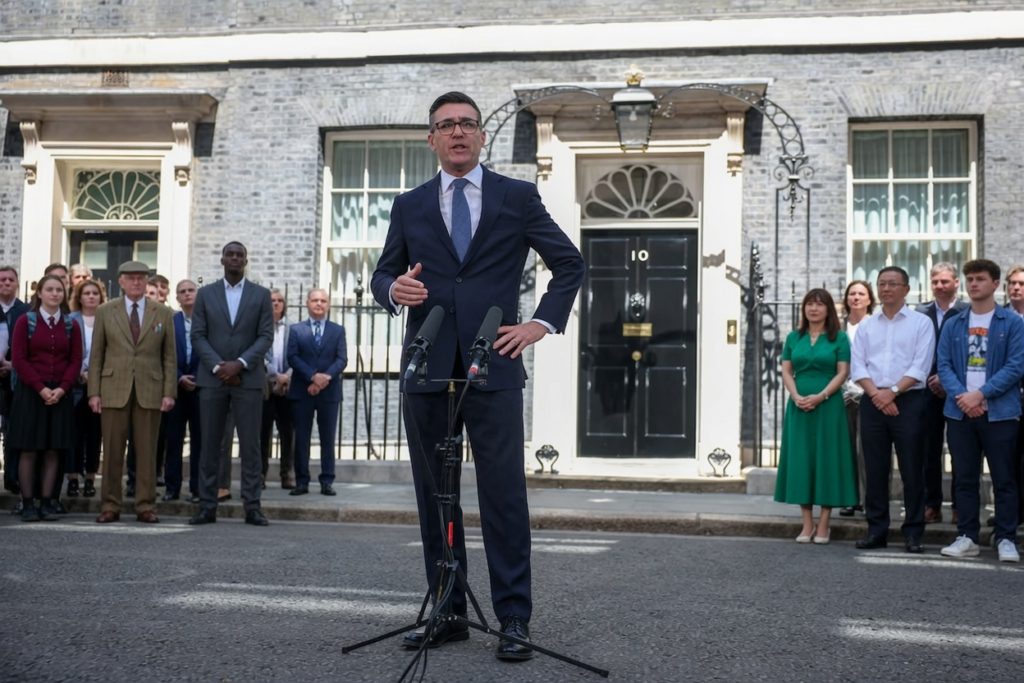
Andy Burnham arrives at Downing Street on July 20, 2026 as the seventh prime minister in ten years. But the story of his arrival depends entirely on where you consume news about it.
This Andy Burnham media analysis demonstrates something critical about how information flows in 2026: institutional news outlets and social networks are operating with fundamentally different editorial logics when covering the same political event. The divergence isn’t marginal. It’s structural. And it matters for anyone trying to understand what British politics actually looks like right now.
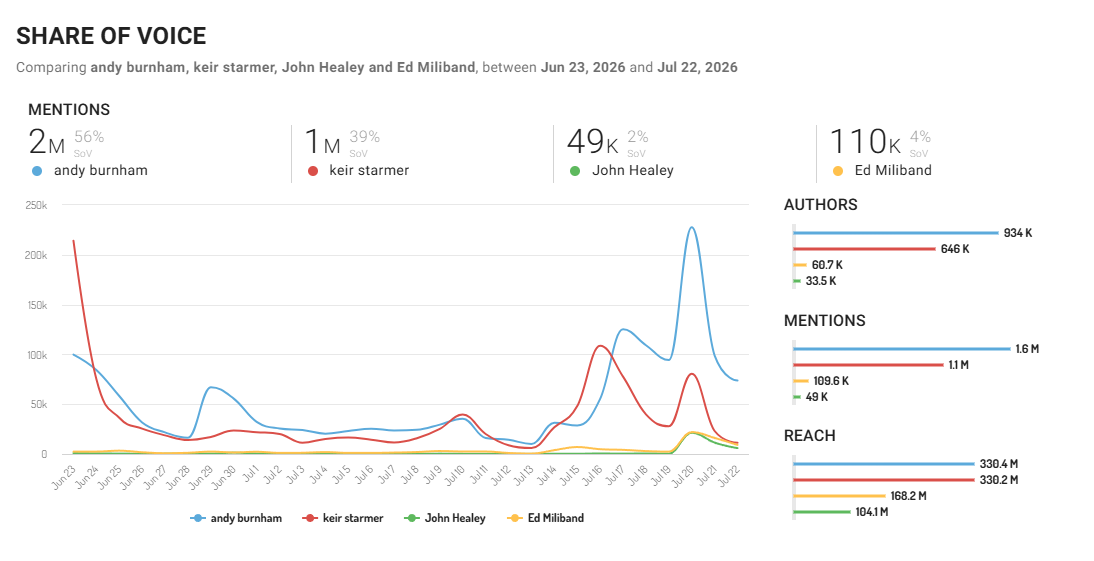
This analysis is based on comprehensive collection and analysis of 102.2K mentions in digital news and 527,968 mentions on social media across the period from July 13 to July 21 8:00 AM, tracked using Onclusive Monitor (media coverage analysis) and Onclusive Social (social media listening). The data reveals a stark divergence in how two channels of communication processed the same political event.
The Andy Burnham social media reaction tells one story about legitimacy, ethics, and continuity. The Andy Burnham institutional media coverage tells another story about process, management, and reset. Understanding this divergence – what media theorists call “gatekeeping difference” – is essential for PR professionals, communications strategists, and political observers trying to monitor political events and trends accurately.
Dominant theme in Media
Dominant conversation theme on Social Media
2d theme in Media
How institutional media answers “Who is the new UK PM?” – the King of the North narrative
Institutional media coverage of Andy Burnham media analysis starts with a consistent biographical framing: he is the “King of the North.” This nickname dominates Andy Burnham news coverage (appearing in hundreds of headlines) and comes directly from his nine years as Mayor of Greater Manchester (2017-2026), his high-profile confrontations with Boris Johnson during COVID, and his championing of devolution.
The biographical elements in Andy Burnham media coverage
News outlets constructing Andy Burnham media narrative emphasize:
- Regional outsider positioning: Born 1970 near Liverpool into working-class family, Catholic education, Cambridge University. But returned to Manchester as elected representative, not Westminster careerist.
- Devolution credentials: Nine years as mayor gives him governance experience outside Parliament. This credentials element appears across all Andy Burnham institutional media analysis.
- Populist communicator: Described as warmer, less wooden, more fluent than Starmer. Early coverage of Andy Burnham media responses notes visual contrast – tie-less, approachable, wife Marie-France visible on No. 10 steps.
- Left-populist positioning: Associated with “Manchesterism” – local control of buses, public services, reindustrialisation. This economic framing appears consistently in Andy Burnham media coverage of policy positioning.
- Hillsborough justice: Outlets emphasize his activism on Hillsborough, though this residual credit factor barely surfaces in day-one news analysis (0.08% of mentions).
The overall Andy Burnham media narrative constructed by institutional outlets: Westminster insider becomes regional outsider, attempts national leadership on third try, arrives as “reset” figure from political chaos.
The instability context – how news frames Andy Burnham
Every piece of Andy Burnham media coverage includes contextual framing of his arrival within Britain’s decade of prime ministerial churning. He is the “seventh prime minister in ten years” or sometimes “sixth person to walk Downing Street in a decade” (wording varies slightly). According to the media data table, instability framing constitutes 12.85% of all news coverage.
But here’s the critical element in Andy Burnham institutional media analysis: this instability frame is used neutrally. It’s contextual, not crisis language. News outlets treat it as factual backdrop rather than fundamental system failure.
Burnham himself leaned into this framing in his July 20 speech: “I am acutely conscious that I am the sixth person in the last 10 years to walk up this street. We have not been good enough and we need to be better.” The “circuit breaker” narrative – that Burnham will restore stability – becomes the dominant theme in Andy Burnham media coverage of his speech.
Dominant conversation themes – Media (24 h News – 53,476 mentions)
| Theme | mentions SOV | Main flavour in media |
| Cabinet / appointments | 23,94% | Dominant story: full lists of who is in/out, Healey as Chancellor, purge of Starmerites, return of Rayner & Haigh |
| Starmer / resignation / handover | 20,16% | Heavy coverage of the formal transition, farewell speech, “my work is done” |
| Energy bills / cost of living / hope / speech | 16,13% | Focus on Burnham’s first speech, VAT cut on electricity, “bring back hope”, “breathing space” |
| Instability / seventh PM in a decade | 12,85% | Strong contextual frame: “seventh prime minister in 10 years”, circuit-breaker narrative |
| North / Manchester / King of the North | 12,10% | Biographical and branding angle: profiles, nickname origin, devolution credentials |
| North Sea / oil / energy policy | 7,56% | Secondary policy interest (potential shift on fossil fuels / net zero) |
| Thames Water / nationalisation | 2,39% | Limited but present – calls for public ownership or special administration |
| Digital ID | 1,13% | Minor – mainly reporting of Burnham’s pledge to scrap the national scheme |
| Gaza / Palestine / Israel / Lineker | 1,01% | Very low volume compared with social media |
| Fraud / criminal appointments (Haigh etc.) | 0,88% | Present but muted – mostly factual notes rather than sustained attack |
| Mandate / general election / unelected | 0,76% | Marginal in news (almost the opposite of social media intensity) |
| Immigration | 0,63% | Minimal coverage on day one |
| Foreign aid | 0,25% | Negligible |
| Wealth tax | 0,13% | Almost absent |
| Hillsborough | 0,08% | Virtually absent in the 24 h news window |
The Andy Burnham social media analysis – legitimacy, ethics, and values
Dominant conversation themes on social media (24 h keyword volumes – 123,600 posts)
| Theme | mentions SOV | Main flavour |
| Cabinet / appointments | 19,07% | High scrutiny of who got in/out |
| Energy bills / cost of living / hope / speech | 14,01% | Mix of welcome for the tax cut and “too little” |
| Starmer / hypocrisy comparisons | 14,79% | Continuity accusations |
| North / Manchester / “King of the North” | 11,67% | Identity & regional pride |
| Gaza / Palestine / Israel / Lineker | 9,73% | Strong left criticism that Burnham still won’t use “genocide” |
| Mandate / general election | 8,17% | Dominant right/Reform demand |
| Thames Water / nationalisation | 7,39% | Left pressure for public ownership |
| Immigration | 5,06% | Criticism of silence or softness |
| Fraud / criminal appointments (esp. Haigh) | 4,28% | Right-wing attack line |
| Digital ID | 2,33% | Scepticism that it is really being scrapped |
| Hillsborough | 3,50% | Positive residual credit |
But the Andy Burnham social media divergence from news coverage starts immediately when examining what audiences actually discuss on Twitter/X, Instagram, and TikTok.
The themes in Andy Burnham social media analysis are different from Andy Burnham media coverage. While Cabinet appointments dominate both channels (19% social, 24% news), the second and third priorities diverge sharply:
Social media priority #2 & #3 – absent or minimal in news
Starmer/hypocrisy/continuity accusations (14.79% of social discourse): This theme barely appears in Andy Burnham news coverage. Instead, social media drives a narrative of continuity rather than rupture. Users emphasize that Burnham represents “same old establishment” and “reshuffled same faces.”
Ben on Wine’s viral tweet captures this: “Andy Burnham has refused to call for a General Election. What a complete hypocrite. This is the same man who demanded a General Election when Rishi Sunak became Prime Minister.” This message generates 678 retweets and reaches 19,953 users in Andy Burnham social media analysis.
Mandate/general election demand (8.17% of social discourse): This represents one of the starkest divergences in the entire Andy Burnham media analysis dataset. Social media users treat “unelected PM” as central legitimacy question. News media covers it at 0.76% – nearly 10 times lower proportion.
Reform UK and right-wing accounts weaponize this angle repeatedly. The implicit question driving Andy Burnham social media conversation: Does an unelected PM possess democratic authority to govern?
Gaza/Palestine silence – second largest media-vs-social divergence
Gaza/Palestine (9.73% social vs 1% news): This represents the most ideologically charged divergence in Andy Burnham media analysis.
In Andy Burnham social media reaction, left-wing users and activists treat Gaza silence as political failure on day one. Zarah Sultana, MP, tweets: “Day 1 of Andy Burnham as Prime Minister and he is still refusing to call the killing of tens of thousands of Palestinians in Gaza what it is, a genocide.”
Multiple Andy Burnham social media posts cite his previous votes, his Labour Friends of Israel membership, his BDS criticism. The pattern: social media treats Gaza as ongoing accountability question regardless of news calendar. Andy Burnham institutional media coverage, by contrast, barely mentions Gaza during day-one coverage.
What this divergence reveals: Institutional news gatekeeping deprioritizes Gaza discourse during UK domestic leadership change. Social networks, particularly left-wing audiences, treat it as continuous accountability matter. The Andy Burnham media analysis here shows how editorial decisions create fundamental information asymmetry.
Haigh fraud scandal – media notes factually, social weaponizes
In Andy Burnham media analysis, Louise Haigh’s reinstatement as Chancellor of the Duchy of Lancaster (First Secretary of State) generates different treatment across channels:
- Andy Burnham news coverage (0.88%): Outlets note her 2014 fraud conviction factually. Most titles mention it as biographical detail alongside other appointment details.
- Andy Burnham social media analysis (4.28%): Users weaponize the appointment as attack line. Ghost Wales tweets, “Why has @andyburnham appointed a criminal to high office?” This generates retweeting across right-wing accounts.
Key finding in Andy Burnham media divergence: News media treats scandals as factual items. Social networks amplify scandals as political ammunition. This gatekeeping difference appears repeatedly in the Andy Burnham institutional vs social media analysis.
Thames Water nationalisation – left pressure in social, limited in news
Andy Burnham social media analysis shows strong engagement (7.39%) with Thames Water public ownership debate. Left-wing users pressure for nationalisation. Feargal Sharkey (River Pageant Trust) tweets amplified calls for “disgraceful” Thames Water takeover.
In Andy Burnham media coverage, this theme appears at only 2.39%, suggesting institutional news outlets report the demand but don’t amplify it. The Andy Burnham media analysis reveals how left-wing social media pressure differs from news coverage tone.
Get the real-time view of your political communication landscape
– what’s trending on social media, which narratives are gaining traction, where institutional media and social networks diverge most sharply.
This Andy Burnham social media analysis required sophisticated listening. Onclusive Social makes it standard.
The divergence quantified – what the Andy Burnham media analysis actually shows
The most revealing finding in this Andy Burnham media analysis concerns where institutional gatekeeping and social platform agenda-setting diverge most sharply:
| Theme | Media rank | Social rank | Key difference |
| Cabinet / appointments | 1st (23.94%) | 1st (19.07%) | Shared top priority, but media is descriptive, social is critical |
| Energy / speech / hope | 3rd (16.13%) | 2nd (14.01%) | Media more positive/explanatory |
| Starmer handover | 2nd (20.16%) | 3rd (14.79%) | Media treats it as institutional process |
| Instability / 7th PM | 4th (12.85%) | Present | Media uses it as neutral context |
| Mandate / general election | Very low (0.76%) | Very high (8.17%) | Biggest divergence – 10.7x |
| Gaza / Palestine | Very low (1.01%) | High (9.73%) | 9.6x difference |
| Fraud / Haigh appointment | Low (0.88%) | High (4.28%) | 4.9x |
| Immigration | Negligible (0.63%) | Moderate (5.06%) | 8x difference |
| Thames Water | 2.39% | 7.39% | 3.1x difference |
| Hillsborough residual credit | 0.08% | 3.50% | 43.8x difference |
What this Andy Burnham media analysis reveals: Institutional news outlets prioritize process, biography, and policy announcement. Social networks prioritize legitimacy, values, and ethics. These aren’t just tone differences. They represent fundamentally different editorial frameworks for the same political event.
What the Andy Burnham speech actually covered – institutional media focus
The Andy Burnham July 20 speech received approximately 1,550 articles in news coverage, making it one of the most covered elements of the day in Andy Burnham media analysis. According to the media data table, energy bills/cost of living/hope/speech constitutes 16.13% of all news coverage.
Core messaging in Andy Burnham news coverage:
- “We need to be better” – acknowledgement that politics has failed public
- “Bring back hope” and “breathing space” on cost of living
- “Circuit breaker for Britain” – biggest changes in politics for 40 years
- Recognition of instability: “Sixth person in last 10 years to walk this street”
- Commitment to publish 10-year plan later in year
The concrete policy cutting through in Andy Burnham media coverage: Scrap VAT on domestic electricity bills, worth approximately £45 per household or £850 million package from October. This single announcement dominated Andy Burnham media headlines and social media reaction.
Titles in Andy Burnham news coverage:
- “PM hits ground running with bold electricity bills VAT pledge” (Mirror)
- “Burnham unveils tax cut to ‘bring back hope’ for struggling families”
- “New PM cuts tax on household electricity bills to give breathing space on cost of living”
Style contrast emphasized in Andy Burnham institutional media analysis: Multiple outlets highlight difference in delivery from Starmer. Burnham described as more fluent, warmer, less reliant on lectern, more conversational. The visual of Burnham with wife on No. 10 steps contrasted with Starmer’s formal lectern approach.
Overall Andy Burnham news sentiment on speech: Predominantly neutral to positive (31% positive, 45% neutral across all news coverage). Treated as competent, calibrated reset rather than radical rupture. Business titles cautiously watchful but not hostile.
Social media reaction to the speech: According to the social data table, energy bills/cost of living/hope/speech generates 14.01% of social discourse. But sentiment differs. Users express mixed reception – welcome for tax cut coupled with “too little” criticism. Comments repeatedly surface: “£3.75 a month. Wow. Thank you unelected Prime Minister Andy Burnham!” User ryan_murton tweets this clearly ironic message, generating retweets.
Cabinet appointments in Andy Burnham media coverage analysis
Cabinet formation generated even higher volume than the speech in Andy Burnham news coverage (approximately 950 articles in this Andy Burnham media analysis). According to the data tables, Cabinet/appointments dominates both channels: 23.94% of news and 19.07% of social media. But treatment differs dramatically.
News framed Burnham as “stamping his authority” and carrying out significant purge of Starmer loyalists. Social media conducted “high scrutiny of who got in/out” with focus on ethics and legitimacy.
Key appointments covered in Andy Burnham institutional media
Chancellor John Healey: Described as “biggest surprise of the day” in Andy Burnham media coverage. Widely unexpected. Seen as market-reassuring, centre-right choice. Sterling reaction noted as mildly positive in financial Andy Burnham media analysis.
Foreign Secretary Ed Miliband: Interpreted as leftward signal in Andy Burnham media coverage, potential hardening on Israel policy. This appointment receives modest coverage in Andy Burnham news.
Louise Haigh as First Secretary: Framed as elevation of key Burnham ally but noted with her fraud conviction in factual Andy Burnham media reporting. Returns to government after Starmer-era resignation.
Angela Rayner returns to Housing: “Rayner returns” was common headline in Andy Burnham media coverage. Presented as rehabilitation and left/soft-left signal.
Dominant narrative in Andy Burnham media analysis of appointments
- “Stamps authority” / “purge of Starmer loyalists” – most common framing
- Leftward tilt with pragmatic edges (Miliband offset by Healey)
- Return of “controversial figures” (secondary narrative, mostly right-leaning outlets)
- Markets/fiscal caution focus in business Andy Burnham media analysis
Sentiment in Andy Burnham news on Cabinet: Roughly 45% neutral, 31% positive, 9% negative overall in the 24-hour Andy Burnham media window.
Social media scrutiny of Cabinet: The social data table shows Cabinet/appointments at 19.07% with “high scrutiny of who got in/out.” This scrutiny focuses on Louise Haigh’s criminal conviction (4.28% of total social discourse), Angela Rayner’s property tax issues, and Lucy Powell’s past comments – all treated as attack lines rather than factual notes.
What people are actually asking on social media – the questions driving Andy Burnham social media analysis
Beyond the theme volumes in the social media data table, the Andy Burnham social media analysis reveals specific questions audiences are debating:
- Will there be a general election?
- Why appoint a convicted fraudster to high office?
- Will he actually nationalise Thames Water?
- Will he call Gaza a genocide?
- Is the Digital ID scrap real or cosmetic?
- Can a soft-left Northern manager fix productivity and energy costs?
- Why did Burnham demand an election for Sunak but not now?
- Is this the same establishment blob reshuffled?
These questions, dominant in Andy Burnham social media analysis, barely surface in institutional news reporting. This drives the central finding in this Andy Burnham media coverage analysis: news outlets explain what happened. Social networks question whether it should be accepted.
Why institutional media and social networks diverge – the gatekeeping insight
This Andy Burnham media analysis demonstrates something fundamental about how information operates in 2026:
Institutional media logic: Process-focused, contextual, explanatory. Questions: Who is he? What did he announce? Who got appointed? How does this fit historical context? The answers appear in Andy Burnham media coverage through neutral instability framing (12.85%) and descriptive Cabinet coverage (23.94%).
Social media logic: Values-focused, accountability-driven, adversarial. Questions: Does he have democratic authority? Are his appointments ethical? Will he change anything or just shuffle the same faces? These questions dominate Andy Burnham social media analysis through mandate demands (8.17%), scandal weaponization (4.28%), and Gaza accountability (9.73%).
The Andy Burnham media analysis shows these aren’t competing versions of the same story. They’re fundamentally different conversations happening simultaneously. One asks “what?” The other asks “should we accept this?”
For PR and communications professionals: Understanding this divergence in Andy Burnham media analysis is critical. The Andy Burnham social media reaction tells you what engaged audiences actually believe. The Andy Burnham institutional media coverage tells you how official gatekeepers framed the event. Neither is “wrong.” Both are essential to understanding political communication landscape in 2026.
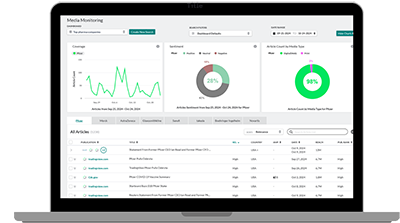
Discover Onclusive Monitor
Discover how Onclusive Monitor tracks institutional media coverage of political events in real-time. See how news outlets frame your political narrative, identify emerging story angles, and monitor how your key messages appear across digital news channels.
The images on this blog were generated by a generative AI tool for illustrative purposes