







AI social listening is the use of artificial intelligence to analyze online conversations across social media, news, forums, blogs, reviews, and broadcast media in order to understand audience sentiment, detect trends, predict outcomes, and inform business decisions.
Social listening has evolved from basic keyword tracking into sophisticated AI-powered audience intelligence. Today’s platforms do not just report what people are saying. They explain:
- Why they are saying it
- How narratives spread
- What brands should do next
Organizations that master AI social listening gain competitive intelligence that drives measurable business outcomes across product development, crisis management, customer experience, and strategic communications.
Why AI social listening matters now
Modern AI social listening platforms process millions of conversations across social media, news outlets, blogs, forums, review sites, and broadcast media. They extract signals from noise, identify patterns humans would miss, and deliver predictive intelligence that enables proactive strategy rather than reactive response.
The scale of the opportunity is enormous. With billions of people now using social platforms every month and AI adoption accelerating across everyday digital experiences, audience intelligence is now a strategic necessity.
The market data confirms this shift. Influencer Marketing Hub estimates the social listening market reached $9.61 billion in 2025 and will grow to $18.43 billion by 2030.
Adoption is rising just as fast. InfluenceFlow’s 2026 guide reports that 62% of marketers now use social listening.
In practice, this means social listening is no longer a specialist marketing activity. It is becoming a core business intelligence infrastructure for understanding audiences, managing reputation, guiding product strategy, and improving customer experience.
Key takeaways
- AI social listening goes beyond monitoring by explaining why audiences behave the way they do.
- Modern platforms use NLP, machine learning, and multimodal AI to analyze text, images, video, and audio.
- The biggest business impact comes from product innovation, crisis management, campaign optimization, and customer experience.
- The real value comes from turning insights into decisions, not just dashboards.
- Social listening is increasingly becoming core business intelligence infrastructure, not just a marketing tool.
Contents
What is AI social listening and what does it mean for modern brands?
How does AI social listening work? The technology stack explained
AI social listening vs traditional social listening
What can AI social listening do? Advanced capabilities explained
How is AI social listening used across the business?
What are the challenges of implementing AI social listening?
How do you measure social listening ROI?
The future of AI social listening
What is AI social listening and what does it mean for modern brands?
AI social listening uses machine learning and natural language processing to analyze online conversations at scale and turn them into strategic audience intelligence.
The distinction matters. Social monitoring tracks what people say about your brand. AI social listening explains why they say it, what influences their perceptions, how opinions spread, and what actions you should take as a result.
Traditional monitoring tools flag brand mentions and calculate basic sentiment scores. AI social listening platforms decode conversation architecture. They analyze how discussions evolve, which influencers shape narratives, what emotional triggers drive engagement, and which emerging topics represent opportunities or threats before competitors recognize them.
In a world where social, video, news, and community platforms shape opinions at scale, audience understanding has become a core strategic asset. The Digital 2026 Global Overview Report shows just how central digital platforms now are to everyday life, reinforcing why brands need systematic, AI-driven ways to understand and anticipate audience behavior.
How does AI social listening work? The technology stack explained
AI social listening works by combining natural language processing, machine learning, and multimodal AI to interpret human conversation at scale.
Natural language processing (NLP)
NLP enables systems to understand meaning rather than just keywords. Modern transformer models understand context, sentence structure, references, and nuance. For example, they know that “this product kills it” is positive, while “this product is killing me” is not.
Sentiment and emotion analysis
Sentiment analysis is the AI-driven process of identifying emotional tone in text. Modern systems detect nuanced emotions such as frustration, excitement, disappointment, or trust. Aspect-based sentiment analysis identifies how people feel about specific features, not just the brand overall.
Machine learning
Machine learning enables platforms to continuously improve. Models adapt to your industry language, brand terminology, and audience behavior patterns.
Named entity recognition (NER)
NER identifies brands, people, locations, products, and events, and understands contextual meaning rather than simple string matching.
Topic modeling
Topic modeling automatically discovers what people are actually discussing, revealing emerging themes you did not think to track.
Network and influence analysis
These systems map how narratives spread, who drives them, and which communities shape opinion.
Image, video, and audio recognition
Modern platforms analyze logos, products, and scenes in visual and audio content, capturing huge volumes of brand exposure that text-only tools miss.
AI social listening vs traditional social listening
| Traditional social monitoring | AI social listening |
| Keyword-based | Context-aware |
| Tracks mentions | Explains meaning |
| Reactive | Predictive |
| Manual analysis | Automated insight detection |
| Surface metrics | Strategic and causal insights |
Traditional tools answer “what happened?” AI social listening answers “why it happened, what happens next, and what should we do?”
What can AI social listening do? Advanced capabilities explained
Predictive trend detection
Predictive analytics identify emerging topics before they reach mainstream awareness by tracking early signals in conversation growth, velocity, influencer participation, and network spread. This allows teams to spot rising issues and opportunities early, and to prepare messaging, content, or responses before topics peak.
Dynamic audience segmentation
AI identifies real audience segments based on behavior, interests, and values rather than demographics alone. By analyzing how different groups talk, share, and respond to narratives, teams can tailor messages, channels, and timing to specific audiences with far greater precision.
Competitive intelligence
AI continuously tracks competitor narratives, positioning, product launches, customer sentiment, and share of voice across media and social channels. This gives teams a live view of where they are winning or losing attention, how their messaging compares, and where strategic gaps or opportunities are emerging.
Crisis detection and trajectory modeling
Anomaly detection systems identify unusual spikes in conversation, sentiment shifts, or emerging narratives that may indicate an early-stage reputation risk. Trajectory modeling then estimates how these issues are likely to spread across media, social platforms, and communities if left unaddressed.
The operational impact is significant. By detecting issues earlier and understanding how they are likely to evolve, communications teams can move from reactive crisis response to proactive risk management, dramatically reducing response times and lowering the chance that isolated issues escalate into full-scale reputation crises.
Brand awareness and perception tracking
Advanced platforms track not just how often a brand is mentioned, but how its narrative and associations evolve over time. By analyzing share of voice, sentiment, topics, and message pull-through, teams can see whether they are becoming more visible in the right conversations and whether perception is shifting in the desired direction versus competitors.
Learn more about using social listening to build brand awareness.
Multilingual and cultural intelligence
Modern platforms use neural translation and multilingual language models to analyze conversations across dozens of languages in near real time. Increasingly, they also account for cultural context and local language nuances, enabling teams to compare narratives, sentiment, and reputation drivers across markets with far greater accuracy and consistency.
Causal analysis
Advanced analytics now go beyond simple correlation to identify which factors are most likely driving changes in brand perception, sentiment, or coverage. By combining time-series analysis, campaign markers, media exposure, and conversation patterns, these systems can model the impact of actions such as launches, campaigns, announcements, or crisis responses.
In practice, this helps teams move from “what changed?” to “why did it change?” and “what should we do next?”, showing which messages, channels, or events are most strongly linked to positive or negative shifts so strategy can be adjusted with confidence.
How is AI social listening used across the business?
AI social listening creates value across multiple functions:
- Product and innovation: Identify unmet needs and roadmap priorities
- PR and communications: Track narratives, journalists, and message resonance
- Crisis management: Detect, triage, and manage reputation threats
- Marketing: Optimize campaigns based on real audience reaction
- Customer experience: Discover friction points and unmet expectations
- Market intelligence: Monitor category shifts in real time
- Sales enablement: Understand buyer concerns and objections
Mapping the full customer journey through social data reveals critical influence points. Learn more about mastering the customer journey with social listening.
What are the challenges of implementing AI social listening?
Common challenges include:
- Data privacy and ethical use
- AI bias and cultural nuance
- Context interpretation complexity
- Data coverage gaps
- Organizational adoption and change management
- Insight overload without clear strategy
The solution is combining AI scale with human judgment, strong governance, and deep integration into business workflows.
How do you measure social listening ROI?
Measure ROI by connecting insights to decisions and decisions to outcomes:
- Activity metrics: What is being monitored and analyzed
- Insight metrics: What is being learned and acted on
- Outcome metrics: What decisions changed
- Financial impact: What value was created or protected
Organizations that operationalize social listening often see very high returns in use cases such as crisis prevention, product optimization, and campaign efficiency, because even small improvements in decision speed or accuracy can have outsized business impact.
If you want to go deeper into how to structure measurement in practice, see our guide on how to build a social media KPI dashboard that actually delivers.
The future of AI social listening
AI social listening is moving from a monitoring and analysis tool into a true decision-support layer for communications, marketing, and reputation management.
Generative AI–driven insight synthesis will increasingly replace static dashboards and manual reporting, automatically turning complex media and social data into clear narratives, executive-ready summaries, and strategic recommendations tailored to different stakeholders.
Predictive modeling and scenario simulation will allow teams to test how different actions, messages, or external events are likely to affect brand perception, media coverage, or stakeholder response before decisions are made, supporting more proactive and resilient communication strategies.
Automated and semi-automated response workflows will connect insight directly to action, helping teams prioritize issues, coordinate responses across regions and channels, and ensure consistent messaging during fast-moving situations.
Emotion, motivation, and intent analysis will go beyond sentiment to explain not just what people are saying, but why they feel that way and what is likely to influence their behavior, making audience understanding more strategic and more predictive.
Finally, full integration with business intelligence, CRM, and performance data will embed social and media intelligence directly into wider business decision-making, linking communications activity more clearly to reputation, demand, trust, and commercial outcomes.
Taken together, this represents a shift from social listening as a specialist analytics function to social intelligence as a core strategic capability that supports leadership decisions across the organization.
The strategic imperative for communications leaders
AI social listening is no longer a “nice to have.” It is a strategic intelligence infrastructure.
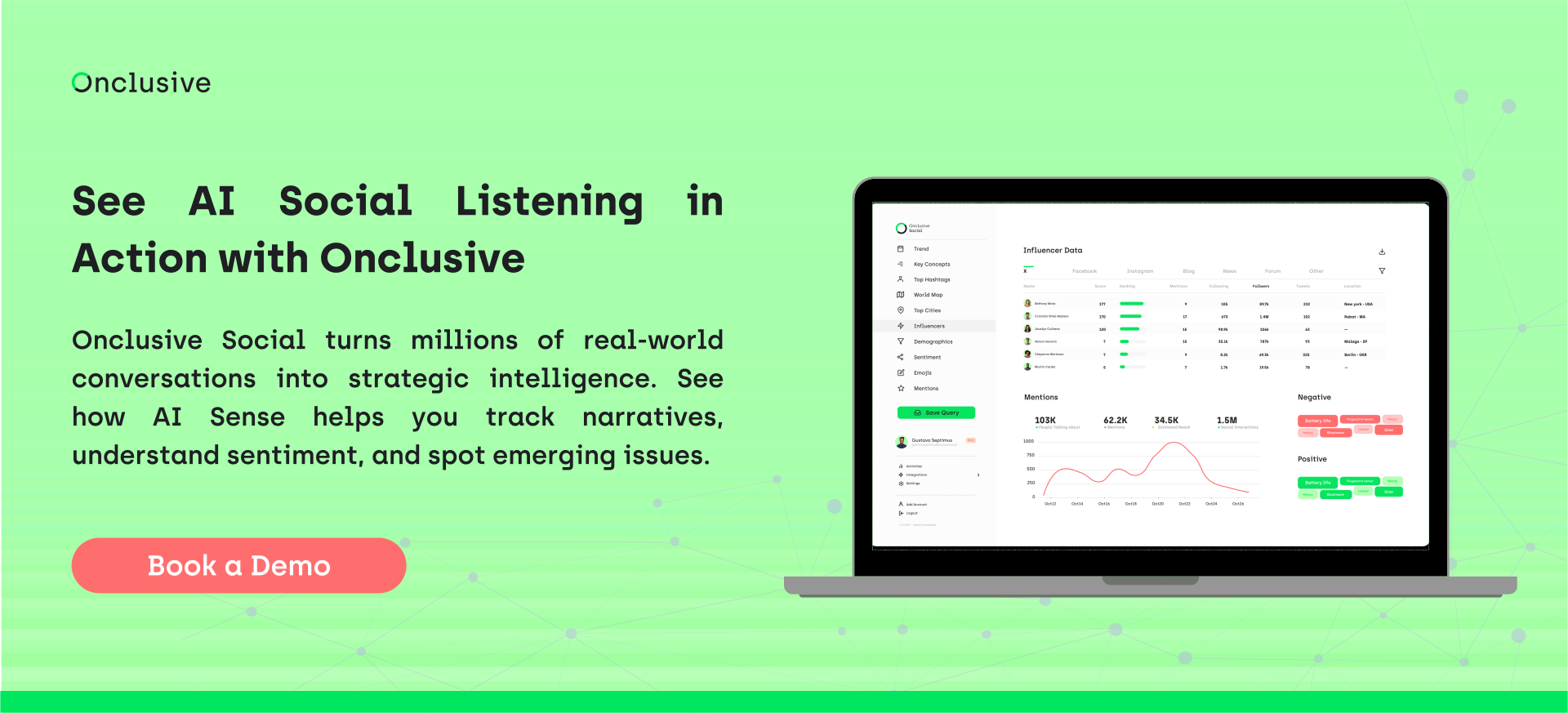
Onclusive’s AI-powered social listening platform helps communications and marketing teams transform millions of conversations into actionable insight across media, social, and online channels worldwide.
For platform evaluation guidance, see our complete guide to social listening tools.
Frequently asked questions
What is the difference between social listening and social monitoring?
Social monitoring tracks mentions, keywords, and basic metrics like volume, reach, and engagement. It answers “what was said, and how much?” Social listening analyzes conversation themes, sentiment drivers, and narrative spread to explain “why people are saying this and what it means.” AI social listening adds prediction and prioritization by detecting emerging topics, mapping influence, and surfacing the insights most likely to require action.
What is AI social listening used for?
AI social listening is used to turn unstructured audience conversations into decisions. Common use cases include trend detection, brand perception tracking, competitive intelligence, campaign optimization, crisis early warning, and customer experience improvement. The strongest programs connect insights to workflows so product, communications, and customer teams can act quickly and consistently.
How accurate is AI sentiment analysis?
Modern sentiment models often reach around 85–90% accuracy in many business contexts, and leading platforms now report accuracy in the high 80s to low 90s for English-language content. Performance varies by channel, language, and topic, especially with sarcasm or slang, which is why human validation remains important for high-impact decisions.
Is AI social listening reliable for strategic decisions?
Yes, when used with governance and validation. AI social listening is highly reliable for trend direction, issue detection, segmentation patterns, and comparative benchmarking. For high-stakes decisions such as crises or regulatory issues, most organizations add an analyst review layer to validate context and intent.
Can AI social listening replace traditional market research?
No. It complements it. Social listening captures unprompted, real-world conversation at scale, while research methods like surveys and interviews provide structured, statistically representative measurement. The strongest approach uses social listening to discover what matters, then research to validate and quantify it.
What platforms should we monitor for social listening?
You should monitor the platforms where your audience influences decisions. Most brands include major social networks, news sites, blogs, forums, video platforms, and review sites. The right mix depends on your audience, industry, and geographic footprint.
How quickly can we see results from AI-Powered social listening?
Most organizations surface useful insights within 1–2 weeks. Expect 30–90 days to build reliable baselines and workflows, and 3–6 months to see compounding strategic value from trend and historical analysis.
How much does an AI social listening tool cost?
Costs vary widely, from tens of thousands to six figures annually for enterprise programs, depending on data volume, sources, languages, and service levels. The best ROI comes when multiple teams use the same platform rather than keeping it limited to a single function.
Do we need a dedicated team to manage social listening?
You need ownership, but not necessarily a large team. Many organizations start with one program owner. Mature programs often have small teams aligned to regions or functions. The critical factor is having a clear workflow from insight to action.
How do we measure ROI from social listening?
Measure ROI by documenting which decisions were informed by social listening and what outcomes those decisions produced. Track insight adoption, operational impact, and business results such as avoided crises, improved campaign efficiency, better product adoption, or improved customer retention.