





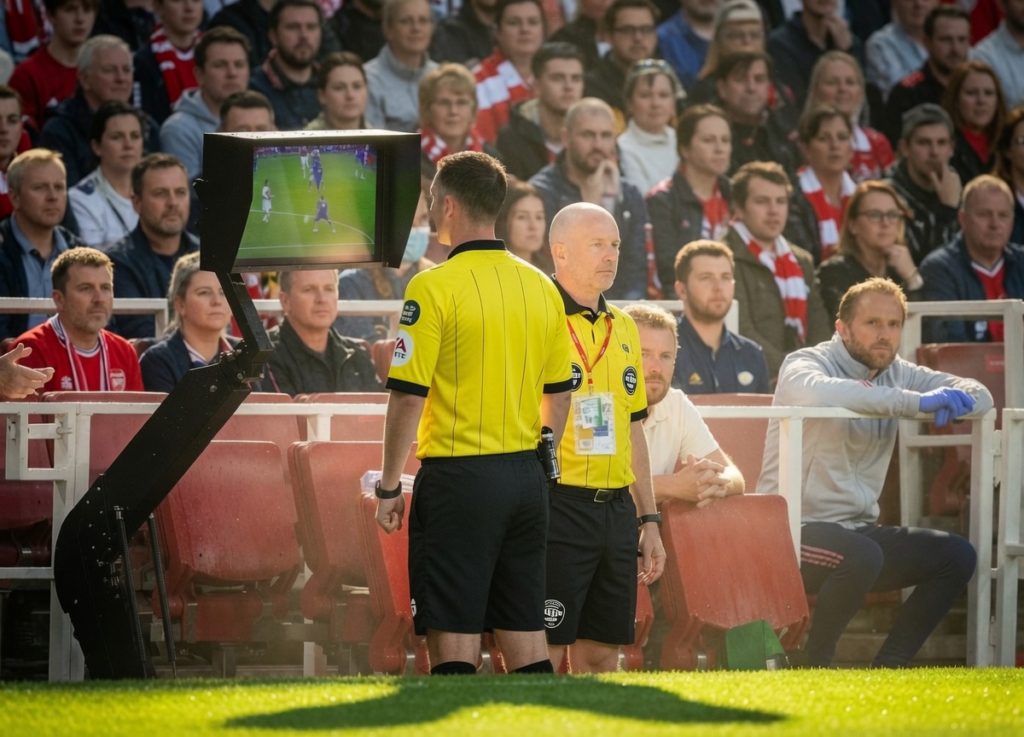
Introduction: FIFA VAR controversy and data-driven intelligence on the 2026 World Cup governance crisis
Disclaimer & Methodology:
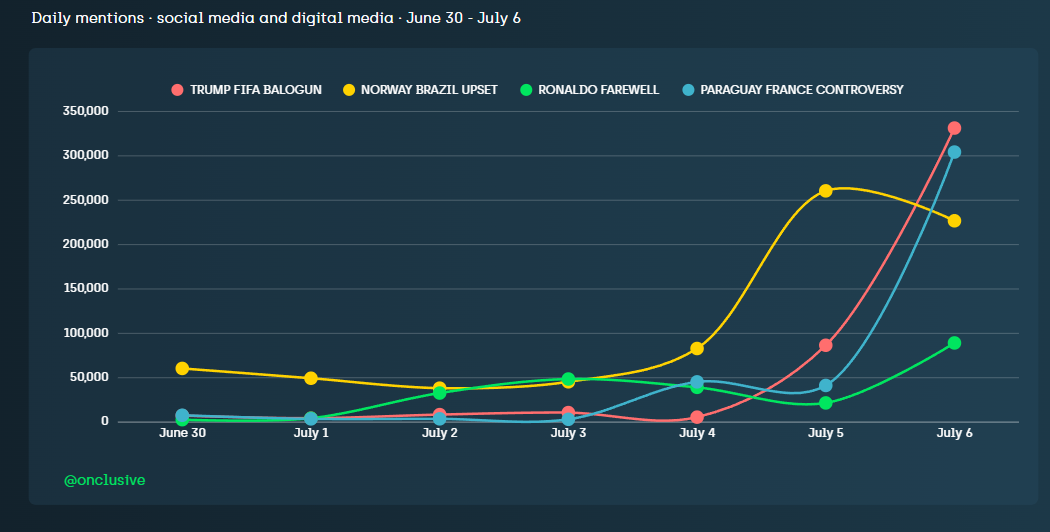
This analysis is based on verified monitoring data collected exclusively through Onclusive Social and Onclusive Monitor, Onclusive’s comprehensive media intelligence platforms. Between June 30 and July 6, 2026 (Round of 32 through Round of 16), we tracked daily mention volume across social and digital media, isolating key growth topics that defined the tournament’s second half: the Trump-FIFA-Balogun diplomatic intervention, the Norway-Brazil upset, the Paraguay-France refereeing-turned-racism controversy, the Ronaldo farewell narrative, and the broader officiating credibility crisis (The FIFA VAR controversy).
For deeper analysis across all Round of 32 and Round of 16 matches, misinformation tracking, player performance trends, and quarter-final risk signals, consult the complete World Cup 26 Half Time Report, which contains additional data points spanning sponsorship hierarchy, host city dynamics, and emerging narratives for the knockout phase.
The FIFA VAR controversy is no longer a footnote
For the first three weeks of the 2026 FIFA World Cup, the dominant conversation followed a predictable arc: goals, upsets, emotional farewells, and star power. But somewhere between the Round of 32 and the Round of 16, a second storyline emerged with enough velocity to compete directly with on-pitch drama for share of voice.
Officiating credibility.
The FIFA VAR controversy cluster, spanning disallowed goals, contested penalties, red card reversals, and a genuine diplomatic intervention from the White House, has become what our halftime intelligence report calls a “Tier 1” narrative heading into the quarter-finals. This is not a minor irritant for communicators to monitor in the background. It is now positioned alongside the Golden Boot race and the host-nation storylines as one of the tournament’s three dominant conversation drivers.
This blog unpacks four specific VAR controversies within a 72-hour window, the unprecedented Balogun red card reversal that pulled the White House into FIFA governance, the mechanics of institutional credibility management in real time, what communicators should say when VAR transparency becomes a crisis.
Four VAR controversies in 72 hours: why officiating became unavoidable
Between June 29 and July 1, 2026, spanning the tail end of the Round of 32, four separate VAR controversy incidents occurred in rapid succession, each involving a different team, a different type of decision, and a different level of public outrage. Individually, any one of these might have generated a 24-hour news cycle. Together, they created a compounding narrative about officiating credibility that outlasted any single match result.
(social media)
(social media)
Between June 11 and July14, mentions of VAR or red cards totaled 2.05 million on social media, peaking on July 6, the day the U.S. lost to Belgium. During the same period, mentions related to refereeing totaled 3.16 million, with a spike during the Argentina-Egypt game
Incident 1: Folarin Balogun’s red card (USA vs Bosnia), July 2
Folarin Balogun, the USMNT forward, scored twice in a commanding performance but received a red card that was later scrutinized heavily by pundits, former referees, and eventually political figures (detailed in the next section). The card meant Balogun would miss the USMNT’s Round of 16 fixture against Belgium, a material tactical disadvantage imposed on the host nation’s breakout star at the worst possible moment.
Incident 2: Youri Tielemans’s controversial 125th-minute penalty (Belgium vs Senegal), July 1
In one of the tournament’s most extraordinary matches, Belgium’s Youri Tielemans scored twice, including a contested penalty awarded in the 125th minute of extra time. The decision drove Belgium’s dramatic comeback against Senegal, but the VAR controversy surrounding the penalty’s legitimacy immediately connected to a broader grievance narrative from African teams about officiating credibility in high-stakes moments, a narrative that traced back to Senegal’s 2025 AFCON final grievances.
Incident 3: Jonathan Tah’s disallowed goal (Germany vs Paraguay), June 29
During Germany’s shock Round-of-32 exit to Paraguay, a Jonathan Tah header was disallowed in extra time under contested circumstances. Combined with Germany’s eventual penalty shootout loss, their first-ever World Cup shootout defeat, the disallowed goal became part of a broader “what went wrong” analysis that blended tactical failure with officiating grievance.
Incident 4: Josko Gvardiol’s disallowed equalizer, Jul 3
A fourth contested VAR controversy centered on a disallowed equalizer that reopened debate about the consistency of offside interpretation and video review standards across different matches and referee crews.
Why the compounding effect matters more than any single incident
Each of these four incidents, viewed in isolation, might read as a normal part of high-stakes knockout football, decisions go against teams, controversy is inevitable, and tournaments move on. But our monitoring data shows something different happening in aggregate.
The “Officiating Credibility Crisis” narrative, as tracked in our forward-looking intelligence for the quarter-finals, is explicitly framed around “VAR failures, refereeing inconsistencies, [and] Paraguay unpunished fouls” creating what the report calls “fragile institutional trust.”
This is the core mechanic of a VAR controversy becoming a crisis rather than a series of incidents: repetition compounds skepticism. A single disallowed goal is a talking point. Four contested decisions within 72 hours, spanning red cards, penalties, and disallowed goals across different confederations and different referee crews, becomes a pattern that fans, pundits, and eventually institutions can no longer dismiss as isolated bad luck.
Strategic implication for communicators: Treat the fourth VAR controversy differently than the first. Escalation thresholds should account for cumulative narrative weight, not just per-incident severity. By the third or fourth contested decision within a short window, the story is no longer about the call, it’s about whether the system can be trusted at all.
The Balogun red card reversal: how FIFA governance collided with political intervention
If the four VAR controversies above represented a credibility problem, the Balogun red card reversal episode represented something categorically different: the first instance in the 2026 World Cup where a FIFA governance decision became entangled with direct political intervention at the highest level.
The specific incident: the red card decision
On July 1, 2026, during the USA vs Bosnia-Herzegovina Round of 32 match at San Francisco Bay Area Stadium, Balogun stepped on Tarik Muharemovic’s ankle during a contested challenge in the 64th minute. The incident was reviewed on a monitor, and officials determined it was serious foul play, resulting in a red card. At the time of his ejection, Balogun had already scored one goal, but his team went on to win 2-0 with him off the field.
The automatic one-match suspension meant Balogun would miss the USMNT’s critical Round of 16 match against Belgium on July 6, 2026, a tactical disadvantage that could determine whether the host nation progressed to the quarter-finals.
The Trump intervention: unprecedented political pressure
What transformed this from a routine disciplinary decision into a governance crisis was the intervention of United States President Donald Trump. Commerce Secretary Howard Lutnick, who led the U.S. delegation to the Bosnia game, read through FIFA’s rules on the flight home and began mapping out how the U.S. might contest the call. Andrew Giuliani, executive director of the White House Task Force on the World Cup, then took up the effort, pulling in Trump-aligned lawyers and supporters to pressure FIFA.
Trump called FIFA president Gianni Infantino about Balogun’s red card and resulting suspension before soccer’s governing body lifted the ban. Trump said he personally asked FIFA chief Gianni Infantino to review the decision, adding that he “didn’t think it was a foul” and referred to the incident as “two guys running full speed that happened to crash into each other”.
The reversal: breaking 64 years of World Cup precedent
FIFA on Sunday July 5 announced that Balogun would be eligible to play in the Round of 16 against Belgium Monday night, igniting questions around the integrity of the tournament. This reversal appears to be the first time since 1962 that a red card during a World Cup didn’t result in a suspension.
FIFA invoked Article 27 of disciplinary committee rules, which allows FIFA’s judicial body to “fully or partially suspend the implementation of a disciplinary measure” and place a player on probation instead. This legal maneuver, while technically within FIFA’s rulebook, had not been applied to reverse a red card suspension in over 60 years of World Cup history.
The data anomaly: no ramp-up phase
Nearly every viral sports moment, goals, upsets, emotional narratives, follows a recognizable growth curve: a triggering event, gradual amplification through highlight clips and reactions, and then a peak before decay. The Trump-FIFA-Balogun story broke this pattern entirely.
Our forward-looking intelligence data (covering the daily mention window from June 30 through July 6, 2026) identifies this as a “critical explosion” with “the absence of a ramp-up phase.” In practical terms, this means the story didn’t build gradually, it appeared at near-peak intensity almost immediately, a pattern our analysts flag as diagnostic of “unprecedented diplomatic intervention in sports governance.”
The multi-stakeholder backlash: institutional credibility under assault
What separates this from a routine political statement about a sports decision is the breadth and severity of institutional response. Within the monitored window:
- The Royal Belgian Football Association filed an appeal of FIFA’s decision to allow Balogun to play in Monday night’s match. But FIFA quickly denied it, deciding that Belgium was not a party to the proceedings and had no standing
- UEFA issued a scathing response, saying it could not believe “such an unprecedented, incomprehensible and unjustifiable decision,” adding that “Football, like any other sports, relies on rules, which are the basis for fair, honest and transparent competition. A minimum automatic suspension of one match following a red card is not a discretionary option”
- New York Mayor Zohran Mamdani was among those who had openly criticized the red card decision, signaling that the controversy transcended sports and entered the political/civic realm
- International media treated the story not as a national curiosity but as a genuine test of FIFA’s institutional independence
Our intelligence report is explicit about the significance: this backlash “transforms this from a single incident into a systemic integrity question.” The Balogun red card reversal discussion stopped being about one player’s disciplinary status and became a referendum on whether FIFA governance can withstand political pressure from a host nation’s government during the tournament it is hosting.
FIFA’s defensive response: the credibility trap
Infantino, in a statement issued by FIFA, defending the decision to reverse Balogun’s suspension, which he said was the result of review by the organization’s “independent” judicial bodies, which operate “autonomously”. However, the simultaneous acknowledgment that Trump had called Infantino undercut any credibility the “independence” claim might have carried.
Trump, for his part, said “I didn’t tell him what to do. I can’t tell him what to do. And I don’t believe he made the decision.” Trump went on to say: “If Balogun’s suspension had been upheld for the match against Belgium, ‘This game would have a big mark on it, if we lost or if we won'”, essentially acknowledging that the White House viewed the reversal as strategically essential to the tournament’s legitimacy.
The outcome: USA lost 4-1 despite the reversal
Ironically, the United States lost to Belgium 4-1 in a World Cup knockout-round game on Monday night in Seattle, despite star American striker Folarin Balogun playing amid a firestorm of controversy. The loss eliminates the U.S. Men’s National Team from the World Cup.
Balogun played in the match that his reversal was meant to protect him for, and the USMNT suffered a humiliating defeat. The narrative thus became not only “did FIFA compromise its independence,” but also “did it compromise its integrity for a result that didn’t matter.”
Why this matters for institutional credibility management
For PR and communications professionals, the Balogun case is a template for a specific and increasingly common crisis type: when a sports governance decision becomes a geopolitical flashpoint.
The critical lesson from the data is that traditional sports crisis management, apologize, explain the process, move on, does not work when the controversy has been absorbed into political discourse. Once the Belgian federation, UEFA, and international media are all engaged, the story requires messaging that operates simultaneously across sports governance and diplomatic registers.
Recommendation: Any brand or institution connected to USMNT, Belgium, or FIFA disciplinary processes during this period needed dual-track messaging: a sports-specific statement addressing the disciplinary process, and a separate, carefully neutral statement addressing the political dimension without appearing to take sides. Organizations that tried to address this with a single, sports-only
When referees become the news: managing institutional credibility in real time
(digital, print, TV, radio)
(digital, print, TV, radio)
In traditional media (digital, print, TV, radio), there were 383,000 mentions of refereeing (30% of which were negative) and 166,000 mentions of VAR/Red cards (29% of which were negative) during the same period, June 11-July 14, with a peak on July 6 as well.
The Balogun episode and the four-VAR-controversy cluster share a common thread: referees and officiating bodies became the story, not a footnote to the story. This is a structural shift that communications teams need to understand, because it changes who the “spokesperson” for a crisis actually needs to be.
The pattern: from match officials to institutional trust
Individually, referees are rarely household names. Wilton Sampaio, the referee whose decisions generated criticism throughout the group stage and into the knockouts, became one of the more frequently discussed officials of the tournament, not because of any single decision, but because his name became a recurring reference point across multiple contested calls.
This matters because when a referee’s name starts recurring across multiple controversies, the story shifts from “was this specific call correct” to “is this specific official, or this system as a whole, reliable.” That shift from decision-level scrutiny to system-level scrutiny is exactly what our data shows happening with the Officiating Credibility Crisis narrative heading into the quarter-finals.
The Paraguay-France case: when officiating controversy gets eclipsed by something worse
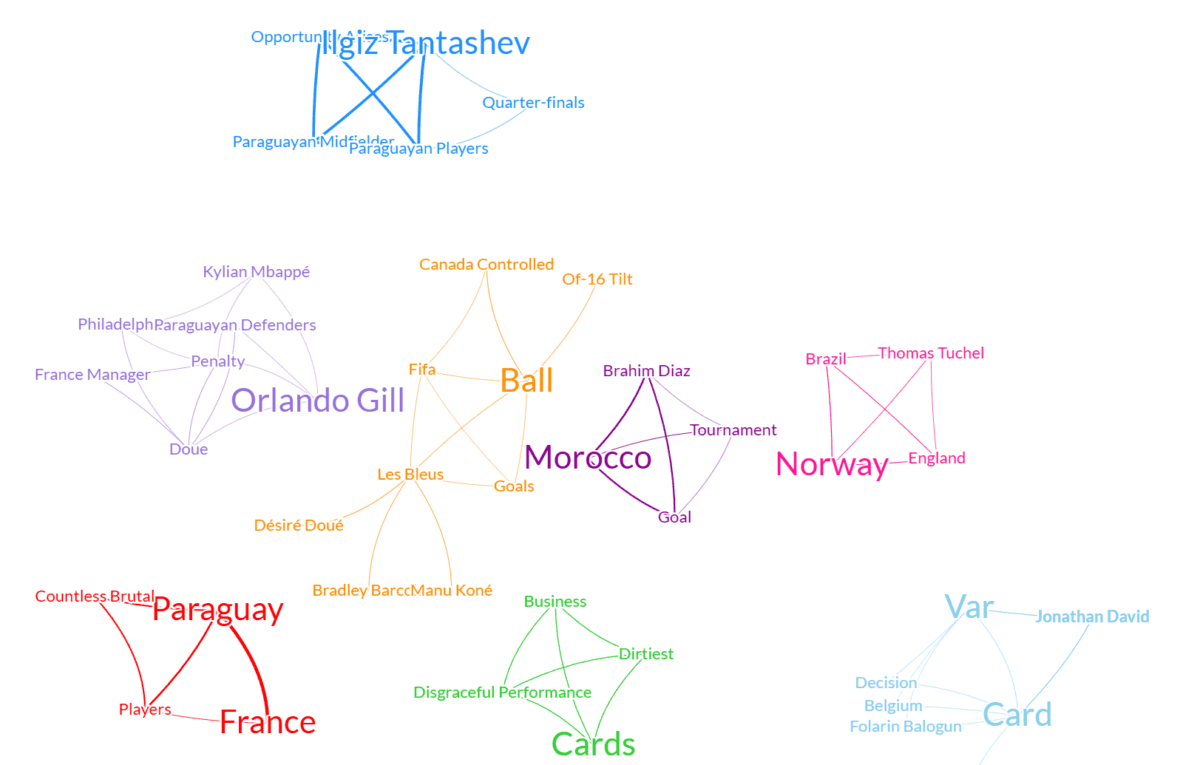
One of the most instructive data points from our monitoring window is the Paraguay-France Round of 16 match (July 4, 2026), which our forward-looking intelligence describes as a “strategic pivot.” France won 1-0, but the officiating performance became the dominant conversation, until a secondary narrative overtook it entirely.
The refereeing disparity: the numbers that sparked controversy
Referee Ilgiz Tantashev, an Uzbek official with 13 years on FIFA’s international referee list, managed the match with a striking disparity in card distribution: Paraguay committed 12 fouls during the match, yet received zero yellow cards. France, by contrast, received three yellow cards.
This 0:3 card disparity, on a match where Paraguay demonstrably committed twice as many fouls, became the central point of controversy immediately after the final whistle.
The specific unpunished incidents
Matías Galarza, a key Paraguay midfielder, was at the centre of several contentious moments: he lashed out an arm at Kylian Mbappé and then, later in the game, struck Jules Koundé. Both incidents went unpunished, with not even a foul blown by the referee. The fact that these arm strikes against France’s star players weren’t even classified as fouls, let alone yellow-card offenses, became the narrative anchor for the officiating criticism.
Didier Deschamps, France’s manager, publicly noted the disparity: France received three yellow cards “despite lots of fouls against them,” while Paraguay escaped without a single caution despite their aggressive physical approach throughout the match.
The credibility cascade
Within hours of the final whistle, the criticism of referee Tantashev escalated across social platforms. Joe Hart, the former England goalkeeper and BBC broadcast analyst, called Paraguay a “disgrace” on live television, further amplifying the officiating credibility question. L’Équipe, France’s national sports newspaper, gave Tantashev a rare rating of “1”, one of the lowest scores ever assigned to a World Cup referee.
The officiating controversy followed a predictable escalation pattern: match incidents → real-time social criticism → retrospective analysis → institutional evaluation. The VAR controversy narrative seemed set to dominate the post-match conversation, with debates about whether Tantashev should face consequences or be benched for future matches.
The pivot: when officiating becomes racism
But then the story changed direction entirely. Our intelligence data flags this moment as a “strategic pivot”: “Refereeing controversy is completely eclipsed by racist senator insults. The story fundamentally changes nature and amplifies. Initial arbitrage complaints are subsumed into larger narrative about racism and social responsibility.”
In the aftermath of Paraguay’s loss, social media posts and press coverage began surfacing racist comments from a Paraguayan political figure, shifting the dominant conversation from “unfair officiating” to “institutional racism and political accountability.” Once that pivot occurred, discussions about Tantashev’s card distribution became almost a footnote, the public conversation had migrated to a far more serious register.
Why this matters for crisis communications
This is the critical case study for institutional credibility management: a manageable, contained officiating dispute was instantly overtaken by a far more serious social issue. The VAR controversy didn’t disappear; it was buried beneath a layer of social responsibility crisis that completely changed the stakeholder landscape and required entirely different crisis messaging.
Communicators who kept preparing statements about “fair officiating decisions” after this pivot occurred were answering a question the public had already stopped asking. FIFA’s communications team had to suddenly pivot from sports governance (referee accountability, card consistency) to social responsibility (addressing racism allegations, institutional ethics).
Strategic implication: Monitor not just the volume of a controversy but its nature. A refereeing dispute and a racism allegation require entirely different crisis registers, legal, ethical, and reputational stakes escalate dramatically when a sports controversy pivots into a social responsibility issue.
Communications teams need real-time classification systems, not just volume-based escalation thresholds. The Paraguay-France case demonstrates that a VAR controversy can be a gateway issue: if it occurs in a geopolitically or socially sensitive context, it can rapidly transform into something far more serious than the initial officiating question. Once that transformation happens, going back to discuss the original refereeing dispute reads as tone-deaf and evasive.
The referee as involuntary public figure
By the Round of 16, several match officials had accumulated enough contested decisions to become recognizable figures in mainstream sports media coverage, not through any personal choice, but through the accumulation of high-stakes decisions during a tournament with unprecedented global attention (48 teams, three host nations, record viewership).
This creates a governance challenge that traditional sports crisis communications wasn’t built for: individual match officials becoming proxies for institutional trust in a system they did not design and cannot unilaterally fix. FIFA’s communications strategy needs to protect individual officials from disproportionate personal blame while simultaneously addressing the systemic questions their decisions have raised. Failing at either side of this balance, either abandoning officials to public criticism or refusing to acknowledge systemic pattern, accelerates the credibility crisis rather than containing it.
VAR transparency in crisis: what communicators should say when decisions divide fans
Given four contested VAR controversies in 72 hours, a red card reversal entangled with political intervention, and a referee whose name has become shorthand for inconsistency, the natural question for PR and communications professionals is: what should we actually say?
Our monitoring data and the halftime report’s recommendations point to a specific, disciplined messaging framework.
Principle 1: Do not defend the specific call
Across every contested VAR decision tracked in this window, our analysis consistently found that defending the accuracy of a specific disputed call generates more backlash than it resolves. Fans who believe a decision was wrong are not persuaded by institutional defense of that decision, they interpret defense as confirmation of bias or incompetence.
Recommended language pattern: “We remain committed to fair play and transparent officiating across all matches. All VAR decisions follow rigorous protocols.”
This statement does two things simultaneously: it reaffirms institutional commitment to fairness without validating or invalidating any specific contested call, and it references “protocols” as a way of pointing to process rather than outcome, a much more defensible position when the outcome itself is contested.
Principle 2: Escalation thresholds should be pre-defined, not improvised
Our data suggests clear numerical thresholds for when a VAR controversy requires escalated response:
- 50,000+ mentions within one hour combined with “unfair” rhetoric = crisis alert requiring immediate acknowledgment
- 150,000+ mentions combined with mainstream media pickup = multi-channel response required, involving coordinated statements across social, traditional media, and potentially spokesperson availability
The value of pre-defining these thresholds is speed. Waiting to decide whether a controversy warrants response while the controversy is actively spreading cedes narrative control to critics, competitors, and speculation.
Principle 3: Transparency explainers reduce ambiguity but must be prepared in advance
Given the technical nature of VAR decisions, offside lines, contact thresholds for penalties, handball interpretation, part of what fuels VAR controversy is genuine public confusion about the rules being applied, not just disagreement with the outcome.
Recommendation: Pre-produce explainer content (video and written) covering the most commonly disputed decision types before the knockout stage begins, not reactively during a specific incident. When a new controversy occurs, communicators can reference existing explainer content rather than producing rules clarification under time pressure, which reduces both response time and the risk of an explanation that itself becomes contested.
Principle 4: Separate the sporting response from the systemic response
As the Balogun and Paraguay-France cases demonstrate, individual VAR controversies can escalate into governance questions (political intervention) or social responsibility questions (racism allegations) that exceed the scope of a standard sports statement.
Recommendation: Build a two-tier response framework. Tier one addresses the specific decision using the neutral, protocol-focused language described in Principle 1. Tier two, activated only when a controversy has demonstrably pivoted into governance or social territory, requires senior spokesperson involvement, coordination with legal and ethics teams, and messaging that explicitly acknowledges the broader issue rather than retreating to procedural language.
Principle 5: The African fairness narrative requires distinct handling
Our intelligence data specifically flags a recurring “African fairness narrative” risk: Senegal’s grievance from the 2025 AFCON final directly informed how audiences interpreted the Tielemans penalty controversy, and any subsequent contested decision involving an African team is likely to be read through this same lens rather than assessed independently.
Recommendation: If a future VAR controversy involves an African team, do not treat it as an isolated incident. Escalation threshold: if mentions spike 50,000+ within two hours combined with “inequality” or “fairness” rhetoric, treat this as a systemic fairness issue requiring an acknowledgment statement such as: “Football is universal. We’re committed to fair officiating and transparent decision-making across all teams and regions. We hear concerns about equality in sports.” Avoid procedural-only language in this specific scenario, the audience is not asking about protocol, they are asking about equity.
Allegations of Argentina favoritism: a statistical controversy emerges
While the four VAR controversies and the Balogun incident dominated the headlines during the Round of 32 through Round of 16 window, a separate and more contentious narrative was building among social media users and match observers: questions about whether Argentina’s run through the tournament had been notably free from unfavorable VAR decisions.
The statistical observation: data patterns fuel favoritism claims
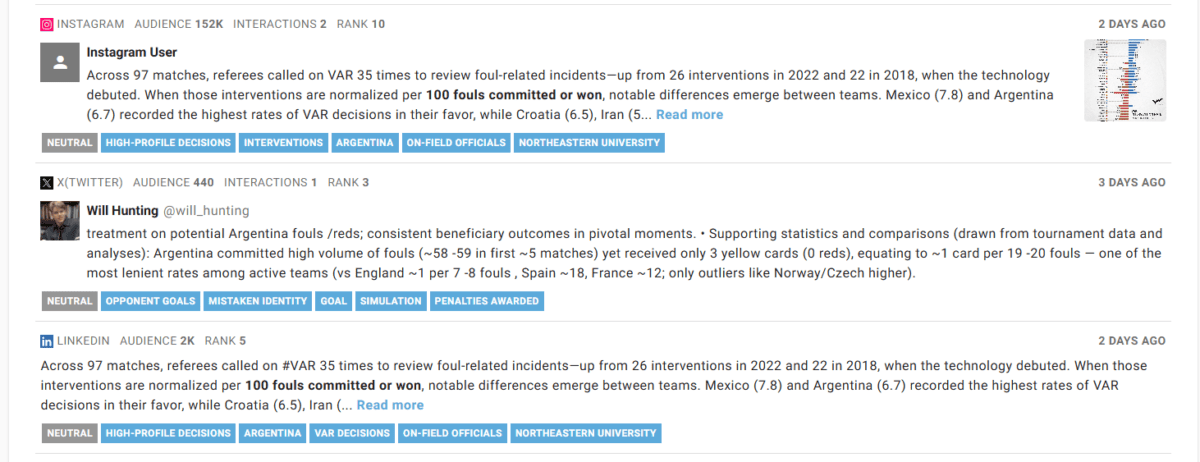
On July 11, 2026, Northeastern Global News published an analysis from NetSI Sport examining VAR intervention rates across the tournament using a baseline of “per 100-fouls committed or won.” The data visualization raised questions, rather than providing definitive conclusions, about VAR’s application across different teams.
What the data showed:
- All other quarter-finalist teams experienced at least one VAR intervention reviewing a foul committed by their players
- Argentina appeared to have zero such unfavorable VAR interventions through July 11, 2026
- Simultaneously, Argentina ranked second (after Mexico) in favorable VAR interventions (four reviews in their favor on foul-related decisions)
Critical context: Northeastern Global News analyst Seth Klein cautioned that this data does not definitively prove bias. “Why are Argentina and Mexico topping this list?” he said. “They are topping this list because the referees missed fouls that the VAR thought should have been fouls. There’s a hop, step and a jump away from: ‘They’re biased against my team or for this team.'”
The social media narrative: #VARgentina as an allegation, not a fact
Within hours of the statistical publication, the hashtag #VARgentina began trending across Twitter, TikTok, and Reddit, primarily among fans of eliminated teams and observers skeptical of the tournament’s fairness. The narrative framed by social media users suggested that Argentina’s lack of unfavorable VAR reviews might indicate preferential treatment.
How the allegation spread:
- Egyptian observers, following their team’s 3-2 Round of 16 loss to Argentina, raised questions about refereeing consistency
- German fans created comparative charts contrasting their VAR intervention rates with Argentina’s
- Some commentators speculated whether the statistical pattern indicated bias, while others cautioned that alternative explanations (random chance, legitimate refereeing precision, or Argentina’s actual playing style) could account for the difference
Egypt forward Mostafa Ziko expressed frustration publicly: “The tournament is being steered towards Argentina,” a claim that should be understood as an allegation voiced amid the emotion of tournament elimination, rather than a verified assessment.
The distinction: data pattern vs. proof of bias
A critical distinction emerged in how different observers interpreted the statistics. The data pattern itself is factual: Argentina did not experience a documented unfavorable VAR intervention through the quarter-finals, while other teams did. The interpretation of that pattern is contested.
Alternative explanations that experts and analysts offered included:
- Statistical randomness: Over 80 matches and hundreds of potential VAR incidents, some teams will naturally experience fewer unfavorable reviews by chance
- Legitimate refereeing consistency: Argentina’s players may have genuinely committed fewer “clear and obvious errors” that warrant VAR intervention
- Playing style: Argentina’s defensive and tactical approach might result in fewer contact-heavy challenges that trigger VAR review
- VAR intervention thresholds: VAR only intervenes when there is a “clear and obvious error”, a subjective determination that varies by incident type
FIFA’s institutional response: maintaining independence amid allegations
FIFA Chief Refereeing Officer Pierluigi Collina issued a statement defending the integrity and independence of match officials. He asserted that “all VAR decisions are made according to the Laws of the Game” and that “no external influence or bias is occurring.”
Collina’s position emphasized that:
- VAR intervention is objective where possible (e.g., offside decisions measured to the millimeter)
- VAR intervention on subjective calls (fouls, penalties) requires a “clear and obvious error” threshold
- Individual match officials make decisions independently
- The presence of a statistical pattern does not constitute evidence of preferential treatment
The communications challenge: While Collina’s defense of the system’s integrity was substantive, some observers felt it did not directly address the social media narrative fueling the #VARgentina allegations. Institutional statements that emphasize “all decisions follow the rules” can read as evasive when the public’s concern is “why does one team’s record look different?” Whether that concern was justified remained contested, but the perception of institutional defensiveness without direct engagement with the statistical pattern contributed to the credibility question.
The Embolo decision: IFAB mistaken identity rule sparks technical debate
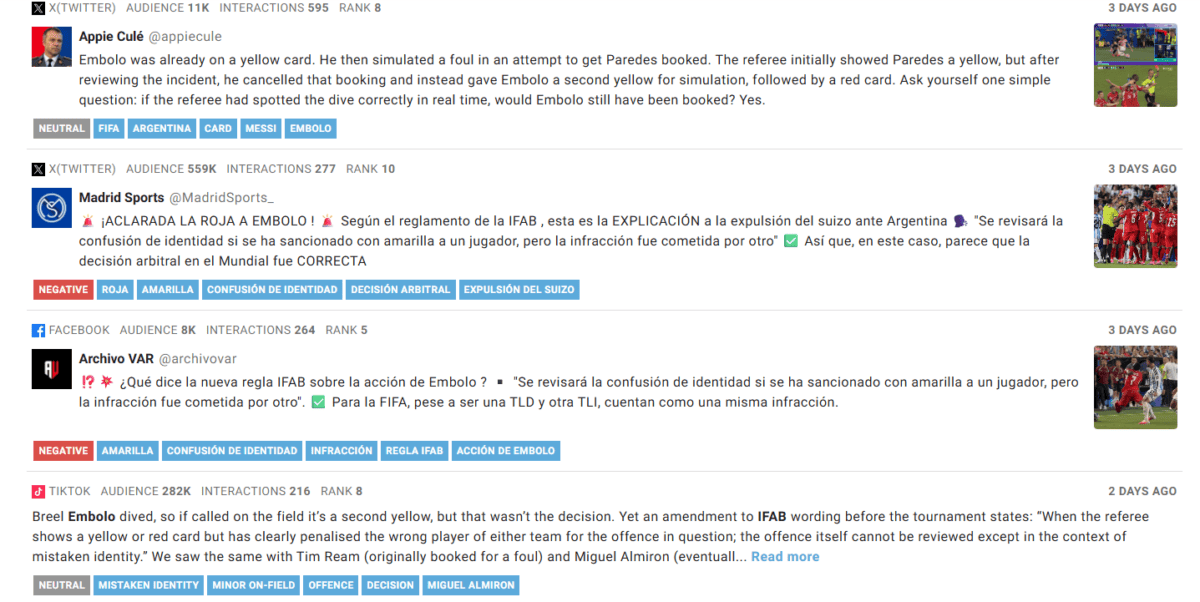
During Argentina’s quarter-final against Switzerland on July 11, 2026, a VAR decision emerged that became the focal point of discussion about how controversial rule interpretations could affect tournament outcomes, particularly given the pre-existing #VARgentina allegations circulating on social media.
The incident: Paredes and Embolo (72nd minute)
In the 72nd minute with the score tied 1-1, Leandro Paredes slid in for a challenge on Breel Embolo. Referee João Pinheiro immediately issued a yellow card to Paredes. On video review, the footage suggested Embolo’s contact with the ground occurred before or simultaneously with Paredes’s contact, prompting VAR intervention.
Pinheiro was called to the pitch-side monitor. He overturned Paredes’s yellow card and issued a yellow to Embolo for simulation. Since Embolo had already been cautioned earlier in the match, this second yellow resulted in a red card and ejection. Switzerland subsequently played the final 20 minutes and extra-time with 10 players, eventually losing 3-1 to Argentina.
The rule interpretation dispute
Switzerland’s coaching staff disputed the ruling. Their argument: the mistaken identity rule, designed to correct situations where an incorrect player receives a card, should address which player was penalized, not the type of offense. If no foul occurred, the appropriate action was to cancel Paredes’s card and restart play, not to simultaneously identify a new offense (simulation) and penalize Embolo.
FIFA’s interpretation held that the mistaken identity protocol permits VAR to recommend overturning an incorrect card and issuing a corrected card reflecting what VAR determines actually occurred. Under this reading, if VAR assessed that no foul occurred but simulation did, the corrective yellow card could be issued to Embolo.
IFAB’s governing language states: “the offence itself cannot be reviewed except in the context of mistaken identity”, a phrase subject to competing interpretations about whether it permits changing the offense type or merely correcting which player was penalized.
How the decision was received
Most analysts agreed the replay showed minimal contact and that Embolo’s movement suggested simulation. Embolo became the fourth player in the past 60 years of World Cup history to be sent off for diving. From a technical standpoint, the decision was defensible.
However, the decision occurred while #VARgentina allegations were actively trending on social media. Swiss coach Murat Yakin expressed frustration: “We were punished by a referee’s mistake. For me there was not a single reason to give the Argentine player a yellow card.” Some observers viewed the decision as a legitimate application of the rule; others interpreted it as evidence supporting the #VARgentina allegations. Whether that interpretation was justified remained contested, but the timing and context meant the decision became a flashpoint in the broader governance debate rather than an isolated incident.
Key takeaways for communications and brand teams
The 2026 World Cup governance crisis illustrates a critical principle: institutional credibility operates as a collective asset but not an isolated incident. When VAR decisions, refereeing inconsistencies, and political intervention erode trust in one domain, audiences interpret all downstream communications, from sponsorship messaging to hydration break partnerships, through a lens of cynicism rather than good faith.
For brand and marketing teams
Monitor social media narratives before they reach 100,000 mentions per hour. The #VARgentina allegations built gradually, then accelerated sharply once the Embolo decision occurred. Early-stage monitoring allows you to identify whether your brand is positioned with FIFA’s governance narrative (high risk) or with independent narratives (player performance, fan experience, community impact, lower risk).
Prepare contingency messaging now. If VAR or officiating controversies affect matches in the knockout stage that involve your primary sponsor sectors or target markets, you need pre-approved alternative content that redirects engagement toward positive tournament narratives rather than attempting to defend governance decisions.
For PR and communications professionals
Never defend a specific call. Reference the process, the rule, and the independence of match officials instead. When institutional trust is fragile (as it was heading into the quarter-finals), defending accuracy becomes a proxy for defending bias. Process-focused communication buys credibility; call-focused communication invites scrutiny.
Build a two-tier response framework: (1) Sporting response (tactical, immediate) for decisions that affect match outcomes; (2) Governance or social responsibility response (institutional, deliberate) for decisions that invite credibility questions. These require different spokespeople, timelines, and messaging.
Escalation thresholds matter. Define internally what volume of social criticism triggers a response (we recommend 50,000+ mentions per hour in a single geography as a yellow flag; 150,000+ with mainstream media pickup as a red flag requiring multi-channel coordination).
For competitive intelligence and media monitoring professionals
The tournament revealed that official sponsor visibility is not correlated with share of voice in media and social discourse. Ambush and non-official brands (SoFi Stadium, MetLife Stadium, Levi’s) captured 40%+ of mentions despite FIFA’s debranding enforcement. Similarly, governance narratives (officiating, political intervention) outpaced pure sports narratives (match outcomes, player performances) in driving engagement and earned media.
This suggests that monitoring architecture should be more granular than “brand mentions” vs. “competitor mentions.” You need narrative-level monitoring that captures: (1) institutional credibility discourse, (2) commercial/sponsor discourse, (3) sporting narrative, (4) player/personality narrative, and (5) social responsibility/ethics discourse. These operate independently and amplify or suppress each other based on timing and context.
The bottom line
The World Cup governance crisis became the story because institutional trust eroded across multiple domains simultaneously. For communicators, this means building monitoring infrastructure that catches credibility questions before they become narratives, and preparing messaging frameworks that acknowledge criticism rather than defend against it. The teams that succeeded in the quarter-finals were those that had already defined which narratives they would lead versus which they would monitor and respond to reactively.
Discover the complete breakdown of how officiating disputes, political intervention, and institutional trust collided during the knockout stage, from four VAR controversies in 72 hours to the diplomatic escalation that pulled the White House into FIFA governance. Our full Half Time Report reveals which narratives pose the highest reputational risk heading into the quarter-finals, and what your team should prepare before the next contested decision goes viral.
The images in this article were generated by a generative AI tool for illustrative purposes.