





What are market research tools?
Market research tools are software platforms and technologies used by organizations to collect, analyze, and interpret data about customers, competitors, industries, and market trends. These help brands understand consumer behavior, measure sentiment, identify opportunities, and reduce decision-making risk.
As markets become increasingly digital and conversation-driven, market research tools have evolved from periodic research solutions into continuous intelligence systems. This shift allows organizations to move from retrospective analysis toward proactive decision-making based on real-time market signals.
Types of market research tools (quick overview)
Market research tools typically fall into six main categories, each supporting a different stage of insight generation and decision-making:
- Survey and feedback tools used to collect structured customer opinions and satisfaction data
- Audience and consumer research tools that provide demographic, behavioral, and attitudinal insight
- Search and keyword intelligence tools that reveal consumer intent and emerging demand trends
- Social listening and media intelligence tools that analyze real-time public conversations and sentiment
- AI-powered qualitative research tools that interpret interviews, focus groups, and open-ended feedback
- Data visualization and business intelligence platforms that transform research findings into actionable reporting
Most organizations combine multiple tools for market research to build a complete and continuously updated understanding of their market.
Key takeaways
- Market research tools fall into six main categories: survey and feedback tools, audience intelligence platforms, search and keyword intelligence, social listening and media intelligence, AI-powered qualitative research tools, and data visualization platforms.
- Social listening has become one of the most important market research tools available to brand and marketing teams.
- Unlike surveys, social listening captures unsolicited, organic consumer behavior in real time, giving brands access to authentic sentiment at scale.
- Brands with mature listening capabilities can detect reputational issues and respond significantly faster than organizations relying only on traditional monitoring methods.
- The most effective market research stacks combine social listening as an always-on foundation with surveys, search intelligence, and audience data.
- Generative AI is accelerating analysis, but human judgment remains essential for interpreting insight and guiding strategy.
The main categories of market research tools
Modern market research no longer relies on a single method. Today’s organizations combine multiple categories of market research tools, each providing a different perspective on consumer behavior, market trends, and competitive activity. The effectiveness of market research increasingly depends on how well these tools work together to translate data into actionable insight.
Survey and feedback tools
Survey platforms remain one of the most direct consumer research tools available for gathering insight at the audience level. Platforms like SurveyMonkey, Typeform, and Qualtrics enable organizations to gather structured feedback from defined audiences.
Surveys provide control over questions and sampling but reflect what consumers say rather than always what they do. For concept testing, pricing research, satisfaction measurement, and brand tracking, they remain essential when combined with complementary research methods.
Despite declining response rates across many industries, surveys remain critical when organizations need statistically controlled validation. In practice, surveys are most powerful when informed by insight from always-on research methods such as social listening or search intelligence.
Audience intelligence and panel data
Audience intelligence platforms suchas GWI (Global Web Index) and YouGov provide access to large pre-profiled consumer panels. These tools help organizations understand demographics, attitudes, behaviors, and media consumption patterns across markets.
Statista complements this approach by aggregating verified industry statistics and forecasts, that contextualize market performance.
These platforms are particularly valuable during campaign planning and market entry analysis, where understanding audience composition and media behavior can significantly influence targeting and messaging decisions.
Search and keyword intelligence
Tools like Google Trends, Answer the Public, and SEO platforms such as SEMrush and Ahrefs reveal what consumers are actively searching for online. Search data provides large-scale visibility into demand signals and evolving category language..
For brand and insights teams, search intelligence is particularly useful for understanding how consumer language around your category is evolving, identifying content gaps, and sizing the potential demand for a new product or service before investing in development.
Because search behavior reflects active intent rather than prompted opinion, search intelligence often provides an early indicator of shifting consumer priorities before changes become visible in surveys or sales performance data.
Social listening and media intelligence
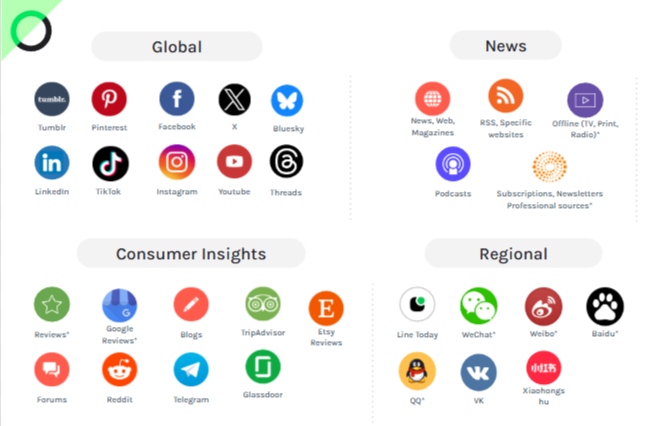
This is where market research has undergone perhaps its most significant transformation. Social listening software monitors and analyzes conversations across social media, forums, blogs, review sites, and news coverage to capture unsolicited consumer opinion in real time. And they do it at a scale that no other research method can match.
The growth of social listening reflects a broader shift toward unstructured data as a primary research source, allowing organizations to understand consumer perception at a scale and speed previously unattainable through traditional methodologies.
Social listening platforms range from broad media monitoring tools to highly specialized consumer intelligence platforms. Key players in the market include Onclusive, Brandwatch, Talkwalker, Sprinklr, and Meltwater. For a detailed breakdown of how these platforms compare on features, use cases, and pricing, see our guide to the top 10 social listening tools in 2026.
AI-powered qualitative research tools
A newer category of tools, including platforms like Discuss and Speak AI, is bringing AI capabilities to qualitative research. These platforms transcribe and analyze interview recordings, generate insight summaries from focus group sessions, and identify themes across large bodies of unstructured text. They are accelerating the timelines that have historically made qualitative research slow and expensive.
Data visualization and business intelligence
Once insights are gathered, platforms like Tableau and Power BI help teams visualize and communicate findings. For market research to drive action, it needs to reach decision-makers in a form they can understand and act on quickly. Visualization tools are increasingly being integrated directly into research platforms, reducing the gap between insight generation and strategic decision-making.
Consumer research in practice
Consumer research rarely relies on a single platform type. Instead, organizations combine multiple market research tools to understand how audiences think, feel, and make decisions.
Survey platforms capture structured feedback, audience intelligence tools provide demographic and attitudinal context, social listening platforms reveal organic consumer conversation, and qualitative research tools uncover deeper motivations behind behavior.
Together, these approaches form a comprehensive consumer research capability that enables brand and marketing teams to translate audience understanding into actionable strategy. Increasingly, organizations treat consumer research as an ongoing capability rather than a one-time project, combining multiple data sources to maintain a continuously updated understanding of audience expectations and sentiment.
Why social listening has become central to modern market research
Traditional research methods ask consumers to reflect within controlled environments. Social listening captures spontaneous expression occurring naturally across digital environments.
When someone posts about your brand on social media, discusses a product category in a Reddit thread, complains about a competitor on a review site, or shares enthusiasm in an industry forum, they are not responding to a research prompt. They are simply expressing what they actually think, in their own language, at the moment it matters to them.
For brand and marketing teams, this translates into several concrete research advantages:
Consumer sentiment at scale:
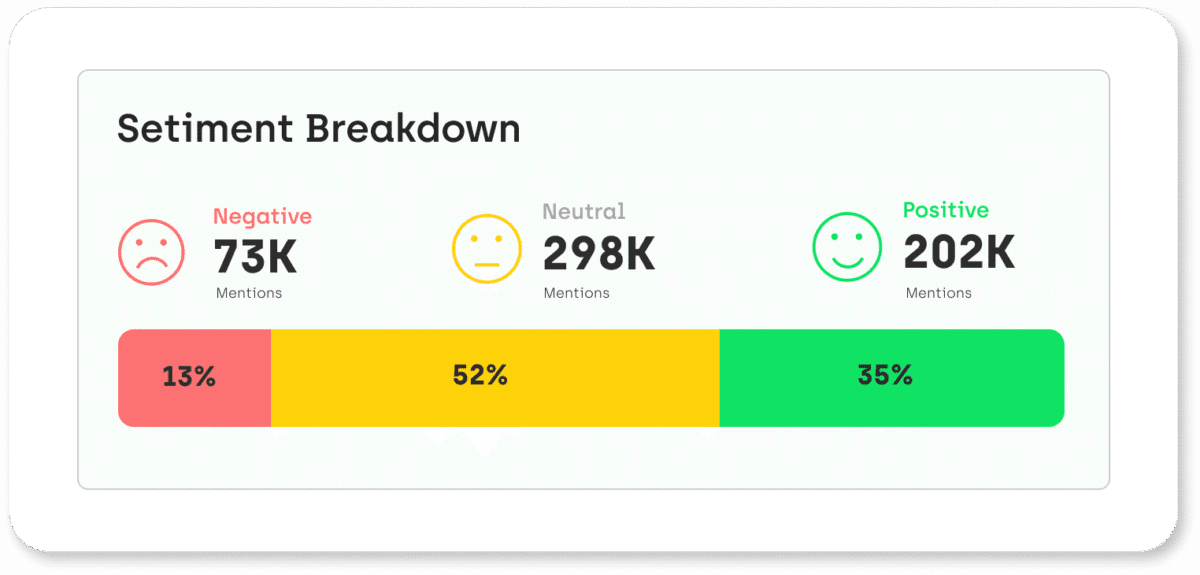
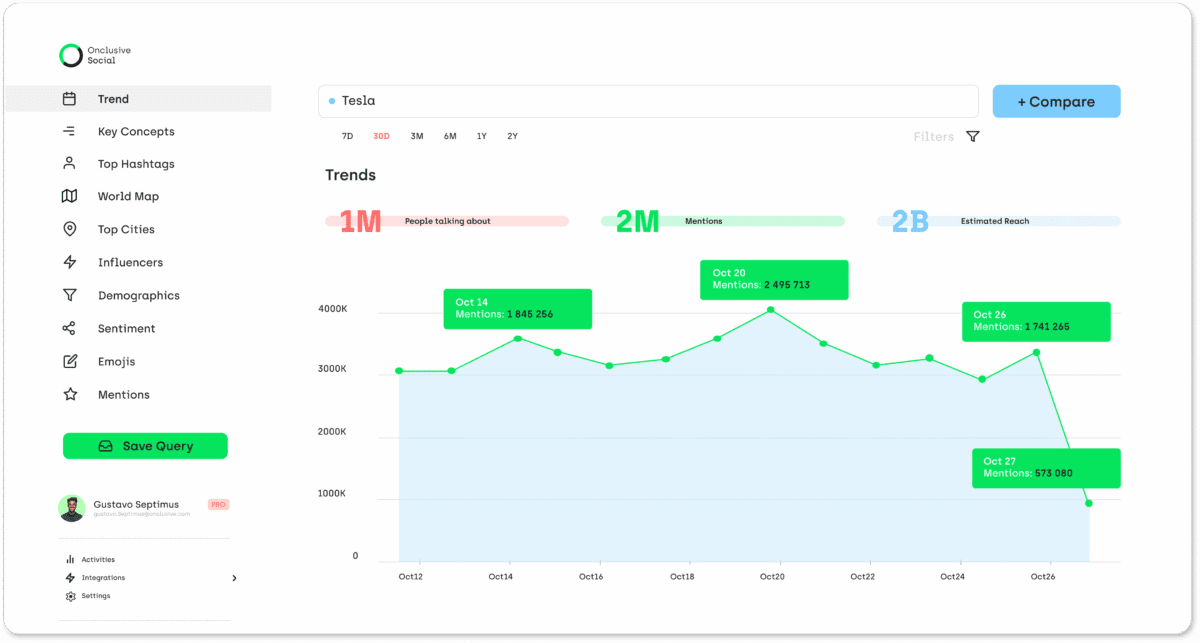
Modern social listening platforms like Onclusive Social analyze millions of conversations simultaneously, applying AI-powered sentiment analysis that goes well beyond simple positive/negative categorization. Today’s platforms can detect specific emotions such as frustration, excitement, and disappointment, identify the topics driving those emotions, and connect them to particular products, campaigns, or brand attributes.
Real-time trend identification:
Social listening enables brands to identify emerging trends as they develop, rather than after they have already shaped consumer behavior. This has become particularly valuable in categories where speed-to-insight creates genuine competitive advantage, whether that’s identifying a new product opportunity, adjusting campaign messaging, or understanding a shift in how your target audience talks about your industry.
Competitive intelligence without the lag:
Social listening provides a continuous feed of intelligence on competitor activity, consumer response to competitor campaigns, and share of voice across earned media and social channels. Unlike commissioned competitive research, it operates in real time and does not require you to know what questions to ask in advance.
Brand reputation and health monitoring:
For brand teams responsible for tracking awareness, perception, and sentiment, social listening provides an always-on alternative or complement to periodic brand tracking surveys. Rather than waiting for quarterly results, teams can monitor how brand sentiment evolves in response to specific events, campaigns, or external factors and respond accordingly.
Cultural and audience intelligence:
Perhaps the most underutilized application of social listening for marketing teams is as a window into cultural context. Understanding how your target audience discusses topics adjacent to your industry, what language they use, what they care about beyond your product, and what cultural narratives they are part of shapes more resonant, relevant marketing.
What to look for when evaluating market research tools
The market for research tools is large and growing. Choosing the right platforms requires clarity on what you are trying to achieve, not just which tools have the most features.
Coverage and data sources. For social listening and media intelligence tools in particular, the breadth and quality of data sources matters enormously. Does the platform cover the channels where your audiences actually have conversations? This now extends well beyond Twitter and Instagram to Reddit, niche forums, review sites, news outlets, broadcast media, and podcasts. Ask vendors to demonstrate coverage in the specific markets and languages relevant to your business.
AI capability and accuracy. Most platforms now claim AI-powered sentiment analysis and trend detection. The quality varies significantly. Look for platforms that can demonstrate nuance, distinguishing between emotions, handling sarcasm and context, operating accurately in multiple languages, and flagging the limitations of their models rather than overstating confidence.
Historical data depth. Some research questions require historical context. How has sentiment around your brand shifted over time? What trends preceded a category shift you are now observing? Platforms that offer deep historical data archives provide significantly more analytical value than those limited to near-real-time monitoring.
Integration with your existing stack. Market research tools deliver most value when their outputs can flow into the systems where decisions are made, including CRM platforms, marketing dashboards, and campaign management tools. Evaluate the integration capabilities of any platform you are seriously considering.
Ease of use and time to insight. A powerful platform that requires extensive technical expertise to operate will not be used effectively. The best platforms combine analytical depth with interfaces that allow non-specialist users to generate insights without needing data science support for every query.
Reporting and communication. Insight that does not reach decision-makers in a usable form does not drive decisions. Look for platforms with strong reporting capabilities, customizable dashboards, and the ability to produce outputs that can be shared with senior stakeholders without extensive post-processing.
Top market research tools by category
Rather than an exhaustive list, the following table provides a useful orientation to the most established and capable platforms across each category. Different market research tools support distinct stages of insight generation, meaning the “best” solution depends less on vendor capability and more on organizational use case.
The following overview highlights some of the top market research tools used by brand, marketing, and insights teams across different research categories.
| Category | Tool | Best for |
| Surveys and feedback | Qualtrics | Enterprise-grade research combining quantitative and qualitative capabilities |
| Attest | Fast turnaround consumer research with expert support | |
| SurveyMonkey | Accessible, widely used for mid-market research | |
| Typeform | Conversational, mobile-friendly surveys | |
| Audience intelligence | GWI | Depth of psychographic and attitudinal profiling |
| YouGov | Global brand tracking across 56 markets, with particular depth in UK and European data | |
| Statista | Quick access to reliable third-party market data | |
| Search and keyword intelligence | Google Trends | Tracking relative search interest over time, free |
| Answer the Public | Understanding how consumer language around a topic is structured | |
| SEMrush / Ahrefs | Comprehensive SEO-focused platforms with market research applications | |
| Social listening and media intelligence | Onclusive | 850M+ source coverage including TikTok and LinkedIn; advanced AI sentiment analysis, historical search, and benchmarking |
| Brandwatch | Deep consumer intelligence, strong emotion analysis | |
| Talkwalker | Visual listening, robust AI features via Blue Silk (now part of Hootsuite) | |
| Sprinklr | Enterprise-scale, omnichannel, large organizations managing multiple brands | |
| Meltwater | Broad media intelligence with social listening integrated | |
| AI qualitative tools | Discuss | Video research with AI-generated highlights and themes |
| Speak AI | Transcription and analysis of audio and video research materials | |
| Visualization | Tableau | Industry standard for complex data visualization |
| Power BI | Organizations already in the Microsoft ecosystem |
How to choose the right market research tools
Selecting the right tools for market research depends on organizational goals, available data, and decision timelines. When evaluating market research analysis tools, teams should consider:
- The primary research objective (exploration, validation, or measurement)
- Whether insight requires behavioral or self-reported data
- Speed of insight required for decision-making
- Geographic and language coverage
- Integration with marketing, analytics, or CRM systems
- AI analysis capabilities and accuracy
- Historical data availability
- Ease of reporting for stakeholders
The most effective research stacks balance always-on intelligence with targeted research methods designed to answer specific strategic questions.
Building an effective market research stack
No single platform satisfies every research requirement. Successful teams combine complementary tools into a unified intelligence ecosystem.
Organizations that achieve the greatest return from market research investments typically treat insight generation as an operational function embedded across marketing, communications, product, and strategy teams.
A practical starting framework for brand and marketing teams might look like this.
- Social listening and media intelligence form the always-on foundation, continuously capturing what is happening in your market, how your brand is perceived, and what competitive and cultural forces are at play.
- Periodic surveys and panel research provide validation and depth for specific strategic questions such as concept testing, pricing research, and brand tracking.
- Search intelligence informs content strategy and helps size opportunities. Audience intelligence platforms provide the demographic and psychographic context that makes the rest of the data interpretable.
The temptation is to invest heavily in data collection and lightly in analysis. The research teams that generate the most value from their tools for market research are the ones that invest equally in the analytical capability and organizational infrastructure to turn data into decisions. That means building clear workflows for how insights reach the people who need them, establishing KPIs that are connected to research outputs, and creating the kind of cross-functional relationships that allow insights to influence strategy rather than just report on outcomes.
How AI is reshaping market research
Artificial intelligence is not just a feature within market research tools. It is reshaping the entire research process. The implications for how insights teams work are significant.
As AI adoption accelerates, competitive advantage increasingly depends not on access to data, but on the ability to interpret AI-generated insight responsibly and translate it into strategic action.
At the data collection stage:
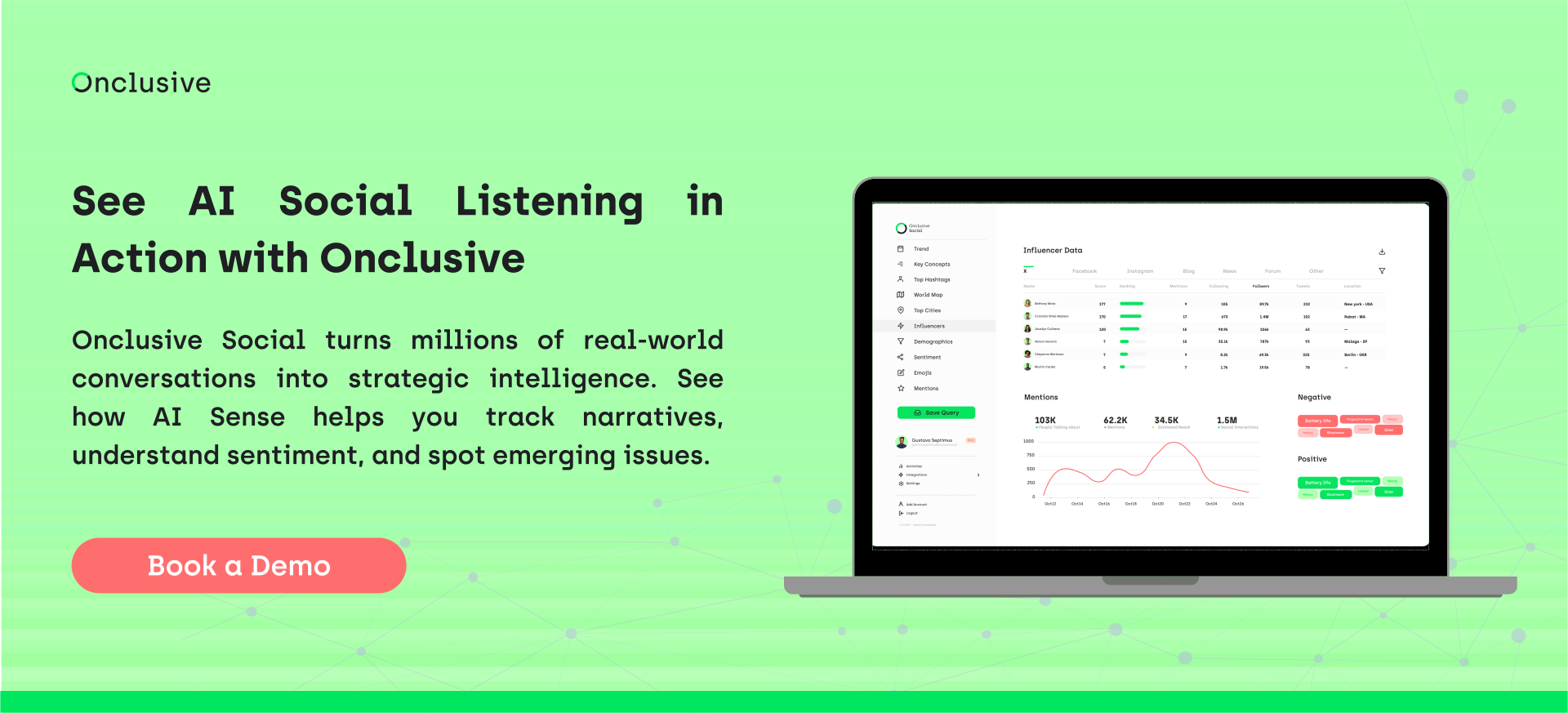
AI is enabling new forms of research that were previously impractical at scale. AI-moderated interviews can conduct hundreds of qualitative conversations simultaneously, asking follow-up questions dynamically based on participant responses. Social listening platforms can now process not just text but images, video, and audio, opening up vast bodies of data that were previously inaccessible to researchers.
At the analysis stage:
AI dramatically compresses the time between data collection and insight. Sentiment analysis, theme identification, trend detection, and anomaly flagging are tasks that once required significant human analytical effort but can now be performed automatically and in real-time. This does not eliminate the need for human judgment. It changes where that judgment is most valuably applied, shifting the researcher’s role from data processing to insight interpretation and strategic application.
Importantly, 91% of social intelligence professionals are already using generative AI in some aspect of their work, though only 3% report fully trusting it (The SILab State of Social Listening Report, 2025). This reflects a sensible approach: AI accelerates and augments research capability, but the critical evaluation of what data means and what to do about it remains a fundamentally human task.
Conclusion
Today’s market research tools function less as standalone platforms and more as integrated intelligence systems supporting continuous strategic decision-making. Organizations combining social listening platforms, consumer research tools, and AI-powered market research analysis tools gain a real-time understanding of market dynamics that traditional research approaches alone cannot provide.
The right market research tools do not just answer questions. They help you ask better ones. In a market that moves faster than any single research method can track, the organizations that build genuine intelligence capability, combining the scale of social listening with the precision of surveys, the cultural depth of qualitative research, and the breadth of media intelligence, are the ones that make decisions the competition cannot anticipate. The tools are more powerful than they have ever been. The advantage lies in knowing how to use them.
Frequently asked questions
What are market research tools?
Market research tools are platforms and software used to collect, analyze, and interpret data about customers, competitors, and market trends. They help organizations understand consumer behavior, measure sentiment, identify opportunities, and support data-driven strategic decisions.
What types of market research tools are available?
Market research tools typically fall into six categories: survey and feedback tools, audience intelligence platforms, search and keyword intelligence tools, social listening and media intelligence platforms, AI-powered qualitative research tools, and data visualization or business intelligence tools.
What are examples of market research tools?
Examples of market research tools include survey platforms such as Qualtrics and SurveyMonkey, audience intelligence tools like GWI and YouGov, search intelligence platforms such as Google Trends and Ahrefs, and social listening platforms including Onclusive, Brandwatch, and Talkwalker.
How do market research tools differ from marketing analytics tools?
Market research tools analyze external market conditions, consumer sentiment, and competitive activity, while marketing analytics tools measure performance within owned channels such as websites, advertising campaigns, and CRM systems. Market research focuses on understanding the market, while analytics focuses on measuring marketing results.
How do organizations choose the right market research tools?
Organizations should select market research tools based on their research objectives, required data sources, geographic coverage, integration needs, and speed of insight required. Most teams combine multiple tools to balance continuous market intelligence with targeted research projects.
Can social listening replace traditional market research methods?
Social listening complements rather than replaces traditional research methods. Surveys and panels provide structured, statistically controlled feedback, while social listening captures unsolicited consumer conversations in real time. Together, they provide a more complete understanding of market perception and behavior.
All trademarks, product names, and company names are the property of their respective owners. This comparison is provided for informational purposes only and does not imply any affiliation, endorsement, or sponsorship
The information presented is based on publicly available data and is accurate to the best of our knowledge at the time of publication. All efforts have been made to ensure the information is complete and reliable; however, specifications, features, and pricing may change over time. Onclusive makes no warranties or representations regarding the completeness or accuracy of third-party information.