


The most influential brands in media in 2026: what the data reveals
Every year, the question is the same: which brands truly lead in the media? Not in market capitalisation, not in advertising spend, not in brand recognition surveys. In actual, measurable influence, across mainstream press, broadcast, and the social platforms where billions of people form opinions every day.
Onclusive’s Brand Influence Rank 2026 answers that question with data. Analysing 100 companies and applying a proprietary scoring model that combines a Media Score and a Social Media Score into a single Global Media Influence Score, the ranking identifies the 50 most influential brands in the world’s media landscape over the 12 months to January 2026.
The results challenge assumptions. The most influential brands in media in 2026 are not necessarily the most financially valuable, the most globally recognised, or the most heavily advertised. They are the brands that are talked about well, at scale, and across every channel where it matters. And the patterns they reveal carry lessons that every PR, communications, and marketing professional should take seriously.
| Volume alone does not determine impact. Sentiment quality, CEO visibility, professional engagement, and presence in AI-generated conversations are the metrics that separate the most influential brands from the rest.
Onclusive Brand Influence Rank 2026 |
I. The top 10 most influential brands in media 2026: a complete picture
The first thing the 2026 ranking makes clear is structural: all ten of the most influential brands in media in 2026 are digital platforms or technology companies. There is not a single consumer goods brand, luxury house, automotive company, or financial institution in this group. This reflects a fundamental structural advantage these brands hold in generating both media coverage and social conversation, simultaneously and continuously.
| # | Brand | Media score /200 | Social score /200 | Global score |
|---|---|---|---|---|
| 1 | YouTube | 137 | 191 | 328 |
| 2 | 136 | 170 | 306 | |
| 3 | 192 | 104 | 296 | |
| 4 | 186 | 79 | 265 | |
| 5 | 74 | 146 | 220 | |
| 6 | Apple | 104 | 94 | 198 |
| 7 | Amazon | 66 | 123 | 189 |
| 8 | Microsoft | 38 | 124 | 162 |
| 9 | TikTok | 70 | 81 | 151 |
| 10 | ChatGPT | 27 | 108 | 135 |
YouTube’s dual dominance is unique
YouTube claims first place with a Global Media Influence Score of 328, the highest in the entire ranking. What makes this position exceptional is the way it is built. YouTube holds the highest Social Score in the top 10 (191/200) while also ranking in the top four for Media Score. No other brand achieves this dual strength. Its 76% positive media sentiment, the highest of the top 10, further amplifies the lead.
The explanation lies in a structural advantage no other brand fully replicates: YouTube is simultaneously the subject of media coverage and the vehicle through which media is distributed. Digital publishers embed YouTube videos in articles about entirely different topics. Political speeches, product launches, and viral moments all generate YouTube links. Every embed is, in effect, a brand mention. This passive but pervasive presence inflates its media footprint in a way no communications budget can manufacture.
Instagram: the highest media score, yet only third overall
With a Media Score of 192/200, Instagram holds the highest press score in the entire top 10, higher than YouTube or Google. Its centrality to debates around social media regulation, mental health, influencer culture, and the creator economy generates extraordinary editorial coverage. Yet it ranks third, not first. Its Social Score of 104 is comparatively moderate, confirming one of the ranking’s clearest lessons: press coverage volume alone is insufficient without the social amplification that makes YouTube’s position unassailable.
Sentiment is the great differentiator
LinkedIn ranks fifth despite far lower raw mention volumes than Facebook or Instagram. The difference is sentiment: with 70% positive media sentiment, LinkedIn’s coverage is substantially more favourable, and that quality elevates its score decisively. Facebook, by contrast, sits at 51% positive media sentiment, the lowest of the most influential brands in media in 2026, constrained by regulatory scrutiny, data privacy debates, and ongoing platform governance controversies.
Regulatory pressure functions as a sentiment ceiling for several brands in this group. Google (53%), Apple (58%), and TikTok (58%) all carry below-average positive sentiment, directly reflecting the weight of antitrust proceedings, Digital Markets Act fines, and platform governance pressures that dominate their coverage narratives.
Microsoft: influential in the rooms that matter, quieter in the streets
Microsoft ranks eighth with a Global Score of 162. For a brand at the epicentre of the global AI revolution through its OpenAI partnership and Copilot ecosystem, eighth place signals a striking gap between strategic importance and media and social visibility. Yet its Social Score is built on a foundation more durable than raw consumer conversation: a LinkedIn reach of 50 million, high professional engagement, and the highest CEO mention volume in the entire ranking. Microsoft’s influence is real but concentrated in a professional audience rather than a mass public.
ChatGPT: the youngest brand to break the top 10
ChatGPT enters the top 10 at tenth place with a Global Score of 135. For a brand that did not exist before November 2022, reaching the top 10 of a global media influence ranking within three years represents one of the fastest influence-building trajectories in the history of brand communications. Its entry is almost entirely driven by AI narrative gravity: every major debate about generative AI, every regulatory discussion, every competitive product launch from Google Gemini, Meta AI or Apple Intelligence, pulls ChatGPT back into coverage as the reference point.
II. Seven insights the most influential brands in media in 2026 reveal about brand strategy
Across the top 10, specific patterns emerge that apply far beyond these ten brands. Here are the strategic lessons the data carries most clearly.
01 AI is the invisible engine of the top 10Eight of the ten most influential brands in media in 2026 are either AI-native or have placed AI at the centre of their business strategy. The top 10 is, in effect, a ranking of the world’s most AI-driven brands. Communications teams that treat AI as a product category rather than a narrative priority are already structurally behind. |
02 Media score and social score rarely peak togetherMost of the most influential brands in media in 2026 excel on one dimension but not both. Instagram and Facebook lead on Media Score but show moderate Social Scores. Microsoft and LinkedIn show the reverse. Dual dominance, as YouTube achieves, is structurally rare and extremely difficult to replicate. Understanding which channel is your brand’s primary influence driver is the foundation of any effective communications strategy. |
03 Regulatory exposure caps sentiment ceilingsThe four brands facing the most active antitrust and regulatory proceedings, Google, Facebook, Apple, and TikTok, all cluster around 51-58% positive sentiment. This is not coincidental. Regulatory strategy and communications strategy are inseparable in 2026. A brand that is simultaneously growing in strategic importance and accumulating regulatory risk will see its influence score capped regardless of its media volume. |
04 B2B influence is real, but structurally cappedMicrosoft’s position proves that a B2B-weighted brand can compete among the most influential brands in media. But its influence ceiling is shaped by strategic credibility rather than mass public conversation, a fundamental difference from consumer-facing platforms. LinkedIn reach, professional engagement quality, and CEO mentions in trade press are the levers for this type of brand, not social mention volume. |
05 Financial value and media influence are divergingApple is widely recognised as the world’s most financially valuable company. It ranks sixth among the most influential brands in media in 2026. This gap is not a measurement anomaly. It reflects the reality that media influence is the result of consistent, measurable communications activity, not of market capitalisation. Financial scale can create coverage opportunities, but it cannot manufacture sentiment quality or social amplification. |
06 CEO visibility reshapes brand influence scoresEvery brand in the ranking is scored on both its own media and social footprint and the visibility of its CEO or managing director. CEO mentions are tracked separately because a leader’s public statements, even when they do not name the brand, have the potential to shape company and product perception. Elon Musk’s CEO Media Score of 52,067 is nearly ten times that of the second-placed Sam Altman (5,703), reflecting a structural amplification loop built on multi-brand presence, platform ownership, and permanent polarising coverage. At the other end of the spectrum, brands like Instagram, whose CEO Adam Mosseri generates minimal media coverage, demonstrate that brand-driven influence without executive dependency is a more durable and structurally robust position. |
07 Platform ownership creates structural amplification loopsYouTube’s ability to be simultaneously the subject of coverage and the infrastructure through which coverage is distributed creates a self-reinforcing loop. Owning a platform and being on it are fundamentally different competitive positions in terms of influence building. For most brands, the lesson is not to replicate this structure but to identify which adjacent channels and content formats create the most efficient amplification of their own earned media. |
III. The brand influence typology: six profiles that define how brands build media power
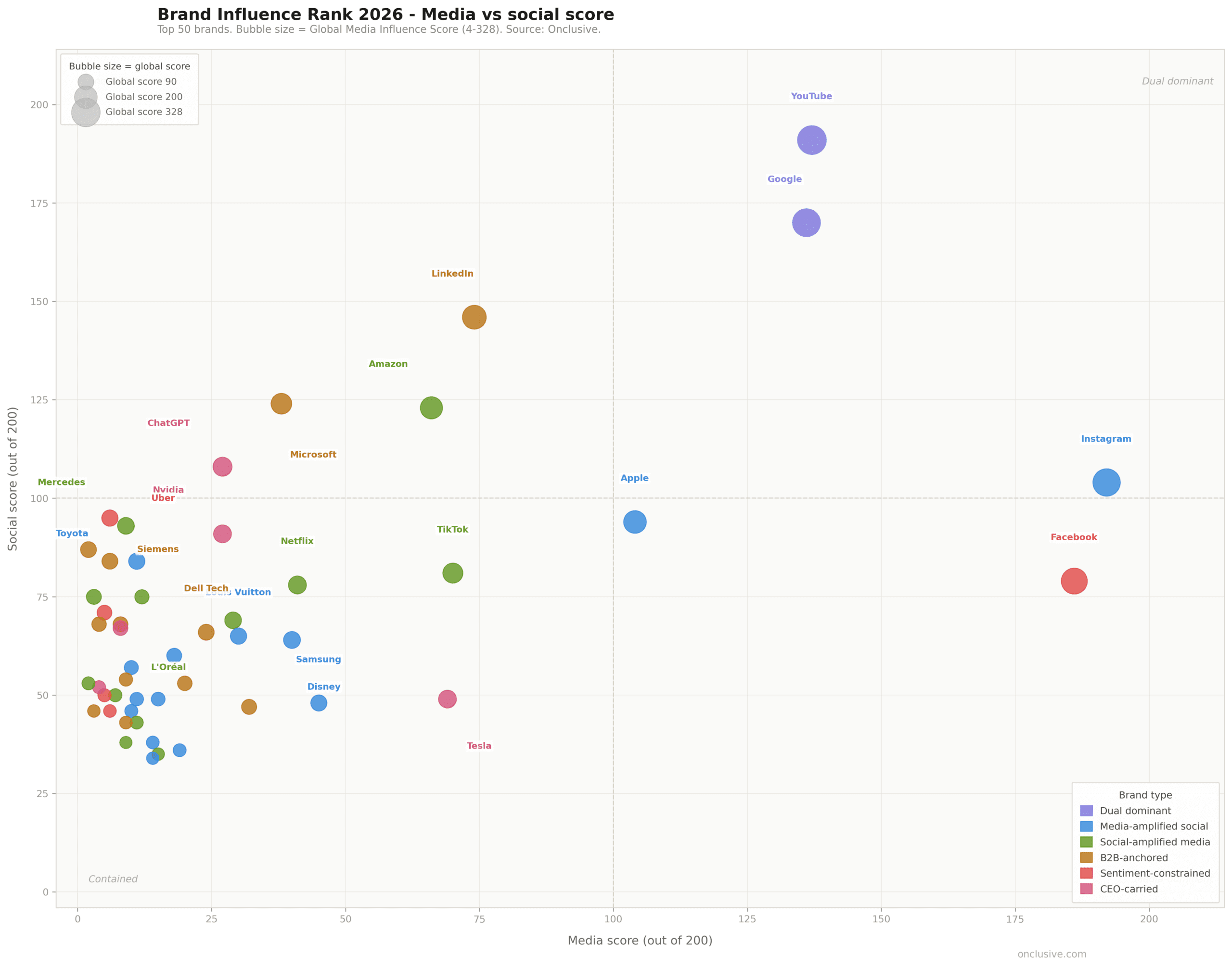
Analysing the 50 most influential brands in media in 2026 ranked by Global Media Influence Score, four distinct influence profiles emerge, based on the relative strength of each brand’s Media Score versus Social Score, and the direction of their coverage amplification flows. The scatter plot below maps all 50 brands across these four quadrants.
The typology matrix
| Profile | Definition | Examples | Strategic implication |
|---|---|---|---|
| DUAL DOMINANT | High on both axes, self-reinforcing | YouTube #1, Google #2 | The benchmark position. Both channels amplify each other simultaneously. Structurally the most powerful and the most difficult to attain. No single communications lever explains their dominance. |
| MEDIA-AMPLIFIED SOCIAL | Press leads, social follows. The majority pattern. | Apple #6, L’Oreal #16, Disney #14, Walmart #24 | Earned media drives social amplification with a lag. Sentiment management in mainstream press is the primary lever. High-quality editorial coverage converts into organic social conversation. |
| SOCIAL-AMPLIFIED MEDIA | Social drives press. The disruptor pattern. | Tesla #13, TikTok #9, Nike #41, Chanel #42 | Online communities, fan bases, and cultural moments generate social volume that crosses over into editorial. Monitoring social-to-press amplification thresholds is critical: negative viral events escalate fast. |
| B2B-ANCHORED | LinkedIn and professional channel dominance. Low consumer visibility. | Microsoft #8, LinkedIn #5, Accenture #26, Aramco #23, SAP #27 | Influence is built through professional reach and trade press rather than mass consumer conversation. CEO mentions in specialist media and LinkedIn engagement quality are the decisive levers. Consumer social benchmarks are irrelevant comparators. |
| SENTIMENT-CONSTRAINED | High mention volume, low sentiment ceiling. Score is capped by negative coverage. | Facebook #4, Uber #18, Wells Fargo #37, Morgan Stanley #44 | Raw mention volume is high but positive sentiment is structurally limited by regulatory scrutiny, controversies, or legacy reputation issues. Influence scores are capped regardless of communications investment until the sentiment deficit is addressed. |
| CEO-CARRIED | Brand score disproportionately dependent on CEO visibility. | Tesla/Musk, ChatGPT/Altman, Facebook/Zuckerberg | A significant share of brand mentions and reach is generated by CEO coverage rather than by the brand’s own communications activity. This creates influence at scale but also dependency: a CEO reputational event directly threatens the brand score. Diversifying influence drivers beyond executive personality is the strategic priority. |
Type 1 – Dual dominant: the benchmark position
YouTube and Google are the only two brands in the entire ranking that achieve high scores on both axes simultaneously and sustain them across a full 12-month period. This is not a communications achievement: it is a structural one. Both brands are simultaneously the subject of media coverage and the infrastructure through which media is created, shared, and embedded. Digital publishers cite YouTube videos in articles about unrelated topics. Google Search is referenced in regulatory proceedings, AI debates, and everyday tech coverage in a self-reinforcing loop. For every other brand in the ranking, Dual Dominant is the strategic aspiration. The path toward it depends entirely on the starting profile.
Type 2 – Media-amplified social: the majority pattern
This is the most common profile in the ranking, and the one that most closely matches what communications teams are familiar with managing. Press coverage leads, and social conversation follows. A major editorial story generates LinkedIn shares, X commentary, and cross-platform discussion, but the impulse comes from journalists and media outlets rather than from communities or platforms. Brands in this profile, including Apple, L’Oreal, Disney, and Walmart, tend to have strong, well-resourced communications and PR functions that consistently generate mainstream coverage. Their influence ceilings are shaped primarily by sentiment quality in earned media: the better the narrative managed with journalists and editors, the higher the potential score.
Type 3 – Social-amplified media: the disruptor pattern
This profile inverts the conventional influence architecture. For Tesla, TikTok, Nike, and Chanel, social conversation precedes and drives mainstream editorial coverage. A viral product moment, a fan community event, or an ambassador post generates enough social volume and reach that journalists and editors pick it up and amplify it into the press. This creates a faster and sometimes more intense coverage cycle than the Media-amplified social pattern, but also a less predictable one. The risk is symmetrical: negative social moments escalate into press coverage just as quickly as positive ones. Monitoring the social-to-media amplification threshold is the most operationally critical capability for brands in this profile.
Type 4 – B2B-anchored: influence through professional depth
Microsoft, LinkedIn, Accenture, Aramco, and SAP build their influence almost entirely through professional channels, with LinkedIn as the primary arena. Their Media Scores are relatively modest in absolute terms, their social mention volumes are low compared to consumer-facing brands, but their LinkedIn reach, professional engagement quality, and CEO visibility in trade publications give them scores that compete with far larger consumer brands. The strategic implication is precise: consumer social benchmarks are irrelevant comparators for these brands. Influence measurement must be calibrated to professional engagement metrics, specialist press sentiment, and CEO visibility in the publications that matter to their institutional audiences.
Type 5 – Sentiment-constrained: the volume trap
Facebook, Uber, Wells Fargo, and Morgan Stanley illustrate one of the ranking’s most important findings: high mention volumes do not automatically produce high influence scores. These brands generate substantial media and social coverage, but their positive sentiment sits structurally below the average for their tier, capping the Global Media Influence Score regardless of volume. The constraint is not a communications problem that can be solved with more coverage or more content. It is a reputation problem that requires addressing the underlying issues generating negative commentary: regulatory proceedings, consumer protection controversies, or persistent legacy reputational damage. For PR and communications teams, the lesson is direct: until the sentiment deficit narrows, additional investment in coverage volume produces diminishing returns on influence score.
Type 6 – CEO-carried: power with dependency
Three brands in the ranking demonstrate a sixth pattern that cuts across the other profiles: influence that is disproportionately generated by the CEO rather than by the brand’s own communications activity. Tesla’s score is dramatically elevated by Elon Musk’s personal media presence, much of which references neither Tesla nor its products. ChatGPT’s top 10 entry is substantially built on Sam Altman’s role as the public face of the AI governance debate. Facebook’s score benefits from Mark Zuckerberg’s visible image rehabilitation cycle tied to Meta’s AI repositioning.
In each case, the CEO creates real influence at scale. But the dependency is a structural risk: a CEO reputational event directly threatens the brand score, and the brand’s own communications activity is insufficient to sustain influence if the executive narrative deteriorates. Diversifying influence drivers beyond the CEO is the primary strategic imperative for brands in this profile.
Note that these types are not mutually exclusive. Tesla is both “social-amplified media” and “CEO-carried.” Facebook is both “dual dominant (media)” and “sentiment-constrained” and “CEO-carried.” That overlap is precisely what makes the typology interesting for a PR audience – you can occupy multiple types simultaneously, and each carries different strategic implications.
Amplification direction
Traditional media amplifying to social (the majority pattern)
Most brands follow the “press leads, social follows” model. A product launch or earnings result generates press coverage, which then fuels social conversation. This applies broadly to: Apple, Amazon, Disney, Netflix, L’Oréal, Toyota, Samsung, Walmart, Coca-Cola, Salesforce, Adobe, Cisco, Mastercard, Visa, Hilton.
Social amplifying to traditional media (the disruptor pattern)
A smaller but strategically important group where social activity generates press coverage rather than the reverse:
- Tesla: Musk’s 5.2M CEO mentions (social-driven) exceed Tesla’s 4.7M brand mentions in press – the clearest inversion in the ranking
- TikTok: consumer-driven social volume (258M mentions) generates regulatory and news coverage, not the other way around
- Chanel: ambassador communities and aspiration-driven organic content on social drive fashion press coverage
- Nike/Adidas: product drops and athlete moments on social create press narratives
- Spotify: artist and user conversations on social generate trade and consumer press
- Reddit (not in top 50 but informative): community content surfaces to mainstream press
Self-reinforcing loops (social and media feed each other bidirectionally)
- YouTube: digital publishers embed YouTube in articles, which drives social conversation, which creates more press
- Instagram: viral Instagram content is cited in press, which creates more Instagram conversation
- Facebook/Meta: Zuckerberg’s social posts become press stories, which generate more social commentary.
| HOW TO USE THE TYPOLOGY
Most brands will recognise elements of more than one profile. The typology is not a rigid classification but a diagnostic tool. Identify your primary profile first – the one that most accurately describes where your influence currently comes from – and then identify which adjacent profile represents the most achievable next step. A B2B-anchored brand moving toward Media-amplified social requires a very different communications investment from a Sentiment-constrained brand working to close a reputation gap. |
IV. The next frontier: AI search visibility and what it means for the most influential brands
The Brand Influence Rank 2026 measures earned media and social media influence over 12 months of real published content. But a parallel shift is already reshaping the visibility landscape for the most influential brands beyond traditional and social media channels: the rise of AI-generated search responses.
| THE VISIBILITY GAP: AI PRESENCE VS. SOURCE-JUSTIFIED PRESENCE
In AI-powered search environments (ChatGPT, Gemini, Perplexity and others), brands appear in generated responses based on two distinct mechanisms: citations from indexed web content (source-driven visibility) and parametric knowledge embedded in training data. The gap between these two, what Onclusive calls the Visibility Gap, is a strategic signal for communications teams. A positive gap (AI% > Source%) indicates AI amplification beyond what earned media coverage would predict. A near-zero gap indicates source-grounded, sustainable visibility. A negative gap indicates AI suppression, a coverage opportunity that content and PR strategy can close. |
For PR and communications teams, this creates a new measurement imperative. A brand that appears frequently in AI responses based solely on training data is in a more fragile position than one whose AI visibility is grounded in recent, high-quality published content. Source-driven visibility is actionable: it can be improved through targeted content production, structured data, and authoritative earned media placements.
ChatGPT’s entry into the top 10 of the most influential brands in media in 2026 is the clearest signal in this ranking of how AI-driven narrative can generate real-world media influence. For other companies watching this dynamic, the implication is pointed: being present in AI-generated conversations is no longer optional. It is a visibility channel that runs parallel to traditional and social media, and it is already shaping how journalists, analysts, and consumers perceive brand authority.
V. What the most influential brands in media in 2026 mean for your communications strategy
The 2026 Brand Influence Rank is not a passive observation of who happens to be famous. It is a measurable map of how influence is built, distributed, and sustained. For communications professionals, the most influential brands in media in 2026 carry five concrete strategic implications.
1 – Stop treating media and social as separate campaigns
The brands that lead this ranking do not manage media relations and social media as parallel workstreams. YouTube, Google, and Netflix achieve their scores because their presence in one channel feeds the other. For communications teams, integration between earned media monitoring and social listening is not a tool preference – it is a strategic necessity. A press article that goes unnoticed on social is only half as valuable as one that is amplified. A viral social moment that does not translate into press coverage has a limited lifespan.
2 – Treat sentiment as a score, not a feeling
The gap between LinkedIn’s fifth-place ranking and Facebook’s fourth, despite Facebook’s far larger raw mention volumes, is explained almost entirely by sentiment quality. LinkedIn’s 70% positive media sentiment versus Facebook’s 51% is the difference of 45 points on the Global Media Influence Score. For PR teams, this means sentiment tracking must be quantified and benchmarked over time, not reported as a qualitative impression. Negative coverage is not just a reputation risk – it is a measurable drag on influence scores.
3 – Build a CEO visibility strategy that is brand-aligned
Every brand among the most influential in media in 2026 benefits from CEO visibility, whether through Sam Altman’s topic-driven dominance in AI coverage, Tim Cook’s presence in Apple’s narrative, or Satya Nadella’s professional reach on LinkedIn. But the data also shows the risk of over-dependency: Tesla’s influence score is substantially elevated by Musk’s personal coverage, but much of that coverage is not about Tesla at all. CEO visibility strategy should maximise the portion of CEO mentions that reinforce brand-specific narratives, not just executive personality.
4 – Know your typology before setting your KPIs
A Media Dominant brand like Instagram needs different metrics and different success criteria than a B2B-anchored brand like SAP or Adobe. A Sentiment-constrained brand like Facebook requires a fundamentally different communications strategy from a Social-amplified media brand like Nike or TikTok. Benchmarking a B2B enterprise brand against a consumer platform’s social mention volumes produces meaningless comparisons. The six-profile typology provides a starting point: identify which profile your brand fits, then set targets that reflect the structural constraints and opportunities of that position. Dual Dominant is the aspiration, but the most productive path toward it depends entirely on your starting profile.
5 – Integrate AI visibility into your measurement framework now
ChatGPT’s entry among the most influential brands in media in 2026 is a signal, not just a data point. AI-generated conversations are already influencing how journalists brief themselves, how analysts form opinions, and how consumers compare brands. PR and communications teams need to monitor not just how their brand is covered in traditional and social media, but how it is being described in AI-generated search responses. The Visibility Gap between AI coverage and source coverage is an early-warning system for narrative control in the next generation of media channels.
Frequently asked questions about most influential brands in media 2026
What is the Global Media Influence Score and how is it calculated?
The Global Media Influence Score is a composite metric that combines two sub-scores: the Media Score (out of 200) and the Social Media Score (out of 200). The Media Score measures a brand’s impact through mainstream press, broadcast, and digital news coverage, accounting for article mentions, CEO mentions, and the positive and negative sentiment of that coverage.
The Social Media Score measures impact through social platforms including LinkedIn, Instagram, X (formerly Twitter), Facebook, TikTok and others, covering brand mentions, social reach, CEO mentions, and sentiment. Both scores are calculated using formulas and coefficients that weight social media volumes fairly against media articles, and reflect the real impact of positive versus negative mentions. The final Global Media Influence Score ranges from 4 for the least influential brands to 328 for the most influential, YouTube in 2026.
Why do all the most influential brands in media in 2026 belong to the tech and digital sector?
The top 10 reflects a structural advantage that digital platforms and technology companies hold in generating both media coverage and social conversation at scale and simultaneously. Consumer-facing platforms like YouTube, Instagram, and Facebook are simultaneously the subject of editorial coverage and the channels through which that coverage is distributed. They generate passive brand mentions every time a news article links to or embeds their content. Non-tech brands, however financially large, do not benefit from this dual-channel presence. Additionally, the AI investment wave of 2025 amplified coverage of technology brands across financial, regulatory, trade, and mainstream press simultaneously, creating a concentration effect at the top of the ranking.
Why is Apple, the world’s most financially valuable brand, only sixth among the most influential brands in media?
The Brand Influence Rank measures media and social influence, not financial brand value. Apple’s sixth-place finish demonstrates that the world’s most financially valuable company is not automatically its most influential in the media. Apple’s positive media sentiment sits at 58%, one of the lowest in the top 10, pulled down by ongoing antitrust proceedings, the EU Digital Markets Act fine, and persistent scrutiny around App Store practices. Financial value and media influence are diverging metrics in 2026.
What does the brand influence typology mean for a non-tech brand?
The six-profile typology – Dual Dominant, Media-amplified social, Social-amplified media, B2B-anchored, Sentiment-constrained, and CEO-carried – is designed to be applied across all brand categories, not just tech. A luxury brand like Chanel is a Social-amplified media brand, where fan communities and brand ambassador networks in Asian markets generate social volume that crosses into editorial coverage.
A B2B enterprise brand like SAP or Siemens is B2B-anchored, building influence through LinkedIn reach and professional community engagement rather than consumer social metrics. A brand like Facebook or Wells Fargo is Sentiment-constrained: high mention volume is offset by persistently low positive sentiment driven by regulatory and reputational challenges. Understanding which of the six profiles best describes your brand determines which levers are actually available to improve your influence score.
How is CEO influence measured in the ranking?
The CEO Media Score captures all mentions of a CEO or managing director across mainstream media and social media, including quotes and references that do not name the brand directly. This methodology reflects the reality that a CEO’s public statements, even on topics unrelated to the company, have the potential to shape how its products and corporate reputation are perceived. CEO influence is tracked as a separate metric alongside brand scores, allowing teams to evaluate how much of a brand’s overall influence is driven by executive visibility versus the brand’s own communications activity.
What is the significance of ChatGPT entering the top 10 of the most influential brands in media?
ChatGPT entering the top 10 at rank 10 in 2026 represents one of the fastest influence-building trajectories in the history of brand communications, reaching global top 10 status within approximately three years of its public launch. Its influence is primarily topic-driven: every major AI governance debate, every competitive product launch from rival AI companies, and every regulatory discussion pulls ChatGPT and OpenAI back into mainstream and specialist media coverage as the reference point for generative AI.
How should communications teams use this ranking for competitive benchmarking?
The ranking provides a framework for competitive benchmarking on three levels. First, absolute positioning: understanding where your brand sits in the full 50-brand ranking and what distance separates you from direct competitors. Second, score composition: comparing your brand’s Media Score and Social Score profile against competitors reveals whether your influence is balanced, channel-concentrated, or sentiment-constrained. Third, typology alignment: understanding which of the four influence profiles best describes your brand allows you to benchmark against structurally similar competitors rather than against brands with fundamentally different media architectures.
Will AI visibility be included in future editions of the Brand Influence Rank?
AI search visibility is an active area of methodological development at Onclusive. The emergence of generative AI search engines including ChatGPT Search, Gemini, and Perplexity as meaningful channels for brand discovery and reputation formation creates a new measurement imperative. Tracking Share of Voice in AI-generated responses, monitoring the Visibility Gap between AI coverage and source coverage, and measuring how brands are framed in AI outputs are all components of what Onclusive calls Generative Engine Optimization (GEO) measurement. These capabilities represent the next frontier in brand influence tracking.