






Every PR team has a version of this story: a well-crafted pitch goes out to 50 journalists, and 3 weeks later, silence. Meanwhile, a competitor lands a feature in the exact same publication with what looks like half the effort. The difference usually isn’t luck. It’s media relations done properly, built on real relationships and useful data, rather than ‘spray-and-pray’ distribution.
Media relations is the practice of building and maintaining relationships with journalists, editors, and other media professionals so that your organization’s story gets told accurately and consistently. It’s one of the oldest disciplines in PR, and still one of the most misunderstood: often confused with the broader practice of public relations itself.
Key takeaways
- Media relations is a specific function within PR, not a synonym for public relations as a whole.
- Targeting beats volume: a small, well-researched list of journalists who genuinely cover your beat will consistently outperform a mass-blasted list.
- Pitches built around what a journalist’s readers want get meaningfully better response rates.
- Success should be measured by placement quality, message pull-through, and share of voice.
Media relations vs. PR: What’s the difference?
Public relations is the umbrella discipline: managing how an organization is perceived by all its audiences, through channels that range from media coverage to internal communications to crisis response. Media relations is one function within that umbrella, specifically, the work of engaging with journalists and outlets to secure earned coverage.
Put simply: all media relations is PR, but not all PR is media relations. A comms team might run an employee engagement campaign, manage a crisis response, or advise the CEO on a sensitive statement — none of which involves a single journalist. Media relations is the piece focused squarely on the press.
Why media relations still matters
Earned media carries a credibility that owned and paid channels can’t replicate. When a trusted outlet covers your company, that endorsement (implicit but powerful) does something an advertisement never will. It’s also compounding: consistent, quality coverage over time builds the kind of reputation and search visibility that a single campaign can’t buy.
Good media relations also acts as an early warning system. Journalists who know and trust your team are more likely to call you for comment before a story runs, rather than running with a one-sided version of events. That relationship capital pays off exactly when you need it, which is why it has to be built before you do.
Building a media relations strategy
Know your media landscape before you pitch
The single biggest mistake in media relations is pitching the wrong person. A generic list of “tech journalists” wastes everyone’s time. Effective outreach starts with understanding which journalists actually cover your specific beat, what they’ve written recently, and what angle they tend to favor. This is where a proper media contacts database earns its keep. The difference between a hit rate of 2% and 20% often comes down to targeting, not writing quality.
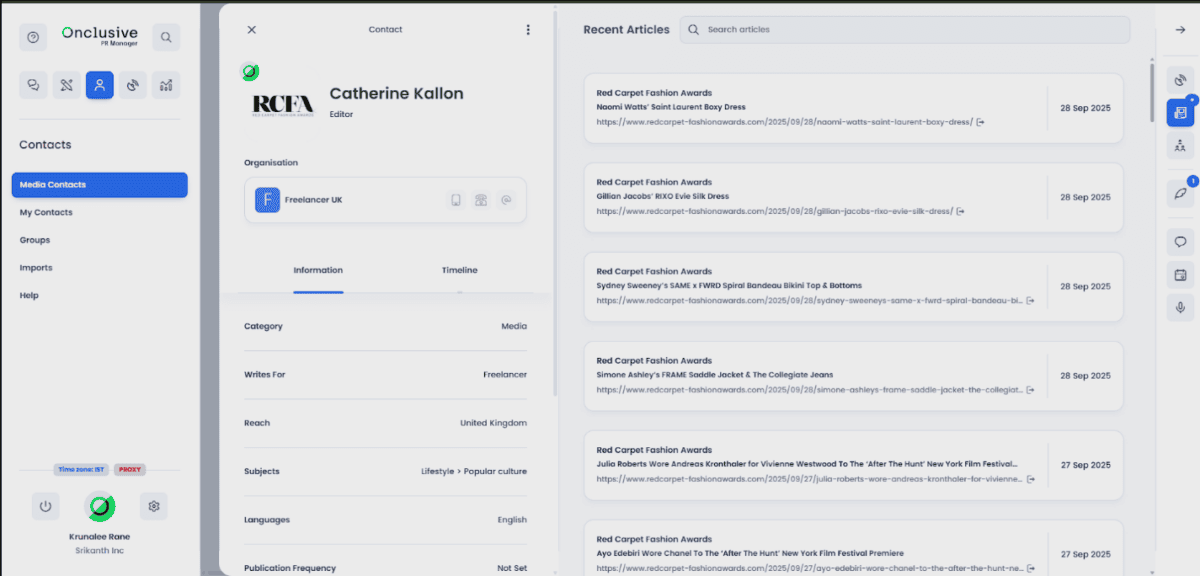
Onclusive’s media contacts database contains 300,000+ regularly updated media contacts and their recent articles, helping you to be targeted in your outreach.
Build relationships before you need them
The best media relations professionals don’t only get in touch with press when they need coverage. They engage with journalists’ work, offer useful context or data even when there’s nothing to pitch, and become a reliable source over time. Journalists remember who wasted their time and who made their job easier.
Craft pitches around what the journalist needs, not what you want to say
A pitch built around your company’s news is a press release. A pitch built around the story a journalist’s readers actually want is media relations. That means leading with the angle, the data, or the human story and keeping it tight enough to read in the time it takes to open an email.
Anatomy of a pitch that gets opened
- A headline that earns the open. You have seconds to earn attention. Your subject line and opening line need to create curiosity or urgency, not just announce your news.
- An introduction with the hook up front. Lead with why anyone should care. Don’t bury the story under company background.
- A clear benefit to the reader. Your story isn’t about you. It’s about what their audience gets from it. Tie it to something timely: recent news, new data, or a story the journalist already covers.
- A simple, scannable structure. Bullet the key facts. Link out to more data rather than including it all inline.
- Real personalization. Reference the journalist’s recent work and explain why this story fits their beat. A first name in the subject line isn’t personalization.
- A complete package. Fact sheets, images, video, quotes, and data ready to go, so the journalist doesn’t have to chase you for what they need.
Personalize at scale
Generic, mass-blasted pitches are easy to spot and easy to ignore. Personalization doesn’t mean writing 50 completely different emails, it means referencing a journalist’s recent work, tailoring the angle to their beat, and proving in the first line that you did your homework. Teams that build this into their process consistently outperform those that don’t, which is exactly why personalized outreach is one of the most data-backed levers in modern pitching.
Timing your outreach
Timing affects open rates as much as the pitch itself. Data from PRNews shows most journalists open pitches between 9am and 1pm local time, many within the first 30 minutes. Sending between 9 and 10am, adjusted for the journalist’s time zone, gives your pitch the best chance of landing when they’re actively scanning their inbox.
Embargoes and exclusives are two ways to guide this timing further. An embargo asks a journalist to hold a story until an agreed release time, giving them preparation time in exchange for early access. An exclusive gives one journalist or outlet first (or sole) rights to a story, in exchange for the coverage guarantee that broad distribution can’t offer. Both are relationship tools. Use them sparingly and honor them without exception, or you’ll burn the trust that makes them work.
Plan around the news agenda
The best pitches don’t just land at the right hour. They land at the right moment in the news cycle.
Knowing what’s coming, industry events, awareness days, product launches, seasonal moments, lets you build a story before a journalist even starts looking for one. It’s the difference between reacting to the news agenda and shaping your place in it.
A global events database gives PR teams the same forward-planning data many journalists use themselves. Onclusive’s covers 250,000+ future events across 140 categories worldwide, maintained by an in-house research team. That level of accuracy matters: our team recently tested whether AI tools could replicate this kind of forward planning data, and found significant gaps in quality, accuracy, and volume compared to human-verified research. That’s the difference between a database you can build a campaign on and one you can’t.
Follow up without becoming a nuisance
One polite, well-timed follow-up is professional. Three unprompted check-ins in a week is how you end up on a mental blocklist. If a journalist hasn’t responded, that’s information. It might be the wrong angle, the wrong timing, or simply the wrong person, and it’s worth adjusting rather than repeating the same pitch louder.
Read our guide: What Makes Journalists Tick? Six Media Relations Rules to Live By
Measuring media relations success
Coverage volume alone is a vanity metric. A more useful measurement framework looks at:
- Placement quality — was the coverage in a publication and section your actual audience reads?
- Message pull-through — did the coverage reflect the angle and key messages you pitched, or did the story go somewhere else entirely?
- Share of voice — how does your coverage volume and tone compare to your named competitors over the same period?
- Sentiment — is the tone of coverage positive, neutral, or negative, and how is that trending over time?
- Downstream impact — did the coverage correlate with upticks in branded search, website traffic, or social mentions?
Tracking these consistently, rather than reporting clip counts after each campaign, is what turns media relations from a series of one-off wins into a strategy leadership can actually evaluate.
Case study: how a four-person team wins national coverage
Avanti West Coast runs media relations for one of Britain’s busiest rail lines with a team of just four, spread across multiple regions. Their approach rests on five things: strategic storytelling, strong relationships with journalists and frontline staff, careful timing, quality multimedia assets, and centralizing everything through Onclusive’s platform.
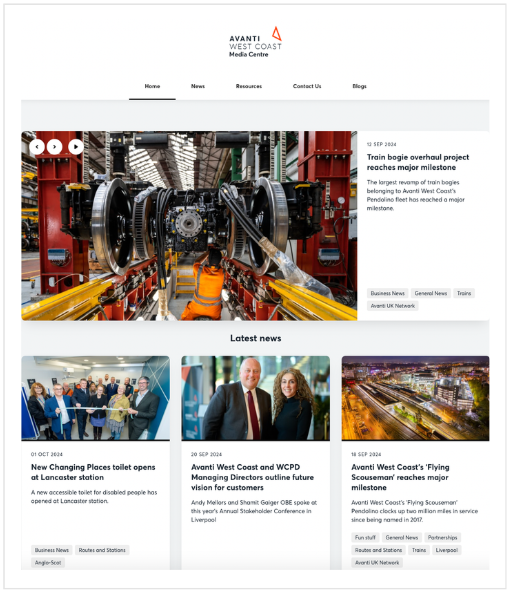
The results speak for themselves: coverage on BBC Breakfast and News at Ten, plus consistent trade and regional pickup, all managed through one integrated newsroom, media contacts database, and query tracking system.
Read the full Avanti West Coast case study
Media relations in the age of AI search
Journalists increasingly use AI tools for research and source discovery, not just search engines. That changes what “being found” means for a comms team.
If your online newsroom isn’t structured for AI systems to read, your official statements can lose out to outdated or third-party summaries, even when a journalist is actively looking for your company’s side of a story. Generative Engine Optimization (GEO), sometimes called AI search optimization, is the practice of structuring newsroom content so AI tools can find, understand, and cite it correctly.
The teams getting ahead here are using consistent terminology across press releases, clear content hierarchies, and up-to-date executive and company information, so both journalists and AI tools land on the accurate version of the story.
Read more: 7 Reasons Your PR Team Needs an AI-Optimized Online Newsroom
How Onclusive supports media relations teams
Strong media relations depends on three things working together: accurate contact data, a home for your story, and the ability to prove impact.
Onclusive’s Media Contacts & Events Database gives PR teams verified, regularly updated journalist information, including each journalist’s recent articles and publication history. That means you can see exactly what a journalist covers and how they cover it, before you ever send a pitch. Outreach built on accuracy, not guesswork.
An online newsroom gives journalists a single, reliable place to find your press releases, media kits, executive bios, and brand assets. It’s often the first stop a reporter makes before they ever reply to a pitch. A well-maintained newsroom builds credibility before a single email goes out.
Once the pitch has landed, media monitoring tracks coverage, sentiment, and share of voice in one place. That closes the loop from outreach to measurable results.
Book a demo to see how Onclusive brings media contacts, newsroom, and monitoring together in one platform.