






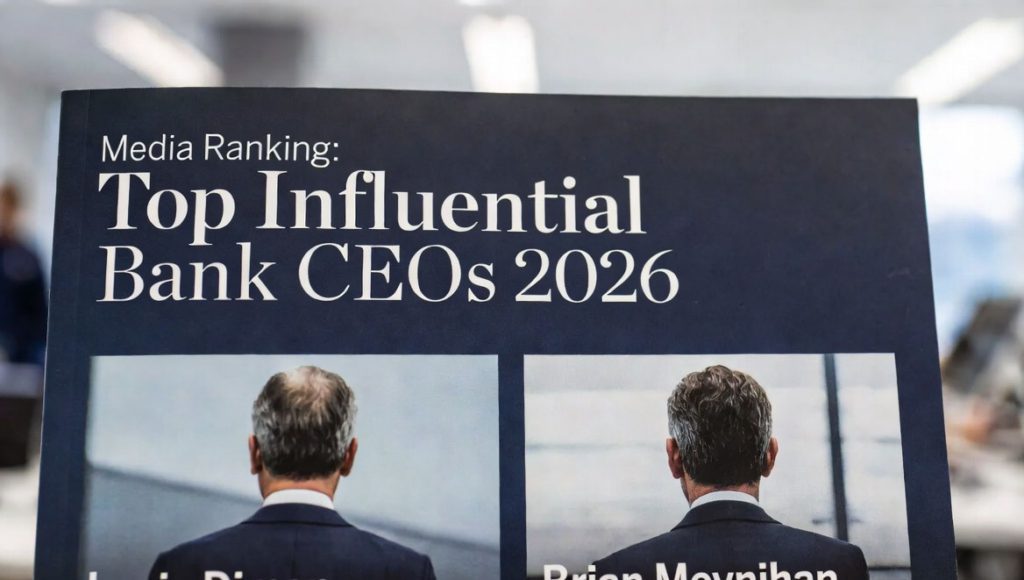
Behind every major bank is a face the media keeps returning to. Our analysis of 53 banking CEOs across January 2025 to January 2026 reveals something striking: the most influential bank CEOs are no longer just business leaders. They have become economic commentators, policy critics, and societal voices that media across every beat – from finance to politics to culture – cannot stop quoting.
This analysis is part of our full Banking Industry Scan 2026, a comprehensive study covering social media share of voice across 10 major banks, LinkedIn content rankings, trending hashtag analysis, customer conversation topics, challenges facing banks in 2026, BNPL disruption, sports sponsorship impact, and the mainstream media stories generating the most reach. This study was conducted using Onclusive Monitor | Self-Service and Onclusive Social.
Table of Contents
The ranking: who dominates media attention
The three most influential bank CEOs: what sets them apart
The topics: what the most influential bank CEOs are quoted on
Why the media relies on bank CEOs beyond finance
Strategic implications for PR and comms professionals
Conclusion about the most influential bank CEOs
FAQ: frequently asked questions about the most influential bank CEOs
The ranking: who dominates media attention
Across 53 banking CEOs tracked from January 2025 to January 2026, visibility
is extraordinarily concentrated:
| Rank | CEO | Bank | Share of media mentions |
| 1 | Jamie Dimon | JPMorgan Chase | 38.2% |
| 2 | Brian Moynihan | Bank of America | 18.7% |
| 3 | Andrea Orcel | UniCredit | 9.2% |
| 4 | Jane Fraser | Citigroup | 6.8% |
| 5 | Bill Winters | Standard Chartered | 6.6% |
| 6 | Carlo Messina | Intesa Sanpaolo | 4.7% |
| 7 | Ted Pick | Morgan Stanley | 3.5% |
| 8 | Charlie Scharf | Wells Fargo | 3.0% |
| 9 | Gonzalo Gortázar | CaixaBank | 2.8% |
| 10 | Georges Elhedery | HSBC | 1.8% |
Most popular CEOs of banking companies discussed on social media and in media: January 2025 – January 2026. Top 10 from a list of 53 CEOs.
The numbers reveal a winner-takes-most dynamic. Jamie Dimon alone captures more coverage than the remaining 10 ranked CEOs combined. The top three account for 66.1% of all coverage. From position four onward, visibility drops sharply – and for the majority of the 53 CEOs tracked, media presence remains marginal.
For PR and communications professionals, this concentration matters. Building a banking CEO into a genuinely influential media voice requires sustained, deliberate strategy – not just reactive comment. The gap between first and fourteenth is not primarily about the size of the institution. It is about positioning, consistency, and willingness to speak on topics beyond the bank’s immediate business.
The three most influential bank CEOs: what sets them apart
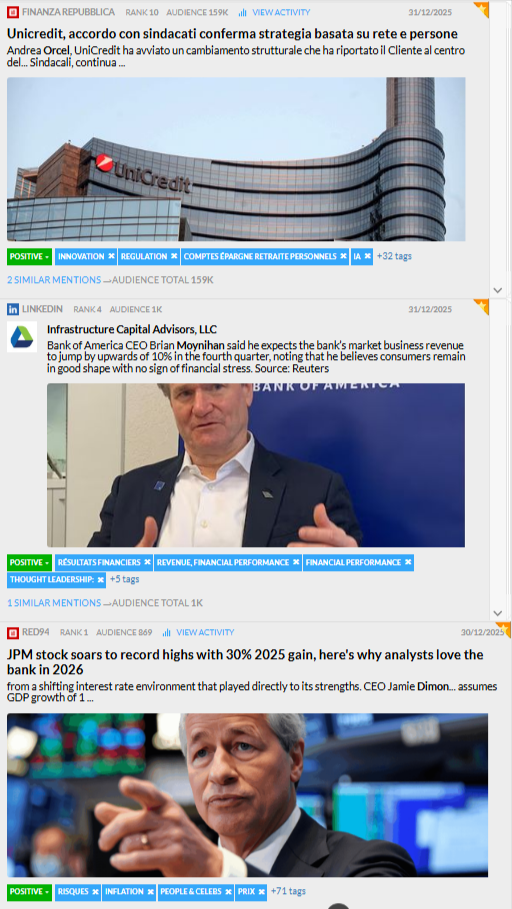
Jamie Dimon: Wall Street’s unofficial economic oracle
At 38.2%, Dimon’s influence is in a category of its own. His dominance stems from a combination of factors that few banking leaders can replicate: 18+ years leading the largest US bank, a willingness to publicly criticise both political parties, and a track record of crisis navigation that gives his commentary institutional weight.
What makes Dimon consistently quotable is not just what he says, but the breadth of what he covers. Journalists writing about tariff policy, Federal Reserve decisions, geopolitical risk, return-to-office debates, and AI disruption all find reasons to include a Dimon quote. He has effectively become a default voice for economic uncertainty across every beat – business, politics, and beyond.
Brian Moynihan: the data-driven consumer authority
At 18.7%, Moynihan’s influence is built on a different foundation. Bank of America’s 67 million clients give him access to proprietary spending data that makes his commentary on consumer financial health uniquely authoritative. While Dimon tends toward broad macro pronouncements, Moynihan’s media value is grounded in real-time economic indicators that journalists and economists rely on to understand what is happening to ordinary consumers.
His measured, data-first approach gives him consistent relevance across economic cycles. When the question is not “what will happen to markets” but “what are consumers actually doing”, Moynihan is the voice editors reach for.
Andrea Orcel: Europe’s most newsworthy dealmaker
At 9.2%, Orcel generates coverage disproportionate to his institution’s size because he is the face of a story the financial press finds irresistible: the reshaping of European banking. His attempted Banco BPM takeover, his Commerzbank stake, and his broader European consolidation thesis give him a running narrative that continues to develop. His investment banking background brings a style of ambition and confrontation that European banking rarely produces at CEO level, and his controversial history – including the aborted Santander appointment lawsuit – keeps journalists returning even when there is no immediate news to report.
The topics: what the most influential bank CEOs are quoted on
Our analysis of the 15 most frequently addressed topics in bank CEO media coverage – drawn from 100 topics analyzed – reveals a consistent pattern: the most influential bank CEOs are pulled toward macro themes that connect banking to the broader economy.
| Topic | Share of coverage |
| Inflation | 6.2% |
| Wealth management | 6.2% |
| Talent and culture | 5.7% |
| Investment banking | 5.2% |
| Interest rates | 4.3% |
| Acquisitions | 3.9% |
| Climate and ESG | 3.8% |
| Banking sector health | 3.6% |
| Consumer spending | 3.5% |
| Bank profitability | 3.4% |
| Risk management | 3.1% |
| Net interest income | 2.9% |
| Economic recession risks | 2.8% |
| Central bank policy | 2.8% |
| Capital return | 2.7% |
Top 15 most frequently addressed bank CEO topics in media, January 2025 – January 2026. % of conversations out of 100 analyzed.
Inflation and wealth management share the top spot at 6.2% each. Inflation gives the most influential bank CEOs universal relevance – their transaction data positions them as more immediate economic authorities than government statistics alone. Wealth management reflects where banking strategy is heading as traditional lending margins compress, and the topic connects CEO commentary to M&A activity, technology disruption, and geographic expansion.
Talent and culture at 5.7% is the most surprising entry in the top five. Return-to-office policies, hybrid work debates, and competition for talent from tech companies and fintech startups have kept this topic in continuous media circulation well beyond its pandemic-era origins. The most influential bank CEOs are now quoted on workforce policy in general business press as regularly as in specialist financial media.
The lower half of the list – cybersecurity, recession risks, central bank policy, capital return – represents territory where CEO commentary is reactive rather than agenda-setting, responding to external events rather than driving the conversation. Banks looking to build proactive CEO influence should focus on the upper half, where sustained expertise creates recurring media opportunities.

Why the media relies on the most influential bank CEOs beyond finance
Understanding why journalists return repeatedly to the most influential bank CEOs requires understanding what they offer that other business leaders do not.
The most influential bank CEOs have access to economic data at a scale no government agency can match in real time. Daily transaction flows across millions of consumer accounts, corporate treasury movements, and lending patterns give them a live view of economic behaviour. When a journalist needs to understand whether consumers are still spending despite rate hikes, or whether corporate confidence is genuinely recovering, a banking CEO can answer from proprietary data rather than surveys or models.
This positions them as credible sources not just for the financial press, but for political correspondents covering tariff impacts, consumer reporters covering inflation, and technology journalists covering fintech disruption. A single CEO with a clear point of view and institutional credibility can become the default voice across multiple beats simultaneously.
The media also relies on the most influential bank CEOs because the institutions they lead are deeply embedded in national economic identity. When JPMorgan, Barclays, BNP Paribas, or Deutsche Bank makes a strategic decision, it has implications for thousands of businesses, millions of consumers, and government tax revenues. Their CEOs carry a form of institutional authority that most corporate leaders simply do not.
Strategic implications for PR and comms professionals
The concentration of media visibility among a handful of CEOs is not accidental. It reflects deliberate communications choices that other institutions can learn from.
Consistency across topics is more valuable than depth on one. Dimon’s dominance is not built on owning a single narrative – it comes from sustained, credible commentary across inflation, geopolitics, talent, M&A, and technology. Building a CEO into a recurring media source requires establishing relevance across the topics that journalists cover most, not just those most directly linked to the bank’s products.
The gap between the top three and the rest is a communications gap, not a size gap. HSBC, Deutsche Bank, Barclays, and UBS are all globally significant institutions. Their CEOs’ relatively low media visibility reflects positioning and media strategy choices more than institutional importance. European banks in particular have a structural opportunity to build the kind of international CEO influence their current coverage levels do not reflect.
Talent and culture commentary is an underutilised entry point. At 5.7% of CEO coverage, this topic is already significant – and it is one where any banking CEO can develop a credible point of view without needing unique transaction data. Return-to-office, skills competition with tech firms, and AI’s impact on banking jobs are topics that general business journalists actively seek expert comment on. For banks looking to expand CEO media influence beyond financial results, this is accessible territory.
Proactive commentary on acquisitions and ESG builds long-term narrative equity. At 3.9% and 3.8% respectively, these topics reward CEOs who develop consistent, distinctive positions rather than commenting only when they have a deal to announce or a sustainability report to publish. Orcel’s visibility is partly a product of having an articulated, repeated thesis on European banking consolidation – not just individual deal announcements.
Monitoring CEO media presence systematically reveals competitive intelligence. Tracking which topics your CEO is quoted on versus which topics competitors own identifies both gaps in your current positioning and opportunities for differentiation. Onclusive’s media monitoring capabilities allow communications teams to track CEO share of voice at the topic level across mainstream press, online mentions, TV, radio, and international media.
Conclusion about the most influential bank CEOs
The most influential bank CEOs have become among the most reliably quoted sources in all of journalism – not because they run large companies, but because their institutions give them a unique vantage point on the economy, the workforce, and society. The media’s reliance on them reflects a genuine informational need that goes far beyond quarterly earnings commentary.
For PR and communications professionals, the implication is strategic. The banks that achieve the highest CEO visibility do so through deliberate, sustained positioning across a broad range of topics – connecting institutional credibility to consistent, quotable points of view on the issues journalists cover most.
The gap between Jamie Dimon at 38.2% and the majority of banking CEOs in single-digit or sub-1% visibility is not primarily a function of bank size. It is a function of how deliberately and consistently a CEO engages with the topics that matter beyond the balance sheet.
Our full Banking Industry Scan 2026 goes much further, covering social media share of voice for 10 major banks, LinkedIn content and audience analysis, trending hashtag data, customer experience topics, challenges facing banks in 2026, BNPL competitive disruption, sports sponsorship ROI, and the most visible mainstream media articles for each institution. CEO influence is one critical dimension in a much larger picture.
About the data: analysis of the most influential bank CEOs examined 53 banking CEOs from January 2025 to January 2026, covering social media and mainstream media mentions. Topic analysis covers 15 topics from a universe of 100 analyzed. The full Banking Industry Scan covers 12 months of data across 53 banks. Produced with specialised Onclusive tools – Media Monitoring and Analysis: Onclusive Monitor | Self-Service , Social Media Monitoring and Analysis: Onclusive Social.
FAQ: frequently asked questions about the most influential bank CEOs
Who are the most influential bank CEOs in 2026?
Based on media mentions tracked from January 2025 to January 2026 across 53 CEOs, the most influential bank CEOs are Jamie Dimon of JPMorgan Chase (38.2%), Brian Moynihan of Bank of America (18.7%), Andrea Orcel of UniCredit (9.2%), Jane Fraser of Citigroup (6.8%), and Bill Winters of Standard Chartered (6.6%).
Why is Jamie Dimon considered the most influential bank CEO?
Dimon’s dominance reflects multiple reinforcing factors: 18+ years leading the largest US bank, political fearlessness in criticising both parties, consistent commentary across macro topics beyond banking, and a crisis navigation track record that gives his views institutional weight. He functions as a default economic voice across multiple media beats simultaneously, which no other banking CEO currently replicates.
What topics do the most influential bank CEOs get quoted on?
Inflation and wealth management each account for 6.2% of coverage, followed by talent and culture (5.7%), investment banking (5.2%), and interest rates (4.3%). The full top 15 spans acquisitions, ESG, consumer spending, bank profitability, risk management, recession risks, and central bank policy.
Which European bank CEO is the most influential?
Andrea Orcel of UniCredit ranks third globally at 9.2%, driven by M&A activity including the Banco BPM takeover attempt and Commerzbank stake, as well as his broader European banking consolidation thesis. He generates coverage disproportionate to his institution’s size due to consistent dealmaking activity and a willingness to challenge the status quo in European banking.
Why do European bank CEOs rank lower than US counterparts in media influence?
The data reveals a structural gap. CEOs of globally significant European institutions – HSBC, Deutsche Bank, Barclays, UBS – rank between 10th and 14th despite the scale of their banks. This reflects a combination of media strategy choices, the greater volume of US financial media relative to European outlets, and a tendency for European banking leaders to comment reactively rather than proactively. It also represents a significant, largely untapped opportunity.
Why do the most influential bank CEOs get quoted on topics beyond banking?
The most influential bank CEOs have access to real-time economic data – from millions of daily consumer transactions and corporate flows – that no government agency can match for immediacy. This positions them as credible sources for political correspondents, consumer reporters, and technology journalists, not just financial media. Their institutional authority extends well beyond their balance sheets.
How can PR and comms teams build a more influential banking CEO?
Our analysis identifies three evidence-based approaches: building consistent commentary across multiple topic areas rather than only responding to immediate business news; developing a clear, repeatable thesis on a major industry trend (as Orcel has done with European consolidation); and entering the talent and culture conversation, which offers accessible entry points beyond pure financial commentary.
Is CEO influence correlated with bank size?
Not directly. While the largest US banks produce the most visible CEOs, the relationship is not automatic. Several major global banks have CEOs with relatively low media visibility, suggesting that communications strategy, positioning, and willingness to engage publicly on broad economic topics matters as much as institutional scale.
What does the full Banking Industry Scan cover beyond the most influential bank CEOs?
The complete report includes social media and mainstream media share of voice for 10 selected banks, LinkedIn owned and earned media analysis across 59 banks, trending hashtag analysis, customer conversation topics across products and services, challenges facing banks in 2026, BNPL competitive analysis, sports sponsorship impact, and the most visible mainstream media articles for each company.
How is CEO influence measured in this report?
Our analysis tracks CEO mentions across social media and mainstream media – including online news, print, TV, radio, and international outlets – using Onclusive’s media monitoring platform. Share of voice percentages represent each CEO’s proportion of total coverage across the 53 CEOs in the study, covering January 2025 to January 2026.