



Banking companies on LinkedIn are discovering a critical disconnect between how they present themselves on LinkedIn and what professionals actually want to discuss
When banks share content on LinkedIn, they lead with thought leadership and deal-making. When LinkedIn users discuss these same banks, the conversation centers on careers, jobs, and professional development.
This isn’t a problem, it’s a strategic opportunity. Our analysis of 328,677 LinkedIn mentions across 59 banking companies, plus 3,541 owned media posts from 46 bank accounts, reveals a communication gap that forward-thinking institutions can turn into competitive advantage. This study was conducted using the media and social media collection and analysis tools Onclusive 360 and Onclusive Social.
Table of contents
Key takeaways about banking companies on Linkedin
The strong foundation: What banks are doing right
The audience insight: What professionals and customers are really discussing
The employer brand gap: Strategic alignment
Strategic recommendations: from thought leadership to talent magnetism
The path forward: from market experts to career destinations
Conclusion about banking companies on LinkedIn
FAQ: Frequently Asked Questions about banking companies on LinkedIn
Our full Banking Industry Scan goes far beyond LinkedIn. It covers the complete media landscape, including share of voice across social media and mainstream media for 10 major banks, trending hashtag analysis, customer conversation topics, challenges facing banks in 2026, CEO media visibility, BNPL disruption, sports sponsorship impact, and the top mainstream media stories shaping the industry. LinkedIn is just one piece of a much larger picture.
Key takeaways about banking companies on Linkedin
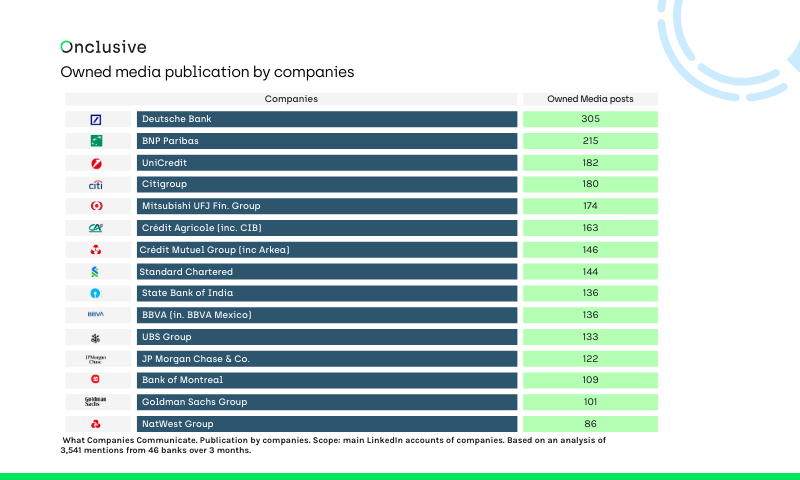
Deutsche Bank leads banking owned media activity on LinkedIn with 305 posts in three months, followed by BNP Paribas (215) and UniCredit (182).
HSBC dominates earned media conversations with 42,800 mentions, ahead of Bank of America (34,199) and JPMorgan Chase (28,964).
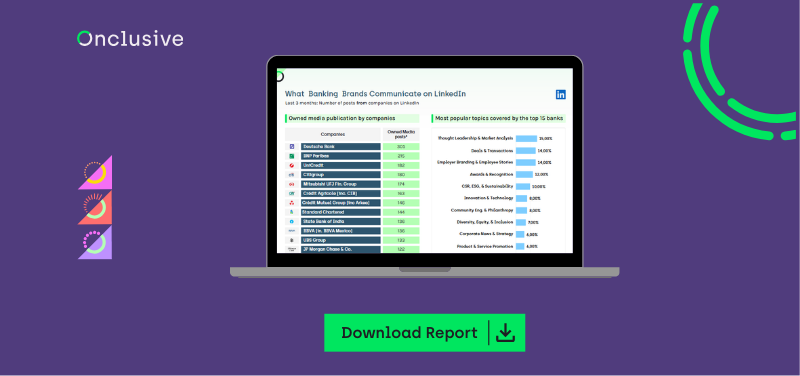
15% of bank-published content focuses on Thought Leadership & Market Analysis, followed by Deals & Transactions (14%) and Employer Branding & Employee Stories (14%).
30% of audience conversations center on careers and employment (18% Career Announcements + 12% Job Postings), making professional development the dominant topic when people talk about banks.
Owned media posts generate 25x more engagement than earned media on average (256 vs. 10.4 interactions per post), but earned media reaches vastly more people.
The opportunity: Banks can leverage their strong thought leadership content while better connecting it to the career and professional development topics their audience cares about most.
The solution: A content strategy that maintains credibility in market analysis while actively engaging with the workforce narrative that defines how most professionals experience banking brands on LinkedIn.
The strong foundation: What banks are doing right
Over the last three months, banking companies demonstrated impressive LinkedIn commitment, with Deutsche Bank leading at 305 posts, followed by BNP Paribas (215), UniCredit (182), and Citigroup (180). This consistent output shows the industry’s investment in professional engagement across global markets (*).
Thought leadership first: A strategic necessity
15% of banking companies’ LinkedIn content focuses on Thought Leadership & Market Analysis, and for excellent reasons.
This investment in intellectual authority makes strategic sense:
- Client confidence: Demonstrating market expertise and analytical depth
- Brand positioning: Establishing banks as trusted voices on economic trends
- Talent attraction: Signaling the caliber of thinking within the organization
- Competitive differentiation: Showcasing unique perspectives on markets and policy
This isn’t generic content, it’s mission-critical. In an industry where trust and credibility determine client relationships, thought leadership is the foundation of brand authority.
The deal-making narrative
Deals & Transactions content (14%) reflects the industry’s core business storytelling. Banks are showcasing:
- High-profile M&A advisory mandates
- Cross-border transaction capabilities
- Sector-specific expertise through deal announcements
- Scale and market position through transaction volumes
This content performs particularly well when it moves beyond announcements to tell the strategic story behind the deal.
The employer brand investment
Employer Branding & Employee Stories (14%) shows banks understand LinkedIn’s dual purpose. This is the single most interesting finding on the owned media side, because it closely mirrors what the audience is actually discussing. Banks are beginning to lean into their role as major employers of skilled professionals, and this alignment is strategic.
What drives the biggest engagement spikes
The top-performing banking posts on LinkedIn reveal what truly captures professional attention. JPMorgan Chase’s announcement of its new NYC headquarters generated 19,378 interactions, the highest of any banking post analyzed. State Bank of India’s new YONO app launch reached 8,973 interactions, while JPMorgan’s London headquarters announcement hit 7,971. Goldman Sachs drove strong engagement through its McLaren F1 partnership tied to Lando Norris’s victory (7,963) and Lloyd Blankfein’s memoirs (3,891).
The pattern is clear: major corporate milestones and strategic partnerships dramatically outperform routine content. Sports partnerships in particular create significant interaction spikes, a theme that plays out across the broader report.
(* Study conducted over a period of 3 months. The number of posts per company may vary depending on their news and seasonality.)
The audience insight: What professionals and customers are really discussing
Now for the revealing part: what happens when banks aren’t controlling the narrative shows exactly where the audience’s attention sits, and it’s overwhelmingly focused on careers and professional development.
The careers conversation: An open door for engagement
18% of earned media conversations about banks focus on Career Announcements, and another 12% on Job Postings & Recruitment.
Combined, 30% of all organic LinkedIn conversation about banks is about employment. This is the single most important finding in the LinkedIn section of our report.
Here’s the positive reframe: nearly a third of your audience is actively engaged with your brand as an employer and waiting for you to participate in that conversation more deliberately.
This represents enormous opportunity:
- Talent pipeline: Organic career conversations signal high interest in banking roles
- Employer brand amplification: People are already advocating for or discussing your workplace
- Recruitment efficiency: Active job seekers are mentioning your brand, creating warm leads
- Culture storytelling: Career announcements from employees serve as authentic testimonials
| Topic | Share |
| 💼 Career Announcements | 18.0% |
| 📰 Industry News & Commentary | 15.0% |
| 📋 Job Postings & Recruitment | 12.0% |
| 🎓 Virtual Programs & Certifications | 10.0% |
| 🎪 Events & Conferences | 9.0% |
| 🤝 B2B & Vendor Content | 8.0% |
| 💡 Thought Leadership | 7.0% |
| 🏆 Third-Party Recognition | 6.0% |
| 🌱 CSR & Sponsorship Thanks | 5.0% |
| 🔍 Job Seeking | 4.0% |
| 🔧 Technology & Innovation | 4.0% |
| ⚠️ Criticism & Activism | 2.0% |
The most popular topic categories on LinkedIn related to banking companies
The conversations happening include:
- Employees celebrating new roles and promotions at major banks
- Professionals sharing their experiences in banking programs and internships
- Active job seekers publicly expressing interest in specific institutions
- Industry commentary that positions banks as economic bellwethers
The key insight: People aren’t just consuming your thought leadership, they’re evaluating you as an employer. The banks that lean into this reality will win the talent war.
Virtual programs & certifications: An unexpected powerhouse
At 10%, Virtual Programs & Certifications is a surprisingly strong category. Forage simulations and similar virtual experience programs generate significant organic content as participants share certificates and learnings.
This is great news. It means:
- Early talent engagement: Students and early-career professionals actively engage with banking brands
- Organic advocacy: Program participants become brand ambassadors without being asked
- Pipeline building: Virtual programs create measurable brand affinity before recruitment
- Content multiplication: Each participant generates multiple posts across their network
The sentiment story: A credibility advantage
The earned vs. owned media comparison reveals a notable insight about trust and engagement:
- Owned media averages 256 interactions per post with ~95%+ positive sentiment
- Earned media averages 10.4 interactions per post with 53.8% positive sentiment
- Negative sentiment in earned media sits at just 2.8%, while criticism and activism represents only 2% of topics
This means the overwhelming majority of organic conversation about banks on LinkedIn is neutral to positive. Banks have a credibility advantage on this platform that they can build on.
The employer brand gap: Strategic alignment
Here’s the strategic opportunity:
- Banks dedicate 15% of LinkedIn content to Thought Leadership & Market Analysis and 14% to Deals & Transactions
- LinkedIn users dedicate 30% of their banking discussions to career-related topics (Career Announcements + Job Postings)
This gap represents untapped communication territory where banks can differentiate themselves, strengthen employer brand, and connect with the largest segment of their LinkedIn audience.
Why this opportunity is valuable
- The audience is already there
Unlike topics where you need to create demand for attention, 30% of your audience is already talking about careers at your institution. You just need to show up in that conversation more deliberately.
- Employer brand drives business brand
In financial services, talent quality directly impacts client outcomes. Banks known as great employers attract better analysts, advisors, and dealmakers, which strengthens the thought leadership and deal-making content that defines their brand.
- Early talent loyalty
Virtual programs (10% of conversations) represent the future workforce actively engaging with your brand. Meeting them where they are builds loyalty that translates to recruitment efficiency.
- Authenticity at scale
Employee-generated career content is perceived as more authentic than corporate messaging. Encouraging and amplifying this content costs little but delivers outsized credibility.
Strategic recommendations: from thought leadership to talent magnetism
1. Complete your LinkedIn narrative
You’ve built strong credibility around thought leadership and deal flow. Now extend the story by connecting institutional excellence to the people who make it happen:
Evolution approach: “Our team just closed a landmark cross-border acquisition, and here’s what the experience meant for the professionals who led it”
This doesn’t replace market analysis; it humanizes it by showing the career trajectories behind the headlines.
2. Activate the employer brand engine
Rather than treating employer branding as a separate HR function, integrate it into your core content strategy:
- Amplify employee career announcements with institutional commentary
- Create series around “day in the life” content for high-demand roles
- Showcase internal mobility stories that demonstrate career growth
- Highlight virtual program participants and their journeys
This leverages organic conversation that’s already happening.
3. Bridge thought leadership and careers
Your market analysis content is strong. Make it do double duty:
- Feature the analysts and researchers behind your reports
- Connect market insights to the skills and expertise required to produce them
- Use thought leadership content as a talent attraction tool
This maintains your intellectual authority while addressing audience interest.
4. Optimize content mix
Consider adjusting your content allocation:
- 25% Thought Leadership & Market Analysis (maintain strength)
- 20% Employer Branding & Employee Stories (increase to match audience interest)
- 15% Deals & Transactions (maintain with more human stories)
- 15% Awards, Recognition & Virtual Programs (amplify what’s working)
- 10% CSR, ESG & Community (continue purpose-driven content)
- 10% Innovation, Technology & Corporate News
- 5% Events & Conferences
This maintains your core authority while significantly increasing alignment with audience interest.
5. Leverage the virtual programs opportunity
Virtual programs generate 10% of all earned media mentions, an outsized impact for relatively low investment:
- Encourage program participants to share their experiences
- Create branded hashtags for virtual program cohorts
- Feature top participants in owned content
- Build pipelines from virtual programs to internships to full-time roles
This turns a talent development tool into a content engine
The path forward: from market experts to career destinations
Banking companies have built remarkable LinkedIn presence around thought leadership and deal-making, and rightfully so. This foundation of market credibility is invaluable.
The opportunity now is to extend this strength by engaging more deliberately with the career and professional development conversations that dominate how people actually experience banking brands on LinkedIn. Your audience isn’t rejecting your thought leadership; they’re looking at your institution through the lens of “would I want to work there?” and “what would my career look like?”
15% thought leadership. 30% career interest. A wide-open strategic opportunity.
The banks that will lead aren’t those that abandon their market authority. They’re the ones that complete the picture by connecting institutional excellence to the professional journeys of the people inside, making thought leadership and employer brand complementary rather than competing narratives.
Beyond LinkedIn, the full Banking Industry Scan reveals how these dynamics play out across the entire media landscape, from the social media conversations where crypto and blockchain dominate the hashtag conversation, to the mainstream media coverage where stock performance and financial results lead, to the CEO visibility rankings where Jamie Dimon commands 38.2% of all banking CEO media presence. Sports sponsorships, BNPL disruption, and customer experience trends round out a comprehensive view of the forces reshaping banking communications.
Conclusion about banking companies on LinkedIn
Your LinkedIn audience is engaged, career-focused, and evaluating your institution as a potential employer. They’re interested in your market expertise, curious about your culture, and actively sharing their professional experiences. This isn’t noise, it’s an invitation to deeper engagement.
The banking companies that accept this invitation, bringing the same sophistication to employer brand storytelling that they bring to thought leadership content, will build the talent pipelines and stakeholder trust that define industry leadership.
The complete Banking Industry Scan goes much further than the banking companies on LinkedIn, covering social media share of voice across 10 major banks, trending topics and hashtags, customer sentiment analysis, banking challenges for 2026, CEO media visibility, BNPL competitive dynamics, sports sponsorship ROI, and the mainstream media stories generating the most reach. LinkedIn is one critical channel in a much broader communications landscape.
About the data: banking companies on LinkedIn analysis examined 328,677 LinkedIn mentions across 59 banking companies, plus 3,541 owned media posts from 46 bank accounts, covering a three-month period. The full Banking Industry Scan covers social media and mainstream media share of voice, hashtag analysis, customer topics, industry challenges, CEO visibility, BNPL disruption, sports sponsorships, and top media articles across a 12-month period for 53 banks. Companies in the LinkedIn analysis include HSBC, Bank of America, JPMorgan Chase, Goldman Sachs, Barclays, Morgan Stanley, Wells Fargo, BNP Paribas, Deutsche Bank, Standard Chartered, and many more.
Produced with specialized Onclusive tools.
Media Monitoring and Analysis: Onclusive 360,
Social Media Monitoring and Analysis: Onclusive Social
FAQ: Frequently Asked Questions about banking companies on LinkedIn
Which bank posts the most on LinkedIn?
Deutsche Bank leads with 305 LinkedIn posts over a three-month period, followed by BNP Paribas (215 posts) and UniCredit (182 posts). These European banks demonstrate particularly high commitment to professional audience engagement.
What do banking companies talk about on LinkedIn?
Thought Leadership & Market Analysis leads at 15% of content, followed by Deals & Transactions (14%), Employer Branding & Employee Stories (14%), Awards & Recognition (12%), and CSR, ESG & Sustainability (10%).
Which bank gets the most mentions on LinkedIn?
HSBC dominates earned media with 42,800 mentions over three months, followed by Bank of America (34,199), JPMorgan Chase (28,964), Goldman Sachs (26,937), and Barclays (26,830).
What topics get the most engagement on banking LinkedIn posts?
Major corporate announcements generate the highest engagement. JPMorgan Chase’s new NYC headquarters inauguration achieved 19,378 interactions, the highest of any banking post analyzed. Sports partnerships also create significant interaction spikes.
Why is there a gap between what banks post and what audiences discuss?
Banks focus on thought leadership and deals (29% combined) to demonstrate market expertise, while audiences are most interested in career-related topics (30% combined). This gap represents an opportunity to connect institutional authority with employer brand storytelling.
How do banking companies perform on LinkedIn compared to other social media?
LinkedIn is distinctive for banking because it’s where professional reputation is built. Our full report shows that on broader social media, Bank of America and JPMorgan Chase lead with 2.72M and 2.71M mentions respectively, driven by different topics like crypto, customer service, and sports sponsorships.
What’s the sentiment around banks on LinkedIn?
Owned media maintains ~95%+ positive sentiment, while earned media shows 53.8% positive and only 2.8% negative sentiment. Criticism and activism represents just 2% of all earned media topics, making LinkedIn a comparatively favorable environment for banking brands.
What drives the most organic conversation about banks?
Career-related content dominates, with Career Announcements (18%) and Job Postings & Recruitment (12%) together representing 30% of all earned media conversations. Virtual Programs & Certifications (10%) is another surprisingly strong driver.
What does the full Banking Industry Scan cover beyond LinkedIn?
The complete report includes social media and mainstream media share of voice for 10 selected banks, trending hashtag analysis, customer conversation topics (products, services, and experience), challenges facing banks in 2026, CEO media visibility rankings, BNPL competitive analysis, sports sponsorship impact, and the most visible mainstream media articles for each company.
How can banks improve their LinkedIn strategy?
Banks should maintain their thought leadership strength while increasing employer brand content to match audience interest. A balanced approach that connects market expertise to the professional journeys of employees creates a more complete and compelling narrative.