





Leading pharmaceutical companies are discovering how to align their innovation story with what patients and professionals really want to hear
When pharma companies on LinkedIn share their stories , they rightfully lead with innovation. When LinkedIn users discuss these same companies, they want to understand access and affordability alongside those breakthroughs.
This isn’t a crisis-it’s an opportunity. Our analysis of 228,100 LinkedIn mentions across top pharmaceutical companies reveals a strategic opening: the industry has built tremendous credibility around innovation, and now has the chance to extend that narrative to address the questions their audience is actively asking. This study was conducted by combining mainstream media monitoring and social media listening insights using Onclusive 360 and Onclusive Social.
In an industry where scientific advancement moves at unprecedented speed, the companies that can tell the complete story-from lab to patient-will build lasting competitive advantage.
Key Takeaways about Pharma Companies on LinkedIn
- AstraZeneca leads pharmaceutical owned media activity on LinkedIn with 223 posts in three months, followed by Boehringer Ingelheim (180) and Pfizer (126) during the period studied.
- 50.30% of pharma content focuses on Innovation & R&D – demonstrating the industry’s commitment to showcasing scientific advancement
- 28.3% of audience conversations center on Drug Pricing & Access – revealing a significant gap between the content provided by pharmaceutical companies and the audience’s interest in the first topic discussed.
- 26.3% of discussions involve Clinical Trials & Research – showing high audience engagement with scientific content
- 18.4% of conversations focus on vaccines – indicating sustained public interest in preventive medicine
- The opportunity: Pharmaceutical companies can extend their strong innovation narrative by proactively addressing access and affordability topics
- The solution: A balanced content mix that maintains innovation leadership while answering the questions audiences are actively asking
The Strong Foundation: What Pharma Companies Are Doing Right
Over the last three months, pharmaceutical companies demonstrated good LinkedIn engagement, thanks to their regular and relevant publication, with AstraZeneca leading at 223 posts, followed by Boehringer Ingelheim (180), Pfizer (126), and Bristol-Myers Squibb (122). This consistent, high-quality output shows the industry’s commitment to professional engagement *. This is one of the findings of our brand new Industry Scan Media and Social Media report covering the pharmaceutical industry.
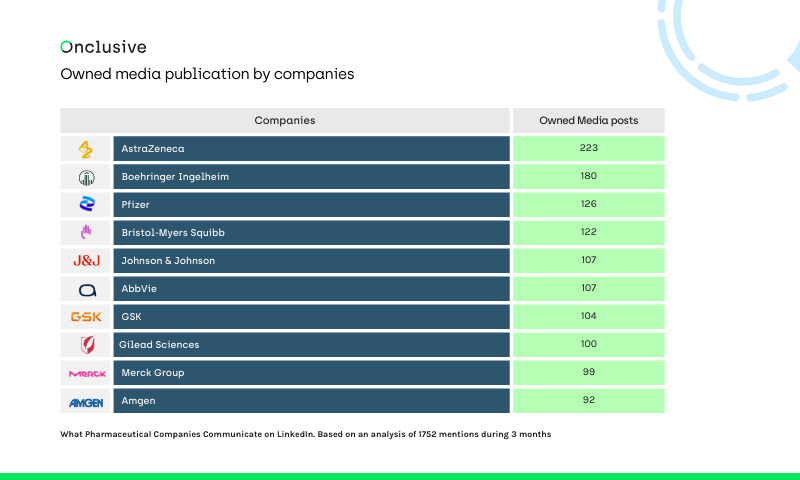
Owned Media: What Companies Communicate. Publication by companies. Scope: main LinkedIn accounts of companies. Based on an analysis of 1752 mentions during 3 months.
Innovation Leadership: A Strategic Necessity
50.30% of pharmaceutical companies’ LinkedIn content focuses on Innovation & R&D-and for excellent reasons.
This heavy investment in innovation storytelling makes strategic sense:
- Investor confidence: Demonstrating pipeline strength and future revenue potential
- Price justification: Connecting high R&D costs to breakthrough therapies
- Talent attraction: Positioning companies as leaders in cutting-edge science
- Competitive differentiation: Showcasing unique capabilities and therapeutic advances
This isn’t misguide, it’s mission-critical. Without innovation, pharmaceutical companies can’t serve patients. The 50% allocation reflects the industry’s core purpose: advancing medical science.
Patient-Centric Progress
Diseases & Therapies content (26%) shows the industry’s evolution toward patient-focused storytelling. Companies are increasingly:
- Humanizing their brands through patient impact stories
- Raising awareness of underserved disease areas
- Creating emotional connections beyond products
- Demonstrating concrete health outcomes
This shift from “what we make” to “who we help” represents meaningful progress in corporate communication.
Smart Employer Branding
Employment & Careers (3.70%) reflects sophisticated multi-purpose communication. Pharmaceutical companies recognize LinkedIn as both a stakeholder engagement platform and a talent acquisition channel.
In a fierce competition for data scientists, AI specialists, and biotech researchers, these companies are smartly leveraging their innovation narrative for recruitment. This is strategic efficiency, not mission drift.
(* Study conducted over a period of 3 months. The number of posts per company may vary depending on their news and seasonality.)

Want to see how your pharmaceutical company performs on LinkedIn compared to competitors? Download our complete Pharmaceutical Industry Scan 2025 for share of voice rankings, disruptive topics, media presence and competitive benchmarking across all major platforms. [Download the Full Report]
The Audience Insight: What Stakeholders Are Curious About
Now for the fascinating part: what happens when pharmaceutical companies on LinkedIn aren’t controlling the narrative reveals incredible audience engagement opportunities.
The Access Conversation: An Invitation for Leadership
28.3% of earned media conversations about pharma companies focus on Drug Pricing & Access.
Here’s the positive reframe: nearly a third of your audience is actively engaged with healthcare access topics and waiting for pharmaceutical companies to lead this conversation.
This represents enormous opportunity:
- Audience engagement: People care deeply about these issues and want to understand them
- Thought leadership space: Relatively few companies are addressing this proactively
- Trust-building potential: Transparent communication here creates differentiation
- Policy influence: Educated stakeholders become advocates
| 💰Drug Pricing & Access | 28.3% |
| 🔬Clinical Trials & Research | 26.3% |
| 💉Vaccine Discussion | 18.4% |
| 💼Career & Jobs | 8.6% |
| ⚠️Side Effects & Safety | 6.5% |
| ❌Industry Criticism | 4.3% |
| 📝Other | 2.5% |
| ❤️Patient Experiences | 1.6% |
| 🌟Innovation Praise | 1.1% |
| 📊Corporate News | 1.0% |
| 🏥Healthcare System | 0.9% |
| ⚖️Regulatory & Legal | 0.3% |
| 🩺Disease Awareness | 0.2% |
The most popular topic categories on LinkedIn in conversation related to pharmaceutical companies
The conversations happening include:
- Questions about pricing structures (curiosity, not just criticism)
- Interest in patient assistance programs
- Comparisons that reveal complexity of different healthcare systems
- Calls for industry innovation in access models
The key insight: People aren’t rejecting pharmaceutical innovation, they want to understand how that innovation becomes accessible. This is an invitation to complete your story, not abandon it.
Clinical Trials: High Engagement Opportunity
At 26.3%, Clinical Trials & Research ranks remarkably high in earned media, nearly matching company-controlled R&D messaging.
This is phenomenal news. It means:
- Growing health literacy: Audiences want to understand the science
- Active participation interest: Patients seeking trial opportunities
- Transparency appetite: Stakeholders engaging with methodology and results
- Partnership mindset: Communities wanting to contribute to medical advances
The distinction in conversation types reveals opportunity:
- Company messaging: Pipeline strength, breakthrough potential, scientific leadership
- User discussions: Practical participation, eligibility questions, real-world outcomes
Smart pharmaceutical companies can bridge this easily by making trial information more accessible while maintaining scientific rigor.
Vaccines: Sustained Interest Creating Dialogue Opportunities
18.4% of conversations focus on vaccines, demonstrating sustained public interest in preventive medicine.
While sentiment is mixed, this creates valuable opportunities:
- Education platform: High engagement means people want to learn
- Scientific communication: Chance to explain complex immunology accessibly
- Public health leadership: Industry expertise in critical health issues
- Long-term relationship building: Ongoing dialogue rather than one-time transactions
The diversity of perspectives (pro-vaccine advocacy, safety questions, scientific analysis) indicates an active, engaged audience willing to discuss complex topics-exactly what pharmaceutical companies need for meaningful stakeholder relationships.
The 22-Point Opportunity: Strategic Alignment
Here’s the strategic opportunity:
- Pharma companies on LinkedIn dedicate 50.30% of ccontent to Innovation & R&D
- LinkedIn users dedicate 28.3% of their pharma discussions to Drug Pricing & Access
This 22-percentage-point gap represents untapped communication territory where pharmaceutical companies can differentiate themselves, build trust, and complete their innovation narrative.
Why This Opportunity Is Valuable
- First-Mover Advantage
Few pharmaceutical companies are proactively addressing access and affordability with the same sophistication they bring to innovation messaging. Early movers will establish thought leadership.
- Complete Brand Story
Innovation without access is incomplete. Companies that connect breakthrough science to patient access tell a more compelling, credible story.
- Talent Attraction Enhancement
Top professionals, especially younger generations, want to work for companies that demonstrate both scientific excellence and societal impact. Addressing access strengthens employer brand.
- Stakeholder Trust Building
Transparent communication about complex issues like pricing builds credibility that pays dividends during both routine operations and crisis situations.
Strategic Recommendations: Amplifying What’s Working
1. Extend Your Innovation Story
You’ve built incredible credibility around R&D. Now complete the narrative by connecting innovation to access:
Evolution approach: “We’re developing breakthrough cancer therapies, and here’s how we’re ensuring patients can benefit from them”
This doesn’t replace innovation messaging; it enhances it by answering the natural follow-up question your audience is already asking.
2. Lead the Access Conversation
Rather than avoiding pricing discussions, lead them proactively:
- Explain R&D costs transparently (you’re already sharing the science)
- Showcase patient assistance programs prominently
- Share success stories of patients who accessed medications
- Discuss industry challenges candidly
This demonstrates confidence and builds trust.
3. Make Trial Content More Accessible
You’re already investing in clinical trials communication. Enhance it by adding:
- Clear, patient-friendly eligibility criteria
- Participation process explanations
- Patient testimonials from actual trial participants
- Transparent results sharing (successes and learnings)
This leverages your existing strength while addressing audience interest.
4. Optimize Content Mix
Consider adjusting your content allocation:
- 40% Innovation & R&D (maintain strength)
- 25% Diseases & Therapies (continue patient focus)
- 20% Access & Affordability (address audience interest)
- 10% Clinical Trials (make practical)
- 5% Other topics
This maintains your innovation leadership while addressing the full patient journey.
5. Activate Your Greatest Asset: People
Your scientists, clinicians, and patient advocates have tremendous credibility:
- Encourage researchers to explain their work in accessible terms
- Have patient services teams showcase assistance programs
- Let employees share why they’re passionate about both science and access
This humanizes complex topics and builds authentic connections.
The Path Forward: Building on Strong Foundations
Pharmaceutical companies have built remarkable LinkedIn presence around innovation, and rightfully so. This foundation of scientific credibility is invaluable.
The opportunity now is to extend this strength by addressing the questions your engaged audience is actively asking. They’re not rejecting your innovation story; they want to understand the complete journey from breakthrough to bedside.
50.30% innovation. 28.3% pricing interest. 22 points of opportunity.
The companies that will lead aren’t those that abandon their innovation narrative. They’re the ones that complete it by connecting scientific advancement to patient access, making innovation and affordability complementary rather than competing narratives.
This is the next evolution of pharmaceutical leadership: companies confident enough to discuss complexity, transparent enough to acknowledge challenges, and sophisticated enough to tell the complete story of how breakthrough science becomes accessible healthcare.
Conclusion
Your LinkedIn audience is engaged, curious, and asking questions. They’re interested in clinical trials, want to understand pricing, and care about access. This isn’t opposition-it’s an invitation to deeper dialogue.
The pharmaceutical companies that accept this invitation, bringing the same sophistication to access discussions that they bring to innovation storytelling, will build the stakeholder trust that defines industry leadership.
About the data: This analysis covers 228,100 LinkedIn mentions across the 30 leading pharmaceutical companies, plus 1,752 owned media posts from corporate accounts, covering a three-month period. Among the companies analysed are Pfizer, AstraZeneca, Novo Nordisk, Merck & Co., Sanofi, Johnson & Johnson, Novartis, GSK, Amgen and Roche.
Produced with specialized Onclusive tools:
Media Monitoring and Analysis: Onclusive 360, Social Media Monitoring Insights and Analysis: Onclusive Social
Ready to dive deeper? Our comprehensive report includes detailed analysis of pharma companies market share of voice, social media trends, consumer insights, and upcoming trend that will shape the pharma industry. Access the complete report now
Frequently Asked Questions about Pharmaceutical Companies on LinkedIn
Which pharmaceutical company posts the most on LinkedIn?
AstraZeneca leads with 223 LinkedIn posts over a three-month period, followed by Boehringer Ingelheim (180 posts) and Pfizer (126 posts). These companies demonstrate consistent engagement with their professional audiences.
What do pharmaceutical companies talk about on LinkedIn?
Innovation & R&D dominates at 50.30% of content, followed by Diseases & Therapies (26%), Employment & Careers (3.70%), and other topics including cancer & oncology, vaccines, and CSR initiatives.
What topics get the most engagement on pharma LinkedIn posts?
According to our analysis of 228,100 mentions, Drug Pricing & Access generates 28.3% of conversations, Clinical Trials & Research accounts for 26.3%, and Vaccine Discussion drives 18.4% of engagement.
Why is there a gap between what pharma companies post and what audiences discuss?
Pharmaceutical companies focus heavily on innovation (50.30%) to demonstrate scientific leadership and pipeline strength, while audiences are equally interested in practical access questions (28.3%). This 22-point gap represents an opportunity for companies to extend their narrative.
How can pharmaceutical companies improve their LinkedIn strategy?
Companies can maintain their innovation strength while adding more content about access, affordability, and patient assistance programs. A balanced approach, connecting breakthrough science to patient acces, creates a more complete and compelling narrative.
Do pharmaceutical companies use LinkedIn for recruiting?
Yes. Employment & Careers content (3.70%) reflects LinkedIn’s dual purpose as both a stakeholder communication platform and talent acquisition channel. Companies compete fiercely for data scientists, researchers, and AI specialists.
What’s the sentiment around pharma companies on LinkedIn?
Sentiment is mixed. Innovation and clinical trial content tends to be positive, while pricing discussions generate more critical engagement. Vaccine content shows the most polarized sentiment with strong opinions on both sides.
How many LinkedIn users discuss pharmaceutical companies?
Our analysis tracked 228,100 LinkedIn mentions across the top 10 pharmaceutical companies over three months, indicating substantial professional and public engagement with pharma topics.
What’s the best content mix for pharmaceutical companies on LinkedIn?
We recommend: 40% Innovation & R&D, 25% Diseases & Therapies, 20% Access & Affordability, 10% Clinical Trials, and 5% other topics. This maintains innovation leadership while addressing audience interests.
Which pharmaceutical companies should I follow on LinkedIn?
For innovation content: AstraZeneca, Pfizer, Boehringer Ingelheim. For patient-focused content: Johnson & Johnson, GSK. For comprehensive industry perspective: follow multiple companies to see different communication approaches.