

Intro – From Lisa to Trump, from Shakira to geopolitics: The FIFA World Cup 2026 most discussed topics
What do BLACKPINK’s Lisa, the Estadio Azteca, Adidas’ Timothée Chalamet campaign, Donald Trump, a $150 train fare in New Jersey, Shakira’s “Dai Dai,” Iranian visa uncertainty, and the debate over natural grass surfaces all have in common?
They are all part of the FIFA World Cup 2026 most discussed topics – with 30 days to go before the opening whistle in Mexico City on June 11.
The FIFA World Cup 2026 is the biggest edition in the tournament’s history: 48 teams, 104 matches, 16 venues across three countries, and a combined audience that will dwarf every previous edition. It is also the most logistically complex, politically charged, and commercially loaded World Cup ever staged – co-hosted by the United States, Mexico, and Canada at a moment of unusual geopolitical tension, soaring cost-of-living pressures, and a media environment that moves faster than any organizing committee can manage.
To find out what people are actually talking about, we analyzed over 4 million data points from mainstream media and social media platforms over the past two months – tracking 35 distinct topic clusters, in five languages, across every major platform. The result is a comprehensive snapshot of the FIFA World Cup 2026 most discussed topics available at the 30-day mark.
What we found is a conversation that is simultaneously excited and anxious, global and hyper-local, dominated by football but never entirely about football. The stadiums may not all be ready. The tickets are unaffordable for most fans. Iran’s participation hangs in diplomatic limbo. And yet: Shakira is back, Messi is in Argentina’s squad, and Katy Perry is headlining an opening ceremony that will be watched by hundreds of millions of people.
I – The numbers behind the conversation: A two-month snapshot of World Cup 2026 media coverage
II – FIFA World Cup 2026 most discussed topics
III – The #1 fastest-rising topic in the FIFA World Cup 2026 most discussed topics: Preliminary squad announcements
Conclusion – 30 Days Out, the World Cup is already happening
FAQ: FIFA World Cup 2026 most discussed topics
I – The numbers behind the conversation: A two-month snapshot of World Cup 2026 media coverage
Before diving into the topics themselves, it is worth understanding the scale of the conversation we are looking at.
Between March 11 and May 11, 2026 – the two months leading up to the J-30 mark – our monitoring of the FIFA World Cup 2026 most discussed topics captured the following:
- 812,785 mentions across mainstream media (television, radio, print, and digital news)
- 3.3 million mentions across social media platforms
- 490.3 million in total reach – the cumulative audience exposed to World Cup content
- 2 million people who actively participated in the conversation
These are not passive impressions but represent an audience that is engaged, opinionated, and already emotionally invested in an event that has not yet started.
The single biggest spike in volume across the period came on May 7, when Shakira announced “Dai Dai” – her collaboration with Nigerian singer Burna Boy – as the official anthem of the 2026 FIFA World Cup, with a premiere date of May 14. The announcement, teased in a video filmed at the Maracanã Stadium in Rio de Janeiro, generated a social media surge that cut across every language, age group, and football fandom, from Argentinian Twitter to K-pop communities in Southeast Asia.
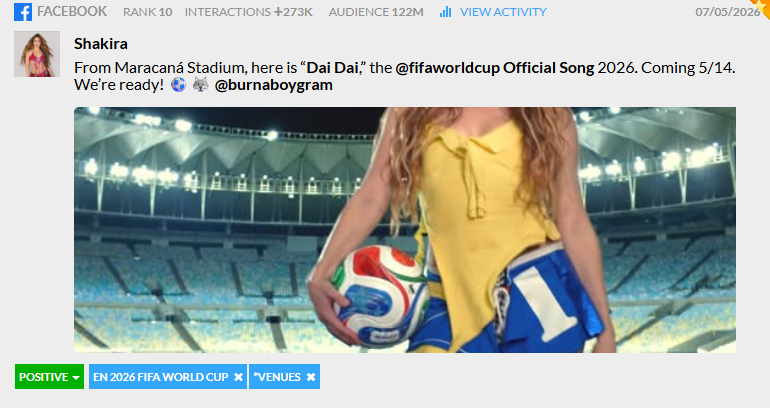
That single moment captures something important about the FIFA World Cup 2026 most discussed topics: the most viral stories are rarely the ones the organizing committees plan for. They emerge from the intersection of football, culture, celebrity, and geopolitics – and they move at a speed that traditional communications can barely track.
Across the 35 topic clusters we monitored, the top 15 account for the vast majority of total volume. The rankings below represent share of voice within that monitored universe – a measure of how much of the World Cup conversation each topic owns, relative to all other.
II – FIFA World Cup 2026 most discussed topics
For 2 months: March 11 – May 11.
| 1 | VENUES (Venues and venue-specific discussions) | 15,76% |
| 2 | SPONSORS (Sponsor, brand activations, and commercial) | 11,02% |
| 3 | COHOSTS (Canada and Mexico as co-hosts) | 9,38% |
| 4 | TRANSPORT (Transport, logistics, and infrastructure) | 5,90% |
| 5 | ANTHEM (Official World Cup anthem “Dai Dai” (Shakira & Burna Boy)) | 5,63% |
| 6 | IRAN GEOPOLITICS (Iran, geopolitics, and team withdrawal risks) | 5,11% |
| 7 | INJURIES (Player injury wave and World Cup absences) | 5,00% |
| 8 | BROADCAST (Broadcast rights and streaming access) | 4,04% |
| 9 | TRAVEL VISA (Visa and entry requirements for fans) | 3,48% |
| 10 | ENTERTAINMENT (Halftime show and entertainment) | 3,21% |
| 11 | FIFA GOVERNANCE (FIFA governance, revenue distribution, and criticism) | 3,16% |
| 12 | BETTING (Betting odds and team prospects) | 3,13% |
| 13 | ACCOMMODATION (Hotels, accommodation, and overall fan costs) | 2,53% |
| 14 | FORMAT (48-team format and competition structure) | 2,22% |
| 15 | TICKETS (Ticket prices, accessibility, and sales phases) | 2,17% |
Share of voice for the top 15 topics out of the 35 analyzed.
With 30 days to go before kickoff in Mexico City, here is what has dominated the FIFA World Cup 2026 most discussed topics over the past two months – ranked by share of voice across 35 monitored topic clusters.
1. Venues (15.76%)
No topic generated more volume than the stadiums themselves – and with good reason. The 2026 edition is the first World Cup to span 16 venues across 3 countries, and the question of whether they will all be ready on time has been a persistent undercurrent of coverage.
In the final weeks before tournament, two competing narratives have shaped the conversation.
The first is optimistic: stadium facelifts nearing completion, grass surfaces being installed at BC Place in Vancouver and BMO Field in Toronto, MetLife Stadium in New Jersey completing its pitch installation after a “massive 27-truck operation,” NRG Stadium in Houston putting finishing touches on the playing surface. Official World Cup host city accounts have been active on social media, with FWC26 Boston, Explore Georgia, and Atlanta’s Metro Chamber all posting content designed to attract visitors.
The second narrative is more critical. A recurring thread in German-language media – widely syndicated – carries the headline “Ich würde das auch nicht bezahlen” (I wouldn’t pay that either), a quote attributed to Donald Trump commenting on World Cup ticket prices. These articles cite slow hotel bookings, one million unsold tickets, and a $30 billion economic boom that is increasingly looking out of reach. The Foxestalk forum thread captures the frustration concisely: British fans are heading to Magaluf instead, watching on big screens for under £4 a pint rather than paying £24,000 for a final seat.
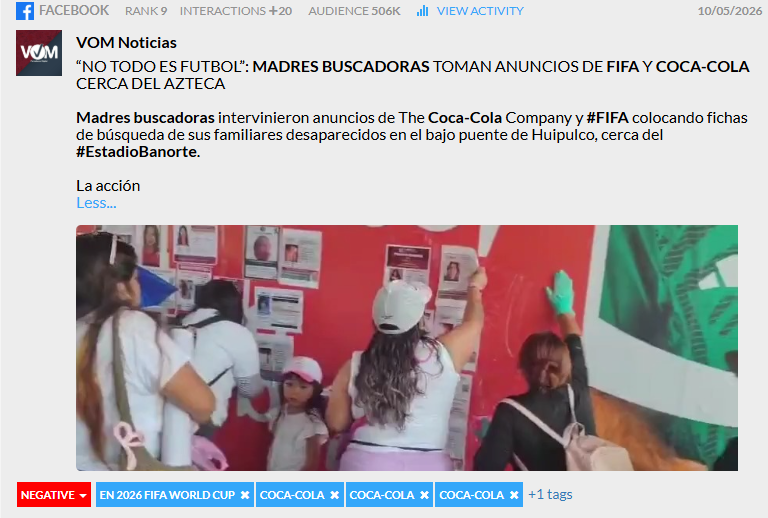
The most viral individual venue story came from Mexico, where families of disappeared persons – “madres buscadoras” – intervened Coca-Cola and FIFA advertising panels near the Estadio Azteca with missing persons flyers. The image, shared thousands of times on X in Spanish, crystallized a broader tension between the tournament’s celebratory narrative and the social realities of its host cities. Guadalajara’s Estadio Banorte generated similar protest content from families in Jalisco.
On the positive side, Estadio Azteca benefited from considerable heritage storytelling – as the first stadium ever to host three World Cup opening matches – and fan excitement around the triple opening ceremony lineup generated enormous reach, particularly in Latin America and across K-pop fandoms.
2. Sponsors (11.02%)
Sponsor visibility during the pre-tournament window has been exceptional, and the data reflects genuine consumer engagement rather than just paid placement.
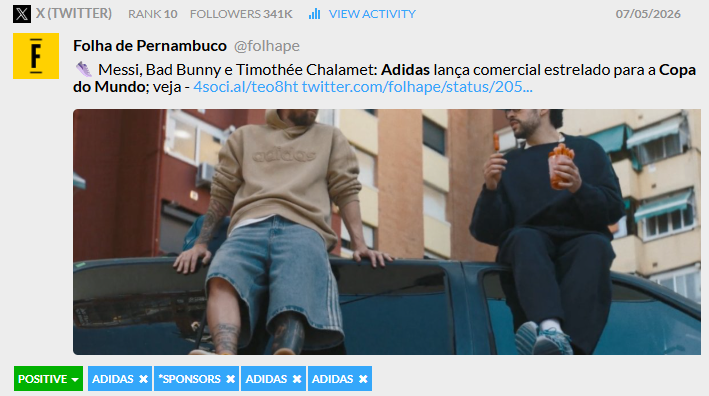
The dominant story has been Adidas. The “Backyard Legends” campaign – a five-minute film starring Timothée Chalamet, Messi, Beckham, Yamal, Bellingham, and Bad Bunny – generated a sustained wave of LinkedIn commentary, TikTok discussion, and news coverage. Marketing professionals have dissected it extensively, praising its rejection of stadium aesthetics in favour of street culture and nostalgia. One LinkedIn post calling it “five minutes, zero wasted seconds” was widely reshared. The campaign has become a case study in real time: brands are being benchmarked against it.
Budweiser’s Maracanã activation also broke through: the brand set a Guinness World Record by wrapping the stadium in a giant beer-bottle hot air balloon, generating substantial Brazilian social media coverage and international pickup. The brand reportedly now allocates 55% of its marketing budget to live events, a data point that circulated widely in the marketing trade press.
Dove Men+Care made its FIFA World Cup debut as an official sponsor with a campaign built around the unofficial anthem chant of football fandom, earning coverage in Adweek. MetLife and Bank of America were jointly highlighted as founding donors of the FIFA Global Citizen Education Fund, generating positive press around social impact. Airbnb received repeated coverage in economic analyses of host cities, particularly Philadelphia and San Francisco.
The data also captures a secondary sponsor conversation: the interest in which brands are running World Cup-adjacent campaigns without official FIFA status. This ambush marketing angle is particularly active in the weeks before a tournament and represents a significant monitoring priority for rights protection teams.
3. Co-hosts (9.38%)
The unprecedented three-nation hosting structure has generated a conversation that no previous World Cup has had: comparisons, rivalries, and logistical anxieties between the US, Mexico, and Canada.
Mexico generates the most emotionally charged content, both positive (the Azteca’s historic role, Latin music at the opening ceremony) and negative (the “madres buscadoras” protest story, security concerns in Guadalajara around the Estadio Banorte, lingering criticism of the stadium’s state of readiness versus other sites). The Mexican government’s communications – including a statement from President Claudia Sheinbaum guaranteeing that construction works would be finished in time – became a news item in itself, suggesting ongoing concern rather than confidence.
Canada’s coverage centers on two things: stadium construction at Vancouver and Toronto (both nearly complete, with the grass installation at BC Place generating multiple national news items) and the country’s opening game against Bosnia and Herzegovina on June 12, which several accounts describe as Canada’s biggest sporting moment in decades. The triple opening ceremony structure also positions Toronto as a genuine co-equal host rather than a secondary venue.
The US narrative is dominated by economics and accessibility. Coverage of the $30 billion economic projections, slow hotel bookings, and the NJ Transit fare controversy ($150 round-trip from Penn Station to MetLife) reflects a growing media consensus that the tournament has been priced for affluent international visitors at the expense of ordinary American fans. Kansas City, however, received unusually warm coverage: a CNA article on how the city became a “World Cup hotspot” described it as punching well above its weight in terms of preparation and community excitement.
A Forbes-commissioned Geotab study ranking host cities by traffic-handling capacity generated significant pickup, with Boston, Houston, and Mexico City flagged as the most congested risk points.
4. Transport (5.90%)
Transport is not a glamorous topic, but it is producing some of the most practically significant coverage of the pre-tournament period – and some of the most viral.
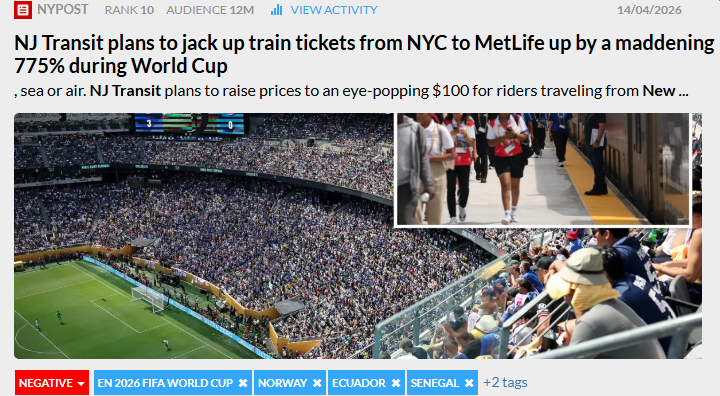
The NJ Transit story: Reports that the rail authority is considering a round-trip fare of approximately $150 for the 18-mile journey from Penn Station to MetLife Stadium – for a route that normally costs a few dollars – triggered immediate backlash across American football media and general news. The story connects directly to the broader narrative about affordability and access.
City-level transport communications have been mixed in quality. Boston’s official World Cup account actively promoted public transport use (“routes to the stadium are expected to be much busier on matchdays – use public transportation where possible”), while a LinkedIn analysis of Monterrey’s preparation noted that mobility remains “the biggest test” despite the city’s strong stadium and security readiness. Mexico City’s new Centrobús public transit service was framed as a World Cup legacy project, though coverage was skeptical about capacity.
Vancouver’s drone deployment for crowd management drew both coverage and discussion: the Vancouver Police Department confirmed use of DJI Matrice platforms at BC Place, generating interest in both security and privacy circles. A LinkedIn post from a security consultancy used the fireworks incident outside Atletico Madrid’s London hotel during a Champions League semi-final as a case study for host city planners, arguing that “modern tournament security has changed” and hotels, transit routes, and fan zones are now part of the operational battlefield.
The private jet story – airports in Vancouver bracing for a wave of private aircraft with more than 200 confirmed to arrive for the tournament – generated colourful and widely shared coverage in Canadian media.
5. Anthem (5.63%)
The return of Shakira to the World Cup stage is the single most-discussed entertainment story of the pre-tournament period, and it has delivered the kind of cross-cultural, cross-language conversation that sponsors dream about.
“Dai Dai”, the official song featuring Nigerian singer Burna Boy, was teased on May 8 from the Maracanã Stadium in Rio de Janeiro – a deliberately symbolic choice that immediately generated conversation about the disconnect between a Colombian artist, a Nigerian co-artist, a Brazilian recording location, and a tournament hosted in North America. A Mexican journalist’s complaint that North America was not represented in the video – “¿Y AMERICA DEL NORTE?” – became a minor viral moment in Spanish-language media.
In French-language markets, the announcement prompted extensive nostalgia coverage linking “Dai Dai” to Shakira’s World Cup heritage (“Waka Waka” in 2010, “La La La” in 2014), with several articles describing her as “the voice of the World Cup.” The fact that “Dai Dai” is Italian slang for “come on” – adding another language layer to an already multilingual release – generated considerable comment.
6. Iran geopolitics (5.11%)
Iran’s presence at the World Cup has become one of the most complex and politically sensitive storylines of the tournament. Unlike most football topics in the FIFA World Cup 2026 most discussed topics ranking, it cuts across security, human rights, diplomacy, and sports governance simultaneously.
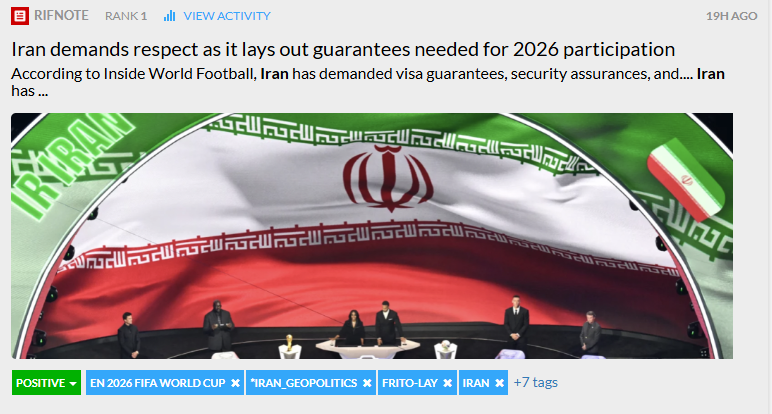
The core tension is this: Iran qualified for the 2026 World Cup as a football team, but the broader context of US-Iran relations – sanctions, the nuclear question, the Strait of Hormuz situation – creates genuine uncertainty about whether Iranian players and fans can travel to the United States, and whether their participation will become a flashpoint.
A Xinhua roundup article on tournament preparations explicitly listed “geopolitics” alongside turf and infrastructure as a key concern, citing Iran’s situation specifically. Multiple English-language security analysis pieces published on LinkedIn by event security consultancies identify Iran’s political context as a threat factor for World Cup planners, noting that “international conflicts may inspire retaliatory threats, extremist propaganda, cyber activity, protests, targeted violence, or lone-actor attacks far from the original conflict zone.”
Human Rights Watch described the tournament as a “potential human rights catastrophe” – a framing amplified heavily in Belgian and French-language media – with ICE enforcement operations in host cities named as a specific risk for international visitors, including those from Iran. RTL.be and 7sur7 were among the highest-reach outlets carrying this story.
The Iran Football Association’s own statement – “Missing World Cup will be a loss of major diplomatic asset” – circulated in a UK database article, hinting at internal pressure on Iran’s government to resolve the visa situation.
A LinkedIn post by a marketing analyst made the sardonic observation that “the FIFA Peace Prize” awarded to Trump had been intended to smooth over exactly these kinds of political complications – and that it had visibly failed to do so.
From a media monitoring perspective, this topic cluster is unusual: it has high reputational risk, high news value, and very low predictability. It is the one story that could shift from a background concern to a front-page crisis in 24 hours.
7. Injuries (5.00%)
- Nico Williams (Spain) ruled out for 3 weeks but expected to recover in time – widely covered in English and Spanish media
- Dybala’s exclusion from Argentina’s preliminary squad fuelled a separate but related debate about chronic injury history (“se perdió el 80% de los partidos por lesión”)
- Brazil’s preliminary squad decisions around Neymar and Thiago Silva heavily coloured by injury and fitness uncertainty
- Hydration breaks during matches officially confirmed by FIFA due to heat conditions at US venues – flagged as a player welfare issue, not just a logistics one
- The Xinhua one-month countdown article specifically listed “team injury monitoring” as a key preparation variable alongside stadium readiness
8. Broadcast (4.04%)
- A Colombian article from La República and LinkedIn post framed the World Cup as a massive TV technology consumption moment: “televisions, surround sound, streaming platforms become a priority”
- DSports Argentina confirmed as the official World Cup broadcaster in Argentina, generating significant social engagement around the full squad announcement
- The triple opening ceremony structure raised questions about simultaneous broadcast logistics across three countries and time zones
- Australia’s Football360 covered the Socceroos squad in the context of Fox Sports broadcast rights and scheduling
- Sud Radio (France) ran a J-30 countdown piece noting growing impatience in the streets, framing France as heavy favourites
9. Travel visa (3.48%)
- Human Rights Watch’s “potential human rights catastrophe” framing – widely relayed in Belgian, French, and European media – centres explicitly on ICE operations during the tournament and their impact on international visitors
- RTL.be and Paris Match Belgium were among the highest-reach outlets on this story
- South African fans discussing Mexico visa logistics in comments under the Bafana Bafana squad content
- The Iran visa situation (see topic 6) is the most acute subset of this cluster
- A travel agency LinkedIn post from Ghana explicitly excluded visa fees from its Toronto World Cup package, signalling the friction point for African fans
10. Entertainment (3.21%)
The triple opening ceremony lineups, announced simultaneously, provided enormous additional momentum to the FIFA World Cup 2026 most discussed topics. Katy Perry headlining the US ceremony at SoFi Stadium drove massive K-pop crossover coverage (Lisa of BLACKPINK co-headlining), entertainment media (Future, Anitta, Tyla, Rema), and Latin media. The Mexico lineup – J Balvin, Maná, Belinda, Alejandro Fernández, Los Ángeles Azules, Lila Downs – dominated Spanish-language social media for multiple news cycles. Canada’s announcement of Michael Bublé and Alanis Morissette with Nora Fatehi (the first Bollywood performer at a men’s World Cup opening) generated substantial coverage in Indian and South Asian media.
- Lisa (BLACKPINK) performance at SoFi Stadium generated disproportionate K-pop community engagement globally, particularly in Thailand, Indonesia, and Japan
- Adidas “Backyard Legends” five-minute film widely discussed as a benchmark for sports entertainment marketing
- Sports Illustrated “Beyond the Pitch” series (50 Cent, The Chainsmokers, Nelly, Diplo across LA, Dallas, Miami, NYC) covered across US music and sports media
- Budweiser Maracanã “World Record” activation – giant beer bottle balloon – broke through as a brand entertainment moment in Brazil
11. FIFA governance (3.16%)
- Ticket pricing is the dominant governance story: FIFA tripling the price of top-tier final seats to ~$33,000 generated widespread anger, a Trump quote (“I wouldn’t pay that either”), and multiple German-language editorial pieces
- Gianni Infantino’s J-30 message to the world – “the biggest and most inclusive World Cup ever” – was covered neutrally in Latin media but with visible scepticism in European and anglophone markets
- Trump receiving the “FIFA Peace Prize” was referenced sarcastically in multiple posts in connection with the Iran situation
- FIFA’s decision to launch an official ticket resale platform (allowing sellers to set their own prices) was criticised as facilitating price gouging rather than controlling it
- Foxborough stadium funding controversy appeared repeatedly in article tags, suggesting an ongoing governance dispute around the New England venue
12. Betting (3.13%)
- Odds and predictions content across Spanish, French and English social media driving consistent low-level volume throughout the period
- A private jet/Taylor Swift story in Canadian media included a sidebar on sports betting market activity around the tournament
- Moroccan football media ran a CAN U17 analysis piece that explicitly referenced betting market dynamics around African teams
- LaLiga Daily Post Nigeria and similar football aggregators regularly attached betting odds context to World Cup squad and form coverage
- The topic remains largely informational rather than controversy-driven at this stage, likely to spike once group stage fixtures start
13. Accommodation (2.53%)
- Slow hotel bookings in host cities are an active news story – German media in particular framing this as evidence the tournament could “fall short of expectations”
- Multiple Instagram and LinkedIn posts promoting short-term rental properties near stadiums (Houston, Atlanta’s Roswell area, New Jersey)
- Philadelphia singled out as the most affordable host city for fans – Folha de S.Paulo and Diario Libre ran specific “budget” positioning pieces for the city
- Airbnb appeared repeatedly in tags related to host city economic analysis – the brand announced a mini-pitch legacy project in the NY/NJ area
- Hotel cancellations and low demand appeared as a recurring tag in German and US business media, linked to ticket pricing deterring attendance
14. Format (2.22%)
- The expanded 48-team / 104-match format is treated as contextual background in most coverage rather than active controversy
- Nigerian and Indian fans regularly citing the format expansion (“48 teams, first time 3 hosts”) as a point of excitement in comment threads
- A few French-language posts expressed concern that the format dilutes quality – “un jeu sans âme” (soulless football) – particularly in the context of France’s matches
- The Bafana Bafana squad prediction piece used the format expansion to argue South Africa has a genuine chance of progressing beyond the group stage for the first time
- FC 26 (FIFA video game) announced a World Cup mode update including new selections and stadiums, generating minor entertainment coverage linked to the format topic
15. Tickets (2.17%)
- Despite ranking 15th overall, tickets carry outsized reputational risk given the pricing controversy
- A World Cup Final resale ticket listed at $11.5 million on FIFA’s own platform was widely shared on Instagram as an illustration of the absurdity
- British fans explicitly choosing Magaluf over the US – watching at bars for £4 a pint – became a viral narrative in UK football media
- One million tickets described as unsold in media reports, creating a paradox of unaffordable prices coexisting with empty seats
- US politicians flagged as having raised concerns about ticketing practices – adding political pressure to the commercial and reputational issues
III – The #1 fastest-rising topic in the FIFA World Cup 2026 most discussed topics: Preliminary squad announcements
With less than 30 days to go before the opening match in Mexico City, one topic has exploded across every language, platform, and time zone: the release of preliminary squads for the 2026 FIFA World Cup.
FIFA’s rules require all 48 qualified nations to submit a preliminary list of up to 55 players by May 11 – 30 days before kickoff – before cutting down to a final roster of 26. That deadline has turned this week into an unofficial “squad announcement season,” and the internet is fully engaged.
Why it’s trending so hard right now
The timing is structural. Every national federation faces the same deadline, which means dozens of squad lists are dropping in rapid succession. Each one generates its own news cycle: who’s in, who’s out, who’s a surprise call-up, who’s been snubbed. The cumulative effect is a sustained, multi-day wave of content that feeds on itself.
The data collected on May 11 alone captures hundreds of posts per hour across X (Twitter), Instagram, and news outlets – spanning Spanish, English, French, Portuguese, and Italian – all tagged to the same topic cluster.
Argentina: the story of the day
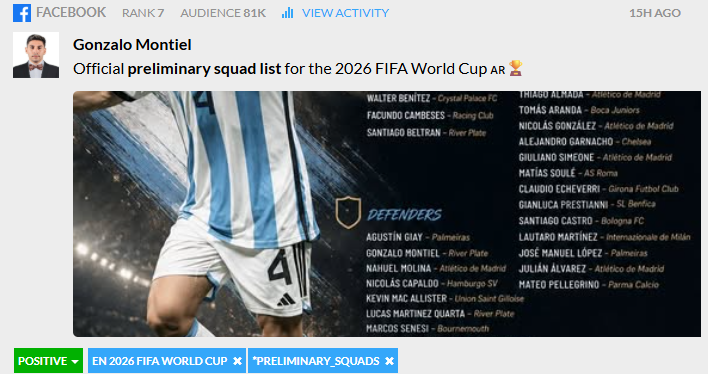
The single most viral storyline in the dataset is Argentina’s 55-man preliminary list, submitted by coach Lionel Scaloni. The announcement hit X as a trending topic almost instantly, with the account @porquetendencia (a widely-followed “why is it trending” account in Argentina) generating thousands of replies within minutes.
The dominant conversation thread: Paulo Dybala’s absence. Scores of posts reacted with shock, frustration, or mockery at the omission of the Roma forward – many comparing it unfavourably to the inclusion of veterans like Germán Pezzella and Martínez Quarta, or young players like Franco Mastantuono (Real Madrid, 18 years old) and Alejandro Garnacho. The debate quickly took on the character of a proxy war between rival fan camps.
Notably, this conversation is not contained to Argentina. The Dybala exclusion generated significant engagement from accounts in Ghana, Nigeria, India, the UK, Bangladesh, and beyond – a reminder that Argentina’s squad news travels globally, especially when Messi’s name is attached.
Mastantuono’s inclusion triggered its own wave of positive buzz, with French-language accounts picking up the story of “la pépite du Real Madrid” making the preliminary list.
Brazil and beyond
The dataset also captures the parallel buzz around Brazil’s preliminary list, managed by Carlo Ancelotti. Neymar’s inclusion in the 55-man pool generated major engagement on Instagram in particular, with Brazilian accounts driving high-reach posts. Thiago Silva’s potential return also drew attention.
Bosnia-Herzegovina added another angle: they were the first nation to publish their final 26-player squad (not just a preliminary list), with Edin Džeko – still playing at 40 – as the headline name. That “first confirmed squad” angle gave the story a distinct hook that circulated in Portuguese, Spanish, and English media.
Ghana’s provisional squad, expected to be named by Carlos Queiroz later in the week, was already being pre-discussed in West African football media.
What this means for monitoring
For PR and comms professionals, this topic cluster is particularly valuable right now because it sits at the intersection of several other high-engagement themes: player injuries (Dybala’s fitness history drove much of the debate), club-vs-country dynamics (Palmeiras players in Argentina’s list, Bundesliga players in Bosnia’s), next-generation talent stories, and coach credibility narratives.
The conversation is also unusually global: unlike venue or logistics stories that skew toward host-country audiences, squad announcements generate engagement wherever football is watched – which is to say, everywhere.
Expect the volume to peak again around June 2, when final 26-player squads must be submitted, and individual cut decisions will generate the same emotional responses, at higher stakes.
Sponsor implications: a 30-day window of amplified visibility
Preliminary squad announcements don’t just generate editorial coverage – they create a concentrated burst of organic brand visibility for sponsors at exactly the right moment.
Player-linked sponsorships get a free ride. Every time a player’s name trends – whether they’re included, excluded, or debated – the brands associated with them get pulled into the conversation. Adidas, Nike, and Puma all have significant jersey and boot deals tied to players whose names dominated the data: Messi, Garnacho, Mastantuono, Neymar. Squad announcements function as unofficial product placement, with fan accounts posting kit photos and player graphics at scale, without any media spend behind them.
Official FIFA partners benefit from the general halo. Sponsors such as Coca-Cola, Adidas, Hyundai, and Visa are present across the broader World Cup conversation as the audience grows week by week. The squad announcement cycle accelerates that growth, bringing casual fans – not just football obsessives – into the conversation for the first time. That expanded audience is precisely the consumer base these global brands are paying to reach.
Conclusion – 30 Days Out, the World Cup is already happening
With 30 days to go before kickoff, the FIFA World Cup 2026 most discussed topics tell a story that is complex and global.
The headline numbers are impressive: 3.3 million social media mentions, a reach of 490 million, and 2 million people actively participating in the conversation. But beneath the volume, a clear tension runs through the data. On one side, genuine excitement – about the scale of the tournament, the three opening ceremonies, Shakira’s return, Adidas’ cultural storytelling, the squad announcements, the prospect of watching Messi play a sixth World Cup. On the other side, a persistent drumbeat of concern: about prices, about access, about geopolitics, about the families of the disappeared whose flyers were removed from a FIFA advertising panel in Mexico City.
Both sides of this conversation are real, and both deserve attention.
For PR and communications professionals, marketers, and competitive intelligence teams, the practical takeaway is this: the World Cup conversation is not waiting for June 11. It has been running for months, across five languages, in formats that range from 280-character reactions to long-form LinkedIn essays. The brands and organisations that will cut through are the ones that understand the full texture of that conversation – not just the official narrative, but the viral moments, the protest content, the squad debates, and the geopolitical undercurrents.
The next major inflection point will come on June 2, when final 26-player squads must be submitted. After that, the conversation shifts from anticipation to action – and the volume will only grow.
Methodology: Data covers March 11 – May 11, 2026. Sources include mainstream media (TV, radio, print, digital) and social media (X/Twitter, Instagram, TikTok, LinkedIn, Facebook, YouTube, Threads, Bluesky…). 35 topic clusters analyzed. Share of voice figures represent the proportion of total monitored World Cup conversation attributed to each topic cluster.
FAQ: FIFA World Cup 2026 most discussed topics
Q1. What are the most discussed topics about the FIFA World Cup 2026 right now?
Based on two months of media monitoring and social listening data (March 11 – May 11, 2026), the top five most discussed FIFA World Cup 2026 topics by share of voice are: venues (15.76%), sponsors (11.02%), co-hosts (9.38%), transport (5.90%), and the official anthem (5.63%). Beyond the top five, Iran’s geopolitical situation, player injuries, broadcast rights, and travel visa concerns are all generating significant volume. The single fastest-rising topic at the 30-day mark is preliminary squad announcements, driven by the May 11 FIFA deadline requiring all 48 nations to submit their 55-player pre-selection lists.
Q2. Why is the FIFA World Cup 2026 generating so much conversation before it even starts?
Several factors are compounding each other. The 2026 edition is the biggest World Cup in history – 48 teams, 104 matches, 16 venues across 3 countries – which means the logistical, political, and commercial stakes are proportionally larger than any previous tournament.
Add to that an unusually charged geopolitical backdrop (US-Iran tensions, ICE immigration enforcement), a major cultural moment (Shakira’s comeback with “Dai Dai”), viral brand campaigns (Adidas “Backyard Legends”), and the structural spike of preliminary squad announcements, and you have a pre-tournament conversation unlike anything seen before. Our data recorded 3.3 million social media mentions and 812,785 mainstream media articles in just two months.
Q3. Which sponsor is generating the most organic buzz ahead of the FIFA World Cup 2026?
Adidas is the clear leader in organic sponsor conversation. The “Backyard Legends” campaign – a five-minute film featuring Timothée Chalamet, Messi, Beckham, Lamine Yamal, Jude Bellingham, and Bad Bunny – has been dissected across LinkedIn, TikTok, and marketing trade media as a benchmark for sports brand storytelling. Budweiser also broke through with a Guinness World Record activation at the Maracanã.
Dove Men+Care generated positive press with its World Cup debut campaign, while Airbnb and MetLife received coverage through their FIFA Global Citizen Education Fund partnership. The data also shows active monitoring of non-official brands running World Cup-adjacent campaigns – a signal that ambush marketing activity is already elevated.
Q4. What is the controversy around FIFA World Cup 2026 ticket prices?
Ticket pricing has become one of the most reputationally damaging stories of the pre-tournament period. FIFA tripled the price of its best available final tickets to approximately $32,970 – prompting Donald Trump to publicly say he “wouldn’t pay that either.” A resale ticket for the final was listed at $11.5 million on FIFA’s own platform.
Meanwhile, around one million tickets remain unsold, creating a paradox of unaffordable prices coexisting with empty seats. British fans have been widely quoted saying they are watching from Magaluf bars for under £4 a pint instead. US politicians have also raised concerns, and multiple German-language news outlets have published editorials asking whether the tournament risks being a “colossale Reinfall” (colossal failure) commercially.
Q5. What is the situation with Iran at the FIFA World Cup 2026?
Iran’s participation in the 2026 FIFA World Cup remains one of the most unpredictable storylines of the tournament. Iran qualified on the pitch, but US-Iran geopolitical tensions – including sanctions, nuclear negotiations, and the Strait of Hormuz situation – create real uncertainty about whether players and fans can obtain US visas.
Human Rights Watch has flagged ICE enforcement operations in host cities as a risk for international visitors. Security consultancies have identified Iran’s political context as a threat factor for tournament planners. Italy has reportedly been positioned as a potential replacement. The Iran Football Association itself stated that “missing the World Cup will be a loss of major diplomatic asset,” suggesting internal pressure to resolve the situation. This is the one FIFA World Cup 2026 topic with the highest potential to escalate from background concern to front-page crisis.
Q6. Why are preliminary squad announcements the fastest-rising FIFA World Cup 2026 topic?
The timing is structural: FIFA requires all 48 qualified nations to submit a preliminary list of up to 55 players exactly 30 days before kickoff (May 11 deadline), which means dozens of squad announcements drop in rapid succession over a matter of days. Each announcement generates its own news cycle – inclusions, exclusions, surprises, snubs – and the cumulative effect is a sustained wave of content.
The biggest single storyline on May 11 was Argentina’s list and Paulo Dybala’s omission, which trended globally and generated engagement in Ghana, Nigeria, India, and the UK, not just in Argentina. The next major spike is expected around June 2, when final 26-player squads must be confirmed.
Q7. Which host city is generating the most positive FIFA World Cup 2026 conversation?
Among the three co-hosts, coverage varies significantly by tone. Mexico generates the most volume overall but also the most negative content – particularly the “madres buscadoras” protest story near the Estadio Azteca and security concerns in Guadalajara. Canada’s coverage is broadly positive, centred on stadium readiness and the historic triple opening ceremony. Among US host cities, Kansas City stands out as the most positively covered, described in a CNA feature as “punching well above its weight.”
Atlanta, Philadelphia (singled out as the most affordable fan destination), and Houston have also received constructive coverage. New York/New Jersey generates the most mixed signals: home to the World Cup final at MetLife Stadium, but also the epicentre of the NJ Transit fare controversy and ticket price backlash.
Q8. What should PR and marketing professionals monitor most closely in the remaining 30 days before the FIFA World Cup 2026?
Based on our data, five areas carry the highest risk and opportunity heading into kickoff. First, Iran’s participation status – any sudden development here will dominate global news instantly. Second, final squad announcements around June 2 – this will generate the largest organic conversation spike before the tournament begins, with major sponsor visibility implications.
Third, ticket and accommodation affordability – the “empty seats” narrative is already forming and could define the tournament’s reputation in mainstream media. Fourth, Mexico security and human rights content – the “madres buscadoras” story has already crossed into international media and could intensify as the opening ceremony approaches. Fifth, ambush marketing activity – with sponsor conversation running high, the risk of non-official brands hijacking the conversation peaks in the final weeks before kickoff. For any brand or organisation with a stake in the tournament, real-time monitoring across all five of these clusters is essential from now through July 19.