




The most influential CEOs in media in 2026: what the data reveals
In the first part of this series, we examined what the most influential brands in media in 2026 tell us about modern communications strategy. One finding stood out consistently: behind every top-ranked brand, the visibility of its CEO – or the deliberate absence of it – is a primary driver of media influence.
The CEO Media Score, one of the three core metrics in Onclusive’s Brand Influence Rank 2026, tracks all media and social media mentions of a company’s chief executive, including quotes and references that make no direct mention of the brand. The methodology is intentional: a CEO’s public statements, even on topics entirely unrelated to the business, have the potential to shape how the company and its products are perceived. Political commentary, industry macro views, personal positioning, all of it becomes part of the brand’s coverage footprint whether the communications team planned for it or not.
The top 10 CEO Media Scores in 2026 reveal a landscape more concentrated, more volatile, and more strategically consequential than most communications benchmarks acknowledge. This article analyses who the most influential CEOs in media in 2026 are, why they rank where they do, and what the patterns mean for any brand that takes its CEO visibility seriously.
| CEO visibility and brand perception are inseparable. A CEO’s public statements, even when they do not mention the brand, always have the potential to shape how the company and its products are perceived.
Onclusive Brand Influence Rank 2026 |
I. How the CEO Media Score is measured
II. The top 10 most influential CEOs in media in 2026
III. The most influential CEOs in media in 2026: individual profiles
IV. The CEO influence typology: six profiles for the most influential CEOs in media in 2026
V. What the most influential CEOs in media in 2026 reveal about brand strategy
VI. What this means for your CEO visibility strategy
Frequently asked questions about the most influential CEOs in media 2026
I. How the CEO Media Score is measured
The CEO Media Score captures a chief executive’s influence across both mainstream media and social media platforms, based on two primary dimensions: the total volume of mentions and the combined reach of those mentions. It is scored using the same weighting model applied to brands, applying coefficients to balance press article mentions against social media volumes and to reflect the asymmetric impact of reach at different scales.
| WHAT THE CEO MEDIA SCORE INCLUDES
All quotes from or about the CEO in mainstream press, broadcast, and digital news – All mentions of the CEO on social platforms including LinkedIn, X, Instagram, Facebook, and TikTok – References to the CEO in analyst commentary, regulatory filings cited in press, and podcast transcripts – Coverage of the CEO’s statements on any topic, whether or not the brand is named. The score does NOT measure only CEO communications about the company. It captures the full public footprint of the individual, because that footprint shapes brand perception in its entirety. |
This methodology reflects a strategic reality that PR and communications professionals have long understood but rarely been able to quantify at scale: the CEO is never entirely separate from the brand. When Elon Musk posts about U.S. political appointments, that content is indexed in coverage associated with Tesla, SpaceX, and X simultaneously. When Jamie Dimon warns about recession risk in the FT, J.P. Morgan’s institutional reputation benefits from the credibility of that commentary. The CEO Media Score makes this dynamic measurable.
II. The top 10 most influential CEOs in media in 2026
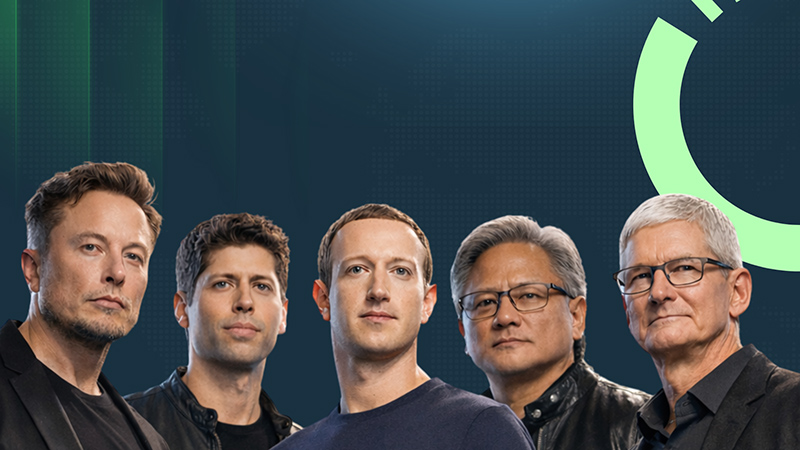
The ranking spans a range from 52,067 at the top to 1,074 at tenth place. That is a 48x spread between first and last within the top 10 alone, reflecting not just differences in communication approach but fundamentally different structural positions in the media landscape.
| # | CEO | Brand | CEO Media Score | Primary driver |
|---|---|---|---|---|
| 1 | Elon Musk | Tesla / X / SpaceX | 52,067 | Platform owner, multi-brand, political polarisation |
| 2 | Sam Altman | ChatGPT / OpenAI | 5,703 | Topic-driven: every AI debate pulls him back in |
| 3 | Mark Zuckerberg | Facebook / Meta | 4,128 | Image rehabilitation + Meta AI repositioning |
| 4 | Jensen Huang | NVIDIA | 3,966 | Face of AI infrastructure, B2B and financial press |
| 5 | Tim Cook | Apple | 2,941 | Product narrative, regulatory voice, tight brand tie |
| 6 | Jamie Dimon | J.P. Morgan | 1,945 | Macro commentary: markets, geopolitics, economy |
| 7 | Sundar Pichai | 1,275 | Default AI commentary voice, regulatory presence | |
| 8 | Satya Nadella | Microsoft | 1,210 | Professional reach, LinkedIn-dominant CEO presence |
| 9 | Michael Dell | Dell Technologies | 1,191 | Enterprise AI server coverage, founder credibility |
| 10 | Jamie Dimon | Chase | 1,074 | Consumer banking: lower media intensity per quote |
Jamie Dimon appears twice in this ranking, in sixth place linked to J.P. Morgan (1,945) and in tenth place linked to Chase (1,074). This is not a data anomaly: it reflects the measurably different media environments of the two brands. The same person generates almost twice the media reach when speaking as the institutional voice of J.P. Morgan compared to his appearances linked to the consumer banking brand Chase. One CEO, two very different influence positions.
III. The most influential CEOs in media in 2026: individual profiles
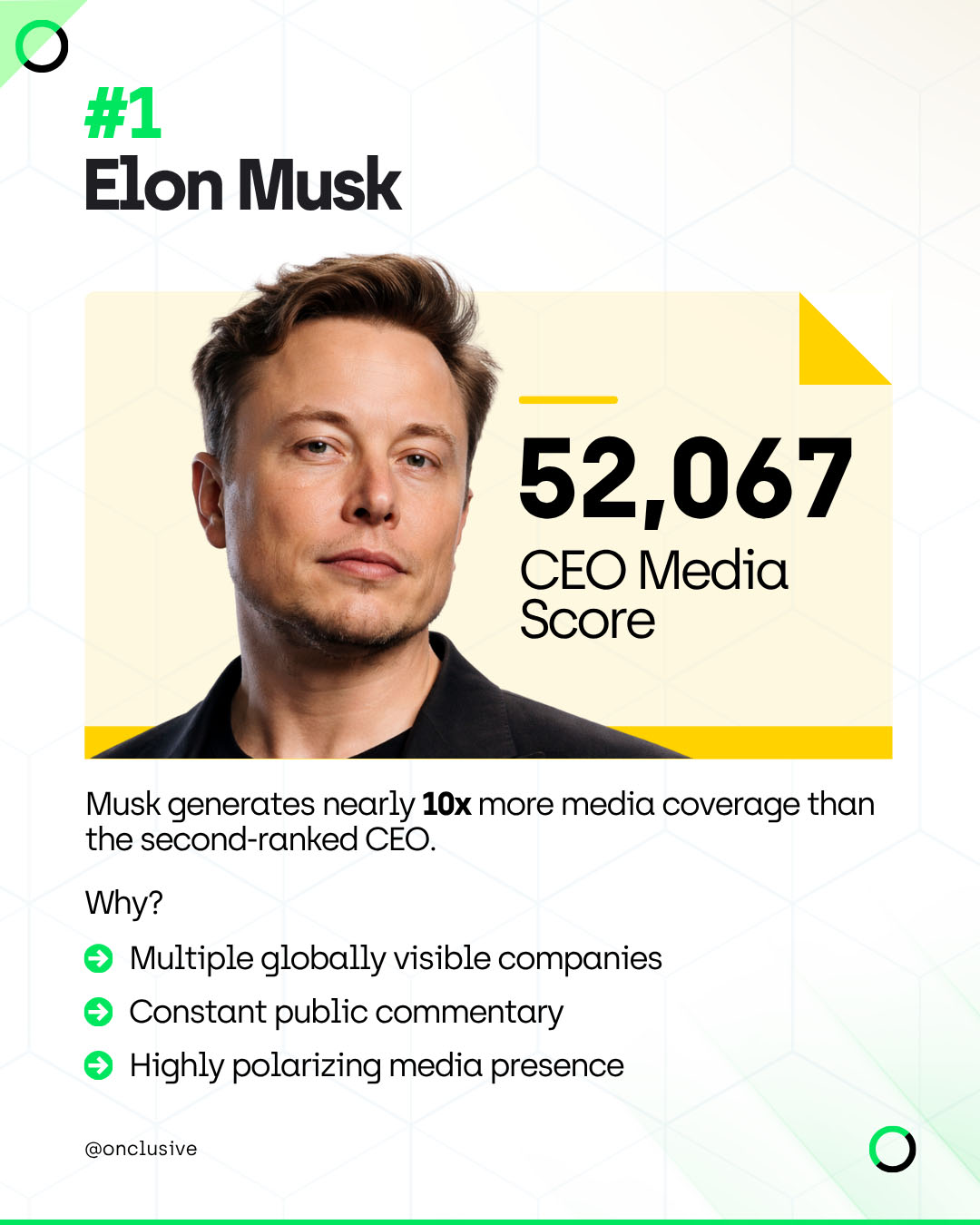
| #1 Elon Musk · Tesla / X / SpaceX / xAI
52,067 CEO Media Score Musk’s score is not a communications phenomenon – it is a structural one. His presence across Tesla, SpaceX, X, xAI, Neuralink, and his role in U.S. political life means there is always an active news cycle attached to his name, regardless of corporate announcements. His ownership of X creates the most significant amplification loop in the entire ranking: he is both a subject of coverage and an active participant who generates his own mentions by posting directly on the platform he owns. Political and societal polarisation adds a further layer of permanent reactive coverage that no communications team can manufacture or fully control. The result is a CEO Media Score nearly 10 times higher than the second-ranked CEO. |
The brand dependency risk is measurable. Tesla’s CEO media mentions (5.2 million) exceed its brand media mentions (4.7 million), the most extreme CEO-to-brand imbalance in the entire ranking. Yet the cost of this structure is visible in the data: Tesla’s positive media sentiment sits at just 39%, the lowest of any brand in the top 15. Musk’s political positioning, his management of X, and his role in the U.S. administration have shaped Tesla’s media narrative independently of its product performance or its pioneering position in the EV industry. The amplification is real; so is the price.
| #2 Sam Altman · ChatGPT / OpenAI
5,703 CEO Media Score Altman’s second place is built almost entirely on topic gravity rather than personal celebrity. Every major AI debate, every regulatory discussion in the U.S. Senate and European Parliament, every competitive product launch by Google Gemini, Meta AI, or Apple Intelligence pulls Altman back into coverage as the reference point for the generative AI era. His CEO mention count of 567K in mainstream media is the highest in the entire top 10, higher than Tim Cook, Mark Zuckerberg, or Sundar Pichai, despite ChatGPT having a fraction of Apple’s or Google’s overall press footprint. Congressional hearings on AGI risk and his public statements on AI governance keep him in mainstream editorial coverage consistently across 12 months. |
What makes this position fragile as well as powerful: ChatGPT’s overall media presence is disproportionately carried by its CEO. Altman’s 567K media mentions dwarf the brand’s own press footprint. This creates an amplification advantage in the short term but a concentration risk that any brand communications team should monitor carefully: if the Altman narrative shifts, the ChatGPT media score shifts with it.
| #3 Mark Zuckerberg · Facebook / Meta
4,128 CEO Media Score Zuckerberg’s third place reflects a visible and deliberate image rehabilitation cycle that ran throughout 2025. After years of regulatory and reputational pressure, his public positioning shifted: more personal content, more visible engagement with AI infrastructure investments, a recalibration of his public persona around Meta’s AI repositioning. This generated substantial reactive coverage and helped partially offset the persistently negative sentiment that Facebook’s regulatory and content moderation controversies continue to generate. For Facebook as a brand, Zuckerberg is both the primary amplifier and the primary sentiment constraint: his visibility raises the score, but the controversies his presence attracts simultaneously cap the positive sentiment ceiling. |
| #4 Jensen Huang · NVIDIA
3,966 CEO Media Score Huang’s fourth place reflects a CEO-brand alignment that is among the tightest in the ranking: when journalists, analysts, and investors discuss AI infrastructure in 2025 and 2026, NVIDIA and Huang are inseparable reference points. His coverage is primarily B2B and financial press, driven by data centre expansion, the AI chip race, and NVIDIA’s positioning as the infrastructure kingmaker for the generative AI era. Jensen Huang is the second most cited CEO on LinkedIn in the entire ranking, with NVIDIA’s owned LinkedIn content generating some of the highest average engagement figures in the study. This makes him the most effective B2B CEO amplifier in the top 10: his visibility builds institutional credibility rather than consumer awareness. |
| #5 Tim Cook · Apple
2,941 CEO Media Score Cook’s fifth place reflects a CEO visibility model that is tightly integrated with the brand narrative rather than extending beyond it. His 293K media mentions are almost entirely linked to Apple-specific events: product launches, earnings results, antitrust proceedings, and supply chain decisions. Unlike Musk or Altman, Cook’s press presence is brand-constrained by design – a deliberate positioning that keeps Apple’s narrative centred on the product and the company rather than on the executive. Apple’s 77% positive sentiment on LinkedIn, the highest of the entire top 10 brands, reflects the professional admiration this approach generates even as the broader media narrative remains contested by regulatory pressure. |
| #6 Jamie Dimon · J.P. Morgan
1,945 CEO Media Score Dimon’s sixth place is built on consistent macro commentary that transcends the financial sector. When he speaks on U.S. economic trajectory, recession risk, interest rate policy, or geopolitical risk, the coverage appears in the FT, Bloomberg, Reuters, and Wall Street Journal and carries institutional weight that few other non-tech CEOs can claim. This positions J.P. Morgan as a macro authority brand rather than simply a financial services provider – a distinction that directly elevates its influence score relative to competitors. Financial sector CEOs only break into this tier of CEO Media Score when they speak consistently on topics that matter beyond their industry. |
Ranks 7-9: the steady institutional voices
Sundar Pichai (Google, 1,275) maintains consistent presence as a default AI commentary voice across regulatory hearings, competitive AI product discussions, and Google’s antitrust proceedings. His coverage is reactive rather than agenda-setting, which explains the lower score relative to his strategic importance: Pichai responds to the media cycle rather than generating it.
Satya Nadella (Microsoft, 1,210) is the most LinkedIn-dominant CEO in the top 10, with Microsoft holding the highest number of CEO mentions in the entire ranking’s LinkedIn data. His influence is concentrated in professional and specialist channels rather than broad consumer media, consistent with Microsoft’s B2B-anchored brand profile. His 118K press mentions are solid but understated relative to Microsoft’s strategic importance in AI infrastructure.
Michael Dell (Dell Technologies, 1,191) reflects the rise of enterprise AI server coverage, which is specialist but remarkably consistent across 12 months. Dell’s positioning as an AI infrastructure provider generated a steady cadence of B2B and financial press coverage that keeps his mention volume competitive, though his personal media presence remains deliberately understated relative to his company’s revenue scale.
Rank 10: the same CEO, a very different score
Jamie Dimon (Chase, 1,074) illustrates one of the most analytically precise findings in the CEO ranking. The same individual, in the same 12-month period, generates a CEO Media Score of 1,945 when associated with J.P. Morgan and 1,074 when associated with Chase. The gap is not about what Dimon says – it is about where his statements are indexed. J.P. Morgan is the name that appears in financial press when Dimon speaks on systemic risk or the economy.
Chase is the consumer banking brand, operating in a more retail-facing editorial environment where CEO commentary carries lower reach-weighted impact per article. A single Dimon quote in the FT outweighs dozens of regional Chase articles in terms of influence score contribution.
IV. The CEO influence typology: six profiles for the most influential CEOs in media in 2026
Mapping the top 10 CEO Media Scores against two dimensions, the primary source of influence (from brand-anchored to CEO-driven) and the level of brand dependency risk (from low to high), produces six distinct profiles. Each defines a different strategic architecture for CEO visibility, with a different set of opportunities, ceilings, and risks for the brand. The size of the bubbles corresponds to the “CEO Media Score” of the most influential CEOs in media industry.
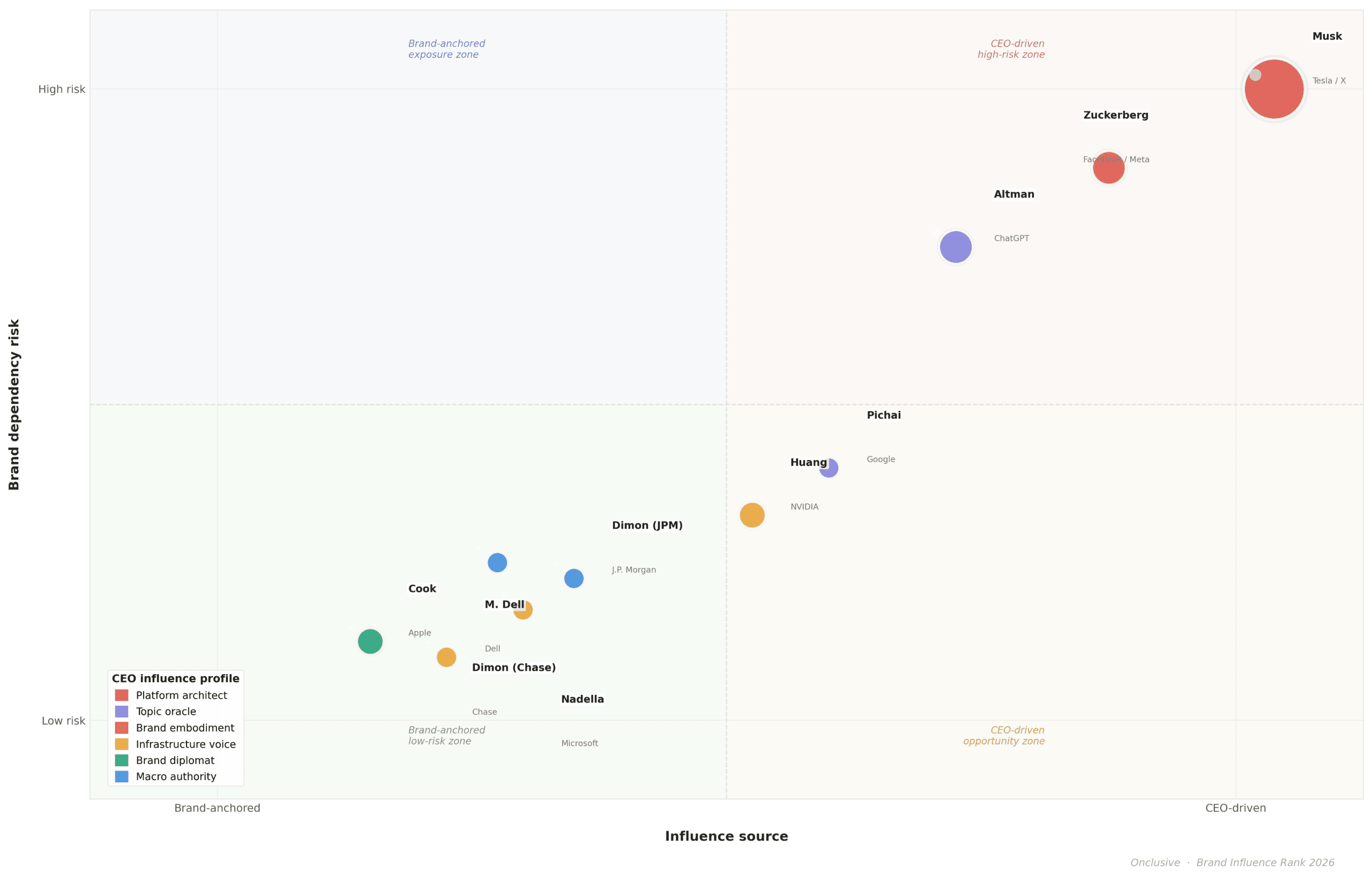
| Profile | Definition | Examples | Strategic implication |
|---|---|---|---|
| PLATFORM ARCHITECT | Owns both the platform and the media narrative. Structural self-reinforcing loop. | Elon Musk (Tesla / X) | Maximum reach, maximum dependency risk. CEO media mentions exceed brand mentions (5.2M vs 4.7M for Tesla). Brand sentiment is directly exposed to every CEO controversy. Building brand-level equity independent of the CEO is urgent. |
| TOPIC ORACLE | Influence anchored to one or two dominant topic narratives. Coverage is topic-pulled, not personality-driven. | Sam Altman (ChatGPT), Sundar Pichai (Google) | More structurally resilient than personality-driven profiles. Influence persists as long as the topic remains in the news cycle. Risk: if the topic loses salience or another CEO becomes the default reference, visibility drops sharply. |
| BRAND EMBODIMENT | CEO and brand are near-inseparable in media terms. CEO drives narrative, reputation, and sentiment simultaneously. | Mark Zuckerberg (Facebook / Meta) | CEO amplifies brand at scale but also concentrates reputational risk. Zuckerberg’s image rehabilitation cycle lifted Facebook’s score while his controversies continue to cap its positive sentiment ceiling. Sentiment diversification and brand-independent content investment are the strategic priorities. |
| INFRASTRUCTURE VOICE | Deep B2B and sector credibility. LinkedIn-dominant. Coverage in specialist and financial press, not consumer media. | Jensen Huang (NVIDIA), Satya Nadella (Microsoft), Michael Dell (Dell) | The most durable CEO influence model in B2B contexts. Credibility compounds over time in professional networks. Huang is the second most-cited CEO on LinkedIn in the entire ranking. Benchmark against sector peers on LinkedIn engagement and trade press presence, not consumer social metrics. |
| BRAND DIPLOMAT | Tightly brand-aligned visibility. CEO presence is deliberate, bounded, and strategically constrained to brand narratives. | Tim Cook (Apple) | Produces the best sentiment quality in the ranking (Apple: 77% positive LinkedIn sentiment, highest in the top 10 brands). Lower absolute mention volume than CEO-driven profiles, but higher per-mention value. The most transferable model for brands seeking durable influence without CEO dependency risk. |
| MACRO AUTHORITY | Financial or institutional CEO whose influence is built on consistent macro commentary that transcends the sector. | Jamie Dimon (J.P. Morgan / Chase) | The only route for non-tech CEOs to reach this tier of CEO Media Score. Dimon generates nearly twice the reach through J.P. Morgan (1,945) as through Chase (1,074) – the same individual, two different media architectures. Macro commentary must be consistent and genuinely cross-sector to sustain the score. |
Type 1 – Platform architect: the unreplicable outlier
Elon Musk is the sole occupant of this profile. The Platform Architect position requires three simultaneous conditions: ownership of a major media platform, multi-brand presence that generates constant parallel news cycles, and engagement in political or societal discourse that produces permanent reactive coverage. Musk meets all three.
The CEO-to-brand mention ratio of 5.2M CEO mentions versus 4.7M brand mentions for Tesla is the most extreme imbalance in the entire study. No communications strategy can replicate this structural position, and it is worth noting that the architecture produces a cost: Tesla’s 39% positive media sentiment is the lowest of any brand in the top 15.
Type 2 – Topic oracle: built to last as long as the topic does
Sam Altman and Sundar Pichai represent the most structurally reproducible model of high-impact CEO influence. Their coverage is generated not by personal celebrity but by the irresistible gravity of the topics they are associated with: generative AI governance, antitrust regulation, and the future of search. Topic oracles do not generate coverage – they attract it. Every major development in their topic territory pulls them back in as reference voices. This makes the position more resilient than personality-driven influence but also more fragile in a different way: it depends on the topic remaining salient, and on the CEO retaining their status as the default reference.
Type 3 – Brand embodiment: the amplifier with a sentiment ceiling
Mark Zuckerberg‘s third-place finish illustrates the dual nature of CEO-brand fusion. His visible image rehabilitation cycle drove substantial coverage and lifted Facebook’s influence score. But the same fusion that enables amplification also creates a ceiling: every controversy attached to Zuckerberg, from content moderation failures to political influence debates, simultaneously caps Facebook’s positive sentiment. The Brand Embodiment position is self-reinforcing in both directions. Communications teams managing this profile face an inherent tension: more CEO visibility raises the score but also concentrates more reputational surface area in a single individual.
Type 4 – Infrastructure voice: the most durable B2B model
Jensen Huang, Satya Nadella, and Michael Dell share a profile that is the clearest proof that B2B CEO influence has a distinct and measurable logic. Huang is the second most-cited CEO on LinkedIn in the entire ranking. Nadella holds the highest LinkedIn CEO mention volume of any brand in the study. Dell’s press presence is specialist but remarkably consistent.
None of them generates the consumer-facing virality of a Musk or a Zuckerberg, and none needs to: their audiences are institutional investors, data centre procurement teams, CIOs, and financial analysts, and those audiences read the FT, Bloomberg, and specialist tech press. Infrastructure Voice is the most sustainable high-influence model for B2B brands.
Type 5 – Brand diplomat: the highest-value model per mention
Tim Cook‘s fifth-place position is the most strategically instructive in the ranking for most communications teams. His CEO Media Score of 2,941 is significantly lower than Musk or Altman, but the brand outcomes his visibility produces are superior: Apple’s 77% positive sentiment on LinkedIn is the highest of any brand in the entire top 10. Cook achieves this by keeping his public presence tightly constrained to brand-relevant events.
Every press mention linked to Cook is almost entirely about Apple – products, policy, earnings, supply chain. This brand-constrained approach sacrifices raw mention volume for per-mention quality. The result is the most efficient influence architecture in the ranking.
Type 6 – Macro authority: finance’s only route to the top tier
Jamie Dimon‘s double appearance in the ranking is the clearest empirical proof that the Macro Authority model works – and that it depends entirely on media context. The 1,945 versus 1,074 gap between J.P. Morgan and Chase scores for the same individual is not explained by what Dimon says: it is explained by which brand name appears in the institutional press versus the consumer press when he says it. For non-tech, non-consumer CEOs, the macro commentary route is the only demonstrated path to this tier of CEO Media Score. But it requires genuine consistency: sector-specific commentary alone is insufficient.
| HOW TO USE THE TYPOLOGY
Most CEOs will show characteristics of more than one profile. Tesla/Musk combines Platform Architect with Brand Embodiment. ChatGPT/Altman combines Topic Oracle with CEO-carried brand dependency. The typology is a diagnostic tool, not a rigid classification. The first step is to identify the primary profile – the one that most accurately describes where CEO influence currently comes from. Then identify the specific risk or ceiling that profile creates for the brand, and the communications investment that addresses it. |
V. What the most influential CEOs in media in 2026 reveal about brand strategy
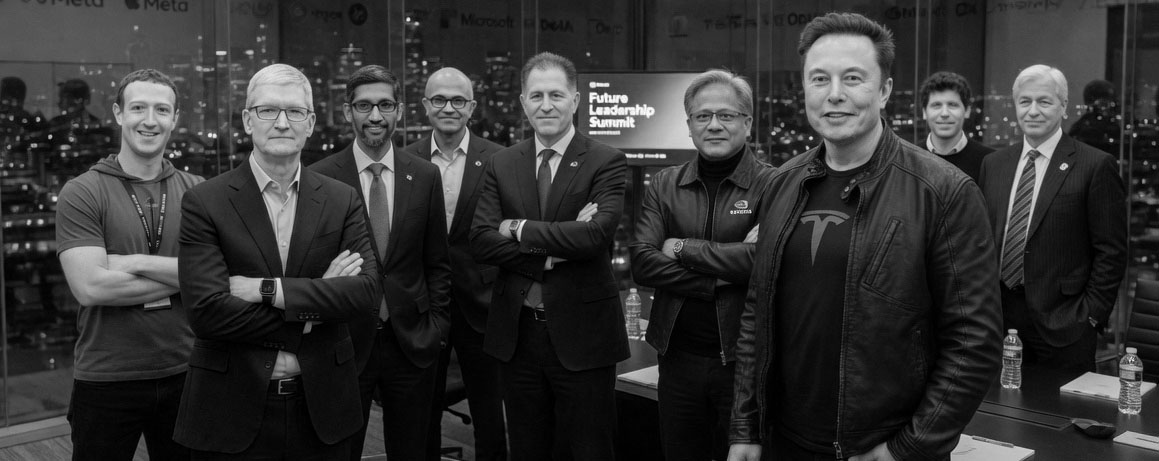
The CEO Media Score ranking carries five specific lessons for communications professionals managing CEO visibility as a strategic asset.
| 1. CEO influence and brand influence are not the same thing
A CEO who generates massive media volume does not automatically produce a high brand influence score. Musk’s 52,067 CEO Media Score elevates Tesla’s visibility, but Tesla’s positive media sentiment of 39% is the lowest of any top-15 brand. The coverage that Musk generates is real and large – but much of it is not about Tesla, and some of it actively damages the brand’s sentiment position. High CEO visibility and healthy brand influence are distinct outcomes that require distinct management strategies. |
| 2. Topic-driven CEOs are more durable than personality-driven ones
Sam Altman’s second-place finish is built on his attachment to the AI governance narrative rather than on personal celebrity. This creates a more structurally resilient influence position: as long as AI policy debates continue, Altman’s press presence is structurally guaranteed. Personality-driven visibility, by contrast, is more volatile: it can spike higher (Musk) but is also more exposed to reputational events. For communications teams planning long-term CEO visibility strategies, anchoring the CEO to one or two consequential topic territories is more sustainable than building on personality alone. |
| 3. Brand-aligned CEOs generate sentiment advantage
Tim Cook’s tightly brand-constrained media presence produces Apple’s 77% positive sentiment on LinkedIn, the highest professional sentiment in the top 10 brands. Jensen Huang’s deep integration with NVIDIA’s AI infrastructure narrative generates consistently positive B2B coverage. The pattern across both is identical: CEOs whose media presence is closely aligned to the brand’s core positioning generate better sentiment quality, even when absolute mention volumes are lower. For most brands, this is the more achievable and more valuable CEO visibility model. |
| 4. The macro-commentary CEO is finance’s entry ticket to influence
Jamie Dimon is the only non-tech CEO in the top 10, and his position is entirely explained by his willingness to speak consistently on macro topics beyond the financial sector. Bank CEOs who limit themselves to sector-specific commentary remain invisible in this ranking. Financial sector CEOs who take positions on macroeconomics, geopolitics, and systemic risk break into this tier. The lesson extends beyond finance: any B2B or institutional brand whose CEO wants to build influence must identify the macro narratives where their expertise is credible and their voice is differentiated. |
| 5. Brand-CEO fusion is a strategic risk, not just an asset
Facebook’s near-total fusion between the platform and Zuckerberg, ChatGPT’s heavy dependency on Altman’s press presence, and Tesla’s extreme CEO-to-brand mention imbalance all illustrate the same structural risk: when the CEO IS the brand in media terms, a CEO reputational event becomes a brand crisis by default. Diversifying influence drivers, building brand-level media equity that is independent of executive visibility, is the most important long-term communications investment for any brand that currently sits in the CEO-carried typology. |
*The image was generated by a Gen AI tool for illustrative purposes
VI. What this means for your CEO visibility strategy
The CEO Media Score ranking translates directly into four operational priorities for communications and PR teams.
1 – Map your CEO’s current influence position before setting objectives
The first step is diagnostic. Where does your CEO’s media presence currently sit in relation to the brand’s own coverage footprint? Is the CEO-to-brand mention ratio balanced, CEO-heavy, or brand-heavy? What is the sentiment quality of CEO coverage compared to brand coverage? What topics dominate CEO mentions – product, strategy, macro commentary, or personal positioning? Without this baseline, any CEO visibility objective is arbitrary. Onclusive’s CEO Media Score provides this baseline in a form that makes longitudinal tracking and competitive benchmarking possible.
2 – Define the topic territory deliberately
The most durable CEO visibility positions in this ranking are topic-anchored: Altman on AI governance, Dimon on macroeconomics, Huang on AI infrastructure. The least durable positions are those where CEO coverage is driven by personal controversy rather than strategic topic ownership. For most communications teams, the practical question is: which two or three topics can the CEO credibly own, where the brand has relevant expertise, and where editorial appetite is structurally sustained? Anchoring CEO communications to those territories builds influence that compounds over time rather than spiking unpredictably.
3 – Measure CEO impact on brand sentiment separately
One of the most underused applications of CEO Media Score data is sentiment disaggregation: tracking what happens to brand sentiment during periods of high CEO visibility versus periods of lower CEO presence. For most brands, this analysis reveals one of three patterns. In some cases, CEO coverage consistently lifts brand sentiment – a signal that the CEO’s positioning reinforces the brand narrative effectively. In others, CEO coverage is sentiment-neutral relative to brand coverage – indicating the two are operating in parallel rather than reinforcing each other. In a third group, CEO coverage depresses brand sentiment – the most consequential finding and the clearest signal that CEO communications strategy needs realignment.
4 – Build brand-level media equity that does not depend on the CEO
The brands that perform most durably in this ranking over multiple years are those whose influence scores are not CEO-dependent: YouTube’s score is entirely brand-driven. Instagram’s score requires no CEO amplification. LinkedIn’s professional influence is built on content and community rather than executive visibility. For any brand whose current influence score is heavily CEO-carried, the strategic priority is to invest in brand-level earned media, thought leadership content, and owned channel development that builds a media presence strong enough to sustain the score independently of what the CEO says or does in any given news cycle.

Frequently asked questions about the most influential CEOs in media 2026
What is the CEO Media Score and how does it differ from the brand influence score?
The CEO Media Score measures a chief executive’s influence across mainstream media and social media platforms, based on total mention volumes and the combined reach of those mentions. It is calculated using the same weighting methodology as the brand’s Media Score and Social Media Score, but applied specifically to content mentioning or quoting the CEO, whether or not the brand is referenced in the same piece of coverage.
The key distinction from the brand score is scope: the CEO Media Score captures the executive’s full public footprint, not just brand-aligned communications. This is intentional. A CEO’s statements on topics unrelated to the brand, political commentary, sector macro views, personal positioning, all have measurable potential to shape how the brand and its products are perceived by journalists, consumers, and stakeholders.
Why is Elon Musk’s score nearly 10 times higher than Sam Altman’s?
The gap reflects a structural advantage that no amount of communications investment can replicate for other CEOs. Musk simultaneously leads Tesla, SpaceX, X, xAI, and Neuralink. Each entity generates its own wave of coverage, all attributed to him personally. His ownership of X creates a self-reinforcing amplification loop: he is both a subject of coverage and an active participant who generates his own mentions by posting on a platform he owns. Political and societal polarisation generates permanent reactive coverage at a scale that is entirely independent of corporate announcements. No other CEO in the ranking operates with this combination of multi-brand presence, platform ownership, and sustained political controversy.
Why does Jamie Dimon appear twice in the top 10?
Jamie Dimon appears in sixth place linked to J.P. Morgan with a score of 1,945, and in tenth place linked to Chase with a score of 1,074. This is not a methodological duplication: it reflects the measurably different media environments of the two brands. J.P. Morgan is the institutional, B2B-facing brand that appears in the financial press when Dimon speaks on macroeconomics, interest rates, or geopolitical risk. Chase is the consumer banking brand, operating in a retail-facing editorial environment where CEO commentary generates lower reach-weighted media impact. The same individual generates different levels of brand influence depending on which brand context journalists and analysts associate with his statements.
What is the difference between a topic-driven CEO and a personality-driven CEO?
A topic-driven CEO builds media presence through consistent association with one or two consequential subject areas where their expertise is recognised and editorial interest is structurally sustained. Sam Altman’s AI governance position and Jamie Dimon’s macroeconomic commentary are examples. This type of visibility is more resilient: as long as the topic remains in the news cycle, the CEO’s press presence is structurally guaranteed. A personality-driven CEO builds media presence through personal celebrity, controversy, or polarisation. This type of visibility can spike higher, as Musk demonstrates, but is more volatile and more exposed to reputational events that can damage brand sentiment directly.
How does CEO visibility affect brand sentiment?
CEO visibility can lift, neutralise, or depress brand sentiment depending on the alignment between the CEO’s public positioning and the brand’s core narrative. Tim Cook’s tightly brand-constrained media presence corresponds to Apple’s 77% positive LinkedIn sentiment, the highest in the top 10 brands. Elon Musk’s polarising public positioning corresponds to Tesla’s 39% positive media sentiment, the lowest of any top-15 brand. The clearest strategic insight from this data is that high CEO visibility without sentiment alignment is a net negative for the brand score. Maximising CEO mention volume while managing the sentiment quality of that coverage requires tracking both dimensions separately and continuously.
Which communications teams should prioritise CEO visibility as a strategic lever?
Every communications team should track CEO Media Score as a baseline. But the strategic priority depends on the brand’s current position. Brands in the CEO-carried typology, where a significant share of media influence is already generated by the CEO, need to focus on two things: ensuring CEO communications are tightly aligned to brand positioning, and building brand-level earned media equity that does not depend on the CEO.
Brands in the B2B-anchored typology, where CEO mentions in specialist press are a primary influence driver, need to focus on topic ownership and LinkedIn visibility for the CEO. Brands in the sentiment-constrained typology, where high mention volumes are offset by low sentiment, should evaluate whether CEO visibility is contributing to or compounding the sentiment problem before investing in more CEO coverage.
How often should brands track CEO Media Score?
Monthly tracking is the minimum for any brand whose CEO is actively generating media coverage. For brands in the CEO-carried or sentiment-constrained typologies, real-time monitoring is more appropriate: CEO coverage events, whether a congressional hearing, a controversial social post, or a product announcement, can shift brand sentiment scores within 24-48 hours of publication. Quarterly benchmarking against competitors’ CEO scores provides the comparative context needed to assess whether CEO visibility strategy is generating a measurable share-of-influence advantage or simply maintaining parity.