







Introduction: the gap between what brands assume and what audiences actually think
Every brand operates on assumptions. Assumptions about who its customers are, what they care about, and what motivates them to buy, stay, or leave. For decades, those assumptions were tested through surveys, focus groups, and customer interviews – methods that were valuable but often slow, expensive, and prone to social desirability bias. That is why some successful brands use social listening for audience insights.
Today, something remarkable is happening across the digital landscape: billions of people are sharing their unfiltered opinions, preferences, frustrations, and aspirations in real time, in public, for anyone willing to listen. They discuss products on Reddit at midnight. They vent about customer service in the comments of TikTok videos. They celebrate brand wins and dissect brand failures on LinkedIn. They quietly reveal their deepest insecurities and aspirations in the way they engage with content on Instagram.
This is not noise. It is, arguably, one of the richest and most authentic source of consumer intelligence ever created – and it is available continuously, at scale, and without the cost of a research agency brief.
Social listening – the practice of systematically monitoring and analysing online conversations to extract strategic intelligence – has emerged as the most powerful way for brands to close the gap between assumption and reality. But the most forward-thinking organisations are moving beyond basic brand mention tracking. Specifically, they are using social listening for audience insights and customer intelligence: a deeper, more human understanding of who their audience is, not just what they said yesterday.
The shift is significant. A brand that only tracks whether its name was mentioned positively or negatively knows very little. A brand that understands the emotional drivers, the vocabulary, the community structure, and the evolving expectations of its audience is in an entirely different strategic position – one that translates directly into more relevant campaigns, sharper positioning, better products, and stronger customer relationships.
This post unpacks exactly how to achieve that – the methodology, the use cases, the pitfalls, and the practical steps any brand can take to move from social monitoring to genuine audience intelligence.
Table of contents
- What is social listening for audience insights?
- Why social listening completes – not replaces – traditional market research
- The 7 core dimensions of audience intelligence
- From raw data to actionable intelligence: a step-by-step approach
- Real-world use cases: how brands apply audience insights
- The role of AI in modern social listening
- Common pitfalls to avoid
- FAQ
What is social listening for audience insights?
It is important to draw a clear distinction from the outset.
Social monitoring is reactive. You track who mentioned your brand, what hashtag is trending, and whether sentiment is going up or down. It answers the question: what is being said?
Social listening for audience insights is proactive and strategic. It goes beyond brand mentions to analyse the full texture of your audience’s online life – the communities they inhabit, the language they use, the values they express, the frustrations they carry, and the cultural currents that shape their decisions. It answers fundamentally different questions:
- Who, exactly, is my audience – not just demographically, but psychographically and behaviourally?
- What language do they use when they talk about problems my product solves?
- What communities do they belong to, and who influences their thinking?
- What do they care about beyond my category – and how can that inform my brand positioning?
- How are their needs and expectations evolving over time?
- Where do we genuinely align with our audience’s values, and where are we out of step?
Social listening uniquely offers a 360-degree view of customers’ lives and interests. You don’t just learn what they think about your product, but what else they care about, what language they use, what problems they face in daily life – making it a form of continuous ethnography, observing customers in their natural setting as they discuss hobbies, values, and frustrations.
This last point is worth dwelling on. The concept of ethnography – immersive observation of people in their natural environment – has traditionally been one of the most powerful but also most expensive and time-consuming tools in the market researcher’s kit. Social listening offers something analogous: continuous, large-scale observation of how people actually live, think, and communicate, rather than how they respond when put in an artificial research context.
The distinction between monitoring and listening also maps to a difference in organisational posture. Brands that only monitor are in a defensive crouch – alert to crises, responsive to complaints, focused on protecting what they have. Brands that genuinely listen are in a growth orientation – constantly learning, constantly updating their understanding of the people they serve, and using that understanding to get ahead of change rather than react to it.
Why social listening completes – not replaces – traditional market research
Traditional market research has enormous value. A well-designed survey or a carefully recruited focus group can answer specific strategic questions with statistical rigour and interpretive depth that no social listening tool can replicate. The key is understanding what each method does best – and building programmes that use both in combination.
Speed. A traditional research cycle – brief, recruitment, fieldwork, analysis, reporting – takes weeks or months. Social conversations are happening now, and the insights they surface can be acted upon the same day. For fast-moving categories, campaign-in-flight decisions, or crisis management, this speed difference is decisive.
Scale. A focus group captures the views of eight to twelve people, carefully selected to represent a target segment. Social listening can process millions of conversations simultaneously, across dozens of platforms and multiple languages, surfacing patterns that no qualitative study could detect at equivalent cost.
Authenticity. In traditional research, participants know they are being observed – a psychological dynamic known as the Hawthorne effect, which can subtly distort responses. People tend to give the answer they think is expected, or the answer that makes them look rational and considered. Social conversations happen organically. A consumer posting a frustrated comment about packaging at 11pm is not performing for a researcher; they are expressing a genuine, unguarded experience.
Unprompted discovery. Surveys can only tell you what you thought to ask. Social listening surfaces insights you did not know to look for: unexpected use cases, emerging competitor concerns, new audience segments, cultural shifts that are brewing just below the surface. Some of the most valuable strategic insights come from patterns that nobody set out to find.
Cost efficiency. Running a nationally representative quantitative survey with 1,000 respondents is a significant budget commitment. Social listening tools, once configured, generate intelligence continuously at a fraction of that cost per insight – making it possible to track audience dynamics in near-real-time rather than through periodic research waves.
That said, the limitations of social listening are real and must be acknowledged. The population of people who express opinions publicly on social media is not a representative sample of any given target audience. Certain demographics – older consumers, lower-income groups, people in markets with lower social media penetration – are systematically underrepresented. Platform algorithms also shape what becomes visible, creating potential biases in what gets amplified and what remains unseen.
This is precisely why the most sophisticated insight programmes treat the two approaches as partners. Social data adds texture to traditional research – surveys and focus groups answer specific questions, while social conversations show unfiltered reactions, together providing a rounded view of what customers say and what they actually do. A common pattern is to use social listening as a hypothesis-generation engine: it surfaces patterns, tensions, and questions that are then investigated with rigour through traditional methods. The result is research that is both faster and deeper than either approach could produce alone.
The 7 core dimensions of audience intelligence
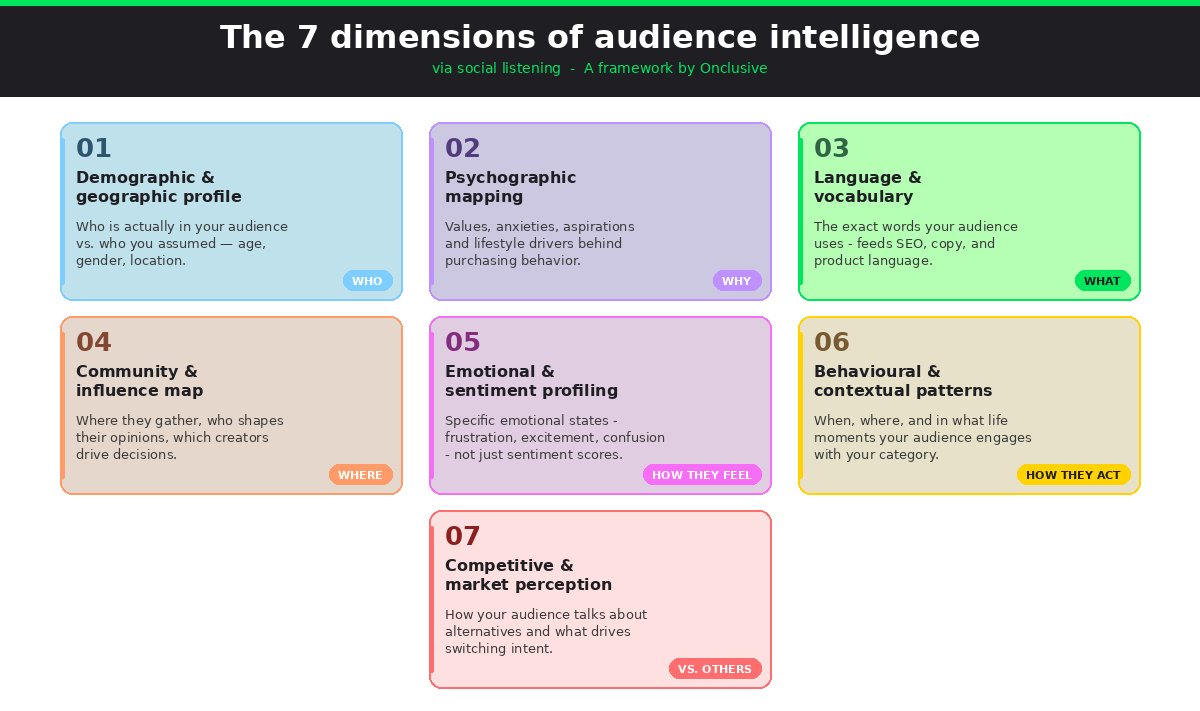
When a brand approaches social listening for audience insights, with the goal of building genuine audience intelligence, there are seven dimensions worth investigating systematically. Together, they form a comprehensive picture of who your audience really is – and what that means for your strategy.
1. Demographic and geographic profile
The most basic layer: who is talking, where are they based, and what does that tell you about your actual (versus assumed) audience? Demographic insights from social listening track information like age, gender, and location, to verify whether the people engaging with your content actually match your intended target audience. Many brands discover that their real community skews differently from their marketing assumptions – a discovery that can reshape everything from media buying to product development priorities.
Geographic profiling adds a further layer of strategic value. A global brand may discover that the conversation dynamics around its category are fundamentally different in different markets: what drives enthusiasm in one country may be irrelevant or even negative in another. Social listening allows these geographic nuances to be mapped systematically, without the cost of running separate research projects in each market.
2. Psychographic mapping
Demographics describe who your audience is. Psychographics explain why they behave the way they do. What values drive them? What anxieties do they navigate? What aspirations animate their choices? What trade-offs are they willing to make – price versus quality, convenience versus ethics, status versus authenticity?
Social conversations – particularly in communities like Reddit, Discord, or niche Facebook groups – are extraordinarily rich sources of psychographic data, because people discuss these deeper motivations far more candidly online than in formal research settings. Someone will tell a focus group moderator that they buy sustainably because it is the right thing to do. They will tell a Reddit thread that they buy sustainably because it makes them feel less guilty about other consumption choices. The latter is far more useful for brand positioning.
Psychographic mapping through social listening also allows brands to identify the internal tensions within their audience – the competing values and desires that create cognitive dissonance and, crucially, unmet needs. These tensions are often where the most valuable product and communications opportunities lie.
3. Language and vocabulary intelligence
One of the most underutilised – and most immediately valuable – applications of social listening is mining the specific language your audience uses. What words do they reach for when describing the problem your product solves? What terminology do they use when they complain, when they praise, when they recommend to a friend?
This vocabulary intelligence has direct, practical applications across multiple functions. For SEO and content teams, it surfaces the exact phrases that potential customers type into search engines – often very different from the technical or brand-specific terminology a company uses internally. For copywriters and campaign teams, it provides the raw material for messaging that resonates because it reflects how the audience already thinks. For customer service teams, it helps scripts and chatbots respond in language that feels natural rather than corporate.
Brands that speak the language of their customers convert far more effectively than those that speak the language of their internal brand team. The gap between “high-performance moisture management technology” and “stops you sweating through your shirt” may seem small, but it is the difference between copy that lands and copy that gets scrolled past.
4. Community and influence mapping
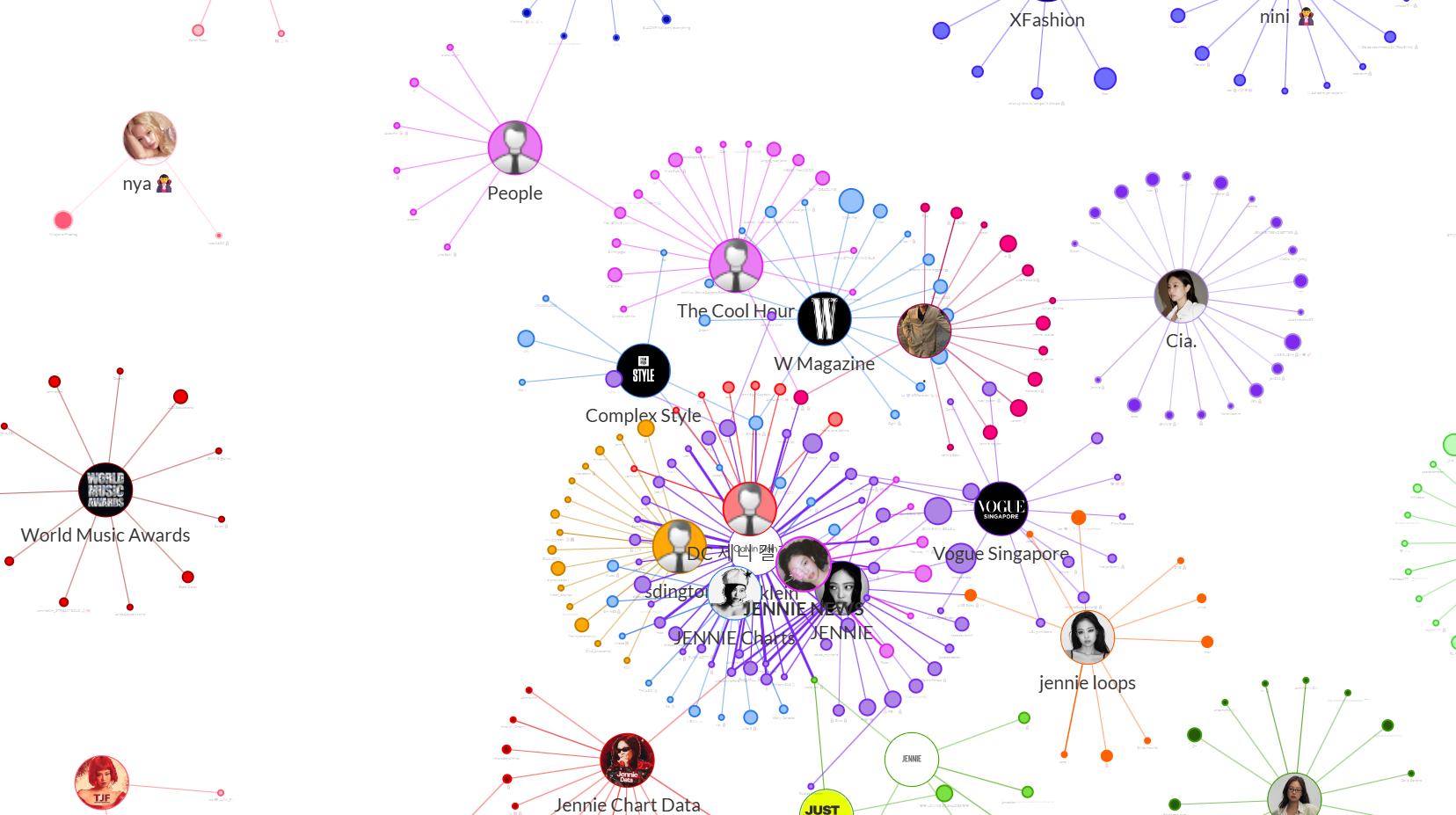
Every audience is structured around communities, subcultures, and influential voices – a social architecture that shapes what people believe, what they buy, and how they talk about brands. Social listening helps you map that ecosystem with precision.
Where does your audience congregate? A fitness brand may discover that its most engaged customers are deeply embedded in Reddit’s r/fitness communities and specific Discord servers – not primarily on Instagram, where the brand has been focusing its investment. Who do they listen to? Not just the macro-influencers with millions of followers, but the micro-creators, the expert voices, the trusted peers whose recommendations carry far more weight within their specific community.
Successful companies are using social insights to identify high-intent prospects, understand buying signals, and lower customer acquisition costs through better audience targeting based on actual conversations and interests rather than demographic assumptions. Understanding community structure also helps brands identify potential allies: the voices who already speak positively about the category, who have built trust with exactly the audience the brand wants to reach, and who could become genuine advocates rather than paid promoters.
5. Emotional and sentiment profiling
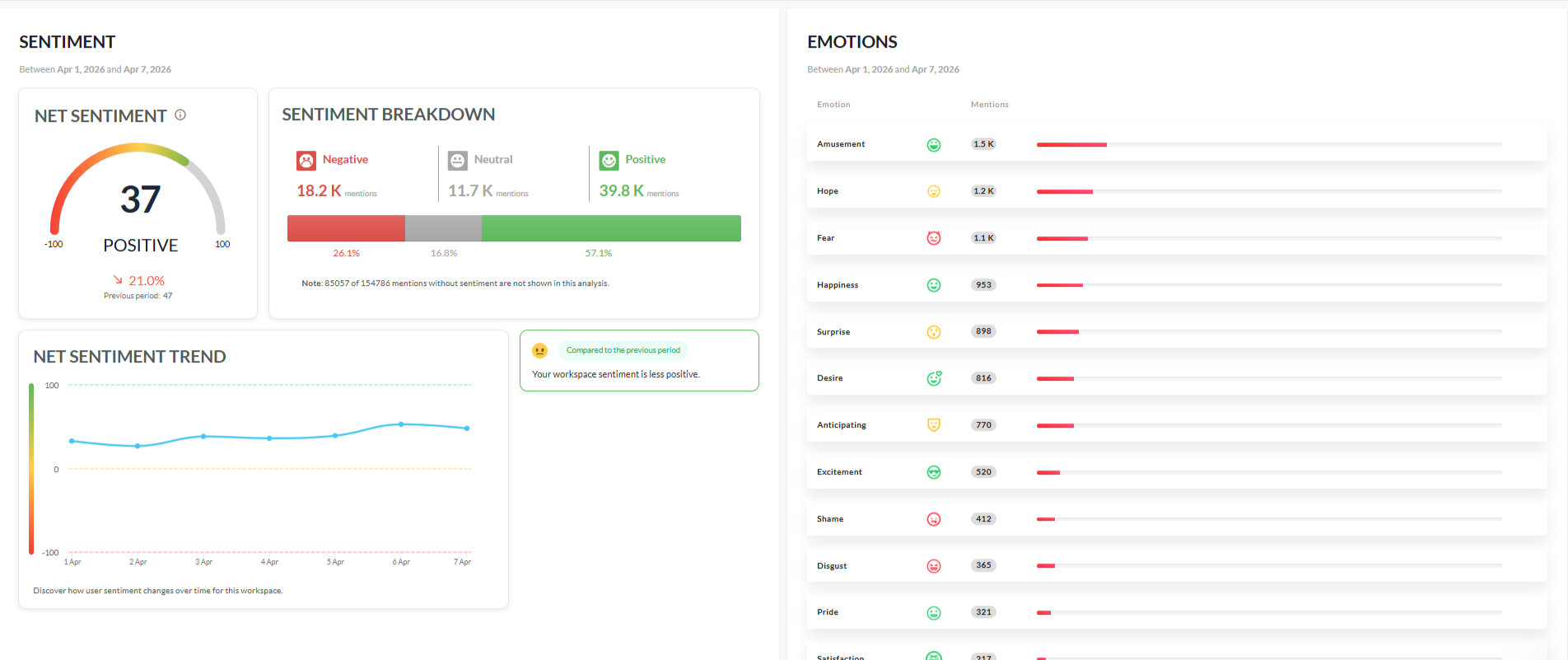
Knowing that sentiment is “positive” or “negative” is a starting point, but it is a very blunt one. True audience intelligence requires understanding the emotional texture underneath the numbers.
Are customers frustrated specifically about shipping times, or about the unboxing experience? Are they enthusiastic about a product feature in general, or about one specific use case that the brand never thought to highlight? Is the negative sentiment around a brand campaign driven by genuine offence, or by a small but loud group whose views are not representative of the broader audience?
AI has evolved to go beyond simple positive or negative categorisations to a more nuanced understanding of context, sarcasm, emojis, cultural nuances, and emotional states – enabling brands to know exactly what to fix or what to celebrate, and to respond while people still care about the issue.
Emotional profiling also enables brands to track how emotional associations with their brand shift over time – a more sensitive indicator of brand health than net sentiment alone. A brand whose conversation is moving from frustration toward confusion, for example, may have a communications problem rather than a product problem. The distinction matters enormously for the appropriate response.
6. Behavioural and contextual patterns
When do your customers post about your category? Where are they when they engage with your type of content – at home, relaxing on a Sunday morning, or on a commute? What triggers them to seek out your product? What moments in their daily lives create the need your product addresses?
This contextual understanding – sometimes called “occasion mapping” in traditional research – can be built through social listening at a fraction of the cost of ethnographic studies or diary research. Food and beverage brands, for example, have used social data to discover that a significant proportion of their customers consume their products in moments of stress or self-care – insights that shaped not just campaign creative but media scheduling, ensuring ads appeared at the moments when the emotional context was most receptive.
Behavioural pattern analysis also reveals the customer journey in ways that CRM data cannot. Social conversations show the consideration phase – what people say when they are thinking about buying, what questions they ask, what objections they raise, what reassurance they seek – giving brands the intelligence to optimise touchpoints long before a purchase decision is made.
7. Competitive and market perception intelligence
Your audience does not experience your brand in isolation – they constantly compare it to alternatives, consciously or unconsciously. How your brand is positioned in their minds relative to competitors is one of the most strategically important things a brand can know, and social listening reveals it with a candour that no direct research method can match.
The primary objective for analysing social data is cultural and trend analysis, but the most common actual use case is competitive benchmarking. Understanding how your audience talks about your competitors – their language, their frustrations, their reasons for switching, the moments when competitive loyalty weakens – is some of the highest-value intelligence a brand can acquire.
It also reveals the gaps in the market: the unmet needs that none of the current competitors are adequately addressing, the pain points that keep surfacing across multiple brand conversations, the audience segments that feel underserved. These are the whitespace opportunities that competitive intelligence through social listening surfaces – and that traditional competitive analysis, focused on products and pricing rather than audience perception, typically misses.
From raw data to actionable intelligence: a step-by-step approach
Collecting social data is the easy part. The hard part – and the part where most organisations underperform – is turning that data into structured intelligence that can actually inform decisions. Here is a practical six-step framework.
Step 1: Define your intelligence questions. Before opening any tool, invest time in defining the specific questions you want to answer.
“What do people think about us?” is too broad to operationalise. “What emotions do first-time buyers in the 25-34 segment associate with our onboarding experience?” is actionable.
“Which competitor is gaining ground in the sustainability conversation, and why?” is specific enough to configure meaningful listening queries around. The quality of your intelligence questions determines the quality of your eventual insights. Involve stakeholders from multiple departments – product, marketing, communications, customer experience – to ensure the questions reflect the strategic priorities of the whole organisation, not just the social media team.
Step 2: Configure multi-platform, multi-signal monitoring. Your audience does not live on one platform, and different platforms reveal different dimensions of who they are. In 2025, the interest in non-mainstream data sources such as Bluesky, Threads, and Rednote is increasing alongside established platforms. Effective audience intelligence requires listening across the full landscape: social networks for broad reach and real-time signals, forums (Reddit is particularly rich for honest psychographic data) for depth and candour, review platforms for specific product and experience feedback, news comments for cultural and political attitudes, and video platforms for emerging cultural trends. The configuration of your listening setup should map directly to your intelligence questions – not default to “monitor everything” without strategic intent.
Step 3: Segment before you analyse. Raw volume data tells you very little. Before drawing conclusions, segment your data rigorously.
- By audience cluster: what are first-time buyers saying versus loyal customers?
- By platform: LinkedIn conversations and TikTok conversations about the same brand often reflect entirely different audience segments with different priorities.
- By geography: market-specific nuances are invisible in aggregated data.
- By timeframe: short-term spikes are often noise, while sustained directional trends carry strategic weight. Patterns only emerge clearly – and reliably – once you have controlled for these variables. Skipping segmentation is one of the most common causes of misleading social intelligence conclusions.
Step 4: Move from reporting to interpretation. This is the step that separates brands that generate social reports from brands that generate social intelligence. Technology is excellent for measuring competitive benchmarking, crisis detection, and brand health tracking. Where it struggles is finding meaning in the data – that requires critical thinking by humans, and the richer insights that result from this are where the strategic impact lies. A tool can tell you that mentions of “sustainability” in connection with your brand increased by 40% this quarter.
A skilled analyst can tell you why – and more importantly, what it means for your strategy. Invest in human capability alongside technology investment: analysts who understand your business context, who can challenge the obvious interpretation in favour of the true one, and who can translate data into language that resonates with senior decision-makers.
Step 5: Distribute insights to the right teams. Audience intelligence is only valuable if it reaches the people who can act on it. This requires deliberate organisational design, not just good analysis.
PR and communications teams need to understand how reputation dynamics are shifting and what narratives are gaining traction.
Product teams need to hear unfiltered feedback on features, usability, and unmet needs. Campaign and brand teams need vocabulary intelligence, emotional data, and audience persona updates.
Customer experience teams need to know what complaints are proliferating before they become crises.
The most successful organisations build systematic workflows for distributing social insights across departments – with tailored formats for each audience, from executive summaries for leadership to detailed briefings for frontline teams.
Step 6: Close the loop and iterate. Act on the insight, measure the impact of that action, and feed what you learn back into your next listening cycle. Audience intelligence is not a one-time research project – it is a continuously evolving understanding of people who are themselves continuously changing. Brands that build this learning loop tend to compound their advantage over time: each cycle of listening, acting, and measuring makes the next cycle more targeted and more valuable.
Set a regular rhythm for reviewing and updating your audience profiles, your listening configuration, and the strategic questions you are asking. Markets move, audiences evolve, and the intelligence function that served you well last year may be missing the most important signals of today.
Real-world use cases: how brands apply audience insights
Repositioning a product through audience language discovery. A consumer brand noticed through social listening that customers consistently described their product using language the brand had never used in its own communications. The audience spoke about the product in terms of a specific emotional benefit – not the functional claim the brand had been leading with for years. By aligning messaging to the language already being used organically by real customers, the brand saw measurable improvements in ad recall, engagement rates, and ultimately conversion – without changing the product itself.
Identifying an unexpected audience segment. An alcohol brand learned through social listening that vegan consumers were driving the majority of conversations about its new whiskey, guiding its targeting strategy – a segment the brand had not initially considered as a primary audience, and one that opened an entirely new channel of influencer partnerships and community engagement.
Product development driven by audience pain points. A geolocation brand reintroduced physical buttons on its device after social data revealed widespread frustration with touch-only controls – feedback that had been consistently present in community forums for months but had not surfaced through formal customer satisfaction surveys.
Influencer and community identification. A gaming brand shifted its influencer strategy to Twitch after social listening revealed that its key communities had migrated away from traditional video platforms – intelligence that prevented significant misallocation of influencer budget and allowed the brand to be present where the conversation was actually happening.
Trend surfing before the peak. Social listening helped brands identify the Labubu toy trend early – when a small but dedicated fanbase formed online – long before the trend reached mainstream media, allowing early movers to ride the buzz before it was saturated. The brands that got on board at the community stage captured the cultural moment; those that waited for mainstream confirmation were too late.
Crisis intelligence and early warning. A retail brand identified, through social listening, that a specific product-related complaint was gaining traction in a niche online community well before it reached mainstream media. By addressing the issue proactively – reaching out to affected customers, publicly acknowledging the problem, and announcing a resolution – the brand contained what could have become a significant reputational incident. The cost of the proactive response was a fraction of what a reactive crisis management campaign would have required.
Campaign co-creation through audience listening. A cosmetics brand used social listening during the planning phase of a major product launch to map the specific aesthetic trends, vocabulary, and cultural references most resonant with its target segment. The resulting campaign felt genuinely native to the audience’s world – because it was built from intelligence about that world – and outperformed equivalent launches that relied on internal creative judgement alone.
The role of AI in modern social listening
The integration of artificial intelligence into social listening tools has fundamentally changed what is possible for audience intelligence. The most significant advances are not about processing speed – though that matters – they are about interpretive depth and predictive capability.
Emotion detection beyond sentiment. Modern AI can now classify not just positive or negative sentiment, but specific emotional states at scale: frustration, excitement, confusion, nostalgia, anxiety, disappointment, pride. This granularity transforms audience intelligence from a blunt instrument into a precision tool. A brand that knows its customers are specifically confused rather than generally unhappy can deploy a very different – and far more effective – response.
Predictive audience analytics. Better resource allocation is now possible through advance warning of which topics will matter most to your audience in the coming months, enabling more successful product launches by developing features based on predicted consumer needs rather than past behaviour, and enhanced brand positioning by consistently staying ahead of market shifts. Predictive models trained on historical social patterns can identify when a topic is in its early growth phase versus approaching saturation – a critical distinction for brands deciding when to enter a conversation.
Automated audience persona generation. AI tools can now automatically cluster social conversations into distinct audience segments – grouping people not by their demographics but by the patterns in how they discuss topics, what language they use, what content they engage with, and what values they express. This produces far richer and more actionable personas than traditional demographic segmentation, and can update them dynamically as audience behaviour evolves – eliminating the stale persona problem that plagues many marketing organisations.
Multilingual and multicultural intelligence. For global brands, AI-powered social listening now enables genuine cross-market audience intelligence at scale. Advanced NLP models process conversations in dozens of languages with high accuracy, identifying where audience profiles are consistent across markets and where they diverge in ways that require localised strategy. Cultural nuances that would previously require native speaker analysts in every market can now be detected and flagged algorithmically.
Narrative and context analysis. Beyond individual posts, newer AI capabilities can track how narratives evolve across a conversation ecosystem over time – understanding not just what is being said but how stories are forming, spreading, and shifting. This is particularly valuable for reputation management and for identifying the moments when a brand narrative is being rewritten by forces outside the organisation’s control.
That said, AI remains a tool, not a substitute for strategic thinking. Most social intelligence professionals are self-taught, relying on instinct rather than theory – which explains a reliance on technology that can only take us so far. Finding meaning in data requires critical thinking by humans. The brands that extract the most value from AI-enhanced listening are those that combine technological capability with skilled human interpretation – using AI to process at scale and surface signals, and human expertise to contextualise, challenge, and translate those signals into decisions.
Common pitfalls to avoid
Mistaking volume for importance. A topic that generates millions of posts is not necessarily more strategically important than one discussed by a smaller, highly engaged community. Depth of conviction – the intensity with which a topic is discussed, the specificity of the language used, the expertise level of the people engaging – often matters more than raw mention volume. A niche professional community debating a technical limitation of your product may be a far more important signal than a fleeting viral moment.
Treating all platforms as identical. The same audience segment can express itself very differently on LinkedIn versus Reddit versus TikTok. On LinkedIn, professional self-presentation creates a particular kind of filtering. On Reddit, anonymity encourages candour that professionals would never express publicly. On TikTok, emotional and creative expression dominates. Aggregating data across platforms without controlling for these dynamics produces conclusions that are systematically misleading about how people actually think.
Confusing brand sentiment with audience sentiment. Your brand’s net sentiment score tells you how people feel about your brand. It tells you almost nothing about how your audience feels about their lives, their needs, or the wider context that shapes their purchasing decisions. Brands that focus exclusively on brand sentiment miss the strategic intelligence that comes from understanding the broader landscape of their audience’s world.
Acting on a single data point. Social listening regularly surfaces outliers, anomalies, and genuinely surprising signals – and it can be tempting to act immediately on a particularly striking insight. Responsible audience intelligence involves triangulating signals across multiple sources, platforms, and timeframes before drawing strategic conclusions. A single viral post is not a trend. A pattern sustained across multiple communities over several weeks is.
Neglecting the “dark social” problem. A significant proportion of social conversations happen in private or semi-private spaces – WhatsApp groups, private Facebook groups, Discord servers, Telegram channels – that are entirely invisible to standard social listening tools. This is not a minor caveat: for some audiences and categories, the most influential conversations happen precisely in these closed environments. Acknowledging this blind spot is important for calibrating the confidence you place in social intelligence findings, and for building complementary research approaches that access what listening tools cannot reach.
Using social intelligence as a one-way mirror. The most sophisticated brands do not just extract intelligence from social conversations – they participate in them. Communities notice when brands listen but never engage, when insights are harvested but the people providing them are never acknowledged or heard. Building genuine audience intelligence includes building genuine audience relationships: the brands that are trusted participants in their audience’s online communities generate far better intelligence than those who observe from a distance.
FAQ: social listening for audience insights
What is the difference between social listening and social monitoring?
Social monitoring is the practice of tracking brand mentions, hashtags, and keywords in real time to stay informed about what is being said. It is largely reactive – you detect a mention and respond if necessary. Social listening goes further and deeper: it involves analysing patterns across those conversations over time, identifying what they reveal about your audience’s values, needs, and perceptions, and extracting strategic intelligence that informs decisions across the business.
Monitoring tells you what happened. Listening helps you understand why – and what to do about it. The distinction matters for how you resource the function, what tools you need, and how you integrate the outputs into strategic planning.
Which social platforms should brands prioritise for audience insights?
There is no universal answer – the right platforms depend entirely on where your specific audience is most active and most candid. That said, a few principles apply broadly. Reddit and online forums tend to produce the richest psychographic data because people write at length about genuine opinions without the personal reputation concerns that moderate expression on named-identity platforms.
Review platforms (Google Reviews, TripAdvisor, Trustpilot, G2) surface specific product experience feedback anchored to real purchase decisions. LinkedIn is essential for B2B audience intelligence and for understanding professional identity and career-related motivations. TikTok comments and Reels reveal cultural attitudes, humour, and emerging aesthetic trends. X (formerly Twitter) remains valuable for real-time reactions to news and events. The most effective approach is to begin with a wide net and progressively focus on the platforms that generate the highest-quality signals for your specific intelligence questions – rather than defaulting to the platforms where your brand has the largest presence.
How often should brands conduct social listening for audience insights?
The right cadence depends on the purpose. Tactical brand monitoring should be continuous – near-real-time, to detect emerging issues before they escalate. Deeper audience intelligence work – profiling audience segments, mapping psychographics, updating persona documentation – is better approached as a structured periodic exercise: quarterly at a minimum, or triggered by a major business event such as a product launch, market entry, or significant campaign.
Annual strategic reviews of audience positioning benefit from a more comprehensive listening audit covering the full year’s conversation landscape. The key principle is building a rhythm that ensures your audience understanding does not become stale. Audience behaviours and expectations evolve continuously, and strategy built on a two-year-old audience profile is strategy built on sand.
Can social listening replace traditional market research like surveys or focus groups?
No – and it should not try to. Social listening and traditional research are complementary disciplines, not competing ones. Social listening excels at scale, speed, authenticity, and unprompted discovery. Traditional research excels at answering specific, structured questions with statistical rigour, representative sampling, and the kind of depth that comes from moderated conversation or longitudinal tracking studies.
The most powerful insight programmes use social listening to identify the questions worth asking in depth, and traditional methods to answer those questions with the confidence required for major strategic decisions. Neither approach alone is sufficient; together, they create a significantly richer understanding of the audience than either could produce independently.
How do small and mid-sized businesses use social listening for audience insights without enterprise budgets?
Start with focused, well-defined questions rather than trying to monitor everything. Even with basic tools, you can extract significant value by systematically tracking conversations in a few key communities where your target audience is active and candid – specific subreddits, industry-specific forums, the review pages of your top competitors. Set aside structured time each week to read and analyse these conversations: what language patterns emerge? What frustrations recur? What does your audience celebrate?
Free tools like Google Alerts provide basic signals. Native platform search functions are more powerful than most people realise. As budget grows, professional tools like Onclusive Social offer scalable options designed to make structured audience intelligence programmes accessible without requiring a dedicated analyst team – enabling even mid-market organisations to build systematic intelligence capabilities.
How does social listening contribute to building better buyer personas?
Traditional persona development relies on interview data, survey responses, and CRM demographic records – all of which are structured, prompted, and potentially filtered by social desirability. Social listening adds a layer of naturally occurring behavioural and attitudinal data: the language people actually use unprompted, the concerns they spontaneously raise at 11pm when no researcher is watching, the values they express in moments of genuine enthusiasm or frustration.
This makes personas far more vivid, specific, and strategically useful than those built on structured data alone. Brands that combine both approaches consistently report that social data either validates their existing personas (building confidence in strategic decisions) or surfaces important nuances that the formal research had smoothed over – a new micro-segment emerging within a broad target, a subgroup with distinctly different needs, or an emotional driver that surveys had not revealed because nobody thought to ask about it.
What metrics should brands track to measure the ROI of social listening for audience insights?
ROI on audience intelligence is inherently indirect and lagged – the value shows up in the quality of subsequent decisions, not in the listening activity itself. That said, useful indicators include: improvement in campaign performance metrics (engagement rates, conversion rates, brand recall) after implementing insight-driven creative informed by social intelligence; reduction in customer complaint volume or NPS score decline after addressing pain points identified through social data;
improved product-market fit scores after integrating social feedback into development cycles; time and cost savings on traditional research due to social intelligence pre-work that sharpens research briefs; speed-to-insight for strategic decisions compared to research-dependent processes; and the commercial impact of trends identified early through social listening before they became mainstream. Over time, organisations that track these outcomes consistently find that audience intelligence is among the highest-ROI investments in their marketing and insight budgets.
The cover image was generated by a Gen AI tool for illustrative purposes