




Media monitoring is the practice of tracking, analyzing, and interpreting how your brand, executives, products, competitors, and industry appear across news, broadcast, online media, and social platforms.
If you work in PR or comms, media monitoring sits at the center of everything: reputation management, crisis detection, campaign measurement, and proving the value of your work to the business.
This guide covers what media monitoring is and how it works, the key benefits and ROI it delivers, the channels and formats a strong platform should cover, real-world media monitoring examples from leading organizations, and how Onclusive’s media monitoring solutions can help.
What is media monitoring?
Today’s platforms automate coverage tracking at scale, using AI to surface the signals that matter and suppress the noise. Traditional monitoring required manual review of press clippings. Today’s tools provide real-time alerts, sentiment analysis, reach estimates, and competitive benchmarking all from a single platform. The goal is to transform raw coverage data into actionable intelligence: understanding not just where you were mentioned, but what it means for your reputation, messaging, and strategy.
Read more: How media monitoring works
Read more: AI media monitoring: how AI is changing PR
Key terms defined: media monitoring, social media monitoring, and social listening
Part of understanding what media monitoring is knowing how it differs from related terms. These four terms are often confused. They describe related but distinct practices. Understanding the difference and knowing when to use each, is essential for building an effective comms intelligence program.
| Term | What it tracks | The question it answers | Primary use |
| Media monitoring | News, broadcast, online publications, trade media, podcasts, forums, licensed content | What coverage did we receive and how does it shape our reputation? | PR performance, reputation management, crisis detection, executive briefing |
| Social media monitoring | Direct mentions, tags, comments, and engagement on social platforms | Who is talking about us and how are they engaging? | Community management, engagement analysis, influencer tracking |
| Social listening | Broader social conversations, trends, and sentiment patterns over time | What does audience opinion mean and what should we do about it? | Brand perception, campaign planning, audience insight, competitive intelligence |
| AI visibility monitoring | Brand mentions, citations, sentiment, and share of voice across AI-generated answers from LLMs | How does our brand appear in AI-generated answers, and which sources are shaping that presence? | AI visibility tracking, source citation analysis, competitive benchmarking, proving earned media impact on AI presence |
Used together, the four capabilities give communications teams a complete picture:
- Media monitoring captures what journalists and publishers are saying.
- Social media monitoring shows how audiences are responding in real-time.
- Social listening surfaces the deeper patterns in those conversations, revealing shifts in sentiment, emerging narratives, and audience perception that inform longer-term strategy.
- AI visibility monitoring captures how your brand appears in AI-generated answers, revealing which sources LLMs draw on, how your brand is described, and where visibility gaps exist across AI platforms.
Each layer adds context the others can’t provide alone.
Read more: Social media monitoring vs. social listening
Media monitoring benefits: why it matters for PR and comms
Once you have a clear understanding of what media monitoring is, the next question is what it delivers. Media monitoring delivers value across the full comms function, from day-to-day PR operations to strategic planning and executive communications. Here’s how:
Protect and manage brand reputation
Brand reputation is built across thousands of individual coverage moments and can shift quickly when a negative story gains traction. Media monitoring gives you a continuous, real-time view of how your brand appears across all channels, enabling early detection of reputational risk before it escalates including sentiment shifts and emerging criticism.
The Brand Influence Rank 2026 analyzed 50 global brands by combining mainstream media and social media performance into a single Global Media Influence Score. The findings show that the brands with the strongest reputations aren’t just generating coverage, they’re generating the right kind, in the right places, with consistent positive sentiment over time.
Read more: Brand monitoring: definition, methods, and best practices
Measure PR performance and demonstrate ROI
One of the most persistent challenges in comms is proving the value of PR activity to leadership. Media monitoring provides the data infrastructure for outcome-oriented measurement: share of voice, message pull-through, sentiment trends, reach by outlet tier, and earned media value.
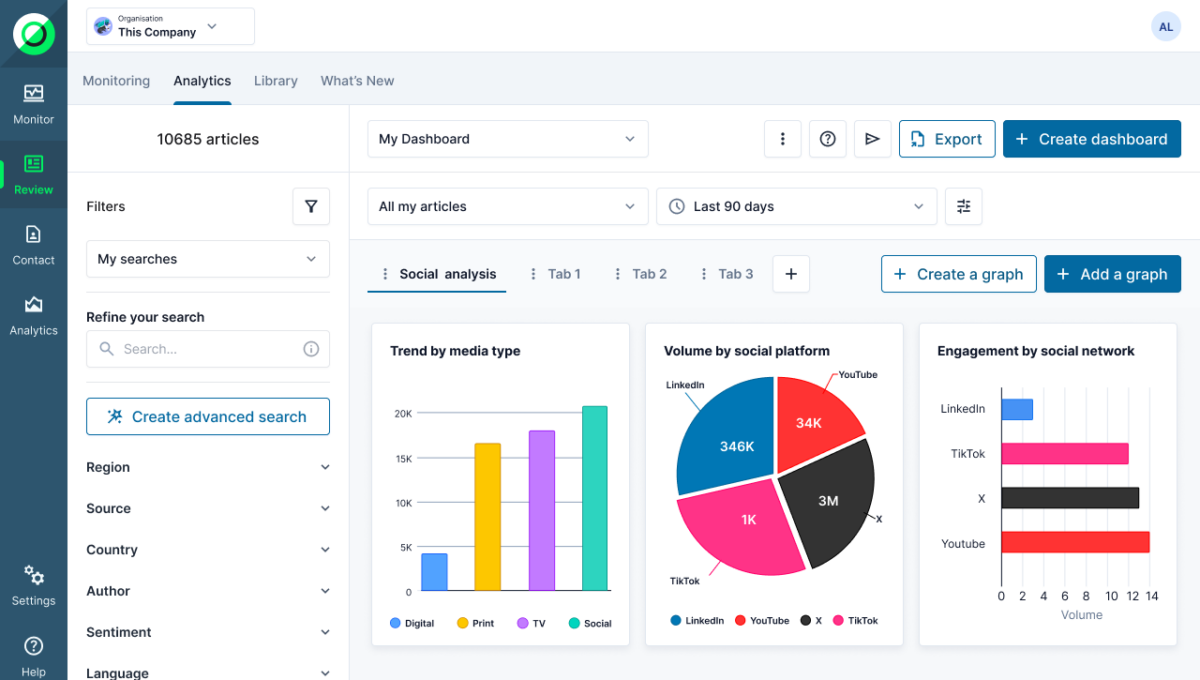
Effective PR measurement starts with a clear framework. Our 5-step guide to building a PR measurement framework shows how to connect monitoring data to business objectives – moving beyond vanity metrics to the evidence leadership actually needs.
Detect and manage crises early
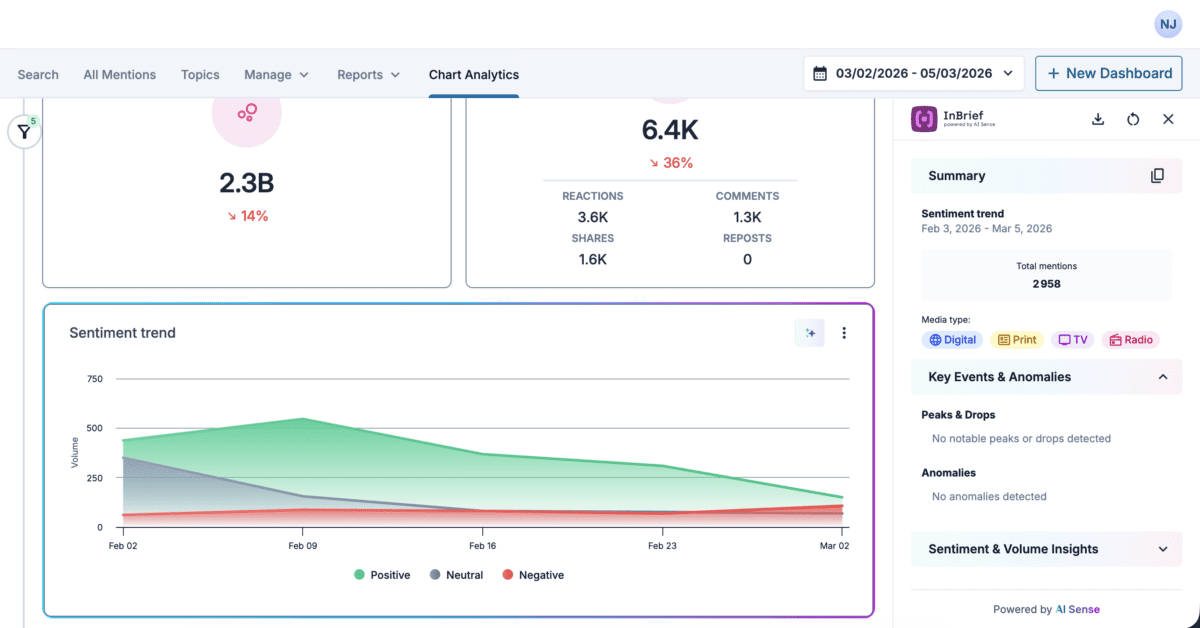
Speed is the single most important factor in crisis comms. Media monitoring platforms with real-time alerting allow you to set volume and sentiment thresholds so they’re notified the moment a story begins to develop, often hours before it reaches mainstream media.
Spike monitoring detects sudden increases in coverage volume or sentiment, giving teams an early warning system for breaking stories, viral moments, competitor announcements, and emerging risks. AI-driven anomaly detection flags unusual patterns in near real time, so you’re alerted to what matters before it escalates.
Read more: Get ahead of a PR crisis: 7 social listening best practices
Track competitor coverage and share of voice
Media monitoring is as valuable for competitive intelligence as it is for self-monitoring. By tracking competitor brands, executives, campaigns, and messaging alongside your own, you can benchmark visibility, identify narrative gaps, and spot emerging competitive threats as they appear in the media.
Read more: What is share of voice?
Support executive and stakeholder communications
Senior leaders rely on media intelligence to understand how the organization is positioned externally, prepare for media engagements, and make informed decisions. Media monitoring feeds executive briefings, spokesperson preparation, board reporting, and investor communications with timely, accurate data.
See how TELUS centralized media monitoring to transform brand management across the organization. Read the TELUS case study
Inform content and thought leadership strategy
Coverage analysis reveals which topics, angles, spokespeople, and formats generate the most traction with target media. These insights feed directly into content planning, helping comms teams develop work that earns coverage rather than chasing it.
Measure message pull-through and campaign effectiveness
Media monitoring helps you close the loop on your campaigns: tracking not just whether coverage appeared, but whether it carried the intended messages and positioning. The key question is not how much coverage you generated, but whether your narrative actually landed with the right audiences.
Campaign monitoring structures this across three phases:
- Establishing a baseline before launch
- Tracking message pull-through and sentiment in real-time during the campaign
- Evaluating share of voice movement and reach by media outlet tier after
Monitor how your brand appears in AI-generated answers
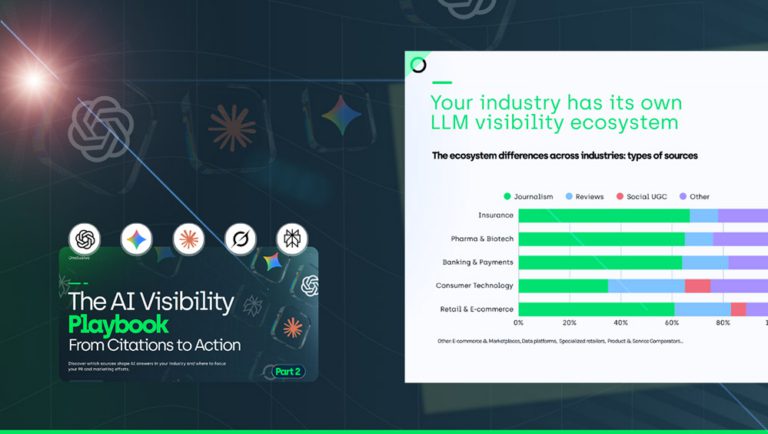
As journalists increasingly use AI tools like ChatGPT, Gemini, and Perplexity to research topics and organizations, the sources those platforms cite, and the narratives they surface, are shaping brand perception in a new way. Understanding your AI visibility: where you appear, how you’re described, which sources AI draws on when discussing your brand, and how that compares to competitors, is becoming as important as tracking traditional coverage.
Media monitoring channels and formats
Comprehensive media monitoring requires coverage across every channel where your audiences and stakeholders consume information. A single story might start in a trade publication, gain traction on social media, and reach broadcast coverage within hours. Monitoring each channel in isolation creates blind spots. A strong media monitoring platform will include:
News and online media
The core of most media monitoring platforms. This includes national and global publishers, regional and local outlets, digital-first newsrooms, and niche online publications. Coverage from these sources is typically editorial in nature and carries high credibility with stakeholders.
Broadcast media: TV and radio
Broadcast remains highly influential, particularly for crisis-related reporting and major announcements. Broadcast media monitoring captures full transcripts and clips from TV news programs, radio segments, and industry-specific broadcast content, ensuring coverage across audio and video formats is included in your intelligence picture, not just text.
Broadcast monitoring is especially important for regulated industries, public affairs, and any organization where executive appearances or spokesperson performance need to be tracked and evaluated.
Read more: Broadcast media monitoring: the complete US guide
Licensed content
Licensed content is premium media coverage made available to monitoring platforms under formal licensing agreements. It includes full-text articles from major national and international titles, regional press, trade publications, and wire services such as Reuters, AP, and PA. This is content that would otherwise sit behind paywalls and out of reach of standard monitoring tools.
For organizations operating in regulated industries, financial services, or markets where trade media is influential, licensed content coverage is often the difference between a complete picture and a partial one.
LinkedIn and professional networks
LinkedIn has become a significant channel for brand narratives in B2B markets, with executive thought leadership, company announcements, industry commentary, and sponsored content all shaping brand perception. LinkedIn monitoring tracks how your brand and executives are discussed and positioned across the world’s largest professional network.
For B2B organizations, professional services firms, and companies where executive visibility is strategically important, LinkedIn coverage can be as influential as traditional media in shaping stakeholder and investor perception.
Social media platforms
While social media monitoring and social listening are distinct capabilities, social platform coverage is an important part of a comprehensive media monitoring program. Posts, threads, and discussions on X (formerly Twitter), Facebook, Instagram, TikTok, Reddit, Bluesky, and other platforms can drive mainstream media coverage and must be tracked alongside editorial sources.
Read more: Social media monitoring: the complete guide to mastering digital listening
Podcasts, video, and audio content
Podcasts and YouTube continue to grow as influential channels for industry commentary, brand discussion, and executive interviews. AI-powered transcription now makes it possible to monitor audio and video content at scale, ensuring mentions in long-form audio and video formats are captured alongside text-based coverage.
Trade publications and industry media
Trade publications reach highly targeted, sector-specific audiences and are often the primary source of credibility among decision-makers, investors, and regulators. Monitoring trade media ensures that the coverage most relevant to your industry and stakeholder group is never missed.
Copyright and licensed content: what to know
Media monitoring platforms operate under strict licensing agreements that govern how content is collected, stored, and displayed. Understanding the copyright framework around media monitoring is important for compliance, particularly when sharing coverage internally or in reports.
Onclusive’s media monitoring solutions
Onclusive offers a suite of monitoring solutions designed to meet the needs of comms teams at every scale, from in-house PR functions, PR agencies managing multiple clients, to global enterprise teams that need fully managed monitoring services.
| Product | What it does | Best for |
| Onclusive Self-Service Monitoring | Direct access to the world’s most comprehensive earned media monitoring platform: 30,000+ print titles, 3 million+ websites, and 3,000+ TV and radio sources, all copyright compliant. Write your own searches, set threshold-based spike alerts, track 12 months of historical content, benchmark against competitors, and generate one-click PowerPoint reports. Includes the Wordplay Broadcast Editor for editing, clipping, and sharing broadcast content directly in platform. | In-house PR and comms teams that want direct platform control: running unlimited searches, monitoring competitors, and generating stakeholder-ready reports on demand. |
Onclusive Managed Monitoring | A fully managed monitoring service combining Europe’s most comprehensive media coverage: 60,000+ print titles, 3 million+ websites, 12,000+ broadcast sources with expert curation and AI-powered analytics. Onclusive’s dedicated team handles everything from monitoring setup to Press Review creation, delivering customized coverage digests, contextual summaries, and validated intelligence across every channel. | Organizations that need high-quality, always-on media intelligence without the internal resource to run a full monitoring program — and want a dedicated team acting as an extension of their communications function. |
Explore Self-Service Monitoring | Explore Managed Monitoring
Complete your media intelligence picture
| Product | What it does | Best for |
Onclusive Press Reviews | AI-powered news digests combining automated summarization with expert curation, delivered directly to stakeholders in branded, ready-to-share formats. Includes daily digests, executive briefings, WhatsApp delivery, and custom editorial services. | Comms teams and agencies that need to keep executives and stakeholders informed without spending hours on manual coverage compilation. |
Onclusive Social | Real-time, deep social listening across X, LinkedIn, Facebook, Instagram, TikTok, Reddit, Bluesky, and more. AI sentiment analysis, topic clustering, anomaly detection, and audience insight. | PR, marketing, and brand teams that need to understand broader social conversation and audience perception alongside earned media coverage. |
Media monitoring examples: How leading organizations use it in practice
Real-world media monitoring examples show how PR and comms teams put coverage intelligence to work. Here’s how two leading organizations use Onclusive to protect reputation, measure performance, and inform strategy.
From fragmented tools to unified intelligence: Hopscotch
Hopscotch, a full-service comms agency managing international clients across multiple markets, faced a core operational problem: coverage was scattered across different platforms, data lived in separate places, and producing consolidated daily reports meant hours of manual work before anything reached a client’s inbox.
Working with Onclusive, the team consolidated monitoring across all markets into a single platform — automating press reviews, generating coverage digests for every client each morning, and replacing unwieldy spreadsheets with clean analytics dashboards organized around the metrics that matter.
The result was an immediate reduction in manual effort and a more credible way to present performance to clients across European markets.
Predicting reputation risk 50% faster: Global biopharma leader
A global biopharmaceutical company faced fragmented reputation data spread across six different tools, with no way to connect external media narratives to enterprise performance or anticipate emerging risks before they escalated.
Working with Onclusive and Maha Global’s Darwin platform, the company replaced manual monitoring with continuous, automated media intelligence — combining Onclusive’s global coverage across digital, print, broadcast, and social with Darwin’s AI-powered analysis of governance, financial, and operational signals.
The result was a 7-point reputation score improvement, fully automated media data feeds, and a Corporate Affairs function that shifted from tactical reporter to strategic advisor to the C-suite.
Media intelligence by sector
See how media monitoring plays out across specific industries. Onclusive’s intelligence reports analyze millions of media coverage pieces and social conversations to benchmark coverage, share of voice, and reputation by sector.
- Banking Industry Trends 2026: A media and social intelligence report
- Energy Industry trends 2026: A Media & Social Media Intelligence Report
- Pharma Industry Scan 2025: The complete media intelligence report
- AI Infrastructure Industry Scan 2025: Who’s winning the race?
Go deeper: What is media monitoring and how does it work?
Looking to go deeper on a specific aspect of media monitoring? These guides cover everything from broadcast monitoring and copyright compliance to PR measurement and social listening.
Core guides
- How media monitoring works
- AI media monitoring: how AI is changing PR
- Broadcast media monitoring: the complete US guide
- Best media monitoring tools 2026
Social and integrated monitoring
- Social media monitoring vs. social listening
- Social media monitoring: the complete guide
- What is social listening?
Measurement and strategy
- What is earned media?
- What is share of voice?
- 5-step guide to building a PR measurement framework
- Brand monitoring: definition, benefits, and best practices
Case studies
- Pharma Giant Predicts Risk 50% Faster with Integrated Analytics
- BT Group: Integrating AI and human intelligence for 360 insights
- International Coverage, Unified Management: Our Team’s Before and After
- How Extreme Networks Measures Up To Marketing To Prove The Value of PR: From Sidelines to Strategic Leadership
Whitepapers and reports
- Brand Influence Rank: Most Influential Brands in the Media 2026
- PR, Comms and Marketing: The 2026 Outlook
Videos
Own the entire earned media lifecycle
Critical Mention – all in one media intelligence
AI Sense and the Global Content Hub
How broadcast monitoring fits into your PR plan
Ready to put media monitoring to work?
Onclusive’s monitoring solutions give PR and comms teams the real-time coverage data, AI-powered analysis, and strategic dashboards they need to protect their brand, measure what matters, and stay ahead of the narrative. Speak to one of our experts to find out how Onclusive can best support your monitoring needs.
What our clients say
“Onclusive’s monitoring is unmatched from all of the tools that I’ve used. The platform is so user-friendly to show you day-to-day what coverage is coming in and then you’re able to dive in and analyze it.”
Senior Account Executive, MullenLowe U.S.
“Being able to know which metrics were the most impactful for my leadership team grew their understanding of the benefit of our work, and with increased exposure, the full company saw the value of PR and became more engaged. The use of Onclusive data has strengthened our collaboration.”
Director, Media Communications, ConnectWise