
Introduction
The Cannes Film Festival 2026 – the 79th edition of the world’s most prestigious film event – ran from May 12 to 23, 2026, on the French Riviera, and once again proved its unrivalled power as a global media and cultural spectacle. This year’s edition delivered remarkable numbers across both traditional and social media, confirmed the dominance of Asian celebrities in online conversations, and cemented L’Oréal Paris as the defining brand partner of the festival.
This post breaks down the key data collected between May 11 and May 25, 2026, using Onclusive Monitor and Onclusive Social, covering social media and traditional media (digital, print, TV, radio and podcast). Whether you are a PR strategist, a brand marketer, a communications professional, or a media analyst, the data from the Cannes Film Festival 2026 offers deep lessons about what drives global cultural conversations today.
1. The numbers: How big was Cannes Film Festival 2026?
The scale of the Cannes Film Festival 2026 media footprint was striking across both channels.
Social media
- 5.2 million mentions on social media between May 11 and May 25
- 689.7 million reach, a figure that underscores the global amplification power of the festival
- Content generated by 3.1 million unique people and sources
However, the figures fall short of those from the 2025 edition, which generated 6.84 million mentions during the same period.
The social media peak occurred on May 16, driven by the buzz around Gemini Norawit, the Thai actor and L’Oréal Paris ambassador, who dominated feeds globally after his appearance on the Croisette wearing Giorgio Armani paired with L’Oréal Paris makeup and Chanel jewelry. The moment triggered a cascade of fan posts across Asia and beyond.
Traditional media
- 221,041 mentions across print, digital, TV, radio and podcasts
- Generated by 3,200 authors
- 17 billion TV reach – an extraordinary figure that reflects Cannes’ enduring presence as a prime-time global broadcast event
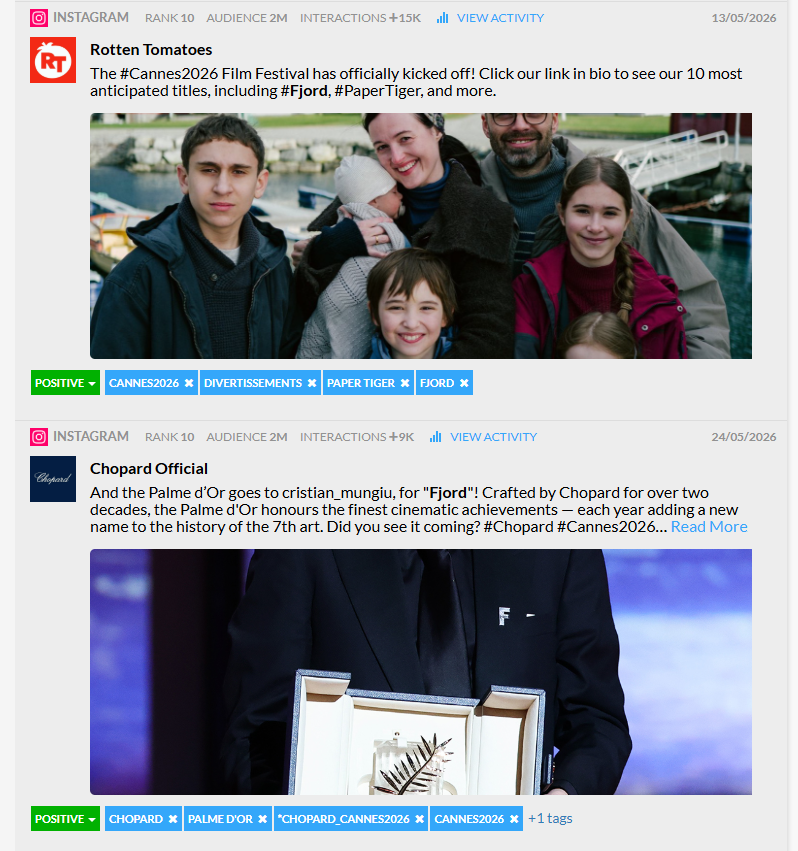
The traditional media peak came on May 23, the closing ceremony date, when Romanian director Cristian Mungiu was awarded the Palme d’Or for his Norway-set political drama Fjord.
The contrast between these two peaks shows once again that social media is driven by the celebrity and fashion highlights that take place throughout the festival, while traditional media focuses on the competition’s climax and the awards ceremony. PR professionals working on the 2026 Cannes Film Festival had to implement two distinct strategies depending on the channel.
2. The Palme d’Or and the 2026 awards: A strong competition year
The Cannes Film Festival 2026 jury, presided over by Demi Moore, awarded the following prizes:
- Palme d’Or – Fjord, Cristian Mungiu
- Grand Prix – Minotaure, Andreï Zviaguintsev
- Prix du Jury – L’Aventure Rêvée, Valeska Grisebach
- Prix d’interprétation féminine – Virginie Efira and Tao Okamoto in Soudain
- Prix d’interprétation masculine – Emmanuel Macchia and Valentin Campagne in Coward
- Prix de la Mise en Scène (ex aequo) – La Bola Negra (Los Javis) and Fatherland (Pawel Pawlikowski)
- Prix du Scénario – Notre Salut, Emmanuel Marre
- Caméra d’Or – Ben’Imana, Marie-Clémentine Dusabejambo
- Palme d’Or du court métrage – Para los Contricantes, Federico Luis
Fjord generated 7.73% of all film-related mentions across both media channels – the highest share of any title in competition – confirming that the jury’s choice resonated with both critics and audiences. La Bola Negra followed closely at 7.37%, buoyed by the enormous popularity of its Spanish directors Javier Calvo and Javier Ambrossi, who topped the actors and directors ranking.
3. Top themes: What the world was talking about at Cannes Film Festival 2026
The theme analysis reveals a clear divergence between traditional and social media priorities, a gap that every communications professional working around the Cannes Film Festival 2026 should understand.
Traditional media: the red carpet and the competition
| Theme | Share of voice |
|---|---|
| Red carpet fashion | 13.55% |
| Competition films | 11.97% |
| Awards 2026 | 8.63% |
| Fjord / Palme d’Or | 5.06% |
| La Bola Negra | 4.97% |
| Jury 2026 | 4.23% |
| Closing / review | 4.14% |
| L’Oréal ambassadors | 3.71% |
| Almodóvar autofiction | 3.41% |
| amfAR Gala 2026 | 3.01% |
| Aishwarya / Lights Women | 2.85% |
| Palme d’honneur Peter Jackson | 2.43% |
| Minotaure / Grand Prix | 2.36% |
| Almodóvar / Free Palestine | 2.21% |
| LGBTQ inclusion | 2.16% |
The four leading themes in traditional media illustrate what editorial and broadcast journalism consistently gravitates toward at the Cannes Film Festival 2026.
Red carpet fashion (13.55%) topped the ranking, as it almost always does. The Croisette remains the world’s most photographed catwalk, and press coverage of couture, jewellery and styling drove the highest volume of editorial content throughout the 11-day festival.
Competition films (11.97%) confirmed that the critical and journalistic community still treats Cannes as a cinema event first and foremost. Interviews, reviews, premiere coverage and behind-the-scenes reporting on the 20+ films in the main competition generated consistent, sustained output across all traditional media formats.
Awards 2026 (8.63%) surged on and around May 23, the closing ceremony date. The entire traditional media ecosystem – from film critics and entertainment journalists to national news outlets – pivoted to cover the jury’s decisions, the reactions of filmmakers and the implications for international distribution and awards season.
Fjord / Palme d’Or (5.06%) is the first title-specific theme in the ranking, reflecting the media cascade triggered by Cristian Mungiu’s win. Coverage spanned political readings of the film’s subject matter (polarisation and democracy in Scandinavia), retrospectives on Mungiu’s career, and reactions from the Romanian and international film communities.
Social media: L’Oréal, fashion and Asian stars
| Theme | Share of voice |
|---|---|
| L’Oréal ambassadors | 23.57% |
| Red carpet fashion | 13.30% |
| Asian presence | 6.79% |
| Nespresso Cannes | 6.62% |
| Awards 2026 | 6.29% |
| Competition films | 5.49% |
| Aishwarya / Lights Women | 5.36% |
| BamBam Thai night | 3.89% |
| La Bola Negra | 2.35% |
| Fjord / Palme d’Or | 1.69% |
| Closing / review | 1.66% |
| Jury 2026 | 1.60% |
| Public funding / Cannes | 1.48% |
| Celebrities outside cinema | 1.26% |
| Almodóvar autofiction | 1.17% |
On social media, the story was radically different, and the four leading themes tell a very clear story.
L’Oréal ambassadors (23.57%) dominated with nearly one in four social media posts about the Cannes Film Festival 2026 referencing a L’Oréal Paris brand ambassador. This is not an organic result: it reflects years of strategic investment in a Cannes partnership built around a large, carefully curated roster of international talent spanning Asian, Western and global markets. Fan communities mobilised massively around each ambassador appearance on the Croisette, creating a self-reinforcing cycle of user-generated content.
Red carpet fashion (13.30%) held its position as the second social theme, confirming that outfit commentary, styling breakdowns and fashion discourse remain a universal social media conversation at the Cannes Film Festival 2026, regardless of platform or geography.
Asian presence (6.79%) is a meta-theme that aggregates all content celebrating or commenting on the visible and growing representation of Asian (Thai, Korean, Chinese, Indian) stars on the Croisette. Its emergence as the third-highest social theme – above the awards, above the films – underlines how significantly the cultural gravity of the festival has shifted toward Asian markets. We see the same phenomenon here as in other cultural or entertainment events, such as Fashion Weeks.
Nespresso Cannes (6.62%) demonstrated the power of a well-activated official sponsorship. The brand’s association with Thai actor and ambassador Win Metawin drove a concentrated burst of social content from his dedicated fanbase, pushing the Nespresso theme to fourth place overall – an extraordinary return for a brand that is not a fashion or beauty player.
Key takeaway for PR professionals: if your objective is traditional media coverage, focus on film, awards and editorial red carpet. If your objective is social media reach and engagement, invest in ambassador partnerships and cultivate relationships with Asian fan communities.
4. Top films: Which titles generated the most buzz at Cannes Film Festival 2026?
Across all media channels combined, the 15 most-mentioned films (out of 62 analysed) were:
| Film | Share of voice |
|---|---|
| Fjord | 7.73% |
| La Bola Negra | 7.37% |
| Amarga Navidad | 6.72% |
| Vol de Nuit pour Los Angeles (Propeller One-Way Night Coach) | 6.15% |
| Karma Canet | 5.89% |
| L’Abandon | 4.22% |
| Hope | 3.75% |
| Paper Tiger | 3.46% |
| Fatherland | 3.31% |
| El Ser Querido | 3.21% |
| Diamond | 3.10% |
| Notre Salut | 3.07% |
| La Vénus Électrique | 2.70% |
| Histoires Parallèles | 2.48% |
| Gun Che | 2.43% |
Why these films topped the ranking
Fjord (7.73%) led the combined ranking for a clear set of reasons. As the Cannes Film Festival 2026 Palme d’Or winner, directed by Cristian Mungiu – one of the most critically respected filmmakers of his generation, already a Palme d’Or winner for 4 months, 3 weeks and 2 days (2007) – the film benefited from the full weight of the closing ceremony media spike and sustained critical coverage throughout the competition. Its subject matter, political polarisation in a Nordic democracy, also resonated with journalists and commentators well beyond the film pages.
La Bola Negra (7.37%) was the social media darling of the competition. Co-directed by Javier Calvo and Javier Ambrossi – known as Los Javis, the Spanish creators of cult TV series like La Veneno – the film carried enormous pre-existing fan communities into the Cannes conversation. Its co-Best Director prize (ex aequo with Fatherland) amplified the media coverage significantly. The presence of Penélope Cruz in the cast added further star power to an already high-visibility title.
Amarga Navidad (6.72%) was Pedro Almodóvar’s latest film, which placed it at the intersection of two powerful media engines: the enduring international prestige of one of world cinema’s most celebrated auteurs, and the star power of a cast aligned with his characteristic aesthetic world. Almodóvar’s appearances at the Cannes Film Festival 2026 – including a much-discussed public statement on cultural funding – generated coverage well beyond the film itself.
Vol de Nuit pour Los Angeles (Propeller One-Way Night Coach) (6.15%) ranked fourth largely through the force of personality of its leading actor. John Travolta’s return to Cannes generated the kind of celebrity-driven press surge that transcends film criticism: news media, entertainment outlets and social media all converged on his Croisette appearances. Travolta’s presence gave the film a visibility disproportionate to its competition profile.
The top four films collectively accounted for 28% of all film-related mentions, a concentration that reflects how the Cannes Film Festival 2026 media machine consistently amplifies a small number of titles above the rest of the selection.
5. The jury: Demi Moore’s Cannes 2026 effect
The jury data is one of the most interesting findings from the Cannes Film Festival 2026 dataset. Among the 25 jury members analysed across all sections (Competition, Un Certain Regard, Caméra d’Or, Cinef and short films):
| Jury member | Share of voice |
|---|---|
| Demi Moore (President) | 41.61% |
| Park Chan-wook | 16.65% |
| Paul Laverty | 8.83% |
| Eye Haidara (emcee) | 6.14% |
| Chloé Zhao | 5.13% |
| Ruth Negga | 4.83% |
| Stellan Skarsgård | 4.07% |
| Diego Céspedes | 2.73% |
| Leila Bekhti | 2.23% |
| Isaach De Bankolé | 2.13% |
| Laura Wandel | 2.05% |
| Monia Chokri | 0.91% |
| Carla Simón | 0.86% |
| Laura Samani | 0.30% |
| Angèle Diabang | 0.28% |
The top 4: who they are and why they dominated
Demi Moore (41.61%) captured more than two-fifths of all jury-related mentions, a dominance that reflects both the prestige of the jury presidency and the particular cultural moment Demi Moore occupies. The American actress, iconic for Ghost, GI Jane and a career spanning four decades, has experienced a major critical renaissance in recent years. Her presence at the Cannes Film Festival 2026 as jury president attracted media attention from entertainment, fashion and general news outlets simultaneously, creating a cross-channel amplification effect that no other jury member could match.
Park Chan-wook (16.65%) brought the second-largest audience of any jury member. The South Korean director – creator of Oldboy, The Handmaiden and Decision to Leave, winner of the Cannes Grand Prix – carries enormous global prestige, particularly across Asian digital media where Korean cinema commands passionate, engaged fanbases. His participation as a juror at the Cannes Film Festival 2026 was widely covered in South Korean press, driving a significant share of jury mentions.
Paul Laverty (8.83%) ranked third, a result that reflects the deep respect the Scottish screenwriter commands in European and Latin American cinema circles. Long-time collaborator of director Ken Loach, Laverty has co-written films that have won the Palme d’Or twice (The Wind That Shakes the Barley, 2006, and I, Daniel Blake, 2016). His participation on the jury carried weight for critics and cinephiles, generating substantial editorial coverage.
Eye Haidara (6.14%) is a French actress of Malian origin. Her presence at the Cannes Film Festival 2026 as emcee generated coverage across entertainment media and social platforms, with particular engagement from French-speaking audience. She stars in *L’Objet du Délit*, Agnès Jaoui’s film, which is being screened out of competition.Her profile as a younger, socially engaged talent added a distinct dimension to the jury’s public image.

6. Top actors and directors: Los Javis, Travolta and Almodóvar
Among 279 actors, actresses and directors analysed at the Cannes Film Festival 2026, the top 15 by share of voice were:
| Name | Share of voice |
|---|---|
| Javier Calvo & Javier Ambrossi | 5.95% |
| John Travolta | 3.99% |
| Pedro Almodóvar | 3.39% |
| Javier Bardem | 3.03% |
| Cristian Mungiu | 3.02% |
| Peter Jackson | 2.69% |
| Virginie Efira | 2.08% |
| Penélope Cruz | 1.86% |
| Sebastian Stan | 1.80% |
| Gilles Lellouche | 1.74% |
| Emmanuel Marre | 1.69% |
| Renate Reinsve | 1.40% |
| James Gray | 1.37% |
| Isabelle Huppert | 1.37% |
| Rodrigo Sorogoyen | 1.33% |
The top 4: who they are and why they led
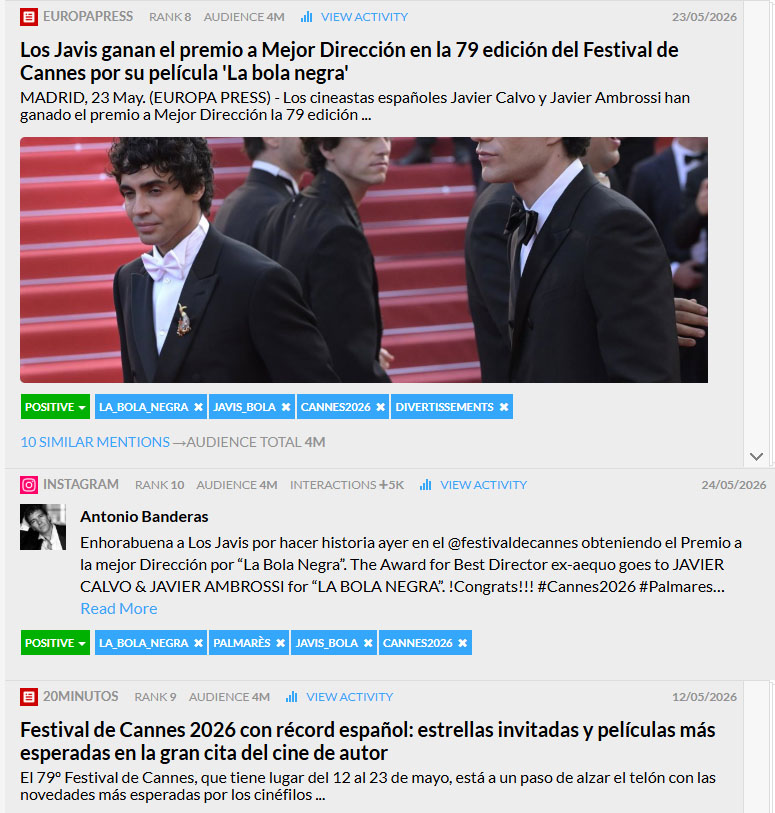
Javier Calvo & Javier Ambrossi (5.95%) topped the ranking as the creative duo behind La Bola Negra. Known universally in Spain as Los Javis, Javier Calvo and Javier Ambrossi built their fame through television: their series Paquita Salas and La Veneno gave them both critical acclaim and a fiercely loyal, largely young audience. Their Cannes debut in competition brought those communities onto the global stage. Their Best Director prize (ex aequo), combined with their high media profile as public figures beyond cinema, drove sustained coverage across entertainment, film, fashion and LGBTQ+ media at the Cannes Film Festival 2026.
John Travolta (3.99%) ranked second through sheer celebrity impact. The star of Grease, Saturday Night Fever and Pulp Fiction arrived at the Cannes Film Festival 2026 with Vol de Nuit pour Los Angeles, and his every appearance on the Croisette was treated as a major event by entertainment and general news media worldwide.
What amplified his presence far beyond the film itself was a conversation that went viral almost immediately: Travolta appeared strikingly younger than expected, prompting widespread commentary across social and traditional media about his appearance. The debate quickly escalated into a full-blown revival of the so-called “clone theory” that has circulated around Travolta for years, with users and commentators comparing current and archival images and speculating about anti-ageing treatments, cosmetic procedures – or more imaginative explanations.
The resulting wave of memes, opinion pieces and talk show segments transformed what could have been a modest film premiere into one of the most-discussed celebrity moments of the Cannes Film Festival 2026, adding a viral dimension that no conventional PR campaign could have manufactured. We almost forgot that he received a surprise honorary Palme d’Or!
Pedro Almodóvar (3.39%) brought his characteristic combination of artistic authority and media magnetism. One of the greatest living European filmmakers, the Spanish director arrived with Amarga Navidad, and his festival presence was amplified by a public statement on cinema funding and cultural policy that generated coverage well beyond the arts press. Almodóvar at Cannes is always a major media event in Spain, Latin America and beyond.
Javier Bardem (3.03%) is one of the most internationally recognised Spanish actors – Oscar winner for No Country for Old Men, star of Biutiful and the Bond film Skyfall. His appearance in El Ser Querido at the Cannes Film Festival 2026 attracted substantial coverage from entertainment and film media, and his appearances on the red carpet alongside Penélope Cruz generated additional lifestyle and fashion coverage.
7. Celebrity power: Asian stars dominate Cannes Film Festival 2026 social media
The celebrity data is where the Cannes Film Festival 2026 reveals its most significant structural shift compared to previous years. Among 100 celebrities analysed on social media (excluding competition actors and directors):
| Celebrity | Share of voice |
|---|---|
| BamBam | 24.50% |
| Becky Armstrong (L’Oréal) | 15.99% |
| Gemini Norawit (L’Oréal) | 9.56% |
| Keng Harit | 9.48% |
| Yoko Apasra | 7.85% |
| Win Metawin (Nespresso) | 2.42% |
| Lim Yoona (Qeelin) | 2.34% |
| Tian Xuning (L’Oréal) | 2.10% |
| Hande Erçel | 1.64% |
| Lay Zhang | 1.63% |
| Chompoo (Araya Alberta Hargate) | 1.54% |
| Zhou Ye | 1.47% |
| Alek Teeradetch | 1.37% |
| Alia Bhatt | 1.27% |
| Aishwarya Rai | 1.14% |
The top 4 social celebrities: who they are and why they dominated
BamBam (24.50%) dominated the entire social celebrity conversation with nearly a quarter of all mentions. Born Kunpimook Bhuwakul in Thailand, BamBam is a K-pop artist and member of the group GOT7 who built a vast international solo career after establishing himself in Seoul. At the Cannes Film Festival 2026, he held a specific and historic role: official representative of Thai cinema, a designation that gave his presence on the Croisette formal cultural weight well beyond that of a typical brand ambassador or celebrity guest.
His crossover status – Thai by origin, Korean pop star by career, with massive fanbases across Southeast Asia, East Asia and beyond – made him the ideal figure to embody Thailand’s growing ambitions in international cinema. This institutional role, combined with the organised mobilisation of his fanbase, turned BamBam’s Cannes presence into a genuine cultural moment. The hashtag #BamBamXCannes2026 accumulated 1,228,730 uses, the highest of the entire festival, triggering one of the largest coordinated fan content campaigns the Cannes Film Festival 2026 has ever seen.
Becky Armstrong (15.99%) is a Thai-British singer and actress, known in Thailand simply as Becky, who represents L’Oréal Paris. Her Cannes appearances were supported by dedicated hashtags including #RebeccaxCannes2026 (546,532 uses) and #LOrealParisCannesxBecky (499,573 uses), which her fanbase – known as Becky’s Angels – activated systematically throughout the festival. Her dual identity as both a Western-named and Thai-heritage star gives her exceptional reach across different audience segments.
Gemini Norawit (9.56%) is a Thai actor who became one of the defining social media faces of the Cannes Film Festival 2026. His appearance on May 16 – wearing Giorgio Armani, L’Oréal Paris makeup and Chanel jewelry – triggered the single largest social media peak of the entire festival. The Thai hashtag #เจมีไนน์ accumulated 767,309 uses, while #LOrealParisCannesxGemini reached 650,560. Gemini’s appearance illustrates how a single, perfectly executed brand ambassador moment can outperform weeks of traditional festival communication in terms of social volume.
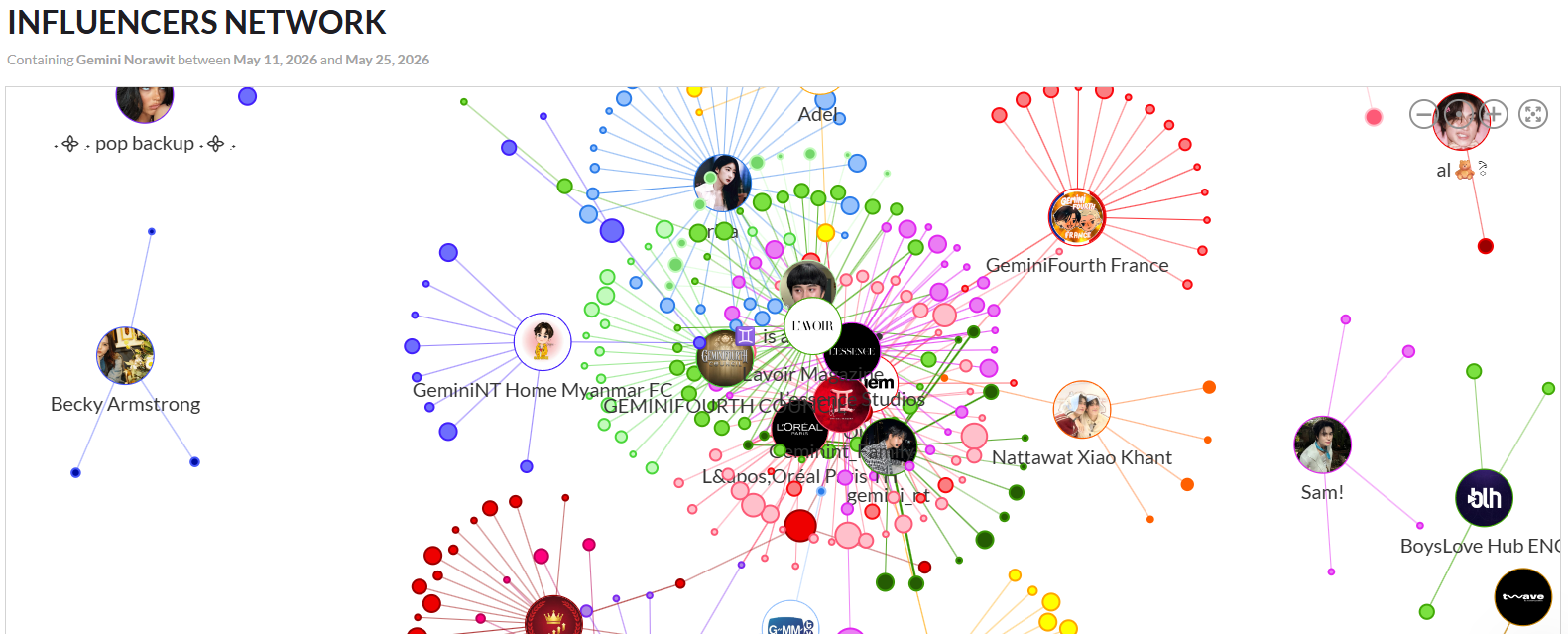
Keng Harit (9.48%) is a Thai celebrity whose Cannes presence was celebrated through the hashtag #KengHaritatCannes, which amassed 1,109,154 uses – the second-highest hashtag volume of the entire Cannes Film Festival 2026. His close score to Gemini Norawit (9.48% vs 9.56%) shows how competitive the Thai celebrity landscape at Cannes has become, with multiple stars attracting near-equivalent fan mobilisation simultaneously.
The contrast with traditional media celebrities
The contrast with traditional media is stark. Among the top 15 celebrities in press and broadcast coverage (out of 90 celebrities analysed):
| Celebrity | Share of voice |
|---|---|
| Aishwarya Rai | 13.33% |
| Bella Hadid | 7.16% |
| Eva Longoria | 5.62% |
| Heidi Klum | 4.57% |
| Cate Blanchett | 4.48% |
| Vin Diesel | 4.32% |
| Alia Bhatt | 4.27% |
| Jane Fonda | 3.97% |
| Tilda Swinton | 3.44% |
| Michelle Rodriguez | 2.61% |
| Barbara Palvin | 2.51% |
| Mickaëlle Paty | 2.47% |
| Jordana Brewster | 2.27% |
| Sharon Stone | 2.08% |
| Meadow Walker | 2.01% |
The top 4 traditional media celebrities: who they are and why they led
Aishwarya Rai (13.33%) is the only celebrity to appear prominently in both the social and traditional media top 15, a testament to her unique cross-channel status. The Indian actress, former Miss World 1994 and Bollywood icon, has been attending the Cannes Film Festival as a L’Oréal Paris ambassador for over two decades. Her red carpet appearances are considered a global fashion event in their own right, covered by Indian, French, international fashion and general news media simultaneously. Her editorial dominance at the Cannes Film Festival 2026 reflects both her longevity as a Cannes fixture and the continued global fascination with her red carpet choices.
Bella Hadid (7.16%) ranked second in traditional media through her combination of supermodel status, fashion industry relationships and the intense press interest her Cannes appearances consistently generate. A fixture at the world’s major fashion events, her red carpet looks at the Cannes Film Festival 2026 generated substantial coverage across fashion, lifestyle and celebrity media.
Eva Longoria (5.62%) is an American actress and director who has built a strong personal relationship with the Cannes Film Festival over the years. Known internationally for Desperate Housewives, she has progressively repositioned herself as a filmmaker and cultural figure, and her Cannes 2026 presence attracted both entertainment and lifestyle press coverage.
Heidi Klum (4.57%) is a German-American supermodel, television personality and businesswoman whose Cannes presence each year generates reliable fashion and entertainment coverage across European and American media. Her red carpet appearances at the Cannes Film Festival 2026 attracted the kind of high-traffic tabloid and fashion media coverage that contributes significantly to traditional media share of voice.
Strategic implication: for brands seeking maximum social media reach at the Cannes Film Festival 2026, partnering with Thai and Korean stars delivered audience numbers that no Western celebrity could match in the digital space. For editorial and press visibility, the more familiar Western red carpet hierarchy continued to dominate traditional coverage.
8. Brands: L’Oréal’s dominance and the Cannes brand ecosystem
Among 93 brands analysed at the Cannes Film Festival 2026 in social media (official sponsors of the Cannes Film Festival marked with *):
| Brand | Share of voice |
|---|---|
| *L’Oréal Cannes 2026 | 41.91% |
| *Nespresso Cannes 2026 | 13.61% |
| AMI Paris | 8.42% |
| Giorgio Armani | 3.55% |
| Chanel | 3.31% |
| Louis Vuitton | 3.02% |
| *Kering Cannes 2026 | 2.59% |
| *Chopard Cannes 2026 | 2.44% |
| Qeelin | 1.77% |
| *Brut | 1.68% |
| Tiffany | 1.56% |
| Pomellato | 1.27% |
| *France Télévisions | 0.85% |
| Gucci | 0.85% |
| HOTEL_MARTINEZ | 0.77% |
L’Oréal: the undisputed Cannes brand
L’Oréal captured 41.91% of all brand mentions at Cannes Film Festival 2026 – more than three times its nearest rival. The brand’s dominance on social media (23.57% of all social media themes) was powered by a roster of Asian ambassadors – Gemini Norawit, Becky Armstrong and Tian Xuning – whose fan communities mobilised massively around every Croisette appearance. This is the result of a decades-long partnership strategy with the Cannes Film Festival that combines official sponsorship with talent investment at global scale.
Nespresso: strong second place
With 13.61% of brand share of voice, Nespresso confirmed its place as the second most visible brand at the festival. The activation around Thai actor Win Metawin as a Nespresso ambassador contributed significantly to the brand’s social media performance, with the Nespresso Cannes theme ranking fourth overall in social media topics at 6.62%.
AMI Paris: the breakout sponsor
AMI Paris achieved an 8.42% brand share of voice, one of the best results among all brands. Although the brand is the main partner of Critics’ Week, mentions of it primarily concern the outfits worn by celebrities, notably actor Thai Keng Harit. This performance positions the French fashion house as the prime example of brand visibility achieved during this year’s festival.
9. Hashtags: the Cannes 2026 social media pulse
The top 15 hashtags used in conjunction with Cannes content (all verified as co-occurring with a Cannes festival mention, bot-generated hashtags excluded, measurement May 11-25):
| Hashtag | Volume |
|---|---|
| #BamBamXCannes2026 | 1,228,730 |
| #KengHaritatCannes | 1,109,154 |
| #Cannes2026 | 1,165,230 |
| #CannesFilmFestival2026 | 1,104,977 |
| #LOrealParisCannes | 934,038 |
| #BamBamAt79thCannes | 822,983 |
| #เจมีไนน์ (Gemini in Thai) | 767,309 |
| #LOrealParisCannesxGemini | 650,560 |
| #RebeccaxCannes2026 | 546,532 |
| #Amiparis | 538,369 |
| #KengHarit | 527,760 |
| #LOrealParisCannesxBecky | 499,573 |
| #beckysangels | 460,499 |
| #winmetawin | 442,319 |
| #뱀뱀 (BamBam in Korean) | 434,529 |
The top two hashtags by volume were both dedicated to individual celebrities: #BamBamXCannes2026 (1.2M) and #KengHaritatCannes (1.1M) both exceeded the volume of the official festival hashtag #Cannes2026 (1.1M). This illustrates how fan-generated celebrity content now drives more measurable social volume than the event’s own branded communication at the Cannes Film Festival 2026.
#LOrealParisCannes at 934,038 is the highest-volume brand hashtag, further amplified by two talent-specific sub-hashtags: #LOrealParisCannesxGemini (650,560) and #LOrealParisCannesxBecky (499,573). This structured ambassador-hashtag strategy is a textbook example of how to amplify a brand sponsorship into sustained social media volume across multiple fan communities simultaneously.
38 hashtags have been mentioned more than 100,000 times during the Cannes Film Festival.
10. Key takeaways for PR and communications professionals
The data from the Cannes Film Festival 2026 offers several actionable lessons.
Asian fan communities are the new Cannes PR powerhouse. For several years now, K-pop stars and Thai entertainment celebrities have been generating a level of social media activity that far exceeds that of Western Hollywood celebrities. Brands and public relations teams need to build relationships with these artistic communities well in advance of the festival. The same goes for events like Fashion Week, the Oscars, and the Golden Globes.
L’Oréal’s ambassador model is the gold standard. The combination of an official sponsorship, a large diversified roster of international ambassadors, and structured hashtag co-creation produced an unmatched 41.91% brand share of voice. It is a model built over many years, but its architecture offers a clear framework for brands with ambitions at the Cannes Film Festival.
AMI Paris proved that organic placement can outperform smaller sponsorships. With no official partnership for Cannes festival (but main partner of Critics’ Week) the brand ranked third among all 93 brands purely through celebrity styling (and a luncheon and an awards ceremony). For brands with limited budgets, strategic celebrity dressing remains a highly efficient route to Cannes visibility.
Traditional and social media require distinct strategies. The peak dates were different (May 16 vs May 23), the top themes were different, and the top celebrities were almost entirely different between the two channels. A single-track Cannes strategy will underperform on at least one dimension.
The awards still matter for editorial media. The Palme d’Or (Fjord) drove the single biggest traditional media spike of the entire festival on May 23. For film distributors and studios, the awards ceremony remains the most powerful earned media moment of the year.
FAQ Cannes Film Festival 2026
What were the total social media mentions for Cannes Film Festival 2026?
The Cannes Film Festival 2026 generated 5.2 million social media mentions between May 11 and May 25, 2026, with a total social media reach of 689.7 million. These mentions were produced by 3.1 million unique accounts and sources.
Who won the Palme d’Or at Cannes 2026?
Romanian director Cristian Mungiu won the Cannes Film Festival 2026 Palme d’Or for Fjord, a political drama set in Norway. The film ranked first in the overall film mentions ranking with 7.73% share of voice across all media channels.
Who was the jury president at Cannes Film Festival 2026?
American actress Demi Moore presided over the main competition jury at the Cannes Film Festival 2026. She dominated jury-related media coverage with 41.61% of all jury mentions across both social and traditional media, making her the single most-covered jury president in recent Cannes data.
Which brand had the highest visibility at Cannes 2026?
L’Oréal Paris was by far the most visible brand at the Cannes Film Festival 2026, capturing 41.91% of all brand share of voice. On social media alone, the L’Oréal ambassadors theme accounted for 23.57% of all thematic mentions. The brand’s strategy of partnering with Asian ambassadors, particularly Thai and Chinese talents, was central to its social media dominance.
Which celebrities generated the most social media buzz at Cannes 2026?
BamBam (Thai-born K-pop artist from GOT7) topped the social media celebrity ranking with 24.50% share of voice. Thai and Korean celebrities collectively dominated the social media conversation, with Becky Armstrong (L’Oréal, 15.99%), Gemini Norawit (L’Oréal, 9.56%) and Keng Harit (9.48%) rounding out the top four.
Who topped the traditional media celebrity ranking at Cannes 2026?
Aishwarya Rai led traditional media celebrity coverage with 13.33% share of voice, the only celebrity to appear in both the social and traditional media top 15 at the Cannes Film Festival 2026. She was followed by Bella Hadid (7.16%), Eva Longoria (5.62%) and Heidi Klum (4.57%).
What was the most popular hashtag at Cannes Film Festival 2026?
The most-used hashtag was #BamBamXCannes2026 with 1,228,730 uses, ahead of #KengHaritatCannes (1,109,154) and the official #Cannes2026 (1,165,230). Notably, both fan hashtags exceeded the volume of the official festival hashtag, illustrating the scale of fan community mobilisation at the Cannes Film Festival 2026.
What was the TV reach of Cannes Film Festival 2026?
The Cannes Film Festival 2026 generated a cumulative TV reach of 17 billion across the measurement period (May 11 to May 25, 2026), confirming its status as one of the most watched cultural events in the world on broadcast media.
Which non-sponsor brand performed best at Cannes 2026?
AMI Paris achieved 8.42% brand share of voice at the Cannes Film Festival 2026 without holding an official festival sponsorship, the highest result of any non-sponsor brand. This performance was driven entirely by celebrity dressing and organic editorial coverage, making it the standout example of earned brand visibility at the festival.
What were the main differences between social and traditional media coverage at Cannes 2026?
Traditional media focused primarily on red carpet fashion (13.55%), competition films (11.97%) and awards (8.63%), peaking on May 23 with the Palme d’Or ceremony. Social media was dominated by L’Oréal ambassador content (23.57%), red carpet fashion (13.30%) and the Asian celebrity presence (6.79%), peaking on May 16 with Gemini Norawit’s Croisette moment. The celebrity rankings were almost entirely different between the two channels.
Data collected between May 11 and May 25, 2026, using Onclusive Monitor and Onclusive Social across social media, digital, print, TV, radio and podcasts. Analysis covers 50 themes, 62 films, 25 jury members, 279 actors and directors, 100 celebrities (social), 90 celebrities (traditional media) and 93 brands.
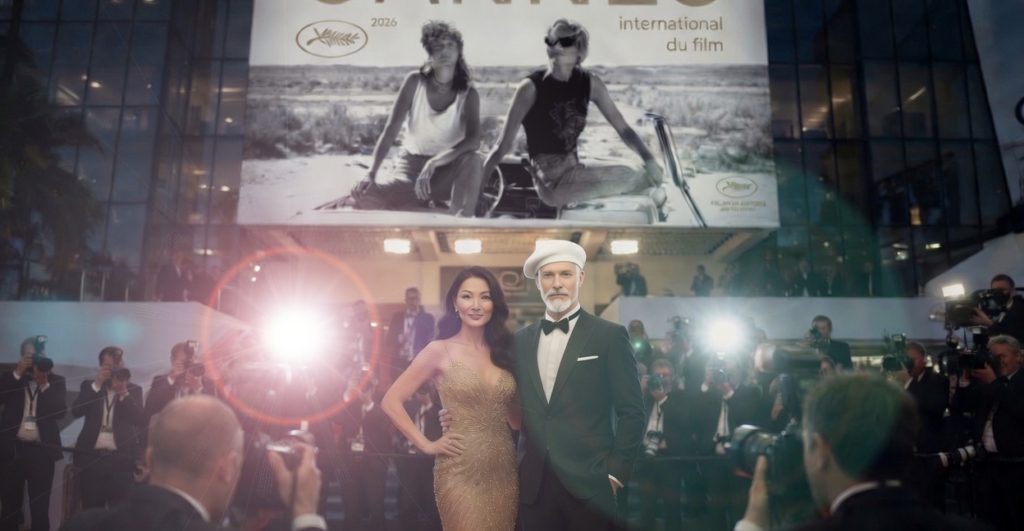
The cover image was generated by a generative AI tool for illustrative purposes.