





Most of you now know if your brand is showing up in AI search results, you have a good sense of which LLMs work best for your brand, even which owned pages and articles seem to be driving most citations. But do you know why? Understanding why is the foundation to improving your AI brand visibility across the LLMs your audiences are using to make buying decisions.
An AI visibility score on its own tells you the direction of travel, but not which lever to pull to start making measurable improvements. Is the problem your sources, your content, your consistency, or your competitors? Without an answer, you could be putting time and effort into the wrong fix, investing in content when the real issue is a missing third-party source, or chasing media coverage when the real issue is an inconsistent narrative.
Why ask these six AI brand visibility questions?
If you’ve read our piece on the four AI visibility gaps, you already know the categories of problem a brand can have: missing entirely, outranked, misdescribed, or under-sourced. These six questions are different. They’re what tells you where your AI brand visibility actually stands today, and where to focus first.
Think of the gaps as the problem, and these six questions as how you find out which one you actually have. Ask them regularly and you move from “what is AI saying about us?” to “where should we focus first?”
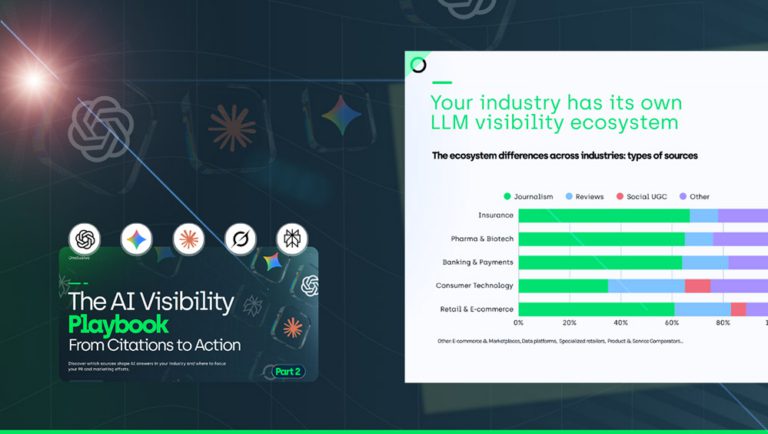
Download the AI Visibility Playbook to run this diagnostic against your own brand.
The six AI brand visibility questions to ask
1. Which sources are shaping AI answers in our category?
AI engines lean on a specific set of publications, domains, and third-party sources when they build the answers that shape your brand’s AI visibility. Some of these are already part of your media strategy but others might not be on your radar at all.
If the sources and online publications shaping your category are ones you already work with, intensify your focus there. If they’re not, you have a source gap to close, and now you know exactly where to start building it. Our article on how AI visibility is built breaks down where these sources sit in the wider picture.
2. What questions are competitors answering that we aren’t?
AI engines reward content that directly answers a real question. If a competitor has a clear, useful answer to a query your brand hasn’t addressed, they’ll show up in the answer without you.
Missing or outdated content is one of the most common reasons for weak AI brand visibility. You need to identify the priority questions where competitor brands are visible and yours isn’t, then close the gap with clearer, more useful content.
3. Are we described consistently across channels?
AI engines can draw on earned media, owned content, social conversation, and third-party sources all at once when they form a view of your brand. If those channels tell different stories, the result is a fragmented or inaccurate description, and you may not find out until a customer repeats it back to you.
This is where PR, comms and marketing have direct leverage. Consistent messaging across channels has always been best practice and now it’s also a core part of protecting your AI brand visibility, since it’s what keeps your narrative intact when an algorithm is doing the summarizing on your behalf.
4. Where are competitors beating us on AI visibility?
Some competitors appear more often, higher up in the answer, or get described more favorably. Each of those chips away at your AI brand visibility in a different way, so each needs a different fix.
You don’t need to match competitors on every front, but you do need to be able to identify the specific topics and sources giving them a competitive edge, so your team can act on the ones that matter most first instead of spreading your effort thin.
5. Are our campaigns improving visibility for the prompts that matter?
PR, social, content, and influencer activity all take time and budget. Most teams still can’t say whether any of it is moving the needle on AI brand visibility, because there’s no baseline to measure against.
That’s the catch with AI brand visibility measurement: you can’t go back and check what an AI engine was saying last quarter. Your baseline only exists from the moment you start tracking, a principle the AMEC makes explicit for anyone measuring this properly. Track visibility before, during, and after a campaign, and you can finally connect the activity to the outcome, and prove it to leadership.
6. What are people asking AI before they decide?
Buyers use AI at every stage of their journey: discovery, comparison, and decision. The prompts they use at each stage are different, and most brands have never mapped them.
A branded prompt like “what do people say about [brand]” tells you something different from an unbranded one like “best [category] for [use case].” Once you know what people are likely to be asking at each stage of their journey, you can align your content and messaging to meet them there instead of guessing.
Where to start with improving AI brand visibility
You don’t need to answer all six questions in this article at once, just start with the one that exposes your biggest blind spot. For most teams, that’s competitive positioning or content gaps, since both show you exactly where your AI brand visibility is being lost, and to whom. If you want the fuller picture of what each type of loss looks like, read our article on the 4 AI visibility gaps putting your brand at risk.
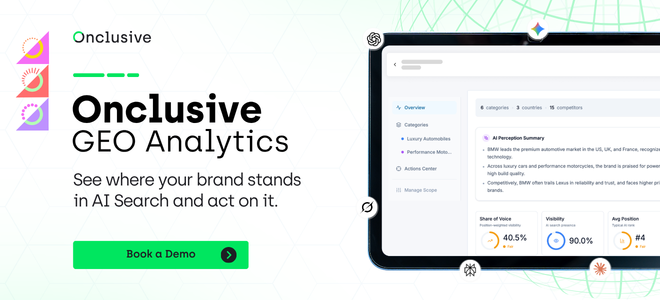
Onclusive GEO Analytics measures your AI brand visibility across all six questions, alongside the earned media monitoring and social listening data you already track. Book a demo to see where your AI visibility gaps are and what to do about them.