






Introduction: The three numbers reshaping e-commerce in 2027
Three numbers define e-commerce disruption in 2027. Social commerce platforms capture 45% market share growth. Livestream shopping commands 42% annual expansion. Resale and secondhand markets grow at 40% rates. Combined, these three categories represent over $450 billion in GMV across new e-commerce entrants that didn’t exist five years ago.
New e-commerce entrants are not competing with established platforms like Amazon, Walmart, or Alibaba for the same customer.They are building entirely different shopping infrastructure around video, community, and value. TikTok Shop as a social e-commerce entrant captures 18.2% of US social commerce. Douyin as a livestream e-commerce entrant controls 47% of China’s livestream market. Vestiaire Collective as a resale e-commerce entrant leads global resale at $220 billion. These new entrants move faster, convert higher, and build loyalty through fundamentally different models than traditional retail.
Established platforms face a strategic asymmetry when competing against e-commerce entrants: they have scale but inherited legacy infrastructure. New e-commerce entrants have purpose-built systems for discovery, community, and social proof. When consumers see what they offer- livestream shopping with real-time questions and direct purchases-traditional product pages feel dated. When resale entrants authenticate inventory and build community, traditional retail margins collapse.
For PR teams, marketers, and competitive intelligence professionals, understanding how these new entrants operate matters urgently. The brands winning in 2026 won’t compete primarily on Amazon. Instead, they’ll own positions created by e-commerce entrants: social commerce, livestream, or resale. That’s where customer acquisition costs drop and conversion rates spike.
All data informing this analysis is available in Onclusive’s E-Commerce Platforms Industry Scan 2026, which tracks 153.7 million mentions across 69 companies and 7 regions, identifying where e-commerce players create narrative gaps and competitive opportunities.
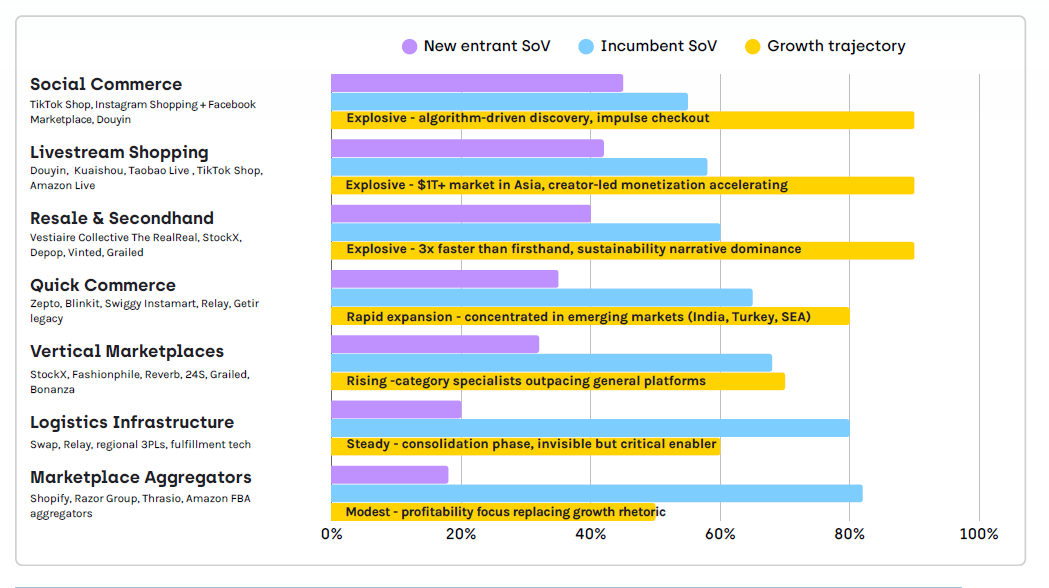
The three disruption categories: Market share, growth rates, and e-commerce entrants
Market comparison: 2025-2026 new entrant penetration
for new entrants
for new entrants
for new entrants
Category 1: Social commerce
- Market size: $87 billion US (2025), $100+ billion (2026)
- New entrant share: TikTok Shop = 18.2% US market, 45% growth rate
- TikTok Shop (social commerce e-commerce entrant) GMV: $64.3 billion global (2025), projected >$112 billion (2026)
- 45% share of voice for news entrants, 9/10 growth
Category 2: Livestream shopping
- Market size: $172.86 billion global (2025), $1.1+ trillion China alone
- E-commerce entrants share: Douyin = 47% China livestream market, 42% annual growth
- US livestream: $14.64 billion (2025), +50% YoY growth as e-commerce entrants emerge
- 42% share of voice for news entrants, 9/10 growth
Category 3: Resale & secondhand
- Market size: $210-220 billion (2025), growing to $360 billion (2030)
- E-commerce entrants growth rate: 40% annual (3x faster than new goods retail)
- Vestiaire Collective (resale e-commerce entrant): Global leader, $220 billion market size
- 40% share of voice for news entrants, 9/10 growth
Social commerce – From channel to primary retail
TikTok Shop rewrites the playbook for discovery-first retail
TikTok Shop captured 18.2% of US social commerce in 2025, just two years after launching. That penetration rate puts it ahead of legacy social platforms struggling to monetize commerce. The speed matters: this e-commerce entrant grew from zero to nearly $16 billion in US sales in 24 months, while Amazon took years to build comparable social commerce volume.
Why e-commerce entrants win in social commerce: the infrastructure is built around discovery, not search. Consumers on TikTok Shop encounter products through creator recommendations, trending sounds, and algorithmic discovery rather than keyword searches. E-commerce entrants seamlessly embed purchasing into the feed, converting viewers to buyers without friction. Traditional platforms bolt commerce onto existing social infrastructure. They built social infrastructure designed for commerce.
Conversion economics demonstrate the advantage. Users under 60 spending $708 average per purchase on TikTok Shop represents a fundamentally different consumer journey than search-driven acquisition on Amazon. Creator-driven discovery by e-commerce entrants generates higher engagement, faster repeat purchases, and stronger brand loyalty than email remarketing or product ads.
New entrants compete on entertainment and value, not retail convenience. When half of US social shoppers now purchase on TikTok, traditional platforms no longer own the distribution channel they assumed was permanent.
The discovery advantage: How e-commerce entrants beat search-first retail
Traditional e-commerce assumes consumers know what they want before searching. New e-commerce entrants assume consumers want to be entertained first and will discover products through creators and community. That flip changes everything.
On TikTok Shop, a creator can recommend a product and 100,000 viewers instantly buy without running a search query. On Amazon, that same product needs significant SEO, paid acquisition, and brand investment to reach visibility. The algorithm of new e-commerce player surfaces products based on virality and engagement. Amazon’s algorithm surfaces products based on past purchases and search history.
For brands, this reversal forces new acquisition strategies. Building presence on e-commerce market requires creator partnerships, authentic recommendation, and entertainment value. Building presence on Amazon requires SEO investment and advertising spend. The cost per acquisition on e-commerce entrants converges toward zero when content performs. On Amazon, it’s tied to bid prices and competitive saturation.
Livestream shopping – Where community and conversion converge
Douyin’s 47% market dominance and the conversion gap
Douyin controls 47% of China’s livestream commerce market, commanding $487 billion in total e-commerce GMV in 2024. By 2026, China’s livestream market is projected to hit $1.11 trillion, with Douyin maintaining its dominant share as the leading livestream e-commerce entrant. For context, US livestream shopping reached only $14.64 billion in 2025, while China’s livestream market exceeds $682 billion.
The gap is the infrastructure. Douyin built livestream technology into core platform experience as an e-commerce entrant. Western social platforms treated livestream shopping as a feature. E-commerce entrants that prioritize livestream compound this into an asymmetric market structure where they capture premium margins while Western platforms compete on traffic and viewer volume.
Conversion rates demonstrate why livestream e-commerce entrants win. They convert at 9-30% compared to 2-3% for traditional e-commerce. Fashion returns drop from 30-35% on traditional retail to 10% on livestream. Consumers shopping through e-commerce entrants demonstrate higher intent, higher satisfaction, and lower return rates than traditional channels.
830 million livestream users on Douyin represent a consumer base entirely comfortable shopping through video and community. Only 21.7% of US digital buyers have purchased via livestream, and 43% of US adults express no interest. E-commerce entrants built new behaviors from foundation.
Why livestream conversion rates exceed traditional retail
Live shopping through e-commerce entrants converts higher because it combines real-time social proof, product demonstration, and scarcity messaging. Viewers watch other buyers purchase in real-time, ask questions directly to hosts, and compete for inventory. This creates urgency and confidence simultaneously.
Traditional product pages optimize for passive browsing. Livestream shopping by e-commerce entrants optimizes for active engagement. A host can demonstrate product fit, answer specific questions, and build emotional connection faster than product photos and reviews. Conversion happens in minutes, not weeks.
For e-commerce entrants, the economics compound. Higher conversion rates reduce customer acquisition cost. Lower return rates reduce fulfillment complexity. Faster repeat purchases build lifetime value. Established platforms inherit infrastructure optimized for volume at lower margins. E-commerce entrants build at high margins and scale profitably.
Resale and secondhand – The sustainability imperative meets market growth
Vestiaire Collective and the $360 billion resale opportunity
Vestiaire Collective is a leader of global resale with a market currently valued at $210-220 billion, growing 10% annually and projected to reach $360 billion by 2030. This growth rate is three times faster than new goods markets, representing a structural shift in consumer behavior around e-commerce entrants focused on resale.
Generation Z drives growth in resale e-commerce entrants. Nearly half of resale platform users report that search experience and seller interaction influence purchase decisions. Resale e-commerce entrants build community around ownership, value retention, and conscious consumption. Traditional retail platforms treat resale as a threat. Forward-thinking companies embrace e-commerce entrants as the primary market opportunity.
Vestiaire Collective captures higher margins through authentication, community management, and trust infrastructure. Consumers pay premiums for verified authenticity. That model generates stronger unit economics than traditional retail competing on volume and discounting.
The narrative advantage belongs entirely to e-commerce entrants in resale. Resale markets align with sustainability, value consciousness, and community. Traditional retailers mention resale defensively. Vestiaire Collective owns the narrative.
Why authentication and community trump retail scale
Resale e-commerce entrants solve a problem traditional retail never solved: how to certify authenticity and build consumer confidence in pre-owned goods. Vestiaire Collective invests heavily in authentication infrastructure, community policing, and seller verification. This creates switching costs and network effects that traditional retail can’t replicate quickly.
28% of wardrobes already consist of pre-loved items, with 55% sourced from online resale. Consumers shopping resale exhibit different behavior than new goods shoppers. They research more, compare more, and commit longer to purchases. That engagement creates data advantages that allow e-commerce entrants to personalize and optimize faster than established retailers.
StockX and Vestiaire Collective demonstrate that new entrants can command premium economics in categories traditional retail abandoned. Sneaker resale, luxury handbags, and collectibles generate margins that exceed new goods retail. For newly established e-commerce players, that’s the entire market.

Need The Complete Data?
The insights in this blog are just the surface. Ready to discover the new e-commerce players that are making their mark?
Get access to all the data. Download the report “E-Commerce Platforms Industry Scan 2026.”
Why established e-commerce platforms can’t compete on e-commerce entrant terms
Legacy infrastructure vs. purpose-built systems
Amazon, Walmart, and other established platforms optimized for efficiency in the last decade. They built search infrastructure, logistics networks, and advertising models around predictable consumer behavior. E-commerce entrants build for the next decade around discovery, community, and social proof.
Established platforms can’t easily rewire. For example, changing Amazon’s core algorithm from search to discovery requires rewriting decades of optimization. Building livestream infrastructure into Walmart requires cultural shift that legacy organizations rarely accomplish. By the time established platforms adapt to what e-commerce entrants pioneered, new players have already captured market share and set consumer expectations.
The infrastructure gap compounds. E-commerce entrants have lower latency, faster iteration, and tighter feedback loops between product and market. Established platforms have process overhead, approval chains, and risk management systems that slow adaptation. In rapidly evolving markets, speed asymmetry becomes competitive asymmetry.
The margin structure inversion
Established platforms compete on volume with thin margins. E-commerce entrants build for high-touch, high-margin segments. Amazon pursues 50% market share at 5% margins. TikTok Shop pursues 20% market share at 25% margins. This fundamental economics inversion means entrants can outspend established platforms on customer acquisition without sacrificing profitability.
Livestream shopping margins for new entrants exceed traditional retail by 2-3x. Resale margins exceed new goods retail by 1.5-2x. Social commerce conversion ratios generate unit economics that established platforms can’t match without completely restructuring pricing. E-commerce entrants don’t need to displace traditional retail-they capture the highest-margin segments.
For brands, this matters strategically. Allocating marketing spend to e-commerce entrants yields higher ROI than equivalent spend on Amazon. The margin inversion means brands profit more by going where e-commerce entrants lead.
The media narrative gap – Coverage of disruption lags market reality
Why mainstream business press undercovers e-commerce entrant dominance
Mainstream business press treats e-commerce entrant growth as incremental. TikTok Shop reaches $64 billion in global GMV, and coverage frames it as social commerce novelty. Douyin commands $487 billion in total GMV, yet Western media treats e-commerce entrants like Douyin as a China-specific phenomenon. Vestiaire Collective leads a $360 billion market growing 3x faster than retail, treated as niche.
The narrative lag exists because established platforms have longer media relationships, larger advertising budgets, and clearer investor narratives. Amazon’s earnings call reaches financial press automatically. TikTok Shop’s growth requires reporters to develop expertise in how e-commerce entrants operate-expertise traditional retail journalists lack.
That gap creates competitive advantage for early adopters. Brands communicating e-commerce entrant strategies to financial press position themselves as forward-looking. Brands still emphasizing Amazon signal outdated positioning.
Strategic positioning: Three playbooks for e-commerce entrant engagement
1. For brands currently on Amazon and traditional retail
Don’t abandon traditional channels. Diversify aggressively into e-commerce entrants. The asymmetric market means new entrants capture margin while traditional channels chase volume. Your profitability depends on quickly building presence where e-commerce newcomers lead.
Immediate priorities: Launch on TikTok Shop within 60 days. Pilot creator partnerships within 30 days. Identify product categories suitable for livestream within 45 days. These aren’t secondary initiatives. They’re where 2026-2027 margin lives via new entrants.
Budget allocation: Maintain current Amazon spend to defend position. Allocate 30-50% of new marketing budget to e-commerce recent players. By end of 2027, e-commerce entrants should generate equivalent GMV to Amazon at 3x margin.
2. For brands launching or scaling on e-commerce entrants
Speed matters. So, entering e-commerce entrants now captures premium positioning. Entering in 2027 competes for saturated inventory and commoditized relationships.
Build authentic presence first. TikTok Shop rewards authentic creator partnerships. Livestream rewards genuine product knowledge. Resale rewards community participation. Adapt brand voice to each e-commerce entrant’s culture.
Measurement: Track margin, not volume. Success on e-commerce entrants is 20% of Amazon volume at 3x margin, not volume parity. That metric flip changes every decision.
3. For media teams, PR, and competitive intelligence professionals
The narrative opportunity belongs to whoever first explains why e-commerce entrants win. Retailers still focused on Amazon coverage miss the story.
Start with numbers: TikTok Shop $64 billion global GMV in two years. Douyin 47% market dominance. Vestiaire Collective $360 billion market projection. Specificity conveys disruption.
End with implication: This isn’t incremental e-commerce growth but rather an infrastructure shift powered by e-commerce entrants. Brands winning in 2026 compete primarily on e-commerce entrants.
About the E-Commerce Platforms Industry Scan 2026
This analysis is part of Onclusive’s comprehensive E-Commerce Platforms Industry Scan 2026, tracking 153.7 million media mentions across 69 companies and 7 regions over 12 months. The report decodes where e-commerce entrants generate competitive advantages, how established platforms lose positioning, and where PR and communications teams should focus to maximize brand impact in rapidly shifting e-commerce landscapes.
This is the second blog in our series exploring how disruption reshapes which stories get covered and which remain invisible.
The cover image was created using a generative AI tool for illustrative purposes.