





Introduction: The global e-commerce narrative that isn’t global
Western PR teams wake up to news of Amazon’s dominance and BFCM’s reach. Meanwhile, MercadoLibre generates 760K media mentions for its own Black Friday event operating on a completely separate calendar. Shopee and Lazada, controlling 99% of Southeast Asia’s $157.6 billion e-commerce market, build their own event calendars and own their regional narratives entirely. This is one aspect of the regional e-commerce platforms dominance.
The aim here is not to view regional platforms as ‘alternatives’ to global events, but rather to recognise that the global e-commerce calendar has fragmented into several distinct regional landscapes, each with its own media ecosystems, event calendars and competitive dynamics.
For PR teams representing brands in multiple regions, this requires abandoning the myth of unified global retail events and building region-specific strategies aligned with how regional e-commerce platform actually operate.
The data reveals something fundamental: regional e-commerce platform dominance now operates independently from Western event narratives, generating comparable media attention and GMV by focusing intensively on their own markets rather than chasing international coverage. All media and social media data is available in the new Industry Report 2026, which focuses on e-commerce platforms
social and media mentions
social and media mentions
Part 1: MercadoLibre’s Latin American, a regional e-commerce platform dominance through calendar independence
Market scale that operates independently
MercadoLibre closed 2025 with $50.4 billion in GMV across 18 Latin American countries, serving 94 million unique buyers and facilitating 1.68 billion items sold. This is the primary e-commerce infrastructure for Brazil, Mexico, Argentina, and Colombia.
More importantly: MercadoLibre doesn’t build its event calendar around Western retail traditions. It operates according to regional purchasing patterns and regional holidays. MercadoLibre Black Friday launches on November 28, 2025 – a full week after Western BFCM ends (November 22-30). It’s strategic calendar positioning gives MercadoLibre separation from Western narratives and concentrated regional media attention.
Regional media ecosystem concentration and regional e-commerce platforms
The 760K media mentions MercadoLibre Black Friday generates concentrate almost entirely in Latin American fintech publications, regional business press, and emerging markets media. This creates a fundamentally different media environment than BFCM coverage, which dilutes across global business press, retail media, deal aggregators, and lifestyle publications.
Translation for narrative strategy: MercadoLibre doesn’t compete for “global e-commerce” media attention. It dominates Latin American e-commerce media completely. Regional fintech outlets, emerging markets analysts, and Latin American business press cover MercadoLibre events with the intensity and focus that Western outlets reserve for Amazon announcements.
Proof through financial momentum
MercadoLibre’s Q4 2025 revenue grew 45% year-over-year, capping a year of 39% annual revenue growth. This isn’t incremental growth. This is market acceleration driven by platform resilience, regional infrastructure investment, and media narrative ownership. When a platform can grow at 45% YoY, it’s not because it’s competing for Western attention. It’s because it owns its regional narrative completely.
In 2025, Latin America reached $191.25 billion in retail e-commerce sales, up 12.2% year-over-year. MercadoLibre’s $50.4B GMV represents 26% of total Latin American e-commerce – not because it’s trying to reach global markets, but because it’s the dominant platform in the region where it operates.
Part 2: Shopee and Lazada’s regional event calendars and live commerce integration
Southeast Asia’s $157.6 billion independent market
Southeast Asia’s regional e-commerce platforms generated $157.6 billion in gross merchandise volume in 2025, a 23% year-over-year increase. Shopee, Lazada, and TikTok Shop collectively control 99% of this market. These three platforms don’t need global event alignment. They operate the entire Southeast Asian e-commerce ecosystem independently.
More critically: they don’t build their competitive strategies around BFCM or Prime Day calendars. Instead, Shopee and Lazada operate monthly “double-digit” shopping festivals tied to specific dates with mathematical resonance (9.9, 10.10, 11.11, 12.12). These events are culturally embedded in Southeast Asian consumer behavior in ways BFCM events are not.
10.10: Regional events data that proves regional e-commerce platform independence
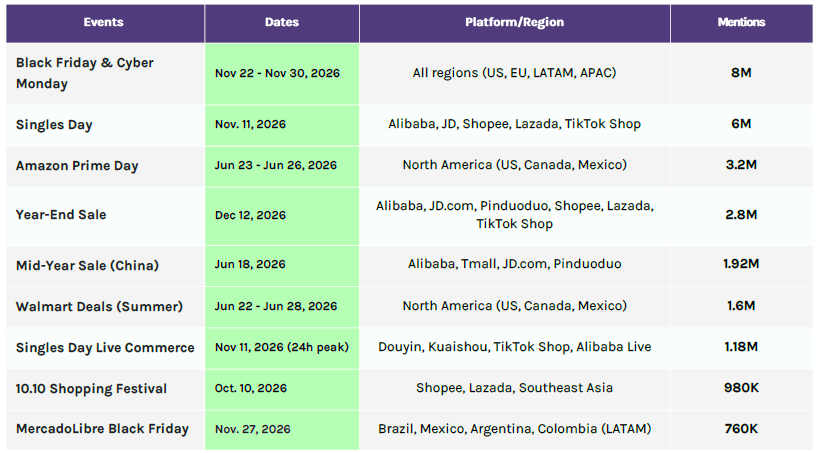
The Shopee+Lazada 10.10 Shopping Festivals generate 980K media mentions across Southeast Asia according to Onclusive analysis (Aug 2025-Jul 2026). These events achieve nearly identical mention volume to MercadoLibre Black Friday, despite concentrating entirely in Southeast Asian press ecosystems.
More tellingly: during Shopee’s 10.10 festival, the platform recorded 30 million live stream engagements, with a 120-fold uplift in “add to cart” conversions driven by live commerce. This demonstrates that Shopee doesn’t treat livestream shopping as supplementary to marketplace events – it’s structural. Live commerce isn’t emerging in Southeast Asia. It’s integral infrastructure.
For Western PR teams, this is the inflection point: When a regional platform records 120x uplift in conversion during a live commerce event, it’s not following a Western retail model. It’s executing a model that Western media barely comprehends, yet it generates media attention and narrative momentum comparable to global events.
Shopee’s market dominance through regional focus
Shopee controls 52% of Southeast Asia’s e-commerce market, with Indonesian operations alone generating $31.2 billion GMV in 2025. This market share doesn’t come from competing globally. It comes from owning the Southeast Asian narrative completely – through regional ambassadors (Jackie Chan for 9.9), regional payment infrastructure (SeaMoney), and region-specific event calendars.
Lazada, backed by Alibaba, operates similarly – building regional event calendars, regional media relationships, and regional narrative ownership rather than attempting to compete in global event coverage.
Need The Complete Data?
The regional fragmentation patterns we're analyzing come from Onclusive's comprehensive E-Commerce Platforms Industry Scan 2026, which tracked 153.7 million mentions across 69 companies and 7 regions.
The full report E-Commerce Industry Scan includes: ✓ Regional event calendar mapped for 2026 shopping events ✓ Share-of-voice analysis for 106 e-commerce topics ✓ Platform-specific narrative drivers by region ✓ 10 actionable PR recommendations…and more!
This data helps PR teams understand where to invest regional narratives for maximum media impact.
Part 3: The fragmentation thesis – Why global commerce calendars are a Western myth
Four distinct regional event calendars now operate simultaneously
The data reveals a fundamental shift in e-commerce narrative structure. There is no unified “global e-commerce calendar.” Instead, four independent regional calendars operate in parallel:
Western markets (BFCM): November 22-30, concentrated in Western business press, deal aggregators, and retail media
Asia (Singles Day): November 11, concentrated in Asian fintech media, supply chain publications, and Asian business press
Latin America (MercadoLibre Black Friday): November 28, concentrated in Latin American regional press and fintech outlets
Southeast Asia (year-round monthly festivals): 10.10 (October), 11.11 (November), 12.12 (December), concentrated in Southeast Asian regional media
When November 2026 arrives, BFCM and Singles Day overlap for nine days, creating calendar chaos for global brands. But this chaos is invisible to regional platforms because they operate on their own timelines.
Why regional media generates comparable mention volumes
Deal-focused Western media dilutes BFCM coverage across hundreds of publications and outlets, each competing for slightly different audience segments. Regional platforms concentrate their media attention in fewer, more specialized outlets (fintech, emerging markets, regional business press) that systematically cover platform-specific events.
Translation: One BFCM mention appears among thousands of competing retail stories. One MercadoLibre Black Friday mention appears in a fintech publication where readers expect deep Latin American e-commerce analysis. Media concentration creates narrative weight that volume doesn’t achieve alone.
Part 4: 10 PR & Communications recommendations for regional e-commerce platforms
| # | Recommendation | Problem | Key Action |
|---|---|---|---|
| 1 | Stop executing global event strategies regionally | One BFCM narrative fails in 3 of 4 regions | Build 3-4 distinct seasonal strategies per region. Assign region-specific PR leads. |
| 2 | Build separate media lists by region + outlet type | Generic BFCM pitches wasted on fintech press | Segment media by region AND outlet type (fintech vs. lifestyle). Create 3 distinct pitch angles per outlet type. |
| 3 | Align PR calendar to regional event dates | BFCM timing misses MercadoLibre Black Friday (Nov 28) | Use regional event calendar: Shopee 10.10 (Oct 10), Singles Day (Nov 11), BFCM (Nov 22-30), MercadoLibre BF (Nov 28). Start media outreach by region 4-6 weeks before. |
| 4 | Hire region-specific PR experts/agencies | Centralized teams optimize for global consistency, not regional ownership | For LATAM: fintech-focused agency. For SE Asia: regional platform specialist. Budget: 30-40% regional / 60-70% central. |
| 5 | Own one regional narrative completely | Competing on volume with MercadoLibre/Shopee is unwinnable | Choose ONE region + ONE platform + ONE narrative (supply chain resilience, payment innovation, or AI adoption). Own it entirely. |
| 6 | Create region-specific media assets | Journalists want owned data, not promotional announcements | Build 3-4 assets per region 4-6 weeks before events: dashboards, guides, case studies, reports. Proactively share with regional press. |
| 7 | Measure narrative share in top-tier outlets | PR teams obsess over volume (1,000 mentions) vs. quality (1 FT placement) | Stop measuring total mentions. Start measuring placement in Tier 1 outlets per region. Success metric: 1 Tier 1 placement > 100 Tier 3 mentions. |
| 8 | Build direct relationships with platform comms teams | Journalists have stronger relationships with platform teams than brand PR teams | Schedule quarterly briefings with MercadoLibre/Shopee comms. Coordinate timing: platform announcement (Week 1) → your brand (Week 2) → joint story (Week 3). |
| 9 | Segment email marketing by region + event angles | Generic BFCM emails irrelevant to 75% of subscribers in other regions | Create 4 email segments: LATAM (MercadoLibre focus), SE Asia (Shopee focus), Western (BFCM), Global/Enterprise (all 4 regions). Send 4-6 weeks before regional events. |
| 10 | Create regional platform monitoring dashboard | PR teams hear about regional platform news weeks later from second-hand sources | Set up Onclusive monitoring with 5 Boolean query sets (MercadoLibre, Shopee, Lazada, regional events, investor coverage). Daily alerts to regional teams. Respond within 24-48 hours. |
About the E-Commerce Platforms Industry Scan 2026
This analysis is part of Onclusive’s comprehensive E-Commerce Platforms Industry Scan 2026, which tracks media narratives and social listening data across 69 major e-commerce companies, 106 topic categories, and 7 geographic regions.
The report identifies where narrative gaps exist, which platforms control regional narratives, and how PR teams can position brands for media attention in fragmented regional markets.
Methodological notes: The media and social media data were collected and analysed using Onclusive’s specialised tools: the Monitor platform for monitoring mainstream media, the Onclusive Social platform for monitoring social media, and historical research covering a 24-month period.
FAQ: Addressing the regional e-commerce platform dominance debate
The cover image was generated by a generative AI tool for illustrative purposes.