


Introduction: The other tournament happening right now
While 48 nations compete for the FIFA World Cup trophy across the United States, Canada, and Mexico this summer, a parallel tournament is playing out in boardrooms, social feeds, and advertising campaigns worldwide. The prize? Billions of dollars in brand exposure, consumer trust, and commercial relevance – and the players scoring the most goals off the pitch are not always the ones you would expect.
The FIFA World Cup 2026 is the largest in the tournament’s history: 48 teams, 16 host cities, a global broadcast audience estimated at over five billion viewers. For brands, it is the single greatest concentration of human attention on the planet. Sitting right at the intersection of that attention are the players – not just as athletes, but as global influencers, cultural icons, and walking marketing platforms.
World Cup player endorsements have become one of the most intensely contested spaces in global marketing. This piece explores how footballers became so commercially powerful, why brands spend hundreds of millions to associate with them, and what Onclusive’s analysis of 160 player-brand endorsement pairs across 332,000 media and social mentions tells us about the real commercial dynamics unfolding at this tournament.
Media and social media share of voice of player endorsements by brands-from May 17 to June 16:
The scale of athlete endorsements – a market in full sprint
The global athlete endorsement market was valued at $62.4 billion in 2025, and is projected to reach $118.7 billion by 2034 – a compound annual growth rate of 7.4%. To put that in context: the entire global music recording industry generates around $28 billion in annual revenue. Athlete endorsements are already more than twice that size.
The broader sports sponsorship ecosystem – event, team, and league deals alongside individual athlete partnerships – is even larger. The Sports Sponsorship Market was valued at $74.59 billion in 2026 and is expected to reach $96.45 billion by 2030, growing at a CAGR of 6.6%. More than 46% of global fan engagement strategies now integrate digital sponsorship activations, while 33% of national campaigns rely on signage-based promotions across professional sports environments.
The shift from passive sponsorship to active athlete partnership is the defining commercial trend of this decade. Brands no longer want just a logo on a kit or a stadium banner – they want a face, a story, a voice, and a social media following. Individual athletes have become among the most powerful distribution channels in marketing.
Average deal size on the OpenSponsorship platform grew from approximately $2,500 in 2024 to $5,147 in 2025 – a 100% year-over-year increase. By 2025, 75% of activations went to female athletes, fuelled in part by explosive growth in women’s sports.
Football, however, remains the single biggest driver of athlete endorsement value globally – and no event concentrates that value more intensely than the World Cup.
For deeper analysis across all 72 group stage matches, misinformation tracking, player performance trends, venue-by-venue breakdown, and geopolitical risk signals, consult the complete World Cup Half Time Report, which contains an additional 350+ data points spanning sponsorship hierarchy, host city dynamics, and emerging narratives for the knockout phase.
Why footballers are so valuable to brands off the pitch
The follower economy
Cristiano Ronaldo’s total social media following has eclipsed one billion across platforms. He tops the Sportico earnings list for the third consecutive year, earning a further $60 million from commercial ventures beyond his Saudi Pro League contract, with partnerships including Nike, Herbalife, Binance, Perplexity, and Yili. His total annual income is estimated at $280 million in 2026, with approximately $50 million coming from sponsorships, endorsements, and off-pitch activities.
Ronaldo’s commercial dominance stems from three decades of deliberate personal brand construction: the social media omnipresence, the carefully managed public image, the CR7 lifestyle lines. World Cup player endorsements at the Ronaldo level function less like advertising deals and more like media partnerships – the brand is buying access to a distribution channel that rivals the largest television networks on Earth.
Lionel Messi operates differently but just as effectively. Messi’s off-field income of $70 million exceeds his MLS salary of $28.3 million. His deals are structured around revenue-sharing arrangements – with Apple TV+, with Adidas, with his growing portfolio of commercial partners – that give him ongoing upside as those brands grow.
Trust, aspiration, and the halo effect
What separates athlete endorsements from celebrity endorsements more broadly is a combination of trust and aspiration that is uniquely powerful in sport. Research consistently shows that consumers attribute qualities they associate with an athlete – dedication, excellence, physical peak, global success – to the brands that athlete partners with. This “halo effect” is measurable.
A study published in the Journal of Marketing found that brands linked to high-performing athletes saw brand perception scores improve by an average of 20% among exposed audiences. For mass-market brands targeting 18-34-year-olds – the core demographic of both football fans and digital consumers – an athlete partner can outperform almost any other form of paid media.
World Cup player endorsements amplify this dynamic to an extreme. When Lamine Yamal scores for Spain or Christian Pulisic sets up a goal for the United States in front of a billion viewers, the brand associated with that moment benefits from a wave of emotional connection that no conventional advertising campaign can manufacture.
Footballers as digital-first influencers
The modern top-tier footballer is no longer simply an athlete who happens to have sponsors. They are content creators with global reach, narrative control, and highly engaged audiences.
Erling Haaland’s “boot-free agency” moment during this World Cup – wearing Nike, Adidas, and Puma boots on different match days after his Nike deal expired – generated millions of organic social mentions and sparked a global debate about which brand would land him next. That kind of earned media value is precisely what the best-structured World Cup player endorsements aim to create, but rarely achieve without a compelling underlying story.
Jude Bellingham’s partnership with Louis Vuitton signals a generation of players who are building endorsement portfolios that transcend sport entirely – entering luxury fashion, fragrance, and lifestyle in ways previously reserved for musicians and film stars. Declan Rice’s deals with Prada, Burberry, and Aimé Leon Dore tell the same story.
Endorsement income no longer correlates linearly with on-pitch output. The players who command the largest and most sustainable commercial portfolios are those who have built genuine cultural relevance – through social media presence, personal story, and cross-category appeal that goes far beyond football.
See the Full Narrative with Onclusive
Stories no longer live in channels.
Get one unified view across social and earned media, so you can track how narratives start, spread, and evolve – and act with confidence.

The World Cup effect – why brands invest so heavily in player partnerships
The FIFA World Cup is unique as a marketing moment for one reason above all others: it combines universal reach with intense emotional engagement. Unlike the Super Bowl, which is predominantly American, or even the Olympic Games, which fragment attention across dozens of sports, the World Cup concentrates global attention on a single sport with a single narrative arc, played out over a month. World Cup player endorsements matter so much precisely because the underlying event matters so much.
For brands, this creates a rare alignment: activate a player partnership in one market and get pickup in forty. The campaigns that work best understand this multiplier effect and build for it.
Adidas “Backyard Legends” – cinema as commercial
Adidas launched the tournament’s most talked-about sportswear campaign with “Backyard Legends,” a full-length cinematic film rather than a traditional ad. Actor Timothée Chalamet assembles a dream football team from around the world, pulling in Jude Bellingham, Lamine Yamal, and Trinity Rodman – with cameos from Messi, Bad Bunny, David Beckham, Zinedine Zidane, and Alessandro Del Piero. The film generated earned media in excess of its paid media spend within 48 hours of launch.
The campaign’s brilliance lies in its willingness to treat World Cup player endorsements not as simple product placement but as cultural storytelling. Adidas was not selling boots – it was selling a vision of what football means across generations, geographies, and popular culture.
LEGO “Everyone Wants a Piece” – 314 million views in 24 hours
LEGO’s campaign with Messi, Ronaldo, Mbappé, and Vinicius Jr. may be the most striking single performance in World Cup player endorsement history. The “Everyone Wants a Piece” film reportedly generated 314 million Instagram views within 24 hours of release across the players’ combined accounts.
The creative strategy is deceptively simple: the world’s four most recognisable footballers, rendered as minifigures, chaotically competing for attention. The campaign works because it leans into the absurdity of assembling this much star power for a children’s toy brand, and because it uses the players’ own social channels as the primary distribution vehicle rather than paid media. Each player’s audience is a distinct market segment – and LEGO reached all of them simultaneously.
McDonald’s – the localisation playbook
McDonald’s approach to World Cup player endorsements at this tournament offers a different strategic lesson entirely. Rather than signing one global superstar at enormous cost, McDonald’s activated three “home stars” – Yamal for Spain and Latin America, Pulisic for the United States, and Davies for Canada – with a unified campaign narrative: “These three home stars are lighting up the FIFA World Cup.”
The distribution strategy was equally smart. Journalist Fabrizio Romano, one of football’s most followed social media accounts, posted “Update powered by McDonald’s” about Yamal’s World Cup debut, generating organic virality across Spain, Latin America, Asia, and beyond. Content that functions simultaneously as local relevance and global reach.
The result, as Onclusive’s data shows, is a share of voice that outperforms brands with far larger individual athlete budgets. McDonald’s ended up with the 4th, 8th, and 9th most mentioned endorsement pairs in our entire monitored corpus.
Lay’s “No Lay’s, No Game” – the legends format
Lay’s (Frito-Lay) took a third approach to World Cup player endorsements: anchoring their campaign around legends rather than active players. The “No Lay’s, No Game” campaign features Messi, David Beckham, Thierry Henry, and Alexia Putellas – an intergenerational cast that spans three decades of football history and four different geographic markets.
The strategy reduces squad-selection risk (retired players cannot be dropped), delivers strong nostalgic resonance with older fans, and gives Lay’s a campaign shelf-life that outlasts any individual tournament performance. For a mass-market snack brand, emotional consistency across the full month of the World Cup matters more than viral peaks.
Nike “Sport Offense” – pop culture over sport
Nike, not an official FIFA sponsor, has historically been the master of ambush marketing at major tournaments, and their 2026 strategy continues that tradition. The “Sport Offense” campaign crosses football and pop culture, featuring Mbappé, Ronaldo, Haaland, Vinicius Jr., and Cole Palmer alongside figures from music and entertainment. Shot in a distinctive Polaroid-documentary style, it deliberately positions Nike’s roster of players as cultural icons first, footballers second.
For Nike, World Cup player endorsements serve a dual commercial purpose: driving boot and kit sales among football fans, while simultaneously repositioning the brand for a broader lifestyle audience that may be only peripherally interested in the tournament itself.
Visa “Tap In” – digital and functional
Visa’s approach to World Cup player endorsements is more functionally focused. The “Tap In” campaign, featuring Lamine Yamal, Erling Haaland, and Christian Pulisic, ties the players’ precision and speed directly to the brand’s payment technology proposition. The campaign is designed for high-frequency digital touchpoints – mobile ads, in-venue screens, contactless payment prompts – rather than traditional broadcast.
What makes it notable is the player selection: Yamal (Spain/Latin America), Haaland (Northern Europe), and Pulisic (USA) cover three of the tournament’s most commercially important host-adjacent markets. The lineup is less about global superstar reach and more about geographic precision.
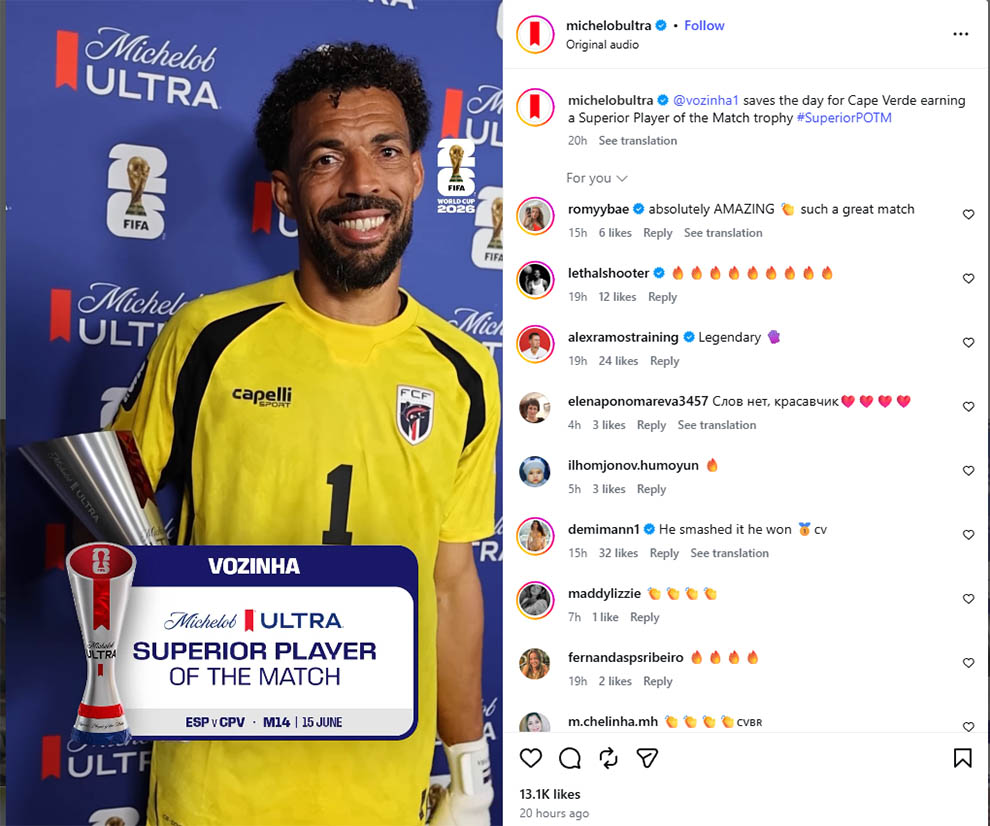
Michelob Ultra – the “Player of the Match” connection
AB InBev’s Michelob Ultra secured one of the tournament’s most cleverly integrated placements: presenting the official “Player of the Match” award at every game, with Messi, Christian Pulisic, Guillermo Ochoa, Ronaldo Nazário, and Alex Morgan all featuring in campaign materials. The brand does not just run ads around the World Cup – it is embedded in the tournament’s formal recognition structure, making its name synonymous with individual excellence rather than simply with football consumption.
Onclusive data – what 160 deals tell us about World Cup player endorsements
The following analysis is based on Onclusive’s proprietary monitoring of 160 World Cup player endorsement pairs across 231,994 media and social mentions, collected from May 17 to June 16, 2026, across 8 languages: English, French, Spanish, Italian, German, Portuguese, Korean, and Japanese.
Nike’s dominant trio at the top
The three most mentioned endorsement pairs in our dataset are all Nike deals:
| Rank | Endorsement pair | Share of voice (% of mentions) |
|---|---|---|
| 1 | Mbappé x Nike | 21.0% |
| 2 | Ronaldo x Nike | 18.8% |
| 3 | Haaland x Nike | 12.6% |
Collectively, these three World Cup player endorsements account for 52.4% of all monitored mentions. Nike – without being an official FIFA sponsor – has built more World Cup conversation around its player roster than any official partner brand.
Mbappé’s deal is particularly striking: his Nike contract was widely reported to be expiring during the tournament itself, making every mention of his boots a live commercial negotiation played out in public. The ambiguity became a media story in its own right, generating coverage that far exceeded any planned campaign.
Haaland’s “free agent boots” moment produced additional earned media on top of his existing Nike mentions. In the modern endorsement economy, a well-timed moment of uncertainty can generate more conversation than a perfectly scripted campaign.
McDonald’s: the biggest surprise in our data
The most unexpected finding in our analysis of World Cup player endorsements is the commercial performance of McDonald’s multi-player strategy:
- Yamal x McDonald’s: 7.87% of share of voice – 4th most mentioned deal overall
- Pulisic x McDonald’s: 4.11% – 8th overall
- Davies x McDonald’s: 1.33% – 9th overall
Yamal x McDonald’s generates more social media coverage than Messi x Adidas (ranked 7th with 1,429 mentions). A brand spending a fraction of what Adidas invests in individual star partnerships achieved higher single-pair visibility through localisation, smart distribution via Romano’s social media, and the cultural moment of Yamal’s tournament debut.
The Asian market: Son and Lee Kang-in outperform expectations
The most significant cultural insight in our World Cup player endorsements data is the performance of two Korean players:
- Son Heung-min x Adidas: 6.87% of share of voice – 5th overall
- Lee Kang-in x Adidas: 6.60% of share of voice – 6th overall
Together, these two Korean endorsement pairs generate 13.5% of all monitored mentions – more than Messi x Adidas and Bellingham x Adidas combined. Korean football fandom is exceptionally active on digital platforms, particularly X (formerly Twitter), and the engagement generated by these two players’ commercial associations reflects that community’s scale.
For Adidas, this underlines the commercial logic of investing in Asian stars alongside European and South American household names. The total reach generated by Son and Lee Kang-in’s activations rivals Western-focused campaigns with far larger nominal budgets.
Emerging deals: new categories entering the World Cup endorsement landscape
Beyond the established sportswear and consumer goods brands, our monitoring captures a new wave of World Cup player endorsements from less conventional categories:
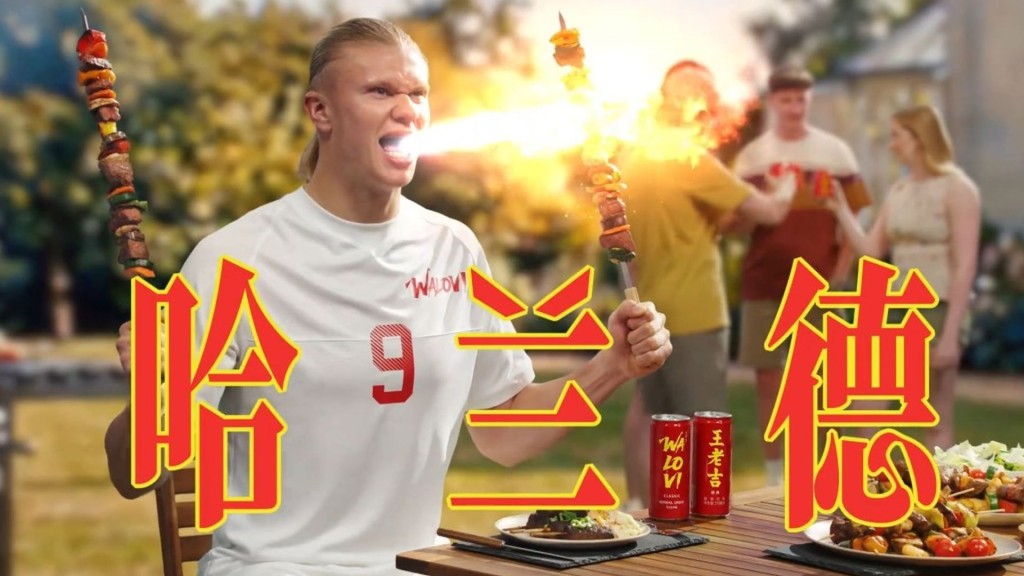
Haaland x Walovi (Wang Lao Ji): The Norwegian striker as global ambassador for a Chinese herbal tea brand is one of the tournament’s more improbable pairings. With strong social engagement, the campaign’s quirky visual storytelling – Haaland speaking Mandarin, holding a red can, playing on the contrast between his Nordic physique and a centuries-old Chinese wellness tradition – generated organic reach well beyond what a conventional endorsement would produce.
Neymar x FlareFlow: Neymar has licensed his AI-generated likeness to FlareFlow, a Chinese vertical entertainment platform owned by COL Group, for a 16-title microdrama franchise premiering globally during the World Cup. With growing mentions in our data, this represents an entirely new category of World Cup player endorsements – content licensing rather than traditional brand ambassadorship – worth monitoring closely as AI-driven content production scales.
Messi x Kalshi: The US prediction market platform’s partnership with Messi and the Argentine national team generated 101 media mentions in our data. Fintech and prediction market brands are actively seeking to leverage World Cup player endorsements for rapid user acquisition at a moment of peak sports engagement.
Legends and non-players: consistent reach, zero squad risk
Our monitoring includes several non-playing figures who generate meaningful endorsement coverage:
- Michael Owen x ForeGate: 816 mentions – the retired England striker’s ambassador role for a predictions platform generated more coverage than many active player deals in our dataset
- David Beckham x Lay’s: 518 mentions – the retired icon remains a commercially active and valuable face for World Cup campaigns
- Thierry Henry x Lay’s: 390 mentions – similarly sustained presence
The key insight for brand strategy: legends with media roles deliver more consistent, predictable activation than active players whose on-pitch performance introduces unpredictable commercial risk. A player eliminated in the group stage takes their brand visibility with them.
The non-selected players: residual commercial impact
Two players in our original monitoring framework were ultimately not selected for the tournament – Cole Palmer (England) and Rodrygo (Brazil) – but both continue to generate residual mentions. Cole Palmer’s Nike and Powerade endorsements still produced social and media mentions. This commercial lag reflects both the gap between news cycle and public awareness, and the real financial risk for brands that build World Cup player endorsements around athletes before final squad confirmation.
Implications for brands and communications professionals
The patterns in our data on World Cup player endorsements offer several actionable takeaways for PR and communications professionals, media monitoring teams, and marketing strategists.
1.Localisation beats single global stars in share of voice. The McDonald’s playbook of activating regional heroes outperforms the “one superstar, one global campaign” approach in media mention terms. Regional World Cup player endorsements that tap home team emotion generate disproportionate earned media relative to cost.
3. Asia-Pacific is not a secondary market. Over 13% of all monitored World Cup player endorsement mentions were generated by Korean player-brand pairs. Any global campaign treating APAC as an afterthought is missing a substantial portion of the conversation.
2. Monitor for unplanned commercial stories. The most covered endorsement narratives of this tournament – Haaland’s boot free agency, Mbappé’s contract expiry, Neymar’s AI licensing deal – emerged from organic news rather than planned activations. Capturing these signals early requires monitoring infrastructure that goes beyond simple brand tracking.
4. Retired players are commercially undervalued. Beckham, Henry, Ronaldo Nazário, and Michael Owen generate consistent, quality mentions without the squad selection uncertainty and performance volatility that make active-player World Cup endorsements a riskier commercial bet.
5. Timing the activation matters as much as the player chosen. Brands that front-load their endorsement campaigns before the knockout rounds reduce performance risk exposure, but miss the emotional peak of tournament moments. The optimal strategy – as McDonald’s demonstrated – is to design content that activates reactively on tournament events rather than running on a pre-determined broadcast schedule.
Conclusion: the game within the game
The FIFA World Cup 2026 is the world’s largest live marketing event as much as it is a sporting one. Across 104 matches, millions of monitored brand mentions, and billions in deployed commercial capital, World Cup player endorsements reveal what consumers actually pay attention to, which pairings resonate across cultures, and where sports marketing is heading.
The clearest finding from Onclusive’s data is that the most effective World Cup player endorsements combine cultural credibility with local relevance and creative distinctiveness. Nike dominates share of voice through three of the tournament’s most compelling athletes. McDonald’s outperforms expectations through localisation and smart journalist partnerships. Korean fandom drives a disproportionate share of the entire endorsement conversation.
For brands, the World Cup remains the highest-stakes, highest-reward commercial environment in sport. For players, it has become the moment that determines their off-pitch commercial value for the next four years. The scoreboard tracking that value is measured in media mentions, not goals.

This analysis is based on Onclusive’s proprietary monitoring of 160 World Cup player endorsement pairs, covering 231,994 media and social mentions from May 17 to June 16, 2026, across 8 languages.
For more information on Onclusive’s sports intelligence capabilities, contact our team:
The cover images were generated by generative AI for illustrative purposes.