





By now, most of us accept that we need to move quickly towards implementing AI search visibility measurement. But this premise has been easier to accept than to act on. AI answers don’t come with robust analytics and there’s no dashboard showing exactly who asked what, or whether your brand made the cut. And according to a 2026 Goodfirms study, only 14% of brands currently track AI and LLM citation visibility.
But here’s the good news: metrics to measure your brand’s AI search visibility over time now exist and we’ll dig into each one in this article.
Why these five AI search visibility metrics exist
AI engines like ChatGPT don’t work like search engines, there’s no ranked list of ten blue links to check. Instead, an AI answer is generated fresh each time, shaped by what the model has read and how it weighs sources.
That means brand visibility in AI answers isn’t binary, you can’t just check whether you rank. You need to know how often you show up, where you land when you do, whether AI picks you over competitors, and whether the answers about you are even favorable.
This is also the thinking behind AMEC’s new standard for AI search optimization measurement: without shared definitions, none of these numbers mean much.
Yaser Ayub, Founder of Rayze Digital, an SEO and GEO agency, has spent over a decade helping brands build search visibility. He sees the same mistake come up again and again when teams start measuring AI visibility:
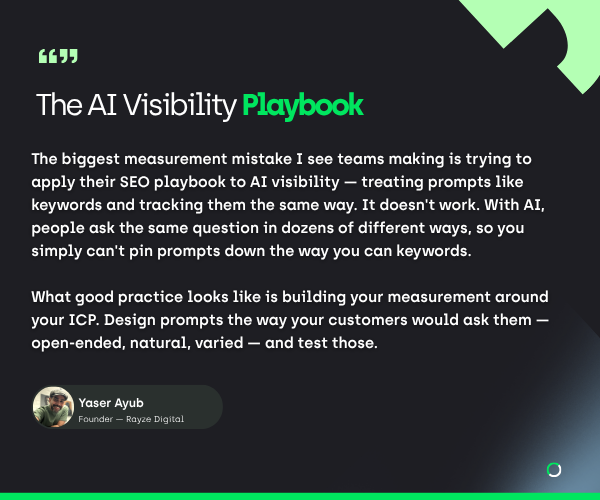
In short, Yaser’s point is that AI visibility measurement has to mirror how real customers actually ask questions, not how brands are used to tracking keywords. That’s the shift these five metrics are built around. It’s not about abandoning a consistent set of prompts, it’s about building that set from how customers actually ask, then tracking it consistently against competitors over time.
Let’s dig into the five AI search visibility metrics that matter . . .
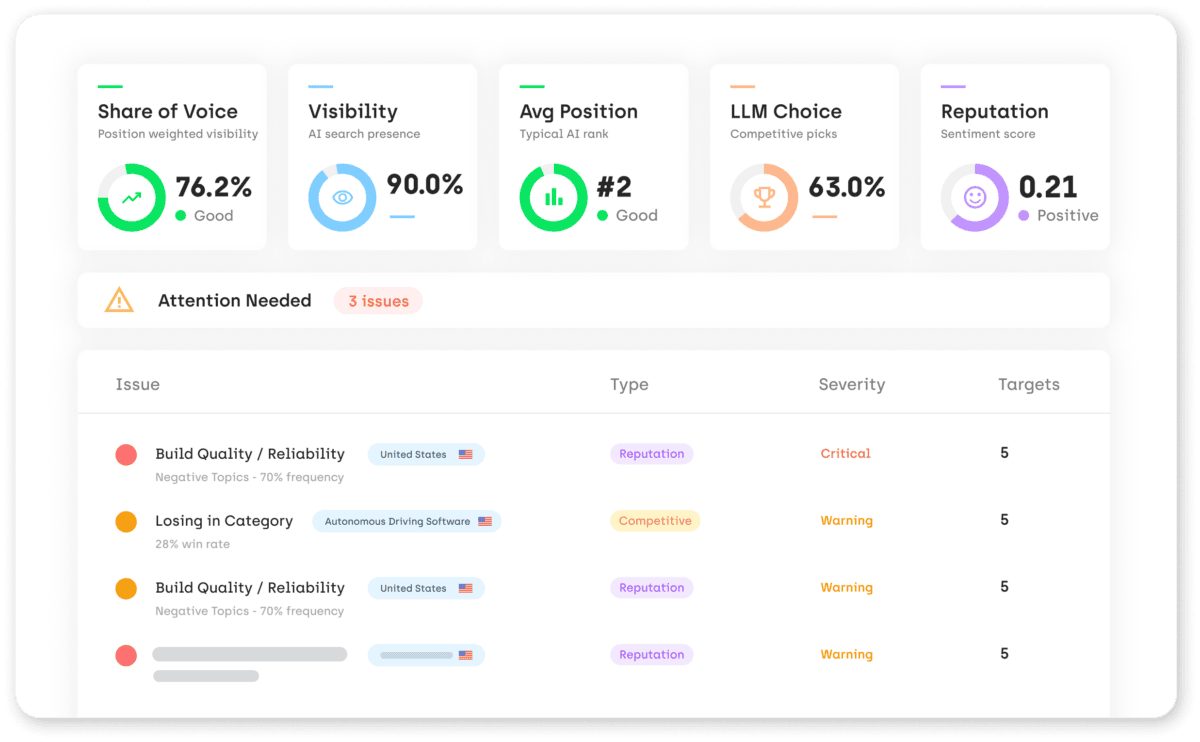
Metric 1: Share of voice
Share of voice measures how often your brand appears in AI-generated answers, weighted by visibility and rank position.
It tells you how consistently your brand features in category conversations, and how strongly it performs against competitors. A low share of voice means AI engines are having conversations about your category without you in the room.
Metric 2: Visibility
Visibility is the proportion of AI responses in which your brand is mentioned at all.
This is the most basic checkpoint. It tells you whether AI engines are forming answers about your category with or without your brand included. If your visibility score is low, none of the other metrics matter yet. You have to show up before you can compete.
Metric 3: Average position
Average position is your average ranking across the responses where your brand does appear.
Where you appear in an AI answer matters. This metric tells you how prominently your brand features when it’s mentioned, and whether competitors are consistently placed ahead of you. A brand can have decent visibility and still lose the moment that matters, because it’s buried third or fourth in the answer behind competitors.
Metric 4: LLM choice
LLM choice measures how often AI engines select your brand as the top result in category and comparison queries.
This is the sharpest of the five metrics. It tells you whether you’re winning or losing when audiences ask AI to recommend or compare brands in your category. It’s the closest thing to a conversion metric in this framework: the moment AI actively picks you over the alternatives.
Metric 5: Reputation
Reputation is a weighted sentiment score drawn from AI-generated responses about your brand.
Visibility and position tell you if you’re in the conversation and where. Reputation tells you what’s actually being said. A brand can be highly visible and still be described in outdated, inaccurate, or unfavorable terms. This metric tells you whether your AI visibility is helping you, or quietly masking a reputation problem.
What these AI search visibility metrics expose together
On their own, each metric is a single data point. Together, they map directly onto the four AI visibility gaps most brands have: a presence gap, a position gap, a narrative gap, and a source gap:
- Low visibility points to a presence gap.
- Weak average position points to a position gap.
- Poor LLM choice and reputation scores often point to a narrative gap, where AI engines are working from outdated or incomplete information about your brand.
Tracking the five metrics is how you find out which gap you actually have, instead of guessing. Once you have your numbers, the six AI brand visibility questions will help you dig into why, and where to focus first.
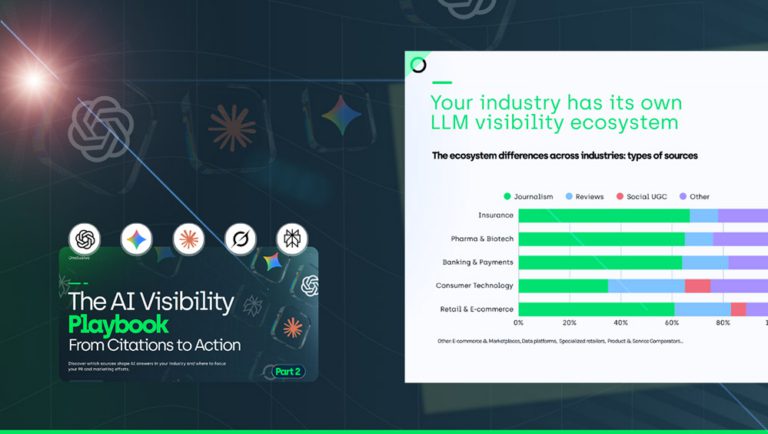
For an in-depth view of how this works in practice, download our AI Visibility Playbook.
Start measuring, not guessing
Most teams don’t have a visibility problem because they’re doing something wrong. Until recently, they’ve had a visibility problem because there was no reliable way to measure it at all.
These five AI search visibility metrics don’t sit in isolation either. GEO Analytics is built into Onclusive’s unified platform, alongside media monitoring, analytics, and PR workflow solutions, so AI visibility can be read and measured against your earned media performance rather than tracked as a separate silo. That means you can see whether strong coverage is actually translating into AI recommendations, or where the two are pulling apart.
See how these five metrics show up for your brand with a GEO Analytics demo, the AI visibility tool built to measure, act on, and improve your brand’s presence in AI search.