Introduction: 22% deals, 0% disruption
Every November, Western media repeats the same story: discount percentages, doorbusters, and deal listicles. AI-referred traffic to ecommerce sites grew 752% year over year during BFCM* 2025 -a genuine disruption signal. Yet when Onclusive analyzed how Black Friday in media actually structures coverage across 8 million media mentions (Aug 2025-Jul 2026), a pattern emerged that contradicts industry assumptions. (*): BFCM=Black Friday Cyber Monday
22% of all Black Friday in media coverage concentrates on deals & discounts. The remaining 78% fragments across hundreds of competing narratives: supply chain logistics, payment systems, AI adoption, regulatory change, marketplace competition, and consumer behavior shifts. But within that 78%, a critical gap exists: live commerce disruption, which reshapes how 600+ million Asian consumers shop, generates virtually no Western media attention.
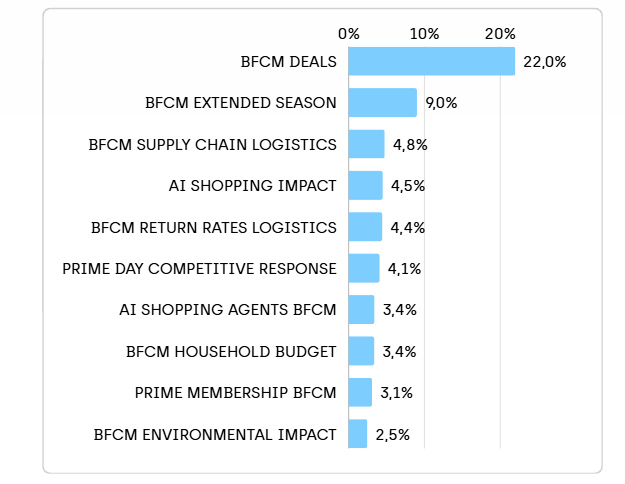
Western media has built an entire coverage infrastructure optimized for discount announcements. That infrastructure creates a narrative trap-one that makes it nearly impossible for PR teams to position anything beyond “% off” stories. Meanwhile, the actual stories (live commerce integration, supply chain pressure, regional platform resilience) remain invisible to Western audiences.
All media and social media data informing this analysis are available in the new Industry Report 2026, which focuses on e-commerce platforms. The report tracks 153.7 million mentions across 69 companies and 7 regions, providing the empirical foundation for understanding how Black Friday in media has fundamentally shifted away from pure deal coverage toward fragmented, specialized narratives.
The data in the report is collected using Onclusive’s specialized tools: Onclusive Monitor for media monitoring and analysis (TV, radio, podcasts, print, and digital), and Onclusive Social for social media listening (discussion platforms, forums, blogs, and social media), GEO Analytics for Gen AI Visibility Share of Voice
For PR and communications professionals, understanding how Black Friday in media actually operates is urgent. The competitive advantage goes to whoever first breaks this deal-driven template.
How Black Friday-Cyber Monday became a deals-only narrative trap
The historical path to media commoditization
In BFCM 2025, shoppers spent $11.8 billion on Black Friday, up 9.1% year-on-year. That number dominates headlines. But the story behind it-how that $11.8 billion flowed through fundamentally different e-commerce infrastructure than five years ago-barely registers.
Western retail media built its BFCM coverage model around one narrative engine: the deal. Deal aggregators (RetailMeNot, DealNews, Honey) became the primary media outlets covering BFCM, optimizing for audience size through listicles and discount percentages. Lifestyle publications followed, competing for clicks on “50% off” announcements. Business press, looking for stories that resonate with mainstream audiences, focused on spend totals and “record years” rather than infrastructure shifts.
Translation for narrative strategy: Once a narrative template becomes dominant media infrastructure, competing outside that template demands more than better storytelling. It requires reconstructing the entire media ecosystem around a new template.
The BFCM deals template is now 15+ years old. It’s built into deal aggregators’ incentive systems, retail media’s editorial calendars, and lifestyle journalists’ story preferences. A PR team pitching live commerce to a deal aggregator encounters a fundamental mismatch-that story doesn’t fit that outlet’s business model.
Why 22% feels like 78% to media teams
Media concentration creates a psychological effect that matters strategically. When 22% of Black Friday in media coverage concentrates on deals & discounts, that coverage clusters in fewer, higher-traffic outlets. A deal listicle on a major aggregator reaches millions of daily users. The remaining 78% fragments across trade publications, fintech outlets, supply chain journals, regional media, and academic research-each reaching specialized audiences.
A PR team sees 22% and thinks “narrow coverage.” Media teams chasing audience volume see the same 22% and think “massive reach.” Deal aggregators, lifestyle publishers, and mainstream business press dominate Black Friday in media discourse, even though they represent a minority of total mention volume.
PR teams attempting to pitch disruption stories to Black Friday in media (live commerce, supply chain resilience, AI-driven personalization) encounter a wall. The journalists and publications that would cover these stories exist in the 78%. The journalists and publications that drive narrative momentum during BFCM live in the 22%.
The cost of the deals trap to brands
While some platforms got more attention this Black Friday than previous years, 2025 BFCM was overall just okay. Unfortunately, that same growth didn’t happen for 2025. Since consumers aren’t spending as freely as they used to, Black Friday and Cyber Monday deals aren’t as effective as they once were.
The result: a vicious cycle for retail brands in how Black Friday in media operates. Discount effectiveness is declining, yet media expectations remain locked in the discount narrative template. Brands trying to differentiate through supply chain transparency, membership value, or AI-powered discovery find themselves competing in a media environment that doesn’t have language or outlets for those stories.
Brands compete on discount depth-a commoditized race to the bottom. Coverage fragments across hundreds of outlets, each reaching smaller audiences. The structural problem, discount-driven Black Friday in media narrative dominance, remains invisible because no major PR player has yet broken the template.
The live commerce blind spot – $77.9 billion invisible to Western media
Southeast Asia’s commerce transformation isn’t Western news
Southeast Asia’s content commerce gross merchandise value (GMV) is on track to reach $77.9 billion in 2026, as live, short video and content-focused affiliates become a core part of the region’s ecommerce mix. Combined content commerce GMV across Shopee, TikTok Shop and Lazada reached $49.7 billion in 2025, up 98 percent year-on-year.
That’s $77.9 billion in projected Southeast Asian GMV for content-driven (primarily livestream) commerce alone. For context, Shopify reports that its merchants generated a record $14.6 billion in sales over BFCM, up 24% from last year. Southeast Asia’s live commerce ecosystem is projected to generate 5.4x the GMV of Shopify’s entire BFCM 2025 performance, concentrated in a single region.
A Western business reporter searching for “live commerce BFCM 2026” will find almost no coverage in mainstream business press. Trade publications track it. Regional fintech media extensively analyzes it. Asian business analysts monitor it daily. Western mainstream media remains silent on this story.
Why? Western media infrastructure lacks the language, reporter expertise, and audience expectations needed to cover live commerce as retail infrastructure.
Live commerce operates outside Western Black Friday Cyber-Monday timing entirely
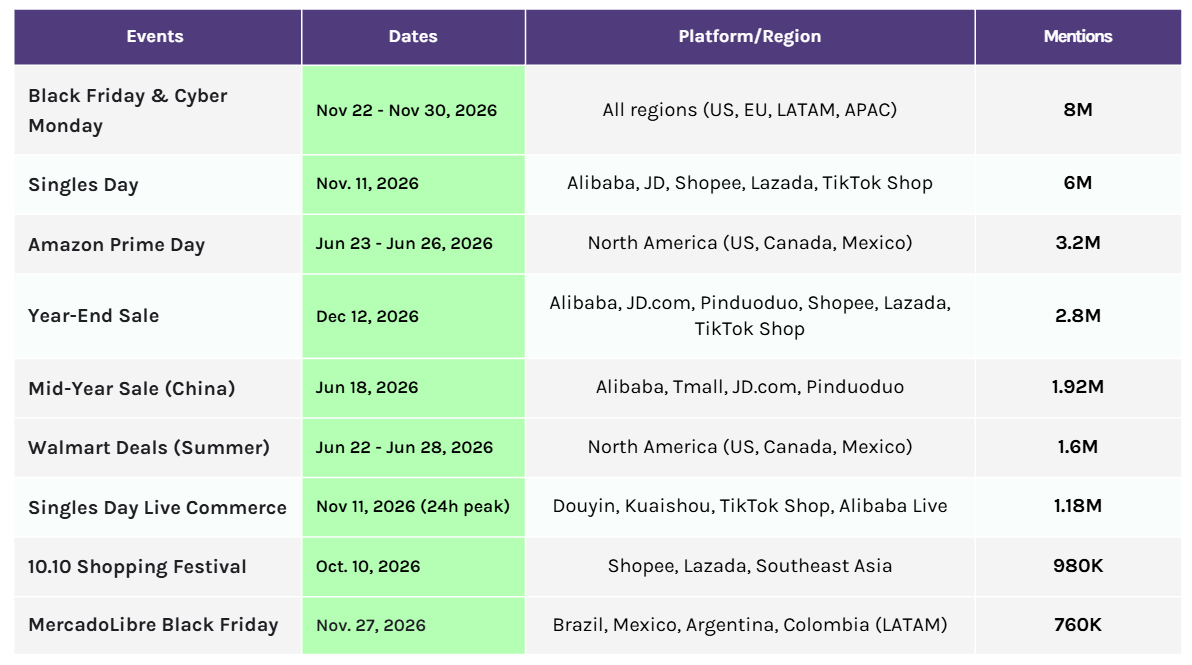
In the first half of 2026, content commerce accounted for 37 percent of Southeast Asia’s platform ecommerce GMV, up from just 20 percent in 2024. That 37% concentration isn’t tied to Western BFCM calendars. Shopee runs its own event calendar (10.10, 11.11, 12.12 festivals). TikTok Shop operates on platform-specific promotional windows. Lazada coordinates regional events independent of Western retail traditions.
When BFCM arrives in November, live commerce platforms in Southeast Asia execute their own 11.11 shopping festivals, generating comparable GMV to BFCM without any coordination with Western retail calendars. Western media covers BFCM as a global phenomenon. Southeast Asian platforms treat it as a coincidental overlap with their own regional events-not the defining moment of their retail calendar.
Translation for narrative strategy:
BFCM isn’t irrelevant to Southeast Asian platforms. It’s simply not their primary narrative anchor. They operate according to their own event calendars, consumer purchasing patterns, and regional media ecosystems.
The conversion gap that Western journalists don’t understand
TikTok Shop reported that conversion rates when selling via livestream are higher than 50% compared to static posts. For context, BFCM 2025 saw Black Friday capture nearly 30% of total conversions and revenue, with Cyber Monday showing a 21.90% conversion rate.
Live commerce conversion rates exceed BFCM conversion rates by 100%+. The story should focus on why 50%+ conversion rates matter more than discount percentages. Instead, Western media continues to frame live commerce as “emerging” or “growing,” language that treats it as secondary to traditional e-commerce. Live commerce has moved from experiment to infrastructure. That should dominate retail media coverage.
It doesn’t, because Western retail media hasn’t built the infrastructure to understand why fundamental shifts in conversion rates matter.
Supply chain pressure -the disruption story Western media ignores
The real BFCM bottleneck isn’t demand but logistics
According to Wells Fargo Supply Chain Finance data, constraints are hitting every stage of the supply chain heading into peak season. These 2025-specific pressures layer on top of recurring holiday season challenges: last-mile delivery bottlenecks, reverse logistics delays, inventory misalignment, and carrier capacity strain.
That’s the underlying narrative of BFCM 2025-2026. Not discounts. Not deal volumes. Logistics infrastructure strain. Carrier Networks face unprecedented pressure. Record-high parcel volumes, labor disputes, and tariff-driven costs are stretching delivery networks thin. Even reliable carriers could face bottlenecks, making on-time delivery promises riskier.
Why does this matter? A genuine systems-level story affects every brand, every fulfillment center, every shipping carrier. BFCM 2025 growth was “just okay” despite record spending-because logistics constraints limited conversion potential.
Yet when you search major business press for “BFCM 2025 supply chain,” you find trade publications and logistics-focused journals. Mainstream business press? Minimal coverage. Lifestyle retail media? Non-existent
Why supply chain pressure remains invisible to Western consumers
Deal aggregators don’t care about supply chain pressure. Lifestyle publications lack the expertise to analyze logistics bottlenecks. Mainstream business press treats logistics as a backend story, not a consumer-facing narrative. Financial analysts and trade publications track it, but they reach specialized audiences, not mainstream retailers and brand decision-makers.
An entire category of Black Friday in media narratives-supply chain resilience, last-mile logistics strategy, reverse logistics optimization, inventory forecasting-remains trapped in trade publications, inaccessible to mainstream PR outreach.
Two- to three-day delivery has become the standard expectation. Customers expect real-time tracking, accurate delivery windows. Faster delivery often comes at higher cost and places increased pressure on fulfillment centers and final-mile delivery. Retailers face a strategic dilemma: deliver faster (higher costs, logistics strain) or disappoint customers with slower delivery.
That’s a story-one that should shape how brands position BFCM. Instead, Black Friday in media coverage remains locked in “discount percentage” narratives.
Media outlet segmentation -why disruption stories never reach retail media
The outlet fragmentation problem
Black Friday in media coverage fragments into three non-overlapping ecosystems:
- Ecosystem 1: Deal/Lifestyle Media -Reach: Millions. Narrative focus: Deal percentages, doorbusters, gift guides. Outlets: Deal aggregators, lifestyle blogs, mainstream consumer publications. Journalist expertise: Consumer shopping behavior, trend spotting, entertainment value.
- Ecosystem 2: Trade/Financial Press -Reach: Tens of thousands. Narrative focus: Supply chain, logistics, financial performance, regulation. Outlets: Supply chain journals, fintech publications, trade media, regional business press. Journalist expertise: Industry dynamics, financial analysis, regulatory interpretation.
- Ecosystem 3: Regional/Platform Media -Reach: Millions (regional concentration). Narrative focus: Regional platform announcements, regional event performance, regional consumer trends. Outlets: Regional business press, Asian fintech media, Latin American retail media. Journalist expertise: Regional market dynamics, platform economics, regional consumer behavior.
A PR team pitching a live commerce story will fail targeting Ecosystem 1 (deal media). It will succeed targeting Ecosystem 2 (trade press) or Ecosystem 3 (regional media). But Ecosystem 1 dominates Black Friday in media narrative discourse, creating the illusion that a story isn’t relevant unless it fits the deal narrative template.
Journalists have different information sources by ecosystem
Deal media journalists rely on press releases from brands and retailers, deal databases, social media trends, and consumer surveys. Trade press journalists rely on company filings, supply chain data, logistical research reports, and industry conferences. Regional media journalists rely on platform announcements, regional analyst reports, regional social data, and direct platform relationships.
A live commerce story that resonates with regional media journalists (who monitor Shopee announcements, regional fintech data) will fall flat with deal media journalists (who monitor discount announcements and consumer deal-hunting behavior). A supply chain story that resonates with trade press will have no audience in deal media.
Translation for PR strategy:
Pitching the same Black Friday in media story to all three ecosystems wastes 67% of your outreach. Each ecosystem requires distinct story angles, distinct sourcing, distinct outlets, and distinct timing.

Need The Complete Data?
The insights in this blog are just the surface. Ready to discover the new e-commerce players that are making their mark?
Get access to all the data. Download the report “E-Commerce Platforms Industry Scan 2026.”
The AI-opportunity narrative gap
752% growth in AI-referred traffic -covered as a footnote
AI-referred traffic to ecommerce sites grew 752% year over year during BFCM 2025. That represents one of the most significant e-commerce infrastructure changes of the decade. Yet when you search mainstream Black Friday in media coverage, AI mentions scatter across financial press and tech publications. Lifestyle retail media largely ignores it. Deal aggregators don’t frame deals through an AI lens.
This should be the Black Friday in media story: How AI-driven personalization, search, and discovery reshape how consumers find and purchase products. Instead, it gets treated as incremental background noise to the “record spending” narrative.
Why? Because AI adoption doesn’t fit the deals narrative template. Deal media focuses on percentages, not algorithms. Lifestyle media focuses on consumer motivation (“shoppers saved X dollars”), not technology infrastructure. Mainstream business press covers it, but after the BFCM narrative window has closed.
The narrative opportunity: A brand can reframe Black Friday in media around AI discovery, AI-powered personalization, or AI inventory optimization, targeting trade press and financial outlets during BFCM. But mainstream retail media won’t carry that angle, creating an audience gap.
10 PR recommendations to escape the BFCM deals trap
| # | Recommendation | Problem | Action |
| 1 | Abandon the unified BFCM narrative | One discount story fails everywhere except deal media | Build three distinct Black Friday in media narratives: Deals for lifestyle media, supply chain resilience for trade press, regional event alignment for regional media. Pitch simultaneously on separate timelines. |
| 2 | Segment media outreach by outlet ecosystem | Generic BFCM pitches sent to deal aggregators and trade press waste time on both sides | Create three distinct media lists: (1) Deal aggregators + lifestyle outlets, (2) Trade press + financial media, (3) Regional media + platform comms teams. Use three different angles per pitch. |
| 3 | Invest 40% of BFCM PR budget in trade press and supply chain media | BFCM budgets concentrate on consumer-facing media, ignoring where infrastructure stories live | Allocate: 35% deal media, 40% trade press, 25% regional/platform media. Measure success in Tier 1 trade publication placements, not total mention volume. |
| 4 | Build AI discovery as your Black Friday in media anchor | Discounts are commoditized; AI adoption is differentiated | Frame BFCM around: “How AI helped us serve customers better than discounts alone.” Source data: AI-search traffic growth, personalization conversion rates, customer satisfaction scores. Target: fintech press, retail tech publications. |
| 5 | Make supply chain transparency a BFCM PR asset | Supply chain stories trapped in logistics journals; need mainstream legitimacy | Develop owned data: inventory forecasting accuracy, last-mile delivery speed, carbon metrics, automation investments. Pitch as “How we’re solving BFCM logistics” to trade press 4-6 weeks before event. |
| 6 | Create region-specific BFCM strategies for Asia & LATAM | Western BFCM narrative ignores regional platform events | For Asia (BFCM + 11.11 festivals): Coordinate timing with Shopee/TikTok Shop. For LATAM (BFCM + MercadoLibre Black Friday): Coordinate timing with regional platforms. Build distinct pitch narratives per region. |
| 7 | Frame discounts through membership, not percentage off | Percentage-off stories are commoditized and indistinguishable | Pitch angle: “BFCM as a membership value story.” Hook: Members receive X% more benefit than discount-driven buyers (loyalty, early access, exclusive products). Target: Business press, lifestyle media focused on loyalty programs. |
| 8 | Own one narrative gap completely | Trying to be everywhere dilutes impact across BFCM media | Choose: Supply chain resilience OR live commerce disruption OR AI-driven discovery. Own ONE narrative completely across 3-4 Tier 1 outlets. That placement > 100 generic mentions. |
| 9 | Build direct relationships with trade press and regional platforms | Journalists discover your BFCM story through media databases weeks after you pitch | Schedule editorial briefings with trade publication editors 8-10 weeks before BFCM. Schedule platform coordination calls with Shopee/TikTok/MercadoLibre comms teams 6-8 weeks prior. Lock in editorial calendar slots. |
| 10 | Measure narrative share in Tier 1 outlets by ecosystem, not total volume | PR teams obsess over 10,000 mentions instead of 3 Tier 1 placements | New success metric: (1 FT article on supply chain) + (1 trade press feature on AI adoption) + (1 regional media placement) = BFCM PR success. Stop counting deals media volume. |
Strategic recommendations: How to navigate the Black Friday Cyber-Monday narrative maze
For brands competing on supply chain and logistics innovation
Black Friday in media becomes your moment to position supply chain investment as a competitive advantage, not a cost center. Standard approach: Announce your BFCM discount. Differentiated approach: Announce your BFCM logistics achievement (same-day delivery expansion, inventory accuracy improvements, carbon reduction in fulfillment).
Media opportunity: Trade press extensively covers BFCM supply chain stories. You have outlet access. Mainstream business press occasionally covers logistics stories during BFCM. Financial press covers it if connected to shareholder value.
Timeline: Begin outreach to trade press 6 weeks before BFCM. Provide data on logistics investments, fulfillment capacity, carrier partnerships. Release supply chain insights as owned assets 4 weeks before BFCM.
For brands embracing AI and personalization
The Black Friday in media narrative has shifted to AI, but mainstream media coverage hasn’t caught up. You have a 3-4 month window to own the “AI-driven BFCM” narrative before it becomes standard.
Media opportunity: Fintech press, retail tech publications, and business innovation outlets actively cover AI adoption in commerce. Supply chain publications track AI logistics. You have access to 15-20 Tier 1 outlets covering this angle.
Timeline: Start building your AI-BFCM narrative in September. Prepare data on AI-search traffic, recommendation engine performance, personalization ROI. Pitch trade press and fintech media in October. Release owned research in early November.
For marketers operating in Asia or Latin America
Black Friday in media is secondary to your primary event calendars (Shopee 11.11, MercadoLibre Black Friday). Use Western BFCM timing to coordinate with regional platforms, not compete against them.
Media opportunity: Regional media and platform comms teams are the relevant outlets. They reach decision-makers who care about your specific market. Mainstream Western coverage is irrelevant to your regional performance.
Timeline: Coordinate with Shopee/TikTok/MercadoLibre comms teams 6-8 weeks before your primary regional event. Build BFCM overlap as a secondary narrative. Focus 70% of budget on regional media outreach, 30% on Western media (if relevant for global brand positioning).
For retail media and fintech brands
Supply chain and logistics stories are your competitive advantage during Black Friday in media. Own the disruption narrative.
Media opportunity: You have direct access to journalists and outlets that cover infrastructure transformation. Trade publications, financial press, and platform comms teams are your natural audiences.
Timeline: Begin building supply chain and logistics narratives in August. Provide research, data, case studies to trade press by September. Coordinate platform announcements in October. Maintain narrative momentum through BFCM with supply chain insights, logistics updates, and disruption analysis.