
PR and communications teams have never had more data at their fingertips, and never faced more pressure to prove what it all means. According to Onclusive’s 2026 Communications & Marketing Trends Report, proving ROI remains the top challenge for PR practitioners. Media mentions, impressions and follower counts are easy to collect, but executives want to know something different: did our communications change anything that matters to the business?
That is the job of communications measurement. Done well, communications measurement turns scattered data points into evidence of value and into practical guidance for your next campaign. This guide explains what communications measurement is, the industry standards behind it, the metrics worth tracking, and how to build a framework your team can actually use.
What is communications measurement?
Communications measurement is the process of tracking and evaluating the effectiveness and impact of your PR and communications activities. It involves regularly collecting and analyzing metrics and KPIs to understand how campaigns, initiatives and communications strategies are performing over time.
Onclusive defines it as a set of standards and key performance indicators (KPIs) that allows communicators to accurately and consistently evaluate performance, demonstrate the business value of PR, and use insight from ongoing evaluation for strategy optimization and future planning.
Two ideas sit at the heart of that definition. The first is consistency: measurement only becomes meaningful when the same standards are applied across campaigns, markets and time periods. The second is use: communications measurement is not only about reporting on what happened, but about informing what you do next.
Through communications measurement, teams can uncover insights such as:
- Overall sentiment and the factors driving it
- Which journalists, creators or stakeholders are shaping coverage
- How media outreach is performing
- Which topics and narratives are resonating with the media and audiences
Communications measurement, PR metrics and KPIs: what’s the difference?
These terms are often used interchangeably, but they play different roles.
- PR metrics tell you what happened. They are individual data points, such as the number of media mentions, reach, social impressions or website visits from earned media.
- KPIs tell you why it matters. They connect activity to strategic goals, for example “increase brand awareness by 25%” or “generate 100 qualified leads from PR efforts”.
- Communications measurement is the overall discipline, and a measurement framework is the structure that connects metrics to objectives, gives them context through baselines and targets, and defines how insights are analyzed and reported.
In practice, you use several metrics to track progress toward a single KPI. If your KPI is improving brand reputation, supporting metrics might include sentiment analysis, share of voice and message pull-through.
For a deeper dive into individual metrics, see Our Guide to Proving Communications Value with Robust Measurement & Analysis.
Why communications measurement matters for PR teams
Measurement is an essential business process for every function, because it helps you define success, track progress, amplify what works and prove your contribution. For communications teams, the benefits are concrete.
Demonstrate value and ROI. Communications measurement connects your activity to tangible outcomes such as increased awareness, improved sentiment or greater trust. Executives speak the language of business results, and measurement translates your work into those terms.
Make data-driven decisions. Instead of guessing which tactics to prioritize, you can allocate resources based on evidence of what delivers the strongest results.
Optimize campaigns in real time. If sentiment trends negative or key messages are not landing, ongoing tracking lets you adjust before the campaign is over.
Spot risks early. A sudden spike in negative mentions or a declining share of voice signals the need to act, often before an issue escalates into a crisis.
Compare performance in context. Shared measurement standards let you compare results across programs, geographies, business units and agency partners, and show stakeholders continuity in results year over year, which builds confidence in the impact of communications.
Power experimentation. Without measurement there is no real innovation. Even a simple A/B test of new messaging requires careful measurement to know which version worked better.
If you recognize gaps in your current approach, our article 4 signs your PR measurement practices could be better outlines common warning signs and how to address them.
The industry standards behind communications measurement
One of the long-standing difficulties in communications measurement is the lack of a universal set of metrics. Different organizations prioritize different outcomes depending on their objectives, audiences and industries. That is why industry standards are so valuable: they provide a shared foundation, even when the specific metrics differ.
The main reference is the International Association for the Measurement and Evaluation of Communication (AMEC), the global professional body dedicated to communications measurement and evaluation.
The Barcelona Principles 3.0
In 2010, AMEC brought the industry together around a consensus on measurement and evaluation known as the Barcelona Principles. They have since been updated twice, most recently in 2020 with Barcelona Principles 3.0:
- Setting goals is an absolute prerequisite to communications planning, measurement and evaluation.
- Measurement and evaluation should identify outputs, outcomes and potential impact.
- Outcomes and impact should be identified for stakeholders, society and the organization.
- Communication measurement and evaluation should include both qualitative and quantitative analysis.
- AVEs are not the value of communication.
- Holistic communication measurement and evaluation includes all relevant online and offline channels.
- Communication measurement and evaluation are rooted in integrity and transparency to drive learning and insights.
The fifth principle deserves a special mention. Advertising Value Equivalents (AVEs), which estimate what coverage would have cost as paid advertising, were long used as a shortcut to express PR value. Industry bodies explicitly advise against using them as a proxy for value, and urge communicators to connect measurement to stakeholder outcomes and organizational impact instead.
The AMEC Integrated Evaluation Framework: from outputs to impact
To turn the principles into practice, AMEC developed the Integrated Evaluation Framework, launched in 2016 as a free interactive tool. It structures communications measurement across four levels of evaluation:
- Outputs: what you produce that is received by your target audiences, such as the volume and quality of media coverage, social posts, events and attendance, and message pull-through.
- Out-takes: how audiences respond and react to those outputs, including shifts in attention, awareness, understanding, interest, engagement and consideration.
- Outcomes: the longer-term effect on your target audiences, such as attitude change, trust, preference, intention and advocacy.
- Impact: the contribution of communications to organizational goals, such as improved reputation, increased sales, policy change or social change.
This chain is the backbone of modern communications measurement. Counting outputs alone tells you how busy your team was. Moving up the chain to outcomes and impact tells you whether that activity made a difference.
Core communications measurement metrics to track
There is no one-size-fits-all list, and the most valuable metrics will always be the ones aligned with your objectives. That said, most communications measurement programs draw on a common set of indicators across earned, owned, shared and paid media:
- Media coverage and reach: the volume of mentions and the potential audience exposed, ideally classified by media tier to capture quality alongside quantity.
- Share of voice: your brand’s presence in the media conversation compared with competitors, on your category or specific topics.
- Sentiment: whether coverage and conversations about your brand are positive, negative or neutral, and what drives each.
- Message pull-through: how often your key messages appear in coverage.
- Thought leadership coverage: how often your executives and experts are quoted, featured or bylined.
- Social media engagement: likes, shares, comments and clicks that signal genuine audience interest. Our Social media measurement: 2026 guide covers this area in detail.
- Website traffic from earned media: referral visits and traffic spikes correlated with coverage.
- Leads and conversions attributed to PR: the most direct link between communications and revenue.
A practical rule: choose a focused set of metrics, typically 5 to 8 core indicators, that map directly to your objectives. Tracking everything creates noise, not insight.
How to build a communications measurement framework in five steps
A communications measurement framework gives your team a roadmap. Rather than a collection of disconnected metrics or tools, it creates a systematic way to collect the right data, analyze performance, extract insights and demonstrate value. Here are the five steps, explored in more depth in 5 steps for building a PR measurement framework
Step 1: Define clear objectives
Start with business objectives, not media objectives. What does your organization need to achieve: enter a new market, launch a product, rebuild reputation after a crisis? Your communications goals should be specific, measurable, achievable, relevant and time-bound (SMART). As AMEC’s framework suggests, it helps to ask two big-picture questions upfront: what human problem are you trying to solve, and what business impact can communications realistically contribute to? The idea of planning with the end in mind is developed further in PR measurement best practices
Step 2: Select relevant metrics and KPIs
With objectives in place, choose the metrics that reflect outcomes, not just activity. If your goal is to improve brand perception, sentiment analysis, quality of coverage and engagement will tell you more than volume alone.
Step 3: Establish data collection and analysis methods
Define your data sources (media monitoring, social listening, web analytics, surveys), how data will be analyzed, how often it will be reviewed, and who owns each task. Many teams combine AI-powered technology, which can identify trends across large volumes of data, with human expertise, which provides the context and nuance needed to interpret them correctly.
Step 4: Set baselines and targets
Baselines show where you stand today, and targets define what success looks like. For example, if brand perception is the goal and social engagement is used as a proxy, a current engagement rate of 3% could serve as a baseline, with a target of 6% within a year.
Step 5: Review, report and apply insights
Decide how results will be communicated, to whom, and in what format: dashboards, reports or presentations tailored to each audience. Then close the loop by using insights to refine the next campaign. As Mastercard’s Julia Monti put it, data should not only measure success but also inform strategy.
One final success factor: organizational alignment. Communications measurement only works if regions, business units and agency partners agree on the approach. Collaborating with marketing colleagues also helps ensure your metrics can be integrated into wider business dashboards.
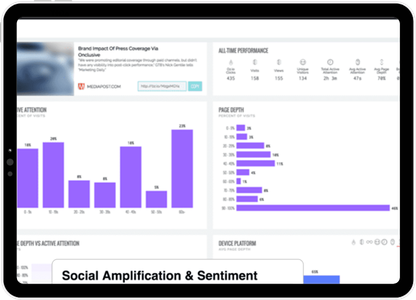
Done building your framework? Now automate it.
Onclusive Analytics automates your measurement framework so you can:
▪️Collect data consistently from 28+ million daily content pieces
▫️Set baselines and targets in customizable dashboards
▪️Move from outputs to outcomes with advanced metrics (share of voice, sentiment, message pull-through)
▫️Report results in minutes, not days
Tactical and strategic communications measurement
Onclusive’s insights consultants distinguish between two complementary levels of communications measurement.
Tactical measurement looks at campaign-level results: what you achieved, why, who you reached, and whether outcomes matched your targets. A useful approach is to separate PR-influenced coverage from coverage you did not influence, then compare the quality of each in terms of sentiment, targeting and message delivery. This shows how much of the conversation your team is actually shaping.
Strategic measurement tracks the longer-term narratives your organization wants to be known for. Consistently analyzing these narratives over time shows whether you are gaining meaningful traction against them, and ties communications directly to company-wide goals. In one five-year study Onclusive conducted for a telecoms organization, media sentiment toward the company closely tracked customer survey data on brand trust, showing how media analysis can ladder up to reputation and trust, not just campaign success.
As Onclusive’s Philip Lynch, SVP Global Insights & Consultancy, notes, the value of reactive work such as averting a crisis is usually visible and immediate, whereas the real objective of communications is building reputation, strength and resilience over time. Strategic communications measurement is what makes that slower, proactive value visible.
Communications measurement in the age of AI search
Communications measurement is now expanding to a new channel: AI-generated answers. When audiences ask ChatGPT, Gemini or other AI engines about your category, the answers draw on information that already exists about your brand, including news coverage, reviews and your own website.
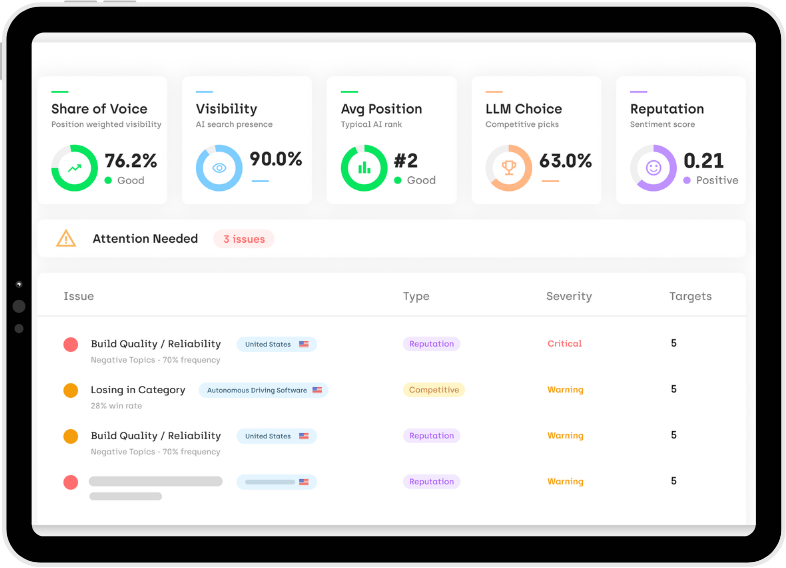
Onclusive GEO Analytics
AI Search Intelligence for PR, Comms & Marketing Teams
▪️Monitor AI visibility
▪️Diagnose competitive gaps
▪️Know exactly what to do next
In May 2026, AMEC published seven GEO (Generative Engine Optimization) Principles, the first industry framework for measuring AI search visibility. Among other things, they call for measurement built on a governed library of both branded and unbranded prompts, an emphasis on source quality over mention volume, results reported across multiple AI engines rather than collapsed into a single score, and a clear distinction between visibility and business impact. That last point echoes the same outputs-to-impact logic as the Integrated Evaluation Framework.
For PR teams, the message is clear: earned media and AI visibility are now closely connected, and AI measurement should sit alongside your earned and social data rather than in isolation. Read more in AI search optimization measurement just got a rulebook. Here’s what it means for comms.
Common communications measurement mistakes to avoid
- Focusing on vanity metrics. Impressions and reach look impressive but rarely prove impact on their own.
- Relying on AVEs. As the Barcelona Principles state, AVEs are not the value of communication.
- Not linking metrics to business outcomes. Every metric should answer the question “so what?”. If it cannot, it probably does not belong in your report.
- Inconsistent tracking. Changing methods mid-campaign makes it impossible to identify real trends.
- Ignoring qualitative context. A drop in mentions may be positive if sentiment and message pull-through improved. Analyze metrics together, not in isolation.
- Keeping measurement within the PR team. If colleagues outside communications do not understand how you define success, they cannot benefit from your data. Explaining your measurement approach is part of the job.
Choosing the right communications measurement partner
You do not need to figure out communications measurement alone. When evaluating tools and partners, look at the breadth and relevance of their media monitoring (print, broadcast, online, social, podcasts), their international and multilingual capabilities, their ability to connect communications to business results such as web traffic and conversions, and the level of strategic support they can provide to help you set goals and interpret data. Our article How to find the right PR measurement partner offers a full checklist of questions to ask.
Getting started with communications measurement
Communications measurement does not have to be complicated, but it does need to be intentional. Start by identifying your top business objective for the next quarter, select a handful of metrics that directly measure progress toward it, set a baseline, and schedule your first review. Use the AMEC Integrated Evaluation Framework as your guide to move from outputs toward outcomes and impact.
The PR teams that earn a seat at the decision-making table are those that can show, with credible data, how their work contributes to the organization’s goals. A solid communications measurement practice is how you get there.