





With AI in pharmaceutical drug development, the pharmaceutical industry stands at a pivotal crossroads where artificial intelligence (AI) and machine learning (ML) are no longer futuristic concepts but critical tools reshaping drug development pipelines. According to recent industry analysis, AI and ML for drug discovery represents one of the top challenges, and opportunities, facing pharmaceutical companies in 2026, with 9.3% of industry discussions focused on this transformative technology.
While supply chain diversification (25.1%) and sustainability initiatives (13.4%) dominate current pharmaceutical concerns, the integration of AI and ML technologies is rapidly accelerating, promising to revolutionize everything from regulatory compliance to personalized medicine.
Key Takeaways
AI is reshaping pharmaceutical development: From discovery to manufacturing, AI and ML are revolutionizing every stage of the drug development pipeline.
Regulatory support leads adoption: At 34.32% of discussions, AI’s ability to streamline regulatory processes and enhance safety represents its most discussed benefit.
Protein structure prediction is transformative: Technologies like AlphaFold (26.40% of discussions) enable unprecedented insights into drug targets and biological mechanisms.
Personalized medicine gains traction: AI-powered genomic analysis (14.87%) is making tailored therapies increasingly viable, particularly in oncology.
Industry leaders emerge: AstraZeneca, Pfizer, and Eli Lilly lead AI adoption with concrete achievements in drug discovery, clinical trials, and patient stratification.
AI addresses multiple challenges: While representing 9.3% of industry challenges, AI offers solutions to regulatory hurdles, talent shortages, and innovation demands.
Accessibility concerns persist: Despite tremendous promise, conversations acknowledge that AI benefits must extend beyond wealthy regions to achieve equitable healthcare outcomes.
AI in pharmaceutical drug development: Which companies?
Leading Companies Embracing AI
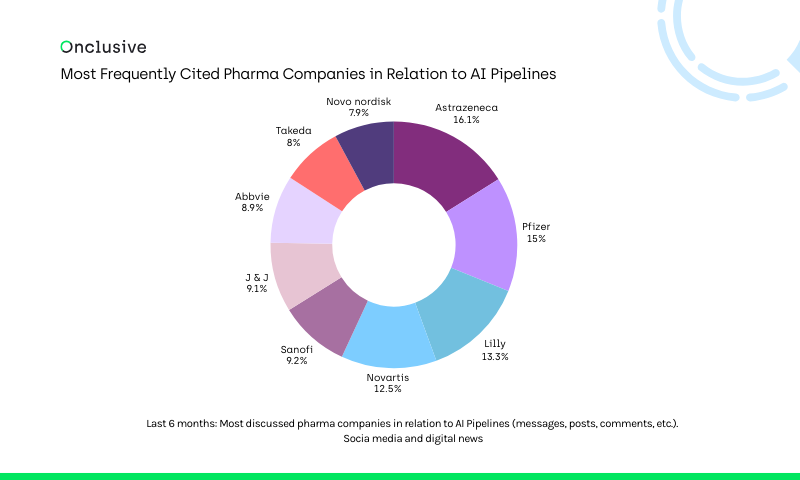
The adoption of AI by the pharmaceutical industry is not uniform, with some companies currently establishing themselves as leaders in terms of visibility in the media and on social media:
Top 3 AI-Forward Pharmaceutical Companies:
- AstraZeneca (16.1% of AI discussions) has significantly reduced drug discovery timelines through AI-powered target identification, enhanced precision medicine approaches in oncology using AI biomarker discovery, and implemented AI-driven manufacturing quality control systems.
- Pfizer (15%) accelerated COVID-19 vaccine and therapeutic development using AI models, reduced clinical trial recruitment time through AI-powered patient identification, and enhanced pharmacovigilance (drug safety monitoring) with natural language processing.
- Eli Lilly (13.3%) advanced AI models for predicting Alzheimer’s disease progression, accelerated diabetes drug discovery through computational biology, and improved clinical trial success rates through AI-powered patient stratification.
Key Applications Driving AI Adoption
1. Regulatory & Safety Support (34.32%)
AI tools like predictive modeling dominate conversations by dramatically reducing regulatory delays. FDA pilots have cut review times significantly, while discussions emphasize safety enhancements, though concerns about data bias persist.
Benefits:
- Faster regulatory approval processes
- Enhanced drug safety monitoring
- Reduced compliance costs
- Predictive risk assessment
2. Protein Structure Prediction (26.40%)
AlphaFold’s groundbreaking impact drives significant industry buzz, enabling rapid structure insights for drug targets. Social media highlights its role in biological revolutions, though users debate overreliance on computational models versus experimental validation.
Applications:
- Accelerated target identification
- Improved drug design accuracy
- Better understanding of disease mechanisms
- Reduced research and development timelines
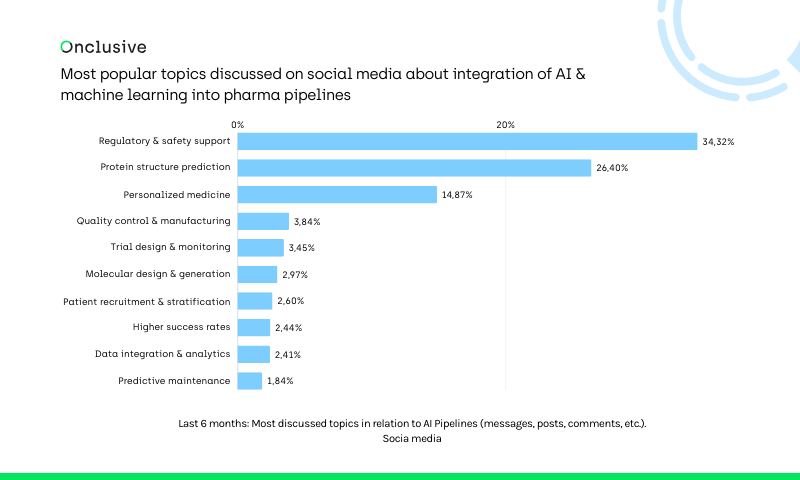
3. Personalized Medicine (14.87%)
AI’s ability to analyze genomics for tailored therapies fuels tremendous interest, with notable examples in oncology. However, conversations acknowledge accessibility gaps in low-income regions that must be addressed.
Advantages:
- Treatment customization based on genetic profiles
- Improved patient outcomes
- Reduced adverse drug reactions
- Optimized dosing strategies
4. Quality Control & Manufacturing (3.84%)
While lower in visibility, this specialized application sees AI optimizing batch production. Industry posts praise significant cost savings, though challenges include substantial infrastructure requirements.
5. Clinical Trial Design & Monitoring (3.45%)
AI enables more efficient trials through innovations like synthetic control arms, though discussions remain limited by validation concerns. Optimism exists for dramatically reducing trial timelines and improving patient recruitment accuracy.
Emerging AI in Pharmaceutical Drug Development Applications
Beyond the top applications, pharmaceutical companies are exploring AI for:
- Molecular Design & Generation (2.97%): Creating novel drug compounds
- Patient Recruitment & Stratification (2.60%): Identifying ideal trial candidates
- Data Integration & Analytics (2.41%): Synthesizing disparate research data
- Predictive Maintenance (1.84%): Optimizing manufacturing equipment
The Broader Context: AI in Pharmaceutical Drug development among Industry Challenges
While AI represents enormous opportunity, pharmaceutical companies face multiple competing priorities:
- Supply Chain Diversification (25.1%): Driven by patent expirations and geopolitical risks
- Sustainability & ESG (13.4%): Environmental regulations and stakeholder demands
- Cybersecurity Threats (11.7%): Protecting sensitive research and patient data
- Regulatory & Compliance Hurdles (8.2%): Navigating complex global requirements
- Talent Shortages (6.5%): Attracting AI specialists and data scientists
Successful pharmaceutical companies must balance AI investment with these other critical concerns while developing comprehensive digital transformation strategies.
Want to understand how AI in pharmaceutical drug development is evolving in your sector? Download our complete “Pharmaceutical Industry Scan 2025” report for detailed analysis of trends, misinformation and strategic recommendations. Download the Full Report →
The Path Forward
The pharmaceutical industry’s AI adoption trajectory appears clear: companies investing strategically in AI and ML technologies today will likely dominate tomorrow’s competitive landscape. However, success requires:
- Strategic Investment: Balancing AI initiatives with other business priorities
- Talent Acquisition: Building teams with AI, data science, and pharmaceutical expertise
- Ethical Frameworks: Addressing bias, transparency, and accessibility concerns
- Collaborative Approaches: Partnering with tech companies and academic institutions
- Regulatory Engagement: Working with authorities to establish appropriate AI governance
Conclusion for AI in pharmaceutical drug development
The integration of AI and machine learning into pharmaceutical pipelines represents one of the most significant technological shifts in modern healthcare. As demonstrated by industry leaders like AstraZeneca, Pfizer, and Eli Lilly, AI offers concrete benefits across the entire drug development lifecycle, from target identification to regulatory approval to manufacturing optimization.
While challenges remain around data bias, infrastructure requirements, and equitable access, the trajectory is clear: AI will increasingly define competitive advantage in the pharmaceutical industry. Companies that invest strategically in AI capabilities today, while addressing ethical concerns and building appropriate talent, will be best positioned to deliver breakthrough therapies efficiently and affordably.
The question is no longer whether AI will transform pharmaceutical development, but how quickly companies can adapt to harness its full potential while ensuring these powerful technologies serve all patients equitably.
This analysis is based on sector data provided by media intelligence company Onclusive, covering December 2024 to October 2025, reflecting the latest trends in AI adoption in the pharmaceutical sector and social media discussions about innovation in drug development. Onclusive, through its media and social media monitoring, integrates data from traditional media and social media (social networks, blogs, forums)
Frequently Asked Questions (FAQ) for AI in pharmaceutical drug development
Q1: How is AI specifically used in pharmaceutical drug development?
A: AI is used across the entire pharmaceutical pipeline: identifying drug targets, predicting protein structures, designing molecular compounds, optimizing clinical trial design, recruiting appropriate patients, monitoring drug safety, streamlining regulatory submissions, and improving manufacturing quality control. These applications significantly reduce timelines and costs while improving success rates.
Q2: Which pharmaceutical companies are leading in AI adoption?
A: According to 2025-2026 industry analysis, AstraZeneca leads with 16.1% of AI-related discussions, followed by Pfizer (15%) and Eli Lilly (13.3%). Novartis (12.5%), Sanofi (9.2%), Johnson & Johnson (9.1%), AbbVie (8.9%), Takeda (8%), and Novo Nordisk (7.9%) also show significant AI engagement.
Q3: What is the biggest benefit of AI in pharmaceutical drug development?
A: The most discussed benefit (34.32% of conversations) is regulatory and safety support. AI tools dramatically reduce regulatory approval delays through predictive modeling, while enhancing drug safety monitoring and pharmacovigilance. This addresses one of pharma’s most significant bottlenecks, the lengthy, costly regulatory process.
Q4: How does AI in pharmaceutical drug development help with personalized medicine?
A: AI analyzes vast genomic datasets to identify genetic markers that predict drug response, allowing physicians to tailor treatments to individual patients. This is particularly impactful in oncology, where AI helps match patients with therapies most likely to succeed based on their tumor’s genetic profile, improving outcomes while reducing adverse reactions.
Q5: What is AlphaFold and why is it important for pharma?
A: AlphaFold is an AI system that predicts three-dimensional protein structures from amino acid sequences. This is revolutionary for pharma because understanding protein structure is critical for drug design. AlphaFold enables researchers to rapidly identify drug targets and design molecules that interact with specific proteins, dramatically accelerating early-stage drug discovery.
Q6: What are the challenges of implementing AI in pharmaceutical companies?
A: Key challenges include: data bias concerns that could affect safety, substantial infrastructure requirements for computing power and data storage, validation needs to ensure AI predictions translate to real-world efficacy, talent shortages in AI and data science, regulatory uncertainty around AI-designed drugs, and accessibility gaps that may widen healthcare disparities.
Q7: How much faster does AI make drug development?
A: While timelines vary by application, leading companies report significant improvements: AstraZeneca has “significantly reduced” drug discovery timelines through AI-powered target identification, Pfizer reduced clinical trial recruitment time through AI patient identification, and FDA pilots using AI have dramatically cut regulatory review times. Some estimates suggest AI could reduce overall development time by 30-50%.
Q8: Will AI replace pharmaceutical researchers?
A: No, AI in pharmaceutical drug development augments rather than replaces human researchers. AI excels at analyzing massive datasets, identifying patterns, and predicting outcomes, but human expertise remains essential for experimental design, interpreting results in clinical context, making ethical decisions, and navigating complex regulatory environments. The future lies in human-AI collaboration.
Q9: How does AI improve clinical trial success rates?
A: AI in pharmaceutical durg development improves trial success through better patient stratification (identifying participants most likely to respond), predictive modeling of outcomes, optimized trial design (including synthetic control arms), enhanced safety monitoring, and more efficient patient recruitment. Eli Lilly specifically reports improved clinical trial success rates through AI-powered patient stratification.
Q10: What role does AI play in pharmaceutical manufacturing?
A: AI optimizes manufacturing through quality control systems that detect defects, predictive maintenance that prevents equipment failures, batch optimization for improved yields, supply chain management, and compliance monitoring. AstraZeneca has notably implemented AI-driven manufacturing quality control systems, while discussions highlight significant cost savings potential in this area. Lab featured image (cover) was created by a generative AI tool for illustrative purposes