





Updated: February 2026
What is broadcast media monitoring?
Broadcast media monitoring is the process of tracking, recording, and analyzing mentions of your brand, competitors, or industry topics across television, radio channels, and increasingly podcasts. Using advanced speech-to-text technology, broadcast monitoring tools capture live content as it airs, transcribe the audio, and make it searchable so you can quickly identify relevant coverage.
For most organizations, this means monitoring major national networks such as CNN, NBC, ABC, CBS, and Fox News, alongside regional television stations, radio broadcasters, and syndicated programs across multiple markets.
While digital media dominates many daily interactions, broadcast media continues to shape national and international narratives. Missing a TV or radio mention can mean missing a critical moment that influences public perception well beyond the original audience.
Why broadcast media monitoring matters for U.S. businesses
Despite the continued growth of digital and social media, broadcast remains a significant source of news and influence. According to Pew Research Center, in 2025 more Americans prefer to watch the news than read or listen to it — highlighting that television retains strong audience demand in a multi-platform media environment.
At the same time, Nielsen reported that streaming has overtaken traditional broadcast and cable combined in total viewing share. This shift does not lessen the importance of broadcast monitoring — it expands it. Today, broadcast content increasingly appears across live TV, network streaming platforms, and on-demand services, making visibility across all formats more crucial than ever.
These audience patterns are not unique to the United States. Across global markets, broadcast media continues to play a central role in breaking news, crisis coverage, and high-trust storytelling that influences public perception and consumer behavior.
For PR and communications teams, broadcast monitoring delivers three critical benefits.
First, it enables rapid crisis detection and response. A negative mention on a national morning show or prime-time news segment can reach millions within minutes. Early awareness allows teams to respond before narratives harden and spread across online and social channels.
Second, broadcast coverage carries a level of credibility few other channels can match. Broadcast journalism operates under established editorial standards and regulatory oversight, which gives TV and radio mentions greater authority than many digital-only sources.
Third, broadcast monitoring provides competitive intelligence. Tracking how competitors appear in interviews, expert panels, and broadcast commentary helps identify emerging themes, messaging gaps, and opportunities to strengthen your media strategy.
Key features to look for in broadcast monitoring tools
Not all broadcast monitoring solutions are created equal. When evaluating tools, prioritize these essential features:
Real-time alerts
Real-time alerts notify you the moment your brand is mentioned on air. In crisis situations, every minute counts, and instant notifications allow your team to respond quickly to both threats and opportunities. Look for tools that deliver alerts via email, SMS, or integrated platforms so you can act immediately.
Sentiment analysis
Sentiment analysis uses AI to evaluate whether broadcast mentions are positive, negative, or neutral. This goes beyond simply counting mentions. It helps you understand the tone and context of the coverage. A single negative segment on national television can have more impact than dozens of neutral online articles, so sentiment tracking is essential for accurate reputation management.
Multi-channel coverage
Effective broadcast monitoring spans television, radio, and podcasts. This includes national broadcasters, regional and local stations, and public radio networks such as NPR, alongside rapidly growing on-demand audio content. Global organizations should ensure coverage extends across all priority markets where they operate.
Reporting and analytics
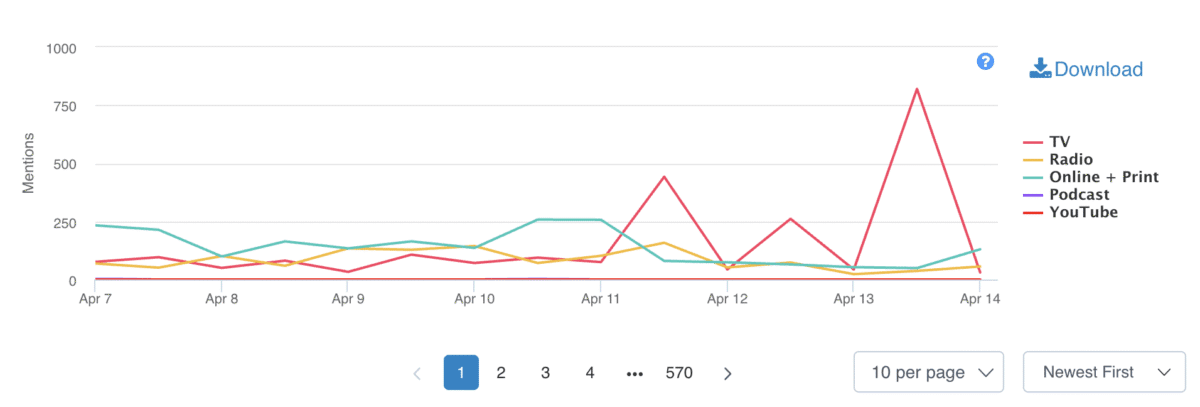
Reporting and analytics transform raw data into actionable insights. Look for platforms that offer customizable reports showing reach metrics, share of voice comparisons, and sentiment trends over time. These reports should integrate with your broader media monitoring efforts across print, online, and social channels.
Integration capabilities
Integration capabilities allow broadcast data to flow into your wider PR and communications workflows. The most effective monitoring strategies connect broadcast coverage with online, print, and social media monitoring to create a comprehensive view of your media presence.
Licensing and compliance
Broadcast monitoring involves copyright, rebroadcast, and content-usage considerations that vary by market. In the US, broadcast standards are shaped by bodies such as the Federal Communications Commission, while other regions operate under their own regulatory frameworks. A reliable monitoring provider manages licensing and compliance across markets so teams can use clips and transcripts confidently and legally.
How broadcast monitoring differs from online and social monitoring
While all media monitoring shares common goals, broadcast monitoring presents unique characteristics that set it apart from digital channels.
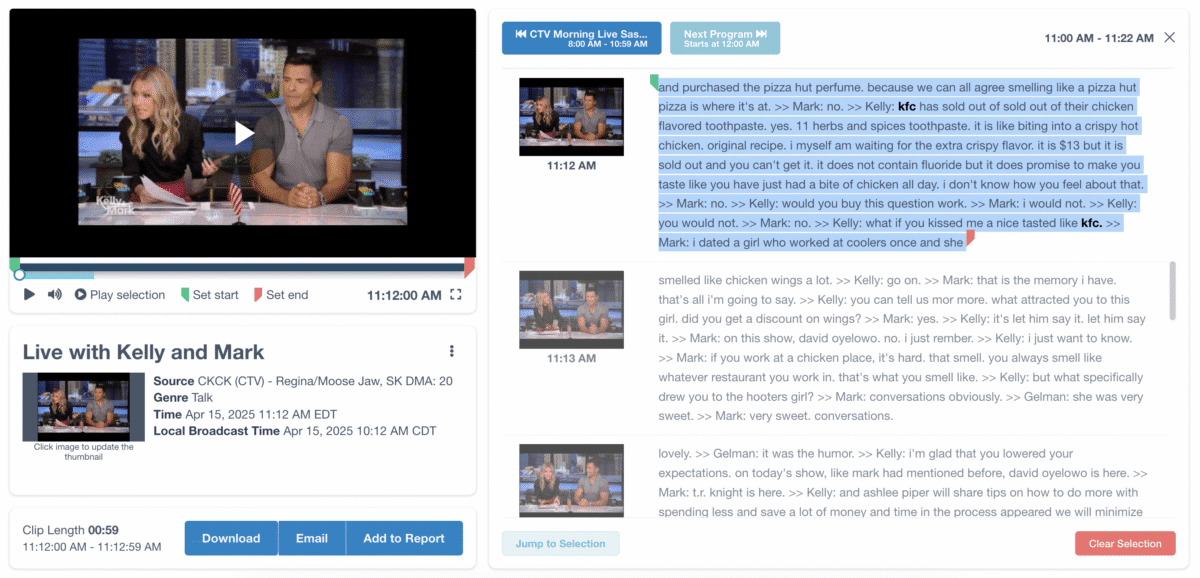
The fundamental difference lies in content format. Broadcast content is audio and visual, requiring speech-to-text transcription before it becomes searchable. Online and social content arrives as text, making it immediately searchable. This technical distinction affects both the speed and accuracy of monitoring.
Editorial standards also differ significantly. Broadcast journalism typically operates under established editorial guidelines and regulatory oversight, which places higher emphasis on accuracy, accountability, and verification. As a result, broadcast mentions often carry more weight with audiences than social media posts or user-generated content. A mention on national television news generally holds more credibility than a widely shared post, even if that post reaches a large audience.
Audience reach and trust dynamics vary too. Broadcast reaches millions simultaneously during live transmission, creating shared cultural moments that social media rarely replicates. When a brand is mentioned on prime-time television, the impact is immediate and widespread.
However, these channels work best as complementary approaches rather than competing alternatives. Effective media monitoring integrates broadcast with online and social listening to provide complete coverage of your brand’s media footprint.
Measuring ROI from broadcast coverage
Demonstrating the value of broadcast monitoring requires clear metrics that connect media coverage to business outcomes.
Audience reach metrics
Start with audience reach metrics. Broadcast monitoring tools typically provide viewing or listening figures for each mention, showing you how many people were potentially exposed to your coverage. These numbers help quantify the visibility your brand achieved.
Sentiment tracking
Sentiment tracking over time reveals whether your broadcast reputation is improving or declining. By monitoring sentiment trends across weeks and months, you can assess whether your PR strategies are working and identify when reputation issues emerge.
Share of voice
Share of voice analysis compares your broadcast presence to competitors. If your competitors are securing more positive broadcast coverage, you’ll need to adjust your media strategy. Conversely, strong share of voice indicates your PR efforts are succeeding.
Connect to business outcomes
Finally, connect broadcast mentions to business outcomes where possible. Track website traffic spikes following broadcast appearances, monitor social media engagement after TV mentions, or survey customers about how they heard about your brand. These connections help prove the commercial value of broadcast monitoring.
Choosing the right broadcast monitoring service
Selecting a broadcast monitoring provider requires careful evaluation of your specific needs and budget.
Step 1: Assess coverage requirements
Begin by assessing your coverage requirements. Do you need national monitoring only, or must you track regional broadcasters too? If your business operates across multiple regions or countries, comprehensive geographical coverage becomes essential. Consider whether podcast monitoring matters for your industry, as this emerging channel is increasingly relevant for many brands.
Step 2: Evaluate pricing
Evaluate pricing transparency early in your research. Broadcast media monitoring services vary significantly in cost depending on the number of channels covered, the geographical scope, and the features included. Understanding pricing structures upfront helps you make informed decisions.
Look for providers that offer scalable solutions. Your monitoring needs may grow as your business expands into new markets or as your media presence increases. Choose a service that can adapt to your changing requirements without requiring you to switch providers.
Step 3: Customer support quality
Finally, consider the quality of customer support and training. Broadcast monitoring tools are only valuable if your team knows how to use them effectively. Providers that offer comprehensive onboarding, ongoing training, and responsive support help you maximize the return on your investment.
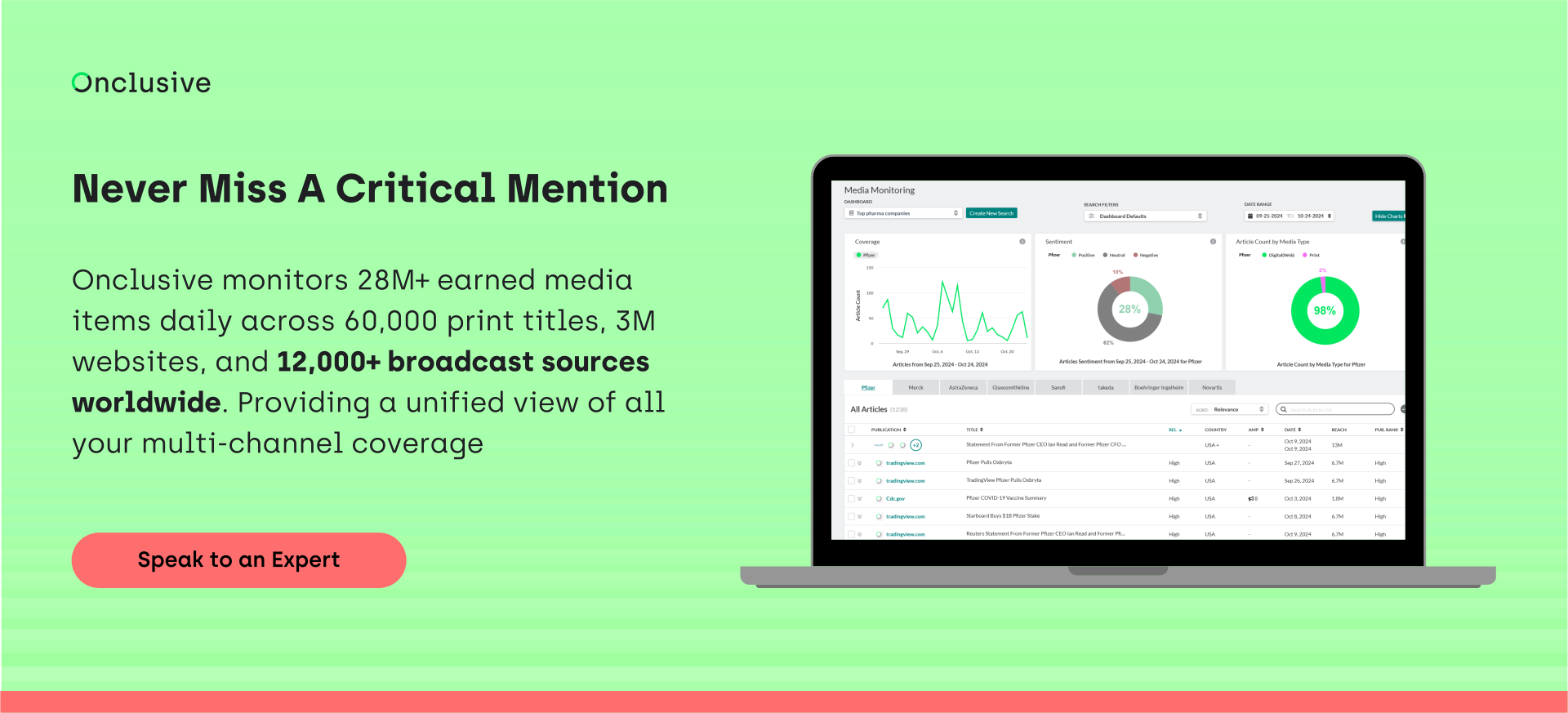
Ready to enhance your media monitoring strategy with broadcast coverage? Understanding what’s being said about your brand across TV and radio channels gives you the complete picture you need to protect your reputation and seize opportunities as they arise. Find out more.
Frequently asked questions about broadcast media monitoring
What is broadcast media monitoring?
Broadcast media monitoring is the systematic tracking and analysis of mentions of your brand, products, or industry topics across television and radio channels. The process uses speech-to-text technology to transcribe broadcast content in real-time, making audio and video mentions searchable and analyzable. This allows organizations to track their media presence, understand public sentiment, and respond quickly to both opportunities and reputation threats.
Why is broadcast monitoring important for PR and communications?
Broadcast monitoring is critical for PR professionals because TV and radio coverage reaches millions of viewers and listeners simultaneously, often with higher credibility than digital sources. It enables rapid crisis detection, allowing teams to respond to negative coverage within minutes rather than hours. Broadcast monitoring also provides competitive intelligence, helps measure campaign effectiveness, and demonstrates PR ROI through concrete reach and sentiment metrics. Given that broadcast media still commands significant audience trust and attention, missing TV or radio mentions can mean missing crucial moments that shape public perception of your brand.
How does broadcast monitoring work technically?
Broadcast monitoring systems record live TV and radio broadcasts from multiple channels simultaneously. Advanced speech-to-text technology transcribes the audio in near real-time, converting spoken words into searchable text. AI algorithms then scan this text for specific keywords, brand names, or topics you’ve configured. When a match is found, the system captures the relevant segment, analyzes the sentiment and context, and sends alerts to your team. The recorded clips and transcripts are stored in a searchable database, allowing you to review coverage, generate reports, and track trends over time.
What features should I look for in a broadcast monitoring tool?
Essential features include real-time alerts that notify you immediately when your brand is mentioned, comprehensive channel coverage spanning national and regional broadcasters, accurate speech-to-text transcription, AI-powered sentiment analysis to gauge tone, customizable reporting and analytics, and integration capabilities with your existing PR and communications tools. Because broadcast monitoring involves copyrighted audio and video content, it’s important to ensure your provider manages licensing, rebroadcast rights, and content usage requirements across all relevant markets. A reliable provider handles these compliance considerations on your behalf, allowing teams to use clips and transcripts confidently and legally.
How much does broadcast monitoring cost?
Broadcast monitoring costs vary significantly based on coverage scope, number of channels monitored, geographical reach, and features included. Basic packages monitoring a limited number of national channels might start at a few hundred dollars per month, while comprehensive solutions covering national, regional, and international broadcasts with advanced analytics can cost several thousand dollars monthly. Many providers offer tiered pricing based on your specific needs. Enterprise solutions with custom coverage, dedicated support, and extensive historical archives typically require custom quotes. When evaluating costs, consider the potential value of catching a crisis early or measuring the ROI of major broadcast placements.
Can broadcast monitoring track podcast mentions?
Yes, many modern broadcast monitoring platforms now include podcast monitoring capabilities. Podcasts are increasingly treated as part of broadcast monitoring because they use similar audio-based technology requiring speech-to-text transcription. However, podcast monitoring presents unique challenges compared to traditional broadcast: the sheer volume of podcast content, varying audio quality, and the decentralized nature of podcast distribution. When evaluating tools, specifically ask about podcast coverage scope, transcription accuracy for podcast audio, and whether pricing includes podcast monitoring or if it’s a separate add-on.
How is broadcast monitoring different from social media monitoring?
Broadcast monitoring and social media monitoring differ fundamentally in content type, credibility, and technical requirements. Broadcast content requires speech-to-text transcription before analysis, while social media content is already text-based. Broadcast media adheres to strict editorial standards and regulatory requirements, giving it higher credibility with audiences than user-generated social content. Broadcast reaches audiences simultaneously during live transmission, creating shared cultural moments, while social media consumption is asynchronous and fragmented. However, both are complementary: effective media monitoring strategies integrate broadcast, social, online, and print coverage to provide a complete view of your brand’s media presence.
What is the difference between linear TV and on-demand broadcast monitoring?
Linear TV refers to traditional live television broadcasts that air at scheduled times, while on-demand includes catch-up and streaming services such as Hulu, network apps, and broadcaster-owned platforms where viewers watch previously aired content. Broadcast monitoring tools typically capture both: they record linear broadcasts in real-time and also monitor on-demand platforms where that content is later available. This distinction matters because viewing patterns are shifting—while linear TV viewership is declining, particularly among younger audiences, on-demand viewing of broadcast content is growing. Comprehensive broadcast monitoring should cover both to capture your complete TV presence.