





By the time a crisis makes the news, the most important work has usually already failed. The brands that navigate a crisis well aren’t necessarily the ones with the best statement; they’re the ones who saw it coming early enough to have a statement ready at all.
Key takeaways
- Crisis management is the full discipline of preparing for, responding to, and recovering from a reputational threat; detection is the specific piece that technology can genuinely transform.
- Most crises escalate through a recognizable pattern, low-visibility complaint, forum or aggregator pickup, mainstream coverage, and each stage is a window for early intervention.
- Media monitoring and social listening catch different signals: monitoring flags shifts in news coverage, listening catches conversations building on social media before they reach the press.
- Detection only helps if it’s connected to a real response process, with agreed thresholds and clear ownership decided before a crisis, not during one.
What is crisis management?
Crisis management is the discipline of preparing for, responding to, and recovering from events that threaten an organization’s reputation, operations, or relationships with the people who matter to it: customers, employees, investors, regulators, and the public. It spans everything from the response plan itself to the post-crisis analysis of what worked and what didn’t.
It’s a broad discipline, closely related to but distinct from crisis communications, which focuses specifically on messaging and stakeholder trust. No single tool “manages” a crisis end to end . That takes leadership judgment, legal input, and often a fair amount of improvisation once things are moving fast. But there’s one part of the discipline that technology has genuinely transformed: detection. Knowing something is building before it becomes a full-blown story is the single biggest advantage a comms team can have.
Why early crisis detection matters more than a perfect response
Crises rarely appear from nowhere. Most escalate through a recognizable pattern: a complaint or comment surfaces somewhere low-visibility, gains a little traction, gets picked up by an aggregator or forum, and only then reaches mainstream media or goes broadly viral. Each stage of that escalation is a window where a well-prepared team can intervene: correcting misinformation, engaging directly, or simply being ready with an accurate, considered statement before a journalist calls.
Teams that only start paying attention once a story is already trending have lost that window. What looks like a fast, capable crisis response in hindsight is very often the result of a team that had days, not minutes, of warning.
The role of media monitoring in crisis detection
Media monitoring tracks mentions of your brand, executives, and key issues across news outlets, broadcast, and online publications, flagging spikes in volume or shifts in tone before they become impossible to ignore. A sudden increase in coverage volume, a shift from neutral to negative sentiment, or unusual coverage in an outlet you don’t normally appear in are all early signals worth investigating immediately, not at the next weekly reporting cycle.
The role of social listening in crisis detection
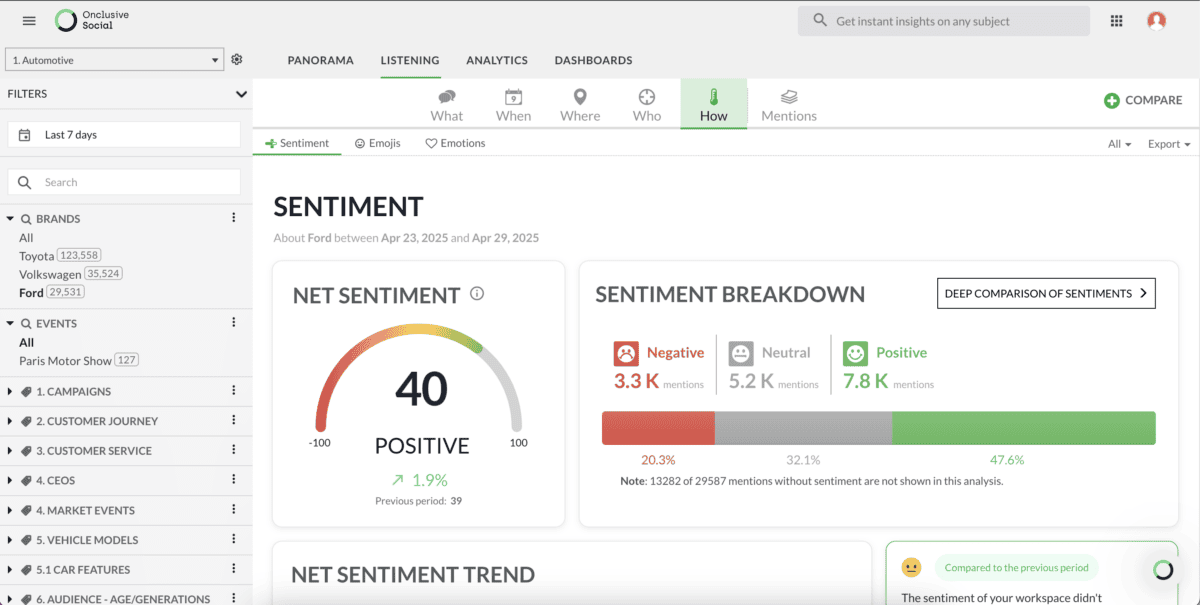
Many crises start on social media or in online forums long before they reach traditional press, be it a customer complaint that gains traction, a leaked internal document, an employee post that goes further than intended. Social listening tracks these conversations as they build, giving comms teams visibility into issues that haven’t yet crossed into “news” but are already shaping public perception.
This matters because the traditional media cycle is often the last stage of a crisis narrative. By the time a story is in the news, the online conversation shaping it has usually been running for hours or days. Listening to that earlier stage is what turns crisis “management” into crisis prevention, at least some of the time. Our case study, How Social Listening Helped Anticipate and Mitigate Crisis Risks at Eurovision, shows this in practice.
Building a detection-first crisis approach
- Set up monitoring before you need it. Waiting until a crisis is underway to configure alerts and keyword tracking means losing the early-warning window entirely. Baseline monitoring should already be running for your brand, executives, products, and known risk areas. For a more detailed breakdown of how to put this into practice, see our guide, Get Ahead of a PR Crisis: 7 Social Listening Best Practices.
- Define what “early” actually looks like for your organization. Agree in advance on the volume and sentiment thresholds that should trigger internal escalation, so the team isn’t debating definitions while a situation is actively unfolding.
- Connect detection to a real response process. Early warning is only useful if it triggers a clear next step — who gets notified, who has authority to respond, and how quickly a holding statement can go out.
- Review near-misses, not just full-blown crises. Some of the most valuable lessons come from situations that were caught early and never escalated. Reviewing what worked in those cases sharpens the detection process for next time.
What a modern communications crisis strategy looks like
The organizations that handle crises well treat detection as infrastructure, not a reactive scramble. That means integrated monitoring across media and social channels, clear internal escalation paths, and, critically, a team that reviews near-misses as seriously as actual incidents, so the detection process keeps improving even when nothing goes wrong.
How Onclusive supports crisis detection
Onclusive is not a crisis management platform. It will not write your statement or decide your response. That work still belongs to your comms and leadership team.
What Onclusive does is give you the earliest possible warning that something is building, and it does that differently depending on what your team is trying to protect.
For PR and comms teams
Media and social monitoring is built for the signals that matter most once a story starts moving through the press. It tracks mentions of your brand, executives, and key issues across news outlets, broadcast, and online publications, flagging a sudden spike in coverage volume, a shift from neutral to negative sentiment, or coverage appearing in an outlet you don’t normally see. For a comms team, these are the early signs that a narrative is forming in the media, often before anyone has briefed a spokesperson or drafted a line to take.
For marketing teams
Social listening is built for the earlier stage, the conversations building on social media and in forums before a story reaches the press at all. A complaint gaining traction, a leaked document circulating, an employee post spreading further than intended. Marketing teams are often the first to see this kind of signal, since they’re already watching social channels for brand and campaign performance. Catching it here, before it becomes a media story, gives the wider organization time to prepare instead of react.
Used together, these two platforms mean nothing catches your organization off guard. PR and comms see it moving through the press. Marketing sees it building before it gets there. That gap between forming and noticing is where every well-prepared response actually gets won.