





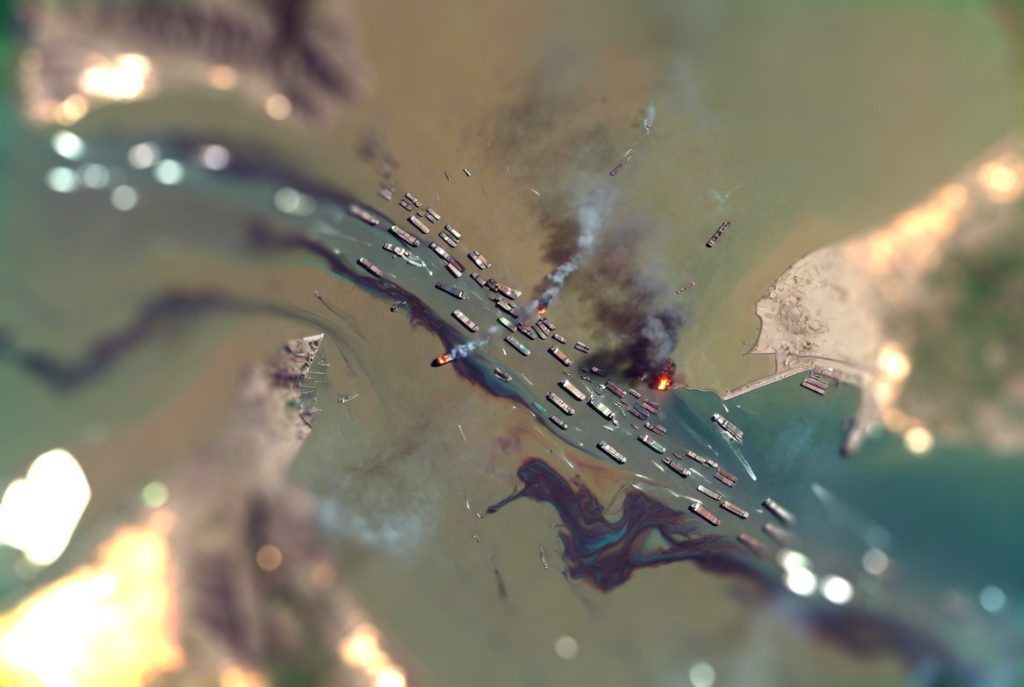
There are before-and-after moments in every industry’s communications history. For global energy, February 28, 2026 is one of them.
In the world of energy sector communications, timing is everything. In less than 72 hours, a series of US-Israeli strikes on Iranian infrastructure transformed the global energy media landscape more dramatically than any single event since Russia’s invasion of Ukraine in February 2022. Oil prices broke records. Supply routes came under threat. Boardrooms across the energy sector scrambled not just to manage operations, but to manage narratives – often without a playbook adequate to the moment.
Onclusive’s new Energy Report tracks exactly what happened, what was said, who said it, and crucially, what was left unsaid. This post walks you through the key moments of that crisis window, the media dynamics it unleashed, and the communications lessons every energy professional needs to absorb.
Download the Onclusive Energy Report to access the full data, the media intelligence methodology, and the complete narrative mapping from the February 28 crisis window.
I. The 72-hour timeline: how a strike became a media storm
II.The March 19 inflection point: when energy owned the conflict story
III. What energy companies said – and what they deliberately didn’t
IV. Four narratives, four challenges
V. What crisis communicators can learn from 72 hours of data
VI. Why this matters for every energy sector communications team
FAQ
I. The 72-hour timeline: how a strike became a media storm
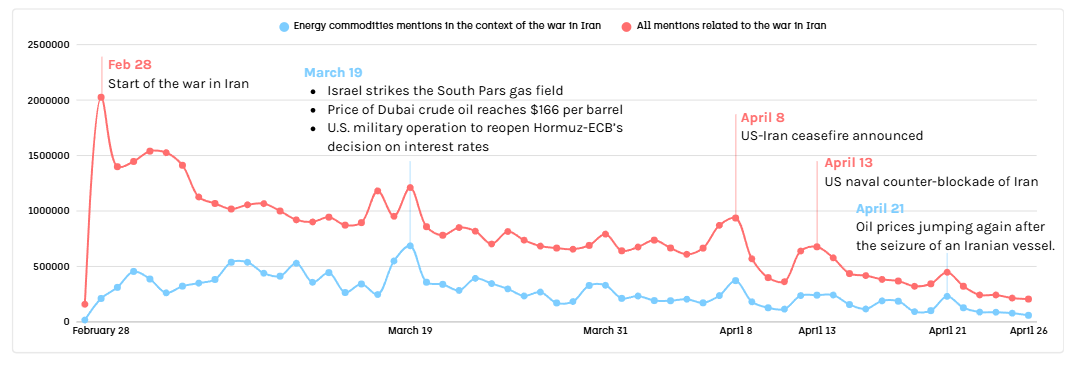
The 72-Hour timeline that redefined the energy sector communications
Day one – February 28: the trigger
At the centre of the crisis was a targeted strike on South Pars, the world’s largest natural gas field, straddling the maritime border between Iran and Qatar. The geopolitical implications were immediate, but the energy market reaction was faster still.
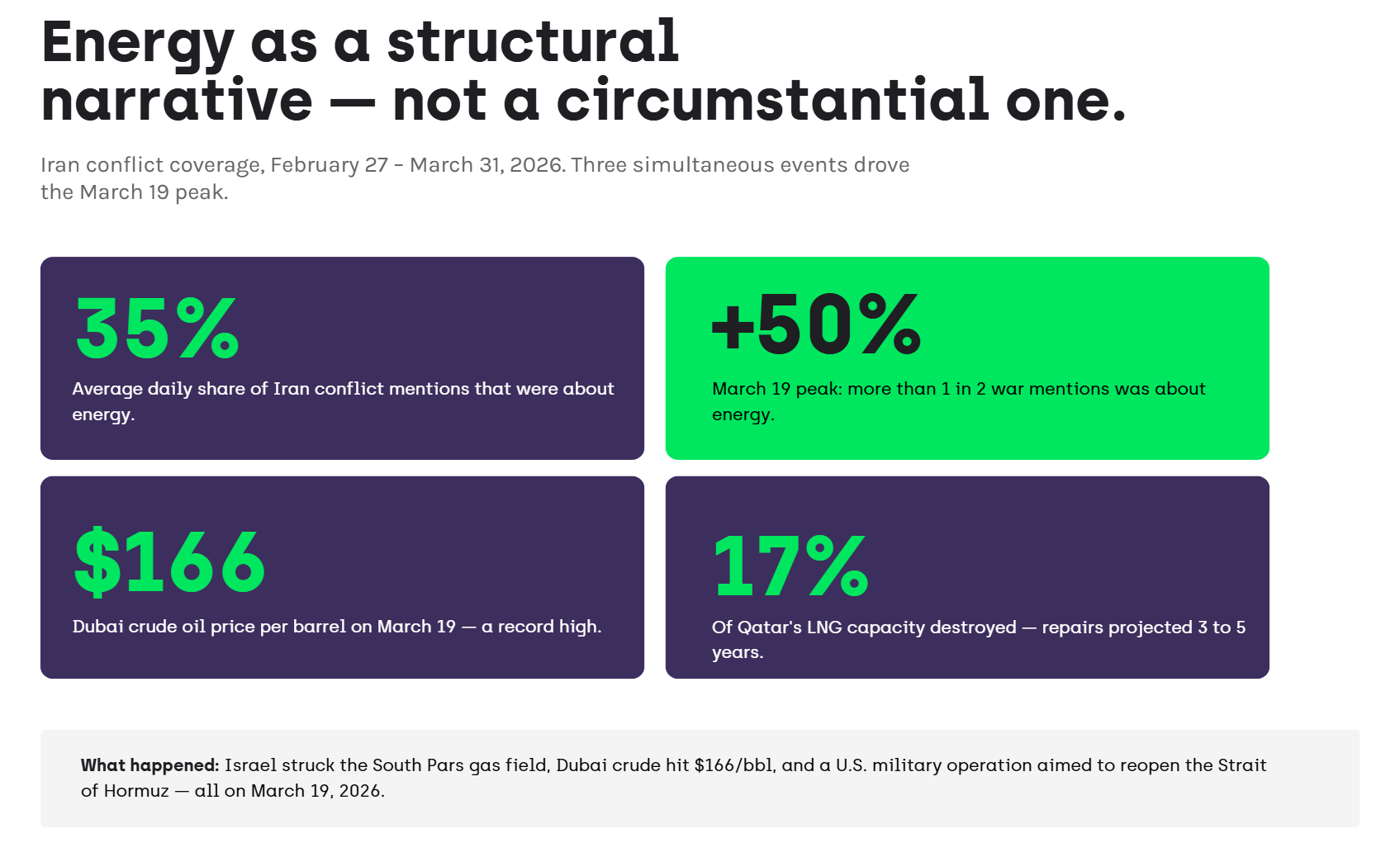
Within hours of the first confirmed reports, Brent crude surged to $166 per barrel, a record-breaking price that shattered previous highs and instantly dominated financial news cycles globally. This was not merely a commodity price story – it became a story about energy security, geopolitical risk, supply chain fragility, and the economic exposure of every nation dependent on Middle Eastern hydrocarbons.
The media volume spike was instantaneous. Onclusive’s monitoring data recorded an extraordinary compression of news cycles: stories that would normally develop over days were breaking, pivoting, and updating within minutes. Energy editors, financial desks, and foreign correspondents were all chasing the same story simultaneously, with the same gaps in verified information.
Day two – the Strait of Hormuz variable
The second critical development came with reports of disruptions to navigation in the Strait of Hormuz – the narrow chokepoint through which approximately 20% of the world’s traded oil passes. A closure, even a partial or temporary one, transforms an energy crisis into a civilisational logistics problem.
The Hormuz dimension multiplied media complexity considerably. Now the story was no longer just about one country’s production capacity. It was about tanker routing, insurance markets, LNG delivery schedules, and the energy security posture of importing nations across Europe and Asia. Energy sector communications teams were suddenly navigating a multi-front media environment with very few settled facts to work with.
Day three and beyond – the narrative crystallises
By March, four dominant narratives had crystallised across global media coverage of the conflict’s energy dimensions, each placing energy companies in a different and often contradictory light:
- Windfall profits – the story of oil majors benefiting from crisis-driven price surges
- Operational disruptions – coverage of supply chain impacts, tanker re-routing, and production adjustments
- Geopolitical exposure – analysis of which companies had the most at risk from continued regional instability
- Accelerated transition – commentary arguing the crisis strengthened the case for renewable energy independence
These four narratives did not compete equally. They competed simultaneously, meaning that any single corporate communication could be framed through any one of them depending on the outlet, the audience, and the political moment.
II.The March 19 inflection point: when energy owned the conflict story
One of the most striking findings in Onclusive’s Energy Report is what happened to media coverage of the Iran conflict on March 19, 2026.
On that date, fully 50% of all media coverage related to the Iran conflict was energy-focused. Not geopolitical analysis, not military reporting, not diplomatic commentary – energy. Supply, price, infrastructure, and corporate response dominated the conversation about a major international security event.
This is a remarkable data point for communications professionals, and it carries a specific implication: in modern geopolitical crises, energy companies are not secondary actors in the media story. They are central characters. Their statements – or their silence – become primary source material for journalists, analysts, and policymakers trying to make sense of what is happening and what comes next.
For PR and communications teams at energy firms, this means that crisis preparedness can no longer be defined purely in operational terms. It must include a media intelligence dimension: knowing when your organisation will become central to a narrative you did not initiate.
III. What energy companies said – and what they deliberately didn’t
One of the most analytically valuable sections of the Onclusive Energy Report examines corporate communications behaviour during the crisis window. The patterns are revealing.
Force-majeure notices: the communication that mattered most
The single most impactful category of corporate communication during the crisis was not the press release. It was not the CEO statement. It was the force-majeure notice.
Force-majeure declarations – formally notifying counterparties of contractual non-performance due to extraordinary events beyond the company’s control – became the dominant signal that markets, journalists, and institutional stakeholders tracked most closely. Why? Because they were specific, legally binding, and operationally truthful in a way that broader public communications often were not.
When a company issued a force-majeure notice, it was communicating something concrete about its actual situation. When it issued a press release expressing “deep concern” about the regional situation, it was communicating something far less useful to anyone trying to understand real exposure.
The lesson for communications teams is pointed: in a commodity crisis, legal and operational disclosures frequently carry more reputational and informational weight than anything the PR function produces. Integrating force-majeure timing into broader communications strategy is not a legal detail – it is a crisis communications priority.
In energy sector communications, this restraint proved strategic. Force-majeure notices carried far more weight than polished press releases in volatile commodity markets.
IV. Four narratives, four challenges
Understanding how Onclusive’s Energy Report maps the four dominant narratives helps communications teams diagnose their own exposure in real time.
Windfall profits: the most politically toxic frame
The surge to $166/barrel placed every publicly traded energy company in an immediate reputational bind. Record prices mean record revenues, and record revenues in a crisis invite record scrutiny. The windfall profits narrative activated political pressure across multiple jurisdictions simultaneously – windfall tax proposals, shareholder pressure, and populist media coverage converged in ways that required careful navigation.
Companies that responded with purely financial framing (“strong results reflecting market conditions”) fared worse in media sentiment analysis than those that anchored their communications in operational context and energy security contribution.
Operational disruptions: the credibility opportunity
Coverage of supply chain impacts – tanker diversions, delivery delays, production adjustments – represented an opportunity as much as a threat for companies willing to engage substantively. Outlets covering this narrative were looking for operational expertise, not corporate spin. Companies that provided clear, factual updates about their logistics situation built credibility with specialist media that has lasting value beyond the crisis window.
Geopolitical exposure: the investor relations pressure point
Analysis of corporate exposure to Iranian or Hormuz-adjacent operations drove significant investor relations activity during the crisis. Onclusive’s monitoring identified a clear correlation between geopolitical exposure coverage and share price volatility in the crisis window – and a secondary correlation between proactive investor communications and reduced volatility.
Companies that got ahead of the exposure story with concrete information fared measurably better than those who waited for analyst questions to force disclosure.
Accelerated transition: the longer narrative arc
The fourth narrative – energy transition – operated on a different timescale to the others. Commentators and advocacy groups used the crisis to amplify arguments for domestic renewable production and reduced dependence on Middle Eastern hydrocarbons. While this narrative had less immediate commercial pressure attached to it, it shaped the medium-term reputational context for every major energy company’s climate positioning.
V. What crisis communicators can learn from 72 hours of data
Onclusive’s Energy Report is, at its core, a media intelligence document. It does not offer opinion on the geopolitics of the conflict. What it does offer is a granular, data-grounded analysis of how the crisis moved through the media ecosystem, and what that movement reveals about best-in-class crisis communications practice.
Four clear lessons can be drawn from the management of energy sector communications:
- Media peaks are predictable if you’re monitoring correctly
The March 19 peak – the moment when energy content reached 50% of all Iran conflict coverage – did not emerge without warning. Monitoring the trajectory of energy-focused framing in the preceding days would have given communications teams a clear signal that peak exposure was approaching. Reactive crisis communications is always more expensive than prepared crisis communications.
- Operational truth outperforms narrative management
In commodity crises, markets and journalists are both searching for operational ground truth. Communications that provide it – even when the truth is uncomfortable – perform better in both short-term sentiment and long-term trust than communications that manage the message at the expense of clarity.
- The four narrative lenses won’t wait for your preference
Your organisation will be framed through one or more of these four lenses whether you engage with them or not. The strategic question is which frame you help shape and which you cede to others.
- Silence is a communications choice with consequences
In a high-intensity media environment, not communicating is itself a communication. Understanding the media volume context – which is exactly what media monitoring delivers – allows communications teams to make that choice deliberately rather than by default.
VI. Why this matters for every energy sector communications team
The February 28 crisis was not a communications stress test designed for oil majors alone. It sent shockwaves through every professional function that sits at the intersection of energy markets, public narrative, and institutional reputation. Understanding why requires moving beyond the headline numbers – the $166 barrel, the 50% coverage share, the 72-hour arc – and looking at the structural realities those numbers exposed.
The audience map has permanently expanded
Energy communications used to operate within a relatively contained stakeholder universe: investors, regulators, specialist trade press, and occasionally mainstream financial media. The Iran conflict confirmed what the 2022 Ukraine crisis first suggested: that universe has fundamentally expanded and shows no sign of contracting.
During the February 28 crisis window, Onclusive’s monitoring captured energy-focused coverage not just in the Financial Times, Reuters, and sector trade publications, but across lifestyle media worried about domestic energy bills, political commentary tracking governmental response, social platforms amplifying retail investor sentiment, and international outlets in 14 languages navigating the story through their own geopolitical frames.
This matters because each of these audiences operates with different informational needs, different tolerances for technical language, and different triggers for reputational judgement. A statement calibrated for an analyst briefing lands very differently when it surfaces in a national newspaper or is clipped and shared on social media without context. Communications teams that were monitoring only their traditional channels missed significant portions of the narrative environment they were actually operating in.
Every communications function had skin in the game
Consider the range of professional roles that faced acute pressure during the 72-hour crisis window:
Communications directors and heads of corporate affairs had to make rapid decisions about whether to issue public statements, when to brief executives for media appearances, and how to sequence internal and external communications without creating contradictions between what the board heard and what the press release said. Those without pre-approved crisis language frameworks spent critical early hours in approval loops rather than in the field.
Investor relations teams were fielding calls from analysts and institutional shareholders who had already read force-majeure disclosures and wanted contextualisation. The gap between what IR professionals knew and what they were cleared to communicate publicly became a live reputational variable – one that media monitoring could have helped them anticipate.
PR strategists at energy-adjacent financial institutions – banks with significant energy sector lending books, asset managers with hydrocarbon exposure, insurance underwriters covering tanker routes through the Strait of Hormuz – found their clients’ stories and their own institutional stories becoming entangled. The windfall profits narrative did not spare financial intermediaries that profited from elevated energy prices, even indirectly.
Policy and public affairs professionals working for governments, industry bodies, or advocacy organisations had to navigate a media environment in which energy security had abruptly displaced energy transition as the dominant policy frame. Arguments that had taken years to build required rapid adaptation to a new context. Communications teams that had invested in real-time media intelligence could track that frame shift as it happened; those relying on weekly monitoring reports were operating on lag.
Social media managers faced perhaps the most acute version of the challenge. Energy price anxiety is intensely personal and intensely shareable. When Brent crude surged to $166, social platforms filled with public anger about petrol prices, heating costs, and airline surcharges within hours – often faster than official corporate communications could respond. Sentiment on social media during the crisis was not a secondary concern; in several cases it shaped the questions journalists asked and the narratives that subsequently appeared in print.
Sustainability and ESG communications directors found themselves navigating the accelerated transition narrative from a position of institutional ambiguity. Energy companies that had made public net-zero commitments were suddenly fielding questions about whether crisis-driven production increases contradicted those commitments. Having a coherent, pre-prepared response to that tension was the difference between a manageable question and a reputational liability.
Structural features, not isolated events
A common cognitive error in crisis communications is to treat extraordinary events as exceptional and therefore unlikely to recur in the same form. The February 28 moment was exceptional in its specific configuration, but the structural dynamics that made it so disruptive are persistent features of the energy communications environment, not aberrations.
Price volatility in hydrocarbon markets is not a geopolitical accident – it is a function of the market’s structural sensitivity to supply concentration, demand unpredictability, and speculative positioning. Events that trigger sharp price movements will continue to occur, and each one will generate a media environment that places energy companies at the centre of a story they did not write.
Geopolitical narrative convergence – the tendency for conflict coverage to become energy coverage when the geography is right – is a direct consequence of where the world’s hydrocarbons are concentrated. The Middle East, the Caspian region, the Gulf of Guinea, the Arctic: each of these geographies represents a potential trigger point. Communications teams that have only planned for domestic operational crises are systematically underprepared.
The inadequacy of reactive communications strategies is not a new finding, but the Iran crisis documented it with unusual precision. Onclusive’s data shows clearly that the companies whose media sentiment held up best during the crisis were those whose communications architecture was already in place before the first strike was reported. Preparation is not a luxury reserved for large communications departments with substantial resources. It is the minimum viable posture for any organisation with meaningful energy sector exposure.
The media intelligence gap is a competitive disadvantage
There is a dimension of the February 28 crisis that does not receive enough attention in standard post-crisis analysis: the information asymmetry between organisations that had real-time media monitoring in place and those that did not.
During a fast-moving crisis, the communications decisions made in the first six hours disproportionately shape the reputational trajectory of the following six weeks. Companies that could see, in real time, which narratives were gaining traction, which outlets were most actively framing the story, and which of their own statements were being picked up and in what context, had a structural advantage over those navigating by instinct or waiting for morning press summaries.
This is not a theoretical argument. Onclusive’s Energy Report documents specific moments in the crisis timeline where narrative momentum was still shapeable – where a well-timed, operationally grounded communication could have redirected coverage – and where that window closed. For communications teams that were watching, those windows were visible. For those that were not, they were invisible until it was too late to act.
Media intelligence is not a reporting function. In a crisis of this velocity and scope, it is a decision-support function. The question it answers is not “what happened?” but “what is happening right now, and what is about to happen next?” That distinction, in a 72-hour crisis, is the difference between leading the narrative and following it.
Preparing for the next February 28
The Iran conflict of 2026 has left the energy communications sector with a set of questions that every team should be working through before the next crisis arrives:
Do you have a tiered crisis communications protocol that distinguishes between operational disruption, market volatility, and geopolitical escalation – each of which demands a different communications posture?
Is your media monitoring infrastructure capable of tracking narrative shift in real time, across mainstream, specialist, social, and international channels simultaneously?
Do your investor relations and PR functions operate from a shared situational picture during a crisis, or do they risk contradicting each other in the first 48 hours?
Have you mapped your organisation’s exposure to each of the four dominant narratives – windfall profits, operational disruption, geopolitical exposure, and energy transition – and prepared communications responses for each?
Is your leadership team briefed and ready to communicate with credibility under pressure, or would a $166 oil price today produce a communications vacuum at the top of your organisation?
These are not rhetorical questions. They are the operational checklist that the February 28 moment has made urgent for every energy sector communications function.
The Onclusive Energy Report exists to help you answer them – with data, with narrative mapping, and with the media intelligence methodology that turns crisis hindsight into forward-looking preparedness. The February 28 moment will not be the last one. What you do with the interval between now and the next one is the only variable still within your control.
FAQ: Energy sector communications in crisis
Q1. What exactly happened on February 28, 2026, and why did it matter so much for energy communications?
On February 28, 2026, US-Israeli military strikes hit Iranian infrastructure, including the South Pars gas field – one of the world’s most critical natural gas production sites. The strikes triggered an immediate and dramatic market reaction: Brent crude surged to a record $166 per barrel, reports of Strait of Hormuz disruptions emerged, and global energy media volume spiked sharply within hours. For communications professionals, the event mattered because it compressed a full crisis arc into 72 hours, revealing precisely where communications strategies succeeded or failed under extreme pressure. Onclusive’s Energy Report provides the media intelligence data to understand exactly how that arc developed.
Q2. What is the significance of 50% of Iran conflict coverage being energy-focused on March 19?
It demonstrates that in modern geopolitical crises, energy companies are not peripheral voices – they are central characters in how the world interprets events. Reaching 50% of all conflict-related coverage means energy narratives had essentially become the dominant lens through which the Iran situation was reported globally. For communications teams, this is a benchmark indicator of sector-level media exposure: when your industry owns half of a major geopolitical story, everything your company says or doesn’t say operates in an extraordinarily high-stakes environment.
Q3. Why did force-majeure notices matter more than traditional PR communications during the crisis?
Force-majeure notices are legally binding, operationally specific declarations that a company cannot meet its contractual obligations due to extraordinary external events. In a fast-moving commodity crisis, markets and specialist media prioritise verified operational facts over corporate messaging. A force-majeure notice signals the actual state of a company’s situation in a way a press statement rarely does. Companies that timed their force-majeure disclosures strategically – and that integrated them into a broader communications plan – were more credible and more legible to the audiences that most influenced their reputational outcome.
Q4. What were the four key narratives Onclusive identified, and how should communications teams use them?
Onclusive’s Energy Report identifies four concurrent narratives that shaped energy media coverage during the crisis: windfall profits, operational disruptions, geopolitical exposure, and accelerated energy transition. Each narrative places energy companies in a different light and attracts different media outlets, audiences, and stakeholders. Communications teams should use these four lenses as a diagnostic framework – assessing which narrative their organisation is most exposed to, which one they have the most credibility to address directly, and where proactive engagement will reduce reputational risk versus where it may amplify attention.
Q5. How can media monitoring tools like Onclusive’s help energy companies prepare for the next crisis?
Effective media monitoring gives communications teams early warning of narrative shifts, volume spikes, and framing changes before they reach peak intensity. In the February 28 crisis, the trajectory toward the March 19 peak was visible in the data before it arrived. Monitoring tools that track energy-specific media across mainstream news, financial press, social media, and international outlets – with sentiment and narrative tagging – allow communications directors to make informed decisions about when to speak, what to say, and which audiences need attention first. Reactive crisis communications is always more costly than prepared communications, and monitoring is the mechanism that makes preparation possible.
Q6. Is this Energy Report relevant for communications professionals outside the oil and gas sector?
Absolutely. The report has clear relevance for anyone whose communications work intersects with energy markets, including financial communications and investor relations teams at banks and asset managers with energy exposure, public affairs professionals working on energy policy, sustainability and ESG communications directors at any sector monitoring energy transition narratives, marketing and PR teams at utilities, renewables firms, or industrial companies facing energy cost scrutiny, and social media professionals tracking commodity-driven sentiment across platforms. The crisis communications dynamics the report documents – narrative fragmentation, the value of operational transparency, the risk of silence – apply across all of these contexts.
The cover image above was generated by an AI tool for illustrative purposes