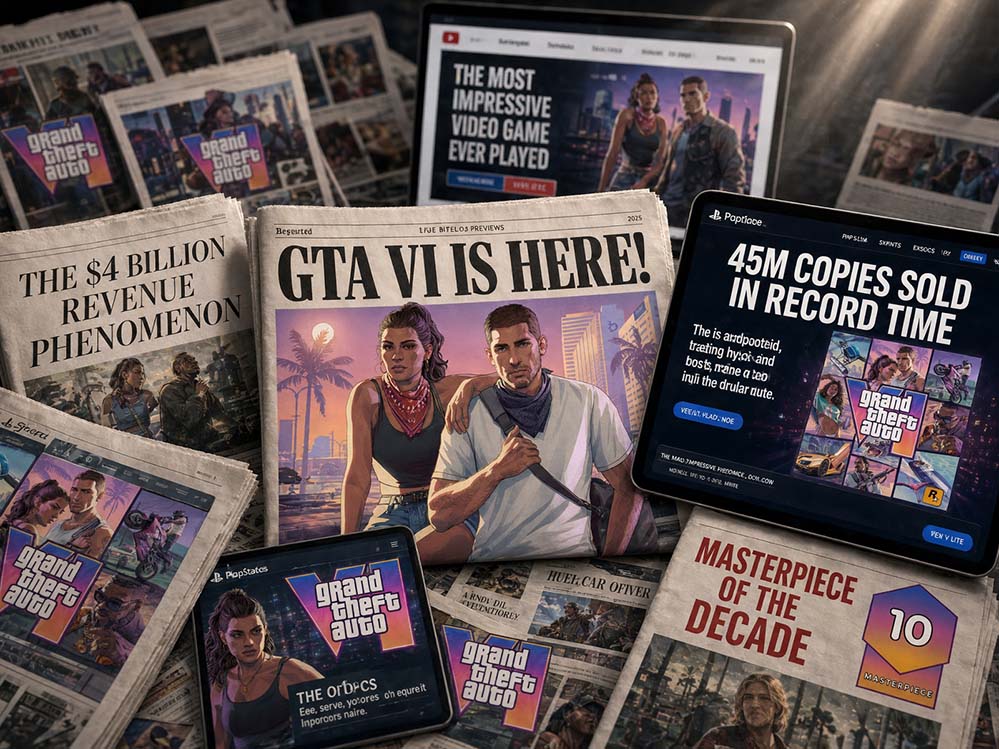
When Grand Theft Auto VI launched on November 19, 2026, for PlayStation 5 and Xbox Series consoles, the GTA 6 media coverage was immediate, massive, and unusually diverse. Onclusive data recorded 17.6 million social media mentions since November 14 and 239,158 mentions across traditional media (TV, radio, podcasts, print, and digital). This was not simply another game release. It became a cultural and commercial event that filled news cycles, brand campaigns, police statements, school notices, and meme pages for days.
For direct 24-hour comparison, the Robert Pattinson James Bond announcement generated 44,648 traditional media mentions and 2,397,413 social media mentions (including 1,725,370 on X). In the first 24 hours after the GTA 6 launch on November 19, Onclusive recorded 58,045 traditional media mentions and 5,653,714 social media mentions. The GTA 6 media coverage was larger in volume and broader in the range of subjects treated.
The scale of the phenomenon in GTA 6 media coverage
Traditional media treated the launch as a historic commercial milestone. Multiple outlets reported Rockstar Games / Take-Two figures of roughly $3.79 billion in first-day retail sales and more than 32 million copies sold or pre-ordered, figures that surpassed the lifetime box office of Avengers: Endgame and GTA V’s own first-day performance. BBC, CNN, Fox News, and numerous Japanese and European titles framed it as the biggest entertainment launch in history.
Development time (roughly 13 years and two delays) and estimated costs above $1 billion were repeated often. Market-share estimates circulating in the press put PS5 at about 75% and Xbox at 25%. International angles were constant: New Zealand players accessed the game first, Miami hosted themed events, and coverage stretched from Japan and India to the UK, France, and Latin America.
Critically, the game earned a 99 on Metacritic, tying The Legend of Zelda: Ocarina of Time. Professional reviews were overwhelmingly positive. User scores on Metacritic were more mixed, with reports of review-bombing activity.
The data in this article is collected using Onclusive’s specialized tools: Onclusive Monitor for media monitoring and analysis (TV, radio, podcasts, print, and digital), and Onclusive Social for social media listening (discussion platforms, forums, blogs, and social media).
Onclusive Figures (total volume) for the launch of GTA VI
- 17.6 million social media mentions since November 14
- 239,158 mentions in traditional media (TV, Radio podcasts, Print, Digital media)
Comparison with The Legend of Zelda: Ocarina of Time (launched on 5 November, measured over the same 10-day period, from 1 to 11 November)
- Social media: 1,995,4140 mentions
- Traditional media: 21636 mentions
GTA 6 generated roughly 8× more social media mentions and 10.6× more traditional media mentions than Ocarina of Time in the equivalent period.
- between November 14 -November 23
- (social platforms, blogs, forums, reviews)
- between November 14 -November 23
- (TV, Radio podcasts, Print, Digital media)
Variety of topics in the GTA 6 media coverage
What stands out in the GTA 6 media coverage is the breadth of angles. Economic and sales stories were only one part of the mix.
Commercial and economic stories focused on the record day-one revenue, comparisons with film box office (Avengers: Endgame, Spider-Man: Brand New Day) and concert tours (Taylor Swift’s Eras Tour), the long development cycle, production cost estimates, and platform split. Some pieces examined the broader entertainment industry implications and the absence of a PC version at launch, which also fed malware and fake-download warnings.
- between November 1 -November 11
- (social platforms, blogs, forums, reviews)
- between November 1 -November 11
- (TV, Radio podcasts, Print, Digital media)
Above: Comparison with “The Legend of Zelda: Ocarina of Time” launch
Social and everyday-life stories received heavy attention. UK data showed spikes in workplace sickness absences and secondary-school absences on launch day (one report cited roughly 35,000 additional student absences across more than 1,400 schools). Japanese companies granted multi-day leave starting on the release date.
One French outlet (Le Parisien) covered a senior residence where residents replaced Scrabble with GTA 6. Articles noted people booking time off, pulling all-nighters, or simply disappearing into the game. The generational gap (13 years between GTA V and GTA VI) fueled human-interest pieces about children who grew up between the two games and about adults realizing they were now older than the protagonists.
Public-safety and institutional reactions appeared quickly. Police departments in the US, UK, and elsewhere issued reminders that “what happens in GTA 6 stays in GTA 6,” warning that street racing, car theft, and violence remain real-world crimes. Schools warned students about absenteeism. Some local forces even produced GTA-inspired videos.
Game content, culture, and technical discussion generated their own sub-coverage. Music and soundtrack pieces highlighted contributions from The Weeknd and Justice, Bad Bunny, Burna Boy, Sexyy Red, Lana Del Rey, and many others. Billboard and others ran dedicated soundtrack stories. Easter-egg reports (the jet-ski dog inspired by a real Florida golden retriever, hidden references to earlier Rockstar titles, movie and TV nods) circulated widely. Technical discussions covered the locked 30 fps, world density of Leonida and Vice City, the slower and more simulation-like pacing compared with GTA Online, and the dual-protagonist structure centered on Jason and Lucia.
Critical reception and player debate pieces examined the dual-protagonist approach, the removal of certain classic mechanics such as hiring prostitutes (explained by Rockstar as supporting the central couple’s story), Japan’s localized censorship (reduced nudity and gore), and the gap between the 99 critic score and mixed user scores on Metacritic, including reports of review-bombing. A smaller but visible thread covered working conditions and a reported union-related dispute at Rockstar.
This mix of hard commercial numbers, social behavior, public-order messaging, music analysis, technical detail, and cultural observation is what made the GTA 6 media coverage unusually broad.
Newsjacking around the launch
Brands moved quickly. Nike released a Cactus Jack / Travis Scott Air Force 1 collaboration timed to the game. Miami Heat turned a home game into a “Night in Vice City” activation; the jerseys sold out rapidly. UFC, FC Bayern, House of Highlights, 9GAG, Vogue, and others posted related content. Travis Scott appeared at Miami events. Even less obvious players (police social accounts, travel accounts promoting Miami as “the real Vice City,” senior-living stories, and lifestyle brands) joined the conversation.
The pattern was classic newsjacking: a high-volume cultural moment created a short, intense window in which sports, fashion, music, automotive, and lifestyle brands could insert themselves with relatively little friction.
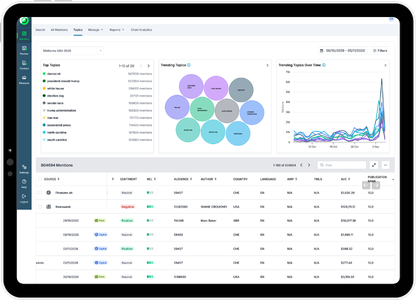
Monitor every major cultural event globally with Onclusive Monitor
This analysis of the GTA VI launch represents just a fraction of what's possible when you have access to comprehensive media monitoring across channels, languages, and geographies.
Onclusive monitors over 28 million pieces of content across mainstream press, online mentions, social media channels, TV, radio, newswire, and international media coverage daily, providing a unified view of all your multi-channel coverage.
Memes and controversies
Memes were constant. The long-running “we got X before GTA 6” format was widely used; one of the most circulated variants after November 16 was “we got a new Bond before GTA 6.” Other recurring themes included glow-ups between GTA V and GTA VI, partners or children aging during the wait, and ironic posts about mundane tasks (home repairs, grocery shopping, phone doomscrolling) inside the game.
Controversies remained secondary relative to the overall volume but were clearly present. Removal of the prostitution mechanic, Japanese version changes (nudity and gore reductions), the 30 fps lock, Metacritic user-score fluctuations and alleged review bombing, and occasional criticism of the more deliberate pacing all appeared. A subset of players and commentators expressed disappointment that the game felt more life-sim and relationship-focused than pure chaos. These voices were loud in certain corners of social media and forums but did not dominate the broader GTA 6 media coverage.

Social media amplification
On social platforms the GTA 6 media coverage translated into widespread, high-volume conversation that was largely festive, observational, or meme-driven. Users shared first-day experiences, screenshots, and short clips of world density, NPC behavior, and small immersive details. The jet-ski dog, the ability to pet cats, home-repair missions before Lucia’s release, and the sheer scale of Vice City/Leonida were frequent subjects of positive posts. Many users described the game as meeting or exceeding long-held expectations and referenced the 99 Metacritic score.
Humor and memes dominated large parts of the conversation. The “we got [X] before GTA 6” format (including the Bond variant) spread quickly. Posts about taking days off, all-nighters, partners or children aging during the 13-year wait, and the contrast between real-life responsibilities and in-game tasks (fixing a house, shopping, working out) were common. Celebrity and brand posts (Nike, Travis Scott, sports accounts, meme pages) amplified these themes and generated high engagement.
Critical or negative reactions existed but were less central. Some users complained about the locked 30 fps, the removal of classic mechanics, the dual-protagonist structure, or a slower pacing that felt more like a life simulation than previous entries. Others noted technical issues at launch (PSN congestion) or expressed frustration that certain features from earlier games were missing. These views appeared in replies, quote posts, and forum threads, yet the overall tone across high-reach accounts and viral content remained predominantly positive or light-hearted. The volume itself-millions of mentions in the first 24 hours-showed how quickly individual player reactions, memes, and brand activations compounded into a continuous social conversation that ran in parallel with traditional GTA 6 media coverage.
GTA 6 media coverage in perspective
The Pattinson Bond announcement proved that a major pop-culture casting can generate rapid, international traditional-media interest and substantial social volume in 24 hours. The GTA 6 media coverage in its first 24 hours after launch was larger (58,045 traditional mentions and 5.65 million social mentions versus Bond’s 44,648 and 2.4 million) and branched into more categories-commercial records, labor and school absences, police messaging, senior gaming, music journalism, technical analysis, brand activations, and pure meme culture. It functioned less as a single news story and more as a temporary media weather system.
The launch demonstrated that a single video-game release, after more than a decade of anticipation, can still command the attention of mainstream newsrooms, brands, public institutions, and millions of ordinary people at the same time.