Understanding the 2026 midterm elections global media coverage through sentiment analysis, regional narratives, and social media engagement across 4 languages
Executive summary: The 2026 Midterm Elections global media coverage story
The 2026 midterm elections generated unprecedented global media attention. Over 30 days (October 4 – November 4, 2026), Onclusive tracked more than 2.52 million mentions in traditional media and 7.3 million mentions across social platforms worldwide. But here is what makes this data exceptional: the same election was told four completely different stories depending on which region’s media you read.
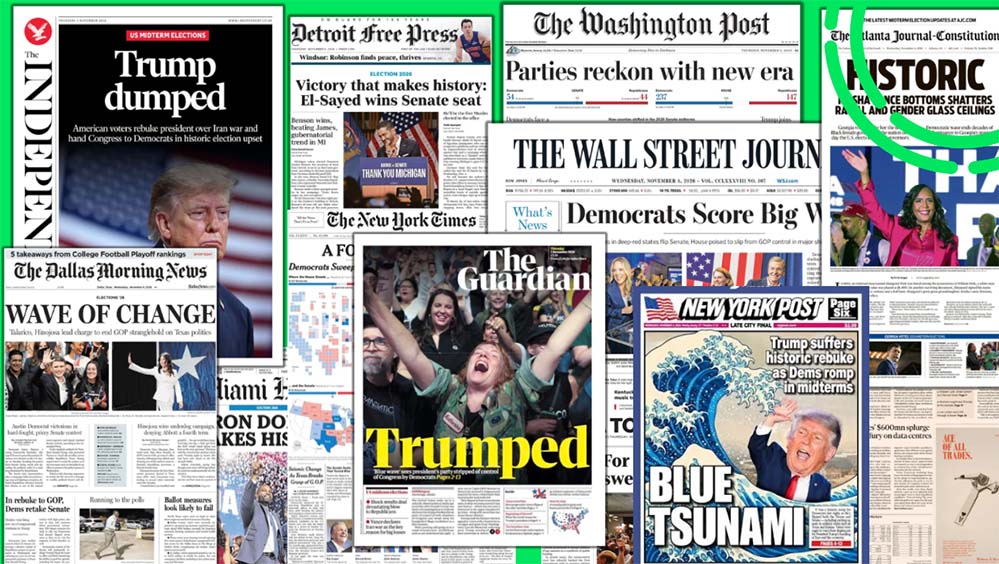
According to Reuters, AP, CNN, The Economist, and The Guardian, Democrats achieved historic gains by flipping deep Republican territories. Yet when you examine the 2026 midterm elections global media coverage region by region, the narrative fractures dramatically. Anglophone media emphasized legislative gridlock. German press attacked Trump’s personality directly. Spanish-language outlets worried about Latin America losing a political ally. French journalists drew parallels with their own economic crisis.
This analysis decodes how the world covered the 2026 midterm elections through the lens of regional priorities, media sentiment, and social amplification.
The 2026 Midterm Elections global media coverage – What the data shows
Volume and reach: A media phenomenon
The 2026 midterm elections global media coverage reached unprecedented scale:
- Traditional Media (TV, Radio, Podcasts, Print, Digital media): 2.52 million mentions across 30 days
- Social Media (social media platforms, blogs, forums): 7.3 million mentions (including 5.4 million in English)
- Peak Coverage: November 4, 2026 at 9:30 a.m. CET (3:30 a.m. EST)
- Sentiment Breakdown: 22.7% positive, 13% negative, 39% neutral/factual
This volume represents one of the most intensively covered U.S. political events in global media history. To put it in perspective: the 2026 midterm elections global media coverage exceeded the coverage of most major international geopolitical events.
This volume represents one of the most intensively covered U.S. political events in global media history. To put it in perspective: the 2026 midterm elections global media coverage exceeded the coverage of most major international geopolitical events.
The data in this article is collected using Onclusive’s specialized tools: Onclusive Monitor for media monitoring and analysis (TV, radio, podcasts, print, and digital), and Onclusive Social for social media listening (discussion platforms, forums, blogs, and social media).
Why 2026 Midterm Elections Global Media Coverage Matters for Your Strategy
For PR professionals and communications specialists, understanding 2026 midterm elections global media coverage is essential because it reveals:
- How regional narratives shape international perception of U.S. politics
- Which economic messages resonate across all languages (spoiler: inflation)
- How financial markets react to political outcomes (tech stocks crashed on midterm results)
- What topics dominate each region’s political agenda
- How to craft messaging that works across borders
The 2026 midterm elections global media coverage tells us that there is no such thing as a global election narrative – only regional ones interpreted through local concerns.
English-language media and the 2026 Midterm Elections global media coverage
How anglophone outlets framed the results
According to Reuters, AP, CNN, The Guardian, and The Economist, the 2026 midterm elections global media coverage in English-language outlets coalesced around a single narrative: gridlock.
The Associated Press and Reuters reported that Democrats gained control of both chambers of Congress with approximately 53-54 Senate seats and over 218 House seats. Decision Desk HQ and Bloomberg confirmed these projections. But the real story, according to CNN and The Economist’s analysis, was what this meant for Trump’s ability to govern.
English-language 2026 midterm elections global media coverage emphasized:
1. Legislative paralysis and the “Lame Duck” presidency
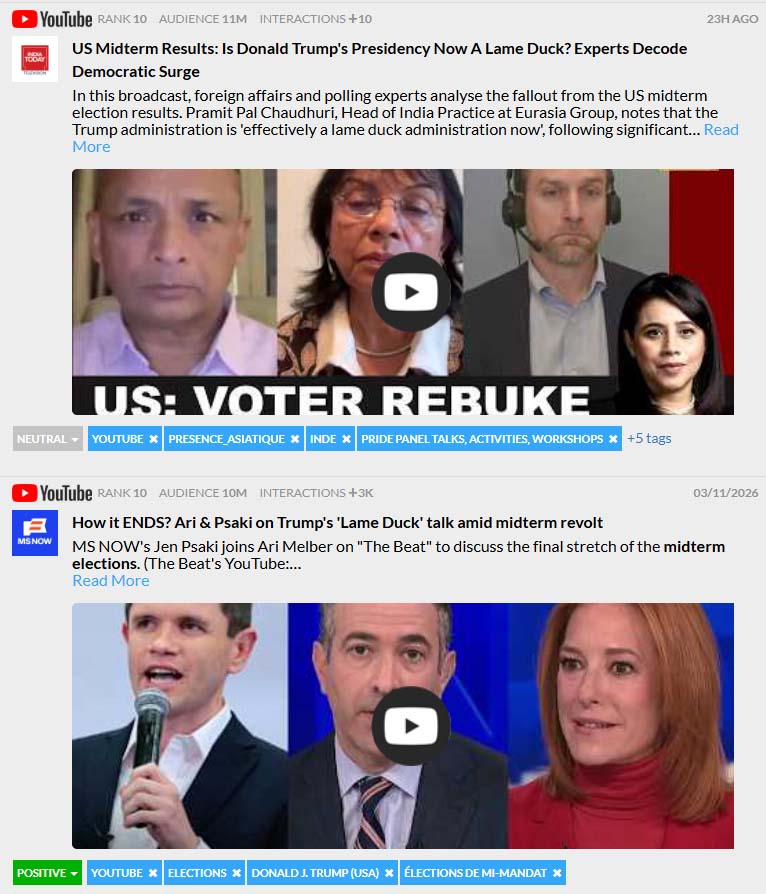
The phrase “lame duck” appeared across news outlets, translated as a president who can no longer govern effectively for his remaining two years. Reuters and The Guardian extensively covered how the Democratic House and Senate would block Trump’s agenda through three mechanisms:
- Subpoena power to launch investigations
- Voting down nominees to the Supreme Court and federal benches
- Controlling budget negotiations and the debt ceiling
This 2026 midterm elections global media coverage angle suggested Trump’s executive orders and veto power would be his only governing tools.
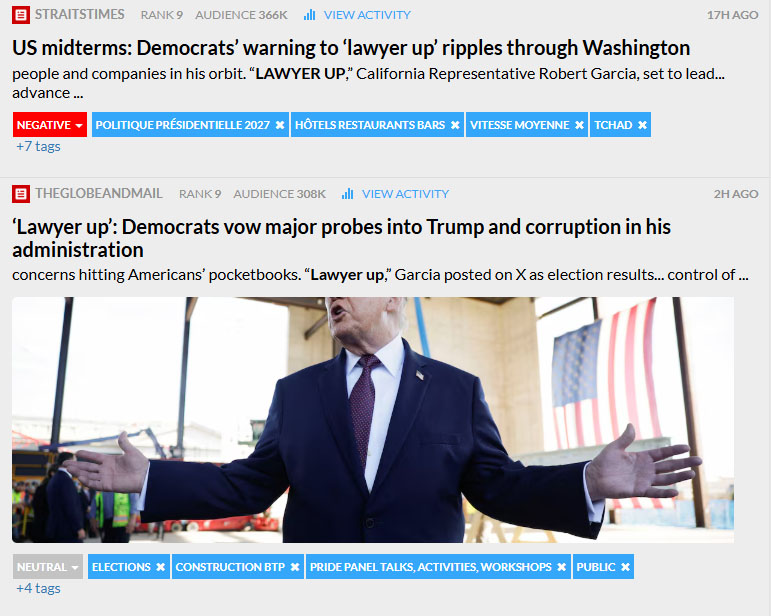
2. The “lawyer up” narrative
One phrase went viral across all English-language platforms when discussing 2026 midterm elections global media coverage: “lawyer up.” Fox News, NBC News, and CBS News all reported that Democratic control of Congress meant imminent investigations into:
- Trump family business dealings
- Jeffrey Epstein connections
- DOGE (Department of Government Efficiency) operations
- AI regulation and data center restrictions
3. Historic flips in red territory
The 2026 midterm elections global media coverage led with unprecedented state-level results:
- Texas: James Talarico (Democrat, age 37, seminary student and teacher) defeated Ken Paxton. First Democratic senator from Texas since 1988. NBC News called this a 54% victory, with Talarico campaigning on anti-corruption messaging.
- Kansas: Adam Hamilton (Methodist minister, independent Democrat) defeated incumbent Roger Marshall. This was the first Democratic Senate victory in Kansas since 1932 – nearly a century of Republican dominance ended. The New York Times noted that Trump had won Kansas by 16 points in 2024.
- South Carolina: Annie Andrews (pediatrician) defeated Darline Graham (unexperienced, sister of deceased Senator Lindsey Graham). First Democratic win since 1998. This 2026 midterm elections global media coverage story shocked political analysts.
Other major flips covered by AP and CNN included Ohio (Sherrod Brown), North Carolina (Roy Cooper), Iowa, and Maine. Abdul El-Sayed, Michigan’s first Muslim senator in U.S. history, won despite “jihadist” attacks from Trump that CNN extensively documented.
4. The “It was the economy, stupid” consensus
The Washington Post (via NORC polling analysis) and Reuters reported a unified finding across all English-language 2026 midterm elections global media coverage: 9 out of 10 voters cited the cost of living as crucial. Two-thirds blamed Trump’s tariff policies for elevated prices. The sentiment:
- Inflation at 3.7% in September (driven by energy costs)
- Gasoline prices linked to Iran War
- Grocery and housing costs consuming household budgets
- Trump’s 2024 promise of “no foreign wars” contradicted by Iran military operations
This economic focus unified all 2026 midterm elections global media coverage across languages.
5. Market reaction and AI regulation fears
The financial press (Bloomberg, Reuters) emphasized that stock markets plunged on midterm results:
- Nasdaq futures dropped 1-2% initially
- AI and tech stocks under pressure (CoreWeave, Nebius, Oracle, Samsung, SK Hynix, SoftBank all declined)
- Dollar index hit one-month lows
- Treasury yields fell (investors fleeing to safety)
The 2026 midterm elections global media coverage of markets revealed investor fear: Democratic Congressional control meant stricter AI regulation, potential data center moratoria (the Texas gubernatorial victory of Gina Hinojosa, a Democrat, signaled this threat), and the end of Trump’s deregulation environment.

Monitor every major political event globally with Onclusive Monitor
This analysis of the 2026 midterm elections represents just a fraction of what's possible when you have access to comprehensive media monitoring across channels, languages, and geographies.
Onclusive monitors over 28 million pieces of content across mainstream press, online mentions, social media channels, TV, radio, newswire, and international media coverage daily, providing a unified view of all your multi-channel coverage.
Non-anglophone media and different 2026 Midterm elections global media coverage angles
French-language coverage: Democracy and inflation
French media, according to sources monitored, presented the most positive framing of 2026 midterm elections global media coverage. Outlets emphasized:
- “Déferlante démocrate” (Democratic wave) as democratic renewal
- Parallels with French inflation crises (cost of living anxiety shared across Atlantic)
- Trump’s acceptance of results (contrast with 2020)
- Bitcoin rebounded after the “blue wave” (financial markets adapting)
- Gridlock limiting Trump’s damage to international agreements
French-language 2026 midterm elections global media coverage sentiment: approximately 31% positive, 37% neutral, 17% negative.
German-language coverage: Personal criticism of Trump
German media adopted the harshest tone in 2026 midterm elections global media coverage. German outlets focused on:
- Trump’s personal failings (Größenwahn = megalomania)
- Ukraine implications (Democratic Congress less likely to appease Russia)
- OTAN/NATO concerns
- Tariff threats to European economies and DAX performance
- Trump as unstable individual, not just political figure
German-language 2026 midterm elections global media coverage sentiment: 23% positive, 34% no sentiment, 24% neutral, 18% negative. The tone was notably harder than English or French coverage.
Spanish-language coverage: Regional geopolitics and Milei
Spanish-language media, especially in Latin America, framed 2026 midterm elections global media coverage through a different lens:
- Trump’s hand-picked candidates failed (strategic error)
- Javier Milei of Argentina loses a Washington ally
- “Pato cojo” (lame duck) language paralleled Spanish terminology
- Border/Mexico implications for immigration
- Cuba and Venezuela connections to Iran policy
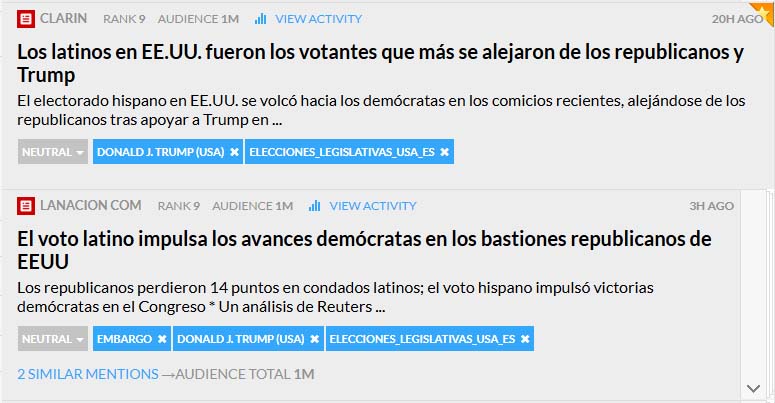
- Electorado latino (Latino voters) crucial to Democratic victories
Spanish-language 2026 midterm elections global media coverage emphasized geopolitical consequence for Latin America, not just U.S. domestic politics.
Social media dynamics in 2026 Midterm elections global media coverage
Platform distribution and engagement patterns
The 2026 midterm elections global media coverage across social platforms showed distinct patterns:
- Twitter/X: 76% of all social mentions (volume leader)
- Instagram: 4%
- TikTok: 2%
- LinkedIn: 1%
- Other platforms: <1%
What this means: Twitter/X drove the conversation volume, but Facebook delivered audience scale. For PR professionals monitoring the 2026 midterm elections global media coverage, this suggests different amplification strategies per platform.
Viral narratives during peak coverage (November 4, 8:00-11:00 a.m. CET)
During peak 2026 midterm elections global media coverage, three themes dominated social:
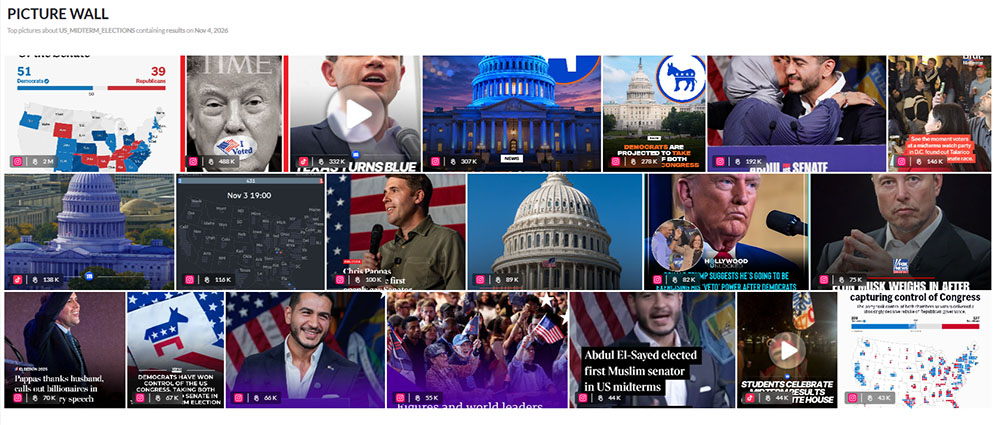
- “Blue Wave” Celebrates – Retweets of Democratic victories by celebrities (Ariana Grande, Miley Cyrus) celebrating Abdul El-Sayed and Hakeem Jeffries (first Black Speaker of the House)
- “Prepare Your Lawyers” Meme – The investigation theme went viral on left-leaning accounts, suggesting Trump faced impending legal scrutiny
- “Not on the Ballot” Defense – Trump’s Truth Social post (“If I was on the ballot, we would have won IN A LANDSLIDE!”) generated 2M+ engagements as supporters and critics debated whether this constituted a real loss
Sentiment evolution across three phases
Phase 1 (November 4, midnight-8 a.m. CET): First results, initial reactions
- Positive 23%, Neutral 29%, Negative 17%
- Dominated by early celebration and initial Trump pushback
Phase 2 (November 4, 8 a.m.-11 a.m. CET – THE PEAK): Maximum 2026 midterm elections global media coverage
- Positive 23%, Neutral 40%, Negative 14%
- Peak amplification of historic flips (Texas!, Kansas!, South Carolina!)
- Celebrity endorsements visible
Phase 3 (November 4-5, 11 a.m.-7 p.m. CET): Synthesis and consequences
- Positive 22%, Neutral 41%, Negative 14%
- Shifted to market reactions, AI regulation fears, 2028 succession implications
Translating 2026 Midterm elections global media coverage into PR strategy
What communications professionals must know
The 2026 midterm elections global media coverage revealed six actionable insights for your strategy:
Insight 1: “Economy First” message transcends all regions
Every language, every country, every platform converged on one point: the economy decides elections. This is your messaging anchor. Regardless of whether you’re targeting U.S., German, French, or Spanish audiences, affordability messaging (healthcare costs, housing, energy prices) will resonate. This is the universal 2026 midterm elections global media coverage lesson.
Insight 2: Regional concerns override global narratives
The 2026 midterm elections global media coverage proved that there is no global narrative – only local ones. German media cared about NATO and Ukraine. French media cared about inflation parallels. Spanish media cared about Latin America. English-language media cared about gridlock and investigations.
For PR: Tailor your messaging to regional priorities, not global talking points.
Insight 3: Investigations and regulatory scrutiny are coming
The 2026 midterm elections global media coverage emphasized investigations into AI regulation, data centers, and business practices. If your organization operates in tech, healthcare, or finance, prepare for heightened Congressional scrutiny. The “prepare your lawyers” sentiment is real.
Insight 4: Market volatility around political transitions is predictable
The 2026 midterm elections global media coverage showed immediate market reactions (Nasdaq futures down 1-2%, dollar receding, tech stocks plunging). These reactions are news-worthy. Prepare your investor communications for post-election market volatility messaging.
Insight 5: Diversify your spokesperson strategy by platform
The 2026 midterm elections global media coverage showed that Twitter/X and Facebook operate under different amplification rules. Twitter/X requires volume and viral potential. Facebook requires more polished, institutional messaging. LinkedIn reaches professionals. Instagram reaches younger demographics. Tailor content accordingly.
Insight 6: Succession politics are already live
The 2026 midterm elections global media coverage extensively covered VP JD Vance distancing himself from Trump and preparing an independent 2028 campaign. Rubio and other Republicans are already repositioning. Watch for defection narratives and shifting alliance statements.
The PR and marketing implications of 2026 Midterm elections global media coverage
Immediate messaging opportunities
For organizations aligned with Democratic priorities:
- Opportunity to lead on affordability, healthcare, and energy regulation
- First Muslim senator and first Black Speaker provide diversity-and-progress narratives
- Use “people spoke” framing to validate customer/stakeholder concerns
- Prepare to defend against Republican “overreach” accusations in 2028
For organizations in tech/finance/healthcare:
- Prepare for increased Congressional investigations and regulatory scrutiny
- Position proactively on AI governance, data privacy, and worker protections
- Avoid partisan messaging; focus on operational excellence and transparency
- Monitor data center regulation proposals (especially in newly-Democratic states like Texas)
For international organizations:
- U.S. policy uncertainty (gridlock) may create market opportunities or threats depending on sector
- European organizations should prepare for climate and trade policy shifts
- Latin American entities should monitor U.S. immigration policy changes
- Asian tech firms should monitor AI regulation closely
Long-Term Narrative Tracking (2027-2028)
The 2026 midterm elections global media coverage sets the stage for two years of coverage around:
- Congressional investigations (monthly news cycles)
- 2028 succession battles (intensifying through 2027)
- Market reactions to regulation proposals
- AI and data center policy development
- Inflation trajectory (economic messaging anchor)
Conclusion: What PR professionals must do with 2026 Midterm elections global media coverage data
The 2026 midterm elections global media coverage represents a watershed moment for understanding how regional media narratives diverge while maintaining surprising consensus on root causes (economy, inflation, war costs).
For communications professionals, this data set reveals:
- There is no global election story – only regional stories interpreted through local concerns
- Economic messaging dominates all others – affordability cuts through all language, culture, and geography
- Social media amplifies traditional media narratives – but traditional outlets (Reuters, AP, CNN, The Guardian, The Economist) retain narrative-setting power
- Market reactions provide credibility signals – when investors flee (as they did on midterm results), your message should acknowledge this sentiment
- Investigations and regulatory scrutiny are now live – expect 24-month news cycle of Congressional investigations, regulatory proposals, and market volatility
The 2026 midterm elections global media coverage is not only a one-time event story but also a thesis statement for two years of political, regulatory, and market disruption. Build your communication strategy accordingly.