





You may not have heard the term Generative Engine Optimization (GEO). It’s the phrase the comms industry has settled on for what most teams call AI search optimization: getting your brand to show up in AI-generated answers.
For the past year, comms teams have been trying to measure this without a rulebook. No shared definitions. No agreed methodology. No way to know if the numbers from one tool meant the same thing as the numbers from another.
That changed in May 2026, when AMEC published its seven GEO Principles. It’s the first industry framework for how comms should measure AI search optimization results.
If you’re already tracking your brand’s presence in AI search (or planning to), this is worth reading. For the first time, there’s an independent standard to measure your efforts against and to hold your tools accountable to.
Here’s my take on what the seven principles actually require, and what they mean in practice.
1. AI search optimization measurement starts with the questions your audience is asking
AMEC’s first principle sounds obvious but it rules out a lot of current practice. Measurement should start from understanding what audiences are actually asking. Your comms objectives should also tie in here.
Before you decide what to measure, you need to know what you are trying to achieve. Are you trying to understand where your brand stands in your category? Track how competitors are being positioned relative to you? Monitor how AI engines are framing your brand on specific issues? The answers shape the questions you ask, and the questions you ask shape everything else.
This means you need to build a governed question library: a set of prompts that reflect how a real person would ask an AI engine about your category and brand.
AMEC is explicit that this requires both branded and unbranded prompts. Why? An unbranded query, “what are the best sunscreens for sensitive skin?”, tells you something different from a branded one, “what do people say about La Roche-Posay?” But they both matter. Only running branded prompts tells you how the engine responds when it already knows who you are. That’s not the same as understanding where you stand against your competitors.
2. AI answers reflect what’s already out there about your brand
This is the principle that most comms teams are not yet acting on. And it has significant implications for where your measurement effort should go.
When an AI engine answers a question about your brand or category, it’s not forming an independent opinion. Instead, it’s drawing on information that already exists. This could include news coverage, reviews, your website and industry analysis. If your brand is missing from AI answers it’s most likely because there’s a gap in the content that exists about you, not in the AI itself. We refer to this as an AI visibility gap.
That has real implications for where you focus your efforts. Tracking what AI engines say about your brand is only useful if you can also see what they’re drawing on to say it. That’s why AI measurement needs to sit alongside your earned media and social data, not in a separate tool.
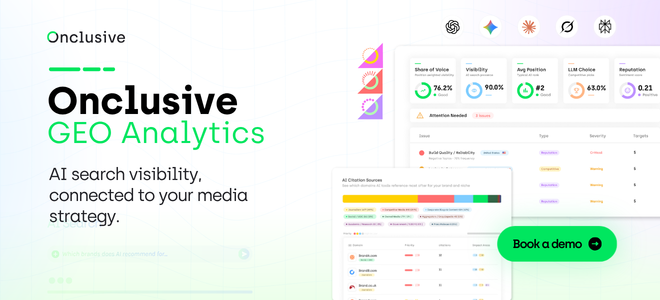
Onclusive’s AI search optimization tool is built into the unified media intelligence platform. That means you can see what coverage and content exists, which content AI engines are actually citing, and whether your assets or a competitor’s are doing the heavy lifting.
3. Your content needs to be findable, credible, and citable
Knowing that AI answers draw on what’s already out there about you is one thing. Knowing whether what’s out there is actually working for you is another.
Most AI engines still pull from web search when forming answers. That means if your content is hard to find, poorly structured, or not backed by credible third-party sources, it’s unlikely to be cited.
Search and content readiness is measurable, not just a vague best practice. In GEO Analytics, we track which domains AI engines are citing, how often, and whether those sources are favorable to your brand. We also flag the third-party sites shaping AI answers in your category. That tells you exactly where your content is working and where the gaps are. It’s the starting point for any content or earned media work aimed at improving your AI visibility.
4. Source quality matters more than mention volume
AMEC is clear on this: trustworthy and current sources matter more than volume. Not all visibility is equal.
A brand cited once by a low-authority site is in a very different position from one appearing across tier one journalism, industry publications, and independent reviews. Your measurement tool needs to show you not just whether you appear. It needs to show you where citations are coming from and whether those sources are credible.
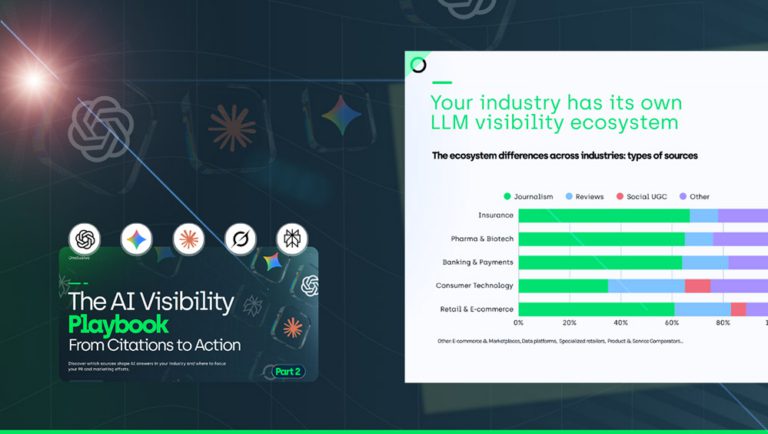
Inside GEO Analytics, we classify every cited source into nine categories: journalism, academic, reviews, press releases, social content, and more. Favorability is tracked at source level. The output is not a mention count, it’s an audit of which parts of your information environment are actually doing the work.
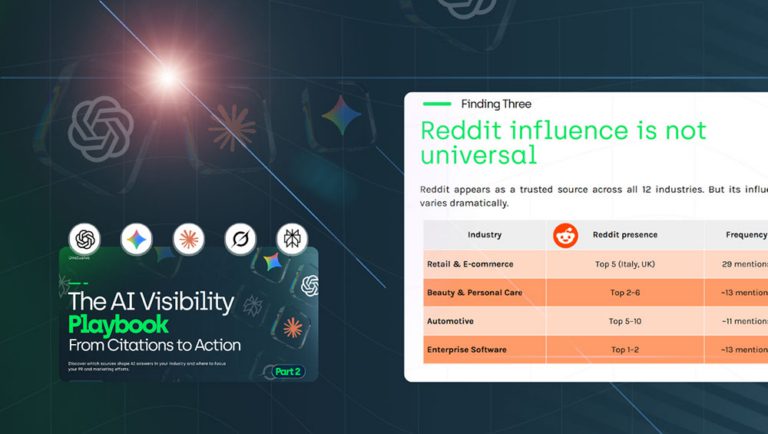
Want to put these principles into practice? The AI Visibility Playbook walks you through exactly how to measure, diagnose, and prove your brand’s presence in AI search.
5. One score is not visibility
This principle has the most direct implications for how you evaluate any AI search optimization or GEO tool.
Different AI engines give different answers to the same question. ChatGPT and Gemini may respond differently to identical queries. The same engine may give different results in French and English. Engines also change how they pull and cite sources without warning. No single score captures any of that.
Credible tools run multiple engines in parallel, test across markets and languages, and store outputs as dated snapshots. They don’t collapse everything into a single headline number.
At Onclusive, we run up to five engines simultaneously, report results individually and in aggregate, and save every run as a fixed record with the date, time, and exact setup used.
One point AMEC makes that is worth repeating: you cannot go back and measure what AI engines were saying before you started. Your baseline only exists from the moment you begin monitoring. Every week you wait is history you will never have.
Read more: Why every PR and marketing stack needs an AI visibility tool in 2026
6. Visibility is not impact
AMEC is firm on this. A change in an AI answer is not, on its own, business impact. The chain runs from:
- Outputs (what the engine says) to
- Out-takes (awareness, perception) to
- Outcomes (behavior) to
- Impact (business results)
Conflating the first with the last is how GEO measurement loses credibility.
Your measurement tool should report visibility, competitive positioning, and sentiment as distinct indicators. Not collapsed into a single score. It should also be honest that connecting AI discovery to traffic, conversions, or pipeline requires combining GEO data with web analytics.
7. Ethical AI search optimization means improving your information, not gaming the system
AMEC’s seventh principle is an ethical guardrail, It rules out:
- Flooding the web with low-quality content to influence AI retrieval
- Disguising promotional material as independent evidence
- Manipulating reviews or forums to shape how engines describe you
The temptation to game the system is huge, but misses the point entirely.
AI search optimization shouldn’t be treated as a tactical fix, but a long-term strategy. Think of it like reputation management: the brands that do it well are the ones that commit to it consistently, not in bursts.
The right response to weak AI visibility is to use it as a catalyst:
- Decide what your organization actually stands for
- Tidy up your online presence
- Pull together genuinely integrated communications
- Make sure your content is accurate, well-sourced, and useful to real people
That’s good practice anyway. But AI search gives you a new and compelling reason to get your house in order. Do the work and you will rank more consistently in AI answers. More than that, your organization’s profile will be stronger across the board, whether you’re trying to reach humans or the machines reading about you.
At Onclusive, GEO Analytics is a measurement and diagnosis tool. It tells you where your information is weak, contradictory, or absent. The rest is down to good communications work.
What this means if you are evaluating an AI search optimization measurement tool
The AMEC principles give comms professionals a practical checklist. Any tool worth using should be able to show you:
- A governed question library that includes both branded and unbranded prompts.
- Results across multiple AI engines, reported separately, not just averaged together.
- Source-level classification so you can assess credibility, not just count citations.
- Saved records of every run, with dates, so you can track change over time.
- Clear separation between visibility metrics, competitive metrics, and sentiment, with no claim that any of these alone constitutes business impact.
If a vendor cannot answer these questions clearly, they’re not measuring to this standard
A line in the sand
The arrival of the AMEC GEO Principles is genuinely good news for our industry. There’s now a shared standard against which tools, methodologies, and claims can be evaluated. It means comms professionals have a framework to bring to procurement conversations and to internal debates about what AI visibility measurement is actually for.
It also means the bar for credible measurement has been publicly defined. Teams that want to be taken seriously in this space, internally and externally, need to be working to it.