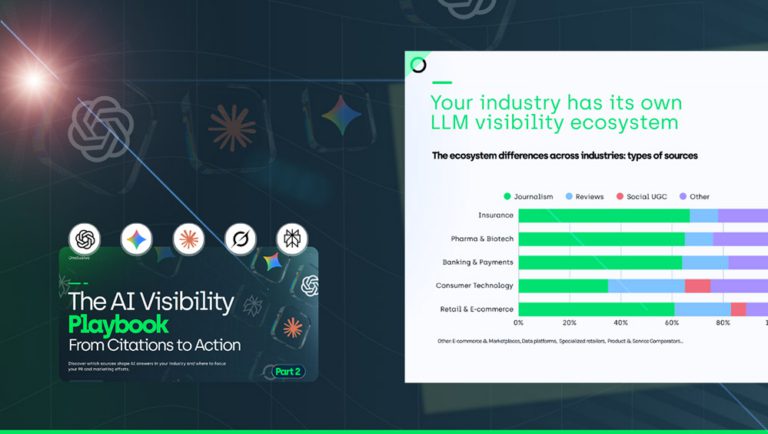






A potential customer is researching their options. Instead of opening a browser and scrolling through search results, they type their question into ChatGPT. They want to know which companies lead in your category and which might be the right fit for them. The answer comes back in seconds and your biggest competitor is recommended but your brand doesn’t appear at all (ouch!).
Chances are, you have several AI visibility gaps you need to tackle.
What is an AI visibility gap?
AI visibility gaps can take different forms. When a potential buyer types a high intent query into an LLM, your brand:
- Might not appear at all
- Might appear in ChatGPT but not on Perplexity, Gemini, or Claude
- Might be described inaccurately
- Might appear less often or less favorably than competitors
Only 14% of brands currently track AI and LLM citation visibility, which means the majority have no idea where they stand in relation to competitors and how to address it. Knowing which type of AI visibility gaps your brand has is the first step towards improving how your brand shows up in AI results. Getting that diagnosis right is the foundation for everything that follows.
The 4 AI visibility gaps you need to understand
There are four distinct AI visibility gaps you need to get to grips with, and it’s important to remember that they can vary from one AI engine to another.
1. The Presence Gap
Your brand does not appear in AI-generated answers for the prompts that matter most. No mention and no recommendation. In the moments where someone is researching their options, your brand isn’t part of the conversation.
Why a presence gap matters
The prompts where you’re absent are often the highest-intent moments in a buyer’s journey. Not casual searches, but the questions people ask when they are close to making a decision. The brands that appear in those answers have a significant advantage over the ones that don’t.
What causes a presence gap
The content and sources AI engines draw on may not connect your brand to the right topics or categories. It might be that your brand lacks sufficient third-party coverage in the publications and platforms AI engines rely on. Or that competitors have built more authority in those places over time. Whatever the cause, the longer it goes unaddressed the harder it becomes to close.
2. The Position Gap
Your brand appears in AI answers, but competitors are recommended more strongly. When someone asks an AI tool for a recommendation, the answer rarely feels like a list of equal options. The brand mentioned first, or framed as the obvious choice, carries more weight than the one that gets a passing mention at the end.
Why a position gap matters
AI-generated answers read as considered opinions, which makes position even more influential. A brand that consistently appears third or fourth is losing ground even when it shows up.
What causes a position gap
Position in AI answers tends to reflect the weight of authority and credibility that AI engines associate with a brand. Competitors that have stronger coverage and more citations from authoritative sources will typically rank higher. It’s less about any single piece of content and more about the overall footprint a brand has built over time.
3. The Narrative Gap
AI engines form their own view of your brand based on the sources available to them. Some rely on training data with a knowledge cutoff and don’t automatically update when your messaging changes. Others crawl the web in real-time but can still surface older articles or coverage that no longer reflects who you are.
Why a narrative gap matters
The answers AI engines surface might not reflect your current positioning. By the time a narrative gap shows up through other channels, it may already have shaped how your audience sees you.
What causes a narrative gap
Narrative gaps tend to form when a brand’s most current and accurate messaging isn’t well represented in the sources AI engines draw on. If your strongest owned content isn’t being referenced by third parties, or if older coverage still dominates, AI engines will keep surfacing an outdated picture. A rebrand or a product pivot are examples of what can create a narrative gap if the new story hasn’t been established in the right places.
4. The Source Gap
AI engines draw on the sources available to them: news coverage, industry publications, and third-party reviews. Those sources may give competitors more authority because they have a stronger presence in the places AI engines pay attention to.
Why a source gap matters
The problem isn’t always what your brand is saying. It’s who is saying it on your behalf, and where. Understanding which sources carry weight moves the question from ‘why aren’t we showing up?’ to ‘where do we need to build authority?’ and gives your teams a clear picture of where to focus.
What causes a source gap
Source gaps tend to develop when a brand’s media and content strategy hasn’t accounted for where AI engines look. Strong owned content is not enough on its own. If the publications and platforms that carry the most weight aren’t covering your brand, competitors with a better third-party footprint will have the advantage.
Why existing measurement won’t catch AI visibility gaps
Traditional reporting is not built to surface AI visibility gaps.
- Search rankings tell you how pages perform in traditional results
- Media monitoring tells you what has been published
- Social listening tells you what people are saying on social platforms
None of these tell you what AI engines are saying about your brand, which prompts are driving those answers, or how your position compares to competitors.
A brand could be losing ground on AI visibility while its Google rankings remain stable. Its analytics dashboard would show no warning signal. By the time the impact shows up in traffic data, the competitive gap may already be significant.
That’s the core problem. AI visibility gaps exist in your reporting before they exist in your results. So, the teams that invest in an AI visibility tool and start measuring now will have a head start on the those who wait until the impact is visible.
How to identify your brand’s AI visibility gaps
Identifying your brand’s AI visibility gaps starts with measurement. If you’ve already been trying to do this, you’ll understand how complex and frustrating it can be: trying to work with new and existing tools that say different things with no clear indicator of what you actually need to do.
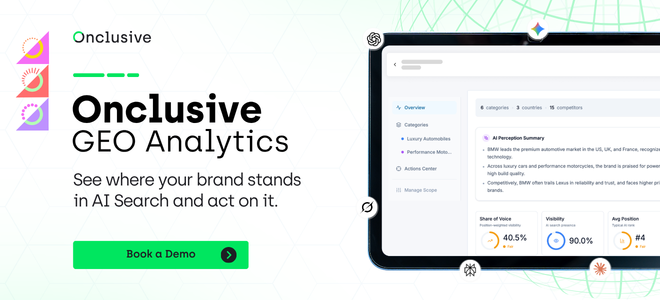
But getting started with AI visibility measurement is more straightforward than it might sound. Onclusive GEO Analytics tracks your AI visibility across the metrics that matter. It tells you not just whether you have AI visibility gaps but which type and where to focus first.
Each AI visibility gap points to a different problem. And that distinction matters because it stops you from applying the wrong fix. Investing in content when you have a source gap, or focusing on media outreach when you have a narrative gap, will not move the needle. GEO Analytics gives you the diagnosis so the work your team does is targeted and the impact is measurable.
How to close your AI visibility gaps
Closing AI visibility gaps starts with knowing where you stand. That means looking at whether your brand is present in AI-generated answers for the prompts that matter, how it appears relative to competitors, and which sources are shaping the picture.
The AI Visibility Playbook gives you a structured framework for doing exactly that. It covers how to measure your AI visibility, diagnose what is driving it, how to act on it, and how to prove impact to your business.