

Introduction: First fashion weeks SS27
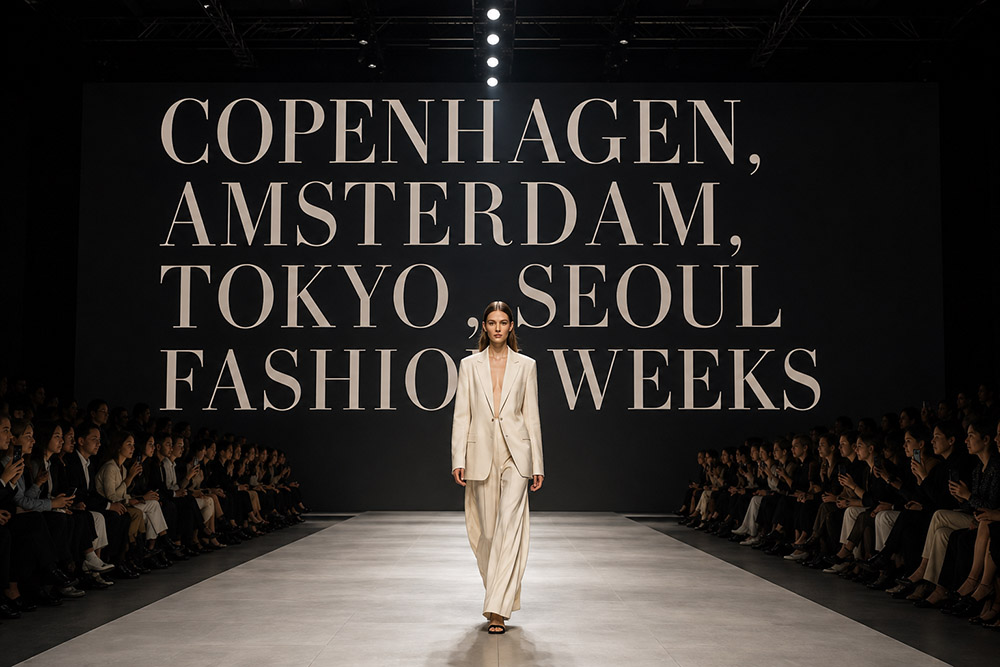
Before the major fashion weeks SS27 of New York, London, Milan, and Paris dominate the autumn calendar, the first fashion weeks of the season have already captured global media attention. The Spring-Summer 2027 season launched with the first fashion weeks beginning in Copenhagen (August 3-7), followed immediately by three concurrent fashion weeks in early September: Amsterdam, Tokyo Rakuten Fashion Week, and Seoul Fashion Week.
This multi-city analysis of the first fashion weeks covers 384,543 monitored mentions across social media and traditional outlets, reaching 103.1 million consumers across four distinct regional fashion ecosystems. Each fashion week event reflects its unique market positioning, influencer landscape, and media strategy, demonstrating how the fashion weeks operate as global interconnected systems rather than isolated events.
Data on these first SS27 fashion weeks was collected using Onclusive’s media monitoring and analysis tools: Monitor for traditional media and Onclusive Social for all social media.
Part I. Copenhagen – Denmark (3-7 August)
Nordic design innovation meets ethical fashion – Copenhagen’s fashion week positioned independent and established Scandinavian brands to claim dominance with 63% of top-15 coverage, powered by 10,393 media mentions delivering 52.1M social reach.
Fashion week media performance overview
The Copenhagen fashion week audience reached impressive scale across monitored channels during the event period of August 3-7, 2026. Our analysis of this fashion week event tracked 10,393 total mentions distributed across social media platforms and traditional media outlets.
Social media and traditional media breakdown
• Social media mentions: 9,200
• Social media reach: 52.1 million
• Traditional media mentions: 1,193 (TV, radio, print, and digital news outlets)
Brand visibility and share of voice
Copenhagen’s fashion week highlighted Nordic design excellence, with established Scandinavian brands and emerging designers dominating media conversation. The top 15 brands by share of voice demonstrated the fashion week’s focus on independent and established Danish-Nordic talent.
Top 15 brands by social media share of voice
| Brand | Share of Voice |
| Collina Strada | 8.7% |
| Stine Goya | 6.1% |
| By Malene Birger | 6.0% |
| Studio Constance | 5.1% |
| Opérasport | 4.9% |
| Anne Sofie Madsen | 4.6% |
| Baum und Pferdgarten | 4.6% |
| Nicklaus Skovgaard | 4.3% |
| Marimekko | 4.3% |
| Gestuz | 4.2% |
| Skall Studio | 3.7% |
| Caro Editions | 3.5% |
| The Garment | 3.3% |
| MFPEN | 3.2% |
| Taus | 3.1% |
The dominance of Collina Strada at 8.7% share of voice reflects the brand’s significant editorial presence and trend-forecasting potential in Copenhagen’s fashion week ecosystem. The concentration of coverage among the top five designers (totaling 31.8% of media conversation) indicates focused media attention on established voices within this fashion week’s design landscape.
share of voice
share of voice
share of voice
Above: Top celebrities’ share of voice on social media during Seoul Fashion Week.
Part II. Amsterdam – Netherlands (1-5 September)
Emerging Dutch independence finds its platform – Amsterdam attracted a distinctly different media ecosystem through deliberate scale reduction and artist-forward curation, generating 7,590 mentions and positioning the city as innovation incubator rather than heritage showcase.
Boutique strategy, boutique metrics
Amsterdam’s fashion week operated under a different calculus than Copenhagen’s. While the 7,590 total mentions represent 27% fewer than Copenhagen, the concentration of that coverage among a tightly curated designer roster indicates intentional selectivity. Social media engagement (7,248 mentions, 10.3M reach) comprised 95.5% of all tracked mentions, with minimal traditional media footprint (342 articles), reflecting the city’s positioning as digital-native platform for emerging voices.
Media distribution
• Social media mentions: 7,248
• Social media reach: 10.3 million
• Traditional media coverage: 342
• Total event mentions: 7,590
• Social-to-traditional ratio: 95.5% digital
Emerging talent commands selective editorial attention
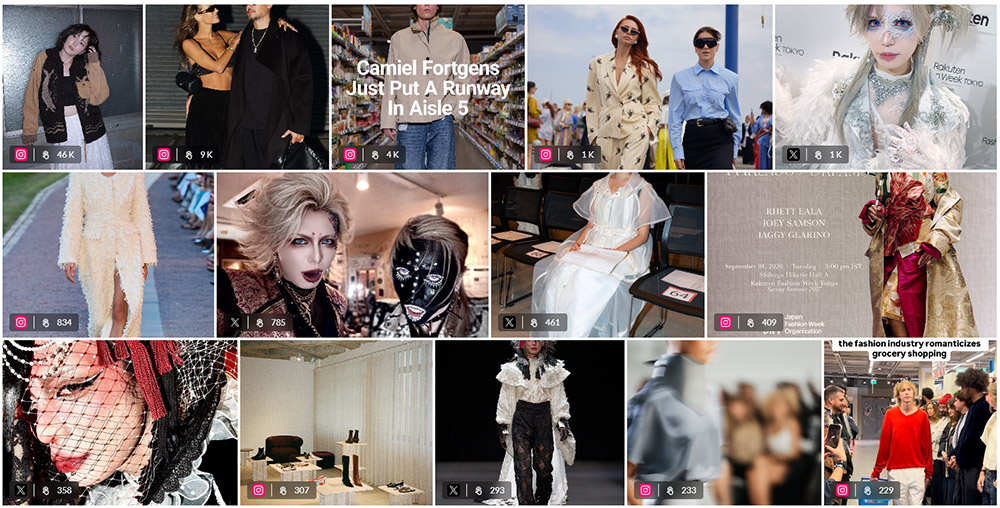
Amsterdam’s fashion week served as launchpad for next-generation Dutch design. The brand list revealed media appetite for emerging independent voices: Tess van Zalinge’s 14.47% dominance reflects critical consensus around fresh design perspectives, while secondary-tier designers (Camiel Fortgens 9.87%, Aïche 8.22%) demonstrated sustained editorial interest in experimental approaches. This fashion week’s top-three concentration (32.56% combined) indicates media gatekeeping around distinctive aesthetic vision.
Top 15 brands by social media share of voice
| Brand | Share of Voice |
| Tess van Zalinge | 14.47% |
| Camiel Fortgens | 9.87% |
| Aïche | 8.22% |
| Vogue Downtown | 5.59% |
| Studio NK | 5.59% |
| Dolly Sports | 5.26% |
| The New Originals | 3.95% |
| Ruben Jurrien | 3.95% |
| Lighting 2026 | 3.29% |
| Love Stories | 2.96% |
| Levi’s | 2.96% |
| Fortanier | 2.63% |
| Atelier Reserve | 2.63% |
| Arcatype | 2.63% |
| United Repair Centre | 2.63% |
Notable: heritage brand Levi’s appearance in the top-15 (2.96%) represents bridge between emerging designers and established heritage, while studio-focused concepts (Studio NK, Vogue Downtown) indicate media interest in design process and sustainability narrative beyond finished products.
Part III. Tokyo Rakuten – Japan (31 August – 5 September)
International design collaboration reimagined – Tokyo Rakuten hosted a fundamentally different fashion week model, assembling global designers under curated collaborative framework and generating 3,004 mentions with record-high social reach efficiency (13.4M reach from limited volume).
Global programming, niche media footprint
Tokyo’s fashion week represented strategic programming inversion: smaller mention volume (3,004 total) combined with exceptional reach per mention (4,450 average reach), suggesting concentrated media quality over volume. The event’s bilingual media presence (Japanese content anchoring domestic engagement, English-language coverage broadening international perception) created two simultaneous narratives within a unified event framework.
Media composition
• Social media mentions: 2,275
• Social media reach: 13.4 million
• Average reach per mention: 4,450
• Traditional media coverage: 729
• Total event mentions: 3,004
Global Fashion Collective defines international platform positioning
Tokyo’s fashion week media narrative hinged entirely on Global Fashion Collective’s 35.69% dominance, establishing this programming entity as the event’s primary brand. Supporting designers (Yoshio Kubo, Enföld, Whitenook, Seivson) comprised 27.6% of second-tier coverage, but Global Fashion Collective’s near-majority share reflects its role as editorial gateway for Tokyo’s fashion week audience. This fashion week’s structure positions curated collaboration as media story rather than individual designer achievement.
Top 15 designers by social media share of voice
| Designer / Programming | Share of Voice |
| Global Fashion Collective | 35.69% |
| Yoshio Kubo | 8.46% |
| Enföld | 6.90% |
| Whitenook | 6.35% |
| Seivson | 6.35% |
| Sonia Carrasco | 5.98% |
| Anthony Calydon | 3.59% |
| Perry Jones | 3.59% |
| Keiko Nishiyama | 3.40% |
| Support Surface | 2.58% |
| Anna Choi | 2.30% |
| Mitsuru Okazaki | 2.02% |
| Taiwan Select | 1.75% |
| Chun-Yuan Jean | 1.56% |
| S’ranouir | 1.38% |
The 35.69% dominance indicates editorial gatekeeping through curatorial programming rather than individual brand strength – a unique model distinguishing Tokyo’s fashion week from Copenhagen’s designer-focused narrative and Amsterdam’s emerging-talent emphasis.
Part IV. Seoul – South Korea (1-6 September)
Entertainment celebrity amplification at unprecedented scale – Seoul’s fashion week shattered regional media volume records, generating 363,556 mentions (95.6% of combined four-city fashion weeks coverage), driven by strategic K-pop and Thai entertainment partnerships that transformed fashion week into cross-genre celebrity event.
Amplification through entertainment ecosystem
Seoul’s fashion week operated in an entirely different media universe. The 363,556 total mentions generated nearly 95 times more coverage than Tokyo’s concurrent event, yet the city’s lower average reach per mention (75 vs. Tokyo’s 4,450) revealed the amplification mechanism: high-volume social media mentions from entertainment fan communities rather than editorial reach concentration. Twitter/X dominated (92.8% of mentions), indicating fan-community driven engagement patterns distinct from professional fashion media.
Media amplification scale
• Social media mentions: 359,300
• Social media reach: 27.3 million
• Traditional media coverage: 4,256
• Total event mentions: 363,556 (95.6% of first fashion weeks volume)
• Primary platform: X/Twitter (92.8% of all mentions)
Dual dominance: brands and celebrity influencers reshape media hierarchy
Seoul’s fashion week media landscape introduced a bifurcated structure absent in other regional events. MMAM and Daily Mirror commanded 70.67% of brand-focused coverage, while celebrity and influencer partnerships (Kong Kongpob and Thomas Teetut commanding 53.45% of celebrity coverage) operated as parallel media system. This duplication – where celebrity narrative eclipses designer narrative – fundamentally distinguishes Seoul’s fashion week from design-centric regional counterparts.
Top 15 brands by social media share of voice
| Brand | Share of Voice |
| MMAM | 45.65% |
| Daily Mirror | 25.02% |
| Ulkin | 7.41% |
| Greedilous | 5.28% |
| Caruso | 4.23% |
| Doucan | 4.18% |
| Kwakhyunjoo Collection | 2.65% |
| Dunst | 1.19% |
| Big Park | 0.98% |
| Hannah Shin | 0.82% |
| Re Rhee | 0.76% |
| Holynumber7 | 0.60% |
| Lie Sangbong | 0.56% |
| Kimouï | 0.22% |
| Phenomenon Seeper | 0.20% |
Top 15 celebrities and influencers by social media share of voice
| Celebrity / Influencer | Share of Voice | Show(s) |
| Kong Kongpob | 26.95% | MMAM, Daily Mirror |
| Thomas Teetut | 26.50% | MMAM, Daily Mirror |
| Wave Thanaphat Tansakul | 13.39% | MMAM |
| XLÓV | 5.64% | ULKIN |
| Ohm Thanakrit | 4.40% | DOUCAN |
| Ryujin Tinnapat | 2.82% | GREEDILOUS |
| Patji Chirachart | 2.81% | GREEDILOUS |
| Net Siraphop | 2.60% | CARUSO |
| Huening Kai | 2.28% | KWAK HYUN JOO Collection |
| DXTEEN | 1.88% | HANNAH SHIN, HOLYNUMBER7, MMAM |
| Syoya Kimata | 1.57% | DUNST |
| Shiroiwa Ruki | 1.45% | HOLYNUMBER7 |
| Woongki | 1.41% | KWAK HYUN JOO Collection |
| Jeongwoo | 1.32% | KWAK HYUN JOO Collection |
| Kono Junki | 1.27% | HOLYNUMBER7 |
Thai BL entertainment stars Kong Kongpob and Thomas Teetut’s combined 53.45% dominance transformed Seoul’s fashion week into entertainment spectacle.
Over 66 per cent of social media volume comes from the Domundi TV trio Thomas–Kong–Wave, centred on MMAM (3 Sept.), with a second Thomas–Kong peak on Daily Mirror (2 Sept.).
The Japanese contingent (JO1 + DXTEEN) is dominated by HolyNumber7 (day 1) and Hannah Shin / Dunst.
Huening Kai, Jeongwoo and Woongki overlap on Kwak Hyun Joo on 5 Sept.
K-pop idols (Ryujin Tinnapat, Huening Kai) and emerging entertainment acts (DXTEEN, D.Ace) occupied secondary tiers, indicating coordinated celebrity strategy spanning Thai, Korean, and Japanese entertainment sectors. This celebrity-first positioning distinguishes Seoul’s event from design-forward first fashion weeks in European and Japanese markets.

Ready to take your social media listening and media monitoring to the next level? Contact us today to learn how Onclusive’s platform can help you track, analyse, and respond to media coverage with precision and ease.
Comparative analysis – Four fashion weeks, four market strategies
The SS27 first fashion weeks season reveals fundamentally distinct regional approaches:
Copenhagen operated as heritage stewardship platform, leveraging Scandinavian design prestige and sustainability narratives to command premium editorial authority through concentrated designer focus.
Amsterdam functioned as emerging-artist incubator, deliberately constraining scale to amplify signal around distinctive new voices within curated independent ecosystem.
Tokyo served as international collaboration model, emphasizing curator-led programming and global designer exchange across bilingual media landscape.
Seoul maximized entertainment-fashion convergence, leveraging entertainment fan communities and cross-genre celebrity partnerships to generate unprecedented social volume.
Conclusion
Together, these first fashion weeks of the SS27 season generated more than 384,000 total monitored mentions and reached 103.1 million consumers across distinctly different media ecosystems. Seoul’s 95.6% share of total first fashion weeks volume reveals the amplification power of celebrity-influencer strategy in contemporary fashion media, while Copenhagen, Amsterdam, and Tokyo fashion weeks demonstrate the continued editorial authority of design-focused narratives.
Understanding these regional variations across thefashion weeks is essential for fashion PR professionals, marketers, and competitive intelligence specialists seeking to navigate the complex global fashion calendar and optimize brand positioning across international markets.
Methodology and data notes
Analysis about first fashion weeks based on Onclusive media monitoring platform tracking of monitored mentions across social media (Instagram, X/Twitter, Facebook, LinkedIn, Tiktok, Reddit, blogs, forums, video platforms) and traditional media outlets (news, TV, radio, digital publications) during fashion weeks events.
Brand and celebrity share of voice calculated as percentage of total monitored mentions within category. Reach figures represent estimated audience impressions from social media platforms and traditional media distribution. Analysis represents snapshot of monitored mentions – full universe may be larger depending on platform coverage scope.
See now New York Fashion Week SS27 insights and data.