



Introduction
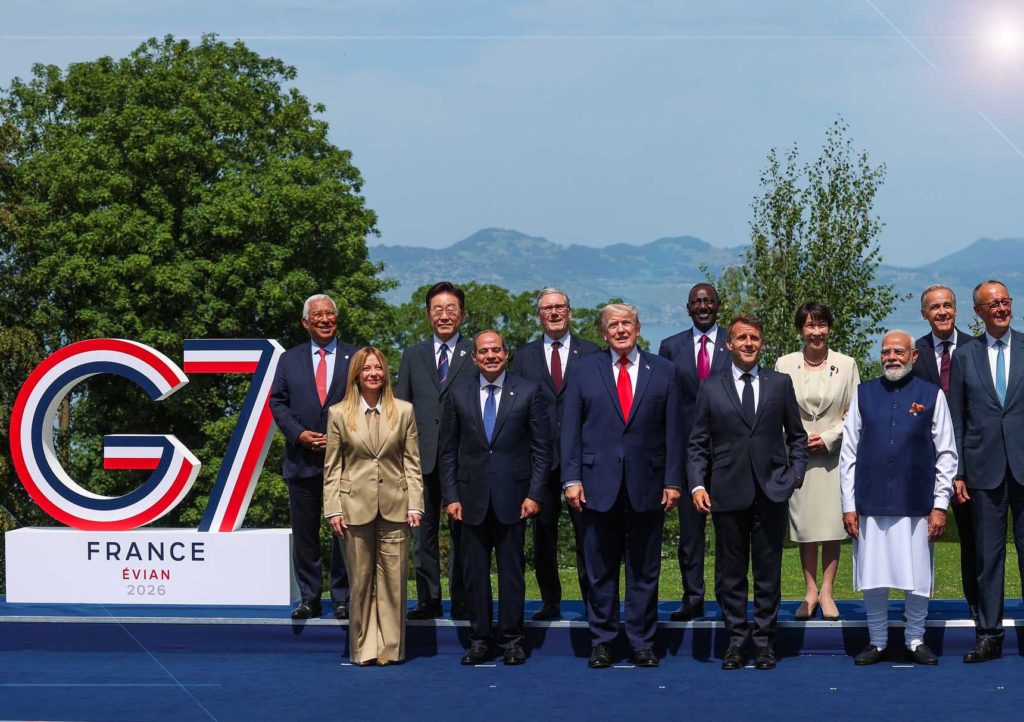
From June 15-17, 2026, Evian-les-Bains hosted the 52nd G7 Summit, chaired by France under Emmanuel Macron’s leadership. This major geopolitical event generated unprecedented media and social media coverage, with 1,164,760 mentions collected across three languages 7 languages (English, French, German, Italian, Spanish, Japanese and hindi), by Onclusive Social in just four days.
The G7 summit in media proved to be far more than traditional multilateral diplomacy. Beyond the conventional G7 agendas of economic growth, international stability, and global partnerships, this summit distinguished itself through its capacity to mobilize journalists, influencers, and the general public around three critical domains: Middle Eastern geopolitics, global trade tensions, and artificial intelligence regulation.
This comprehensive analysis explores how the G7 summit in media was framed across different channels, which actors dominated the conversation, how social media amplified or obscured key narratives, and how a historic agreement signed at Versailles extended the summit’s diplomatic ambitions beyond the official closing.
Key Figures: Massive and multidimensional coverage
Volume and linguistic diversity
The mentions collected from June 15-18 reflect the extraordinary scope of the G7 summit in media coverage. Distributed across 7 languages (English, French, German, Italian, Spanish, Japanese and hindi), these figures demonstrate global engagement, particularly strong in anglophone and francophone spheres, and significant presence in Latin America and Spain. For media monitoring and communications professionals, this data reveals that coverage of the G7 summit in media extended far beyond traditional press channels (mentions collected by Onclusive Social and Onclusive Monitor)
Thematic distribution: Middle East dominates the conversation
The breakdown of reactions and critiques by theme reveals clear editorial hierarchies in how the G7 summit in media was handled:
Dominant Themes
- Middle East and Trump diplomacy: 42.9% share of voice
- Global trade tensions: 38.0%
- Online child safety: 6.9%
- Zelensky bilateral meetings: 8,175 mentions 6.7%
- AI regulation: 4,259 mentions 3.5%
- Other themes economy, general AI: less than 1% each
Geopolitical and commercial issues dominated the G7 summit in media discourse at the expense of economic sustainability, health initiatives, and long-term development commitments. This reveals that media outlets and social platforms prioritize conflict narratives over constructive cooperation when covering the G7 summit in media environments.
Most Mediatized G7 members (by media and social media share of voice):
first lady-France
Most mediatized actors
Political leaders: Trump at the center
Among 700,764 mentions of G7 members, the media hierarchy by share of voice is unmistakable:
- Donald Trump (United States): 40.89%
- Emmanuel Macron (France, host): 16.02%
- Brigitte Macron: 13.01%
- Keir Starmer (United Kingdom): 10.19%
- Other leaders (Meloni, Takaichi, etc.): less than 6% each
Key finding: Trump monopolizes 40% of G7 summit in media coverage, confirming he was the focal point of the event. Despite Macron’s role as summit chair, his share of the G7 summit in media narrative is only 16%. This disparity reflects media appetite for contrasting positions and polarizing figures, particularly regarding Trump’s views on AI, trade tariffs, and Middle Eastern diplomacy.
Invited guests: Zelensky and Modi in the spotlight
Among 233,419 mentions of non-G7 invitees:
- Volodymyr Zelensky (Ukraine): 42.21%
- Narendra Modi (India): 40.48%
- Other invitees (Qatar, Egypt, Brazil, Kenya): less than 5% each
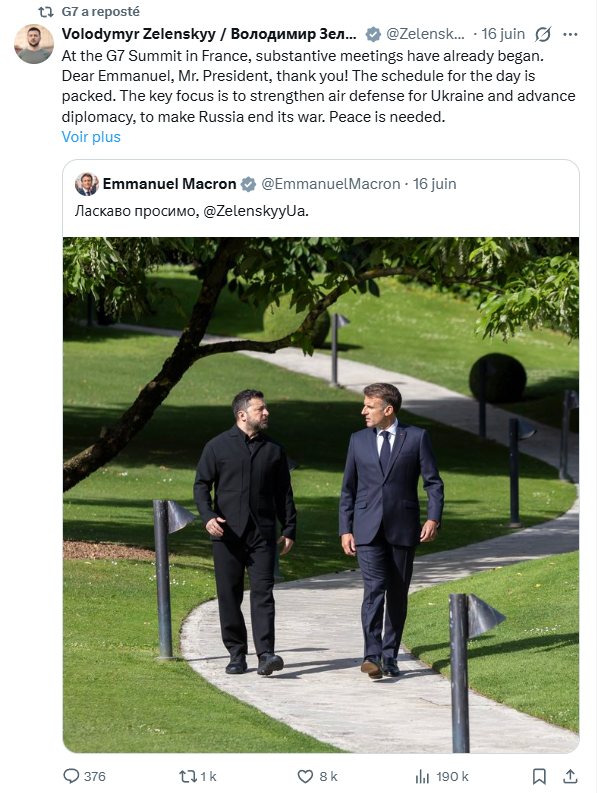
Zelensky’s prominent position in the G7 summit in media coverage, despite his limited time at the summit, reflects the centrality of Ukraine security concerns and the diplomatic effort to keep the U.S. engaged in European security.
Tech leaders: Anthropic at the center of AI debate
Among 166,030 mentions of the technology sector:
- Anthropic (Dario Amodei): 42.5%
- OpenAI (Sam Altman): 25.9%
- Tech leaders at the summit: 21.4%
- Mistral AI (Arthur Mensch): 10.2%
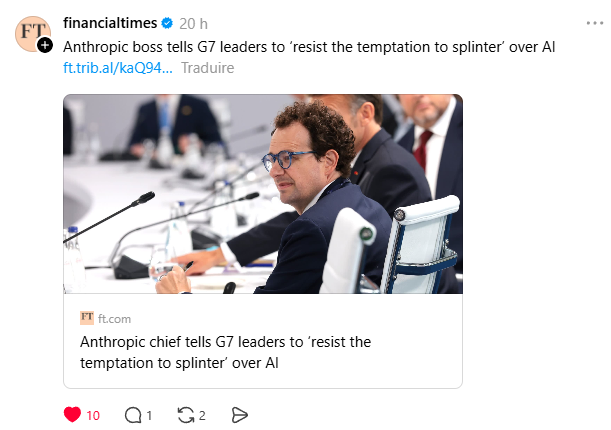
Editorial Context: Anthropic dominates tech-related coverage of the G7 summit in media, partly due to the U.S. government’s decision on June 12, 2026, to suspend access to Anthropic’s most powerful models. This event fueled discussions about AI geopolitics, American export controls, and tensions between innovation and security – all key themes in how the G7 summit in media framed technology governance.
Dominant narratives and media frameworks
1. Middle East: Diplomatic convergence and persistent tensions
Coverage: 42.9% share of voice
The summit gave major visibility to negotiations addressing the Middle Eastern crisis. The G7 summit in media coverage structured around three axes:
Strait of Hormuz reopening: Media outlets emphasized negotiations involving the U.S., Iran, Egypt, Qatar, and the UAE. The agreement on rapid reopening of the strait – a blockade costing the global economy dearly – was presented as a major diplomatic victory, even though complete G7 unanimity was absent (Trump pursuing parallel Iranian negotiations).
Gulf states participation: For the first time, Gulf states (Egypt, Qatar, UAE) participated in G7 summit in media-covered sessions dedicated to regional stability. This innovation was hailed as an inclusive approach, though criticized by some commentators as diluting G7 principles.
Saudi absence notable: Saudi Arabia’s absence received minimal coverage, highlighting the subtle geopolitical calculations and shifting alliances in the region.
2. Trade tensions: The protectionist specter
Coverage: 38.0% of total
Trade tensions, driven notably by Trump’s positioning on tariffs and trade wars, captured 38% of the G7 summit in media conversation. Three issues dominated:
Trade wars and tariffs: Trump signaled his intention to pursue a protectionist approach, a stark contrast to traditional G7 free-trade consensus. Media coverage of the G7 summit in media extensively highlighted these frictions, particularly between the U.S. and European allies.
Critical minerals and China dependency: A major success of the summit, widely covered in the G7 summit in media, was the launch of the Critical Minerals Resilience Alliance, aimed at reducing Chinese dependence (which dominates approximately 70% of extraction and 90% of rare earth refining). The goal of less than 60% dependency on any single non-G7 country by 2030 was amplified by economic press covering the G7 summit in media.
Durable economic resilience: A final declaration on “more balanced, sustainable, and resilient growth” was adopted but received minimal coverage (0.6% share of voice), revealing a lack of editorial interest in non-conflict economic narratives in the G7 summit in media environment.
3. Artificial intelligence: Regulation and geopolitics
Direct coverage: AI regulation 3.5%, Indirect coverage (tech leaders):1.6% of total
AI occupied a major place in the G7 summit in media, though less immediately than geopolitical crises. The main dimensions included access to technology, export controls, and the role of technology leaders.
American export controls and tech geopolitics: The suspension of Anthropic’s most powerful AI models, announced June 12, 2026, by the U.S. government cast a significant shadow over G7 summit in media discussions about collaborative and safe AI. This decision was widely presented as illustrating the conflict between U.S. national security and multilateral AI governance. Politico and Bloomberg probed the implications: how could the U.S. advocate for responsible, collaborative AI while unilaterally imposing export restrictions? This tension dominated tech-political coverage of the G7 summit in media.
Technology company leadership: A working lunch Wednesday brought together Dario Amodei (Anthropic), Sam Altman (OpenAI), and Arthur Mensch (Mistral AI) alongside G7 political leaders. This event was extensively covered as a major innovation – the direct integration of AI CEOs into diplomatic discussions signaled recognition of these companies’ central role in future geopolitical relations. In the G7 summit in media coverage, Anthropic received 42.5% of tech sector mentions, largely due to the controversy surrounding its suspension, but also because of its direct presence in negotiations.
“Safe and beneficial AI” theme: Beyond commercial friction and geopolitical jockeying, a formal G7 declaration calling for “safe and beneficial AI” was adopted. This declaration committed technology companies to integrating security and ethics into model deployment. However, coverage of this initiative in the G7 summit in media was largely eclipsed by debates over export controls and competition between the U.S., France, and China for technology leadership.
4. Online child Safety: A new pillar of digital governance
Coverage: 6.9% of total. Official declaration: “Leaders’ Call on a Safer Digital Space for Minors“
Child online safety emerged as one of the most visible pillars in the G7 summit in media, particularly under French presidency impetus. This topic transcends simple technology regulation, inscribing itself within a broader vision of digital governance and parental and educational responsibility.
Technology company engagement: The G7 issued a collective call to technology companies to ensure minor online safety. This call explicitly targeted major platforms (Meta, TikTok, YouTube, etc.) and messaging applications. The Wednesday tech lunch also covered this issue, engaging AI leaders (Anthropic, OpenAI, Google) to adapt their chatbots and interfaces to ensure minors’ interactions were safe and developmentally appropriate.
French age minimum initiative: The most aggressive French position in the G7 summit in media coverage involved banning social media access for minors under 15 or 16 years old. This proposal, championed by Macron, generated massive and polarized coverage. France Culture and Le Monde detailed the French reasoning: protecting childhood against psychological risks, digital dependency, and algorithmic manipulation. However, this position encountered less restrictive U.S. approaches and practical questions about implementing such a ban in the era of cross-border digital technology.
Polarized media coverage: Across social media and traditional media, the G7 summit in media coverage of minimum age sparked heated debates. Positions crystallized between, on one side, advocates for strict minor protection (largely aligned with Nordic and French approaches) and, on the other, digital liberals and tech actors arguing for parental responsibility rather than legal prohibition. This polarized engagement explains why 6.9% of total share of voice focused on this theme – it triggered strong emotional and ideological reactions among audiences.
Practical dimensions: Media covering the G7 summit in media also addressed operational challenges: how to verify age online without violating privacy? How could a 14-year-old in France continue using TikTok if a ban passed? This pragmatic coverage tempered initial enthusiasm for the French proposal, revealing the gap between regulatory ambitions and technological realities.
International coalition: Beyond France, other G7 members expressed varying degrees of support in G7 summit in media discussions. The UK and Germany also advocated for more protective frameworks, while Canada adopted a middle position. The U.S. emphasized voluntary public-private collaboration over legal bans. This fragmentation of the G7 consensus on an apparently obvious issue – protecting children – illustrates underlying tensions regarding regulation versus technological innovation.
5. Ukraine and european security
Coverage: 6.7% share of voice for Zelensky bilateral meetings
Volodymyr Zelensky received disproportionate G7 summit in media coverage relative to his time at the summit. Bilateral meetings with Trump and other leaders were presented as critical for:
- Reinforcing military aid (air defense, long-range capabilities)
- Maintaining sanctions against Russia
- Resisting American demands to abandon the Donbas
The summit reaffirmed G7 unity on Ukraine despite Trump-Macron divergences, though the issue received less coverage than trade tensions and Middle Eastern geopolitics in the G7 summit in media discourse.
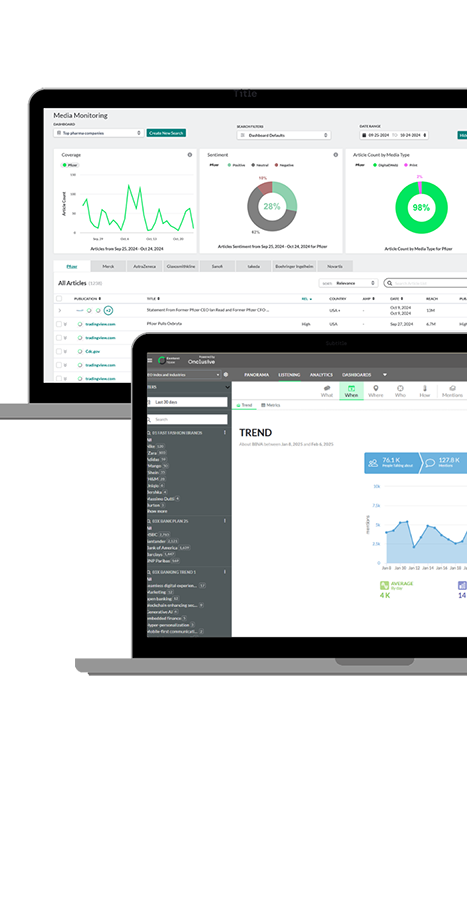
See the Full Narrative with Onclusive
Stories no longer live in channels.
Get one unified view across social and earned media, so you can track how narratives start, spread, and evolve – and act with confidence.
Media coverage by channel: Traditional vs. social media
Traditional media: Dynamics of coverage by theme
Media coverage of the G7 summit in media followed a clear editorial hierarchy, revealing journalists’ and editorial boards’ perceived priorities. Issues related to immediate crises (Ukraine, Middle East, trade tensions) benefited from maximum coverage, while structural and long-term issues received secondary attention.
Ukraine constituted the dominant focal point for generalist and specialized media. Zelensky’s presence, the organization of dedicated sessions, and existential security stakes naturally generated sustained attention. France 24 headlined allies “pushing Ukraine high on Trump’s agenda,” signaling editorial concern about American determination amid parallel Iran negotiations. Politico and Reuters emphasized “support promises and harder sanctions against Russia,” framing the summit as an opportunity to strengthen Western cohesion. Le Monde adopted a more analytically critical approach, covering latent tensions between Trump and Macron over viable ceasefire conditions, while noting an “unprecedented alignment” of the G7 despite these divergences.
The Middle East and trade negotiations occupied the second editorial position, particularly for business and economic media. The stakes of the Strait of Hormuz, implications for global energy economics, and power plays between Trump, Gulf states, and Iran captivated Reuters, Bloomberg, and Financial Times. These outlets covered not only G7 working sessions, but also underlying diplomatic calculations – explaining why Egypt, Qatar, and the UAE had been specifically invited.
Critical minerals and China dependency received deep economic coverage, though targeted to specialized audiences. The specialized press (geopolitical analysis, mining economics, trade policy) hailed the creation of the Critical Minerals Resilience Alliance and the 60% dependency reduction goal as a major strategic advance. Financial Times and Politico probed operational implications and scalability risks. However, these articles were largely confined to economics pages or specialized analysis, far from generalist coverage.
BBC and Politico adopted a broader “governance” and “soft power” angle, examining how the G7 attempted to remain relevant amid rising emerging powers and growing fragmentation. This angle offered more reflective perspective on format and participation of invited countries.
Health issues (cancer as major priority, Ebola epidemic, funding exceeding one billion dollars) received moderate coverage, concentrated in specialized sections or summit summary analyses. Official sites (Elysee.fr) and specialized health press highlighted the innovation of placing cancer on the G7 agenda for the first time, but without generating the urgency or virality perceived for geopolitical crises.
Finally, sustainable macroeconomics, universal healthcare access, and long-term partnerships with Global South countries were largely relegated to sidebars or concluding syntheses, reflecting apparent editorial lack of interest in constructive governance issues devoid of conflict or immediate drama.
Social media: User engagement and virality
Social networks, particularly X (formerly Twitter) and Threads, amplified certain G7 summit in media narratives while relegating others to the background. Unlike traditional media, where editorial hierarchy determines story priority, X operates according to viral engagement dynamics and user interest following different but complementary logic.
Ukraine and Zelensky generated maximum virality regarding the G7 summit in media. Official accounts (@ZelenskyyUa, @Elysee, @G7) received massive engagement, with cascading retweets and spontaneous adoption of #UkraineSolidarity hashtag. Visual content – photos of bilateral meetings, images of working sessions, moments of displayed G7 leader support – circulated widely, creating narratives accessible and emotionally resonant for users. Posts emphasizing unity despite Trump-Macron tensions also found echo, confirming that conflict or convergence around polarizing figures amplifies engagement in G7 summit in media discussions.
Trump tensions generated polarized and contentious engagement. Posts criticizing or supporting the American president’s protectionist positioning, AI export controls, and parallel Iranian negotiations fueled structured and fragmented debates. This engagement remained high but more fragmented than Ukraine-related coverage, revealing audience divisions on networks regarding G7 summit in media interpretation.
Displayed unity against China – particularly around critical minerals – generated consensus posts valorizing Western “resilience.” The hashtags #CriticalMinerals and #ResilienceAlliance achieved moderate trending, notably among accounts specialized in economic strategy, supply chain, and geopolitical analysis. This relative success suggests that structural economic issues generate moderate but structured engagement on X, particularly in professional niches discussing the G7 summit in media.
The “family photo” of G7 leaders gathered at Evian sparked community sharing, with light comments and iconic images circulating as generalist content. This imagery-based engagement complements denser debates about the G7 summit in media substance.
Artificial intelligence constituted a secondary but structured conversation. Posts by tech experts and company representatives (Anthropic, OpenAI, Mistral) on public-private collaboration and responsible AI governance circulated, notably around the Anthropic suspension controversy amplified in G7 summit in media discourse. The hashtags #AISafety and #IARegulation achieved moderate presence, reflecting professional interest without reaching generalist virality.
Health (cancer and Ebola) received moderate presence in G7 summit in media discussions. Public health bodies (@WHO, @GAVI) shared announcements factually, but without generating viral engagement of geopolitical themes. Retweets came largely from specialized or institutional accounts, not from general users amplifying messages about the G7 summit in media.
Audience Dynamics: Official accounts (@Elysee, @EmmanuelMacron, @realDonaldTrump, @ZelenskyyUa) generating highest engagement and reach remained conversation pivots in G7 summit in media coverage. Think tanks and geopolitics and economics research centers relayed detailed analyses to professional audiences. Major media (France 24, Reuters, Bloomberg) used X to distribute headlines and short videos, serving as bridges between traditional press and social network users discussing the G7 summit in media.
General tone: Media and social convergence and frictions
Consensus emerges across traditional media and social platforms: the G7 Evian is presented as a summit of “concrete results” capable of producing nine official declarations, despite persistent friction with Trump and global geopolitical uncertainty. This dominant narrative emphasizing displayed unity facing crises, even where disagreements remain substantive, shapes how the G7 summit in media is understood.
Convergence points between media and networks reflect shared judgment: Ukraine benefited from clear renewal of support and sanction commitments; critical minerals represent a constructive and strategically important agenda; format innovation (participation of invited countries, lunch with tech leaders) signals G7 adaptation to multipolar realities; and overall, the G7 remains pertinent and capable of producing results, even in turbulent American context.
However, persistent frictions temper this optimism in G7 summit in media discourse. Trump and artificial intelligence constitute the main tension point: American export controls (Anthropic suspension June 12, 2026) directly contradict the G7’s call for public-private collaboration on safe AI. Media framed this as “AI geopolitics” where American national security concerns override multilateral governance in G7 summit in media coverage. Trump and critical minerals generate a second friction, with implicit fears concerning terms allies could access strategic resources.
A gap between rhetoric and action also appeared, particularly in health. Promises about universal healthcare access (cancer, Ebola), though inspiring, confront questions of long-term financing and practical implementation. Reduced coverage of these issues reflects this implicit skepticism in G7 summit in media analysis.
Finally, observers noted editorial absence: coverage of sustainable economic issues (balanced growth, fair trade, global imbalances) was largely eclipsed by geopolitical and trade conflicts. This suggests media outlets and social network audiences concentrate on crises and divergences rather than long-term constructive agendas, even when the latter represent concrete summit achievements reflected in G7 summit in media reports.
The dominant sentiment on X synthesizes these tensions: cautious optimism (“the G7 could be more divided”), skepticism about agreement durability (“Will Trump keep his Ukraine and sanctions promises?”), displayed solidarity with Ukraine tempered by uncertainties, and recognition that critical minerals constitute the “true structural agenda” of the post-summit G7 – the one that will shape global economic relations in the coming decade, as analyzed in ongoing G7 summit in media coverage.
Conclusion: Geopolitical convergence and diplomatic continuities
The G7 Evian 2026 summit inscribes itself within context of growing multipolarity, trade tensions, and alliance recomposition. Its G7 summit in media coverage of 1,164,760 mentions reflects intense engagement of public, decision-makers, and analysts toward major current issues.
Long-term questions (health, sustainable economy) received less than 1% share of voice, while geopolitical and trade conflicts dominated 81% of G7 summit in media discourse.
Three G7 media victories
- Global South Inclusion: Involvement of India, Brazil, Kenya, South Korea signaled G7 determination to remain relevant in multipolar world, shaped how the G7 summit in media was presented.
- Critical minerals and resilience: The Critical Minerals Resilience Alliance offered constructive agenda for reducing China dependency, framed favorably in G7 summit in media discourse.
- Online minor protection and regulated AI: French push for safe AI and social media ban for minors positioned G7 as actor in global technology governance, widely covered in G7 summit in media outlets.
Three unresolved tensions
- Trump vs. Multilateral consensus: The American president maintained protectionist positioning contrasting traditional G7 free-trade, without formal rupture – a central dynamic in G7 summit in media analysis.
- Compartmentalized Middle East: G7 negotiations on Middle East unfolded parallel to Trump’s unilateral ambitions, creating lasting ambiguity in how the G7 summit in media presented outcomes.
- Unequal coverage of issues: Long-term questions (health, sustainable economy) received less than 1% share of voice, while geopolitical and trade conflicts dominated 81% of G7 summit in media discourse.
Versailles signature: Symbolic closure
The U.S.-Iran agreement signed at Versailles June 17, 2026, extends the G7 Evian beyond formal timing. It represents:
- Diplomatic success: formal war end, Strait reopening, $300B reconstruction promise
- Continuity: execution of G7 Middle East negotiations, with Trump as central actor
- Question mark: absent clear multilateral mechanism (G7 did not formally validate agreement) raises questions about deal durability and compatibility with G7 ally positions
For communications professionals and media monitoring specialists, the G7 summit in media illustrates how major geopolitical events unfold across multiple temporalities – the official summit, parallel negotiations, and margin-signed agreements, all capturing media attention according to audience dynamics, editorial interest, and polarizing figures.

This analysis is based on Onclusive’s proprietary monitoring, covering 1,164,760 media and social mentions from June 15 to June 17, 2026, across 7 languages.
For more information on Onclusive’s events and politics intelligence capabilities, contact our team:
Cover imags: Image by Ministry of External Affairs-India-CC-Free of use