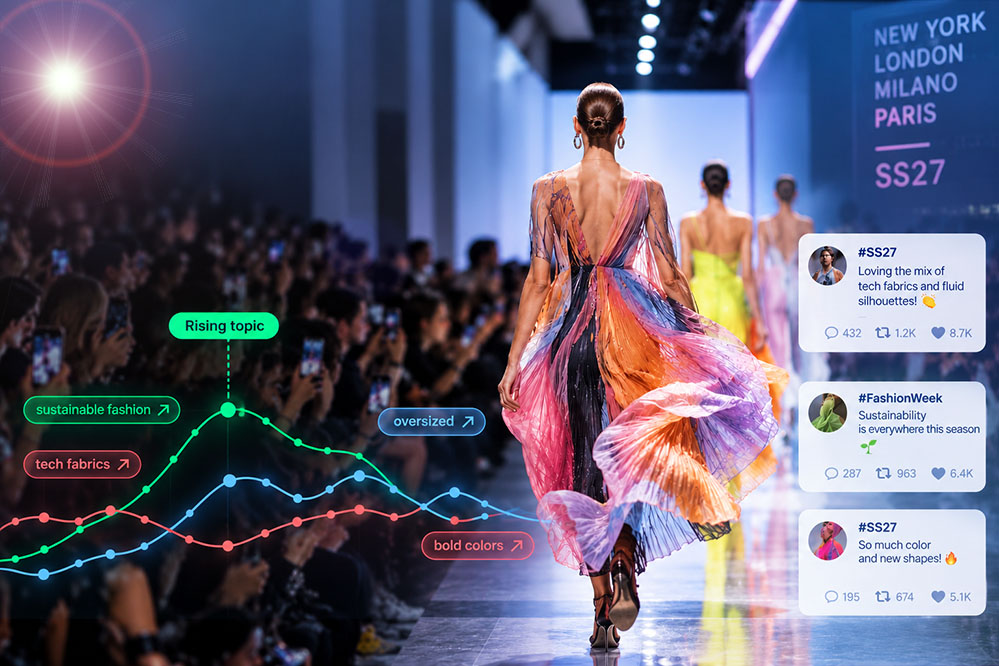
Social listening trends analysis provide one of the clearest ways to separate structural shifts from short-lived noise. Social listening is the systematic capture, filtering and analysis of public conversation (mentions, reach, authors, hashtags, share of voice) across social platforms. When done with structured queries, clean windows and cross-checks against confirmed attendance, it becomes a precise instrument for identifying trends at every level of granularity.
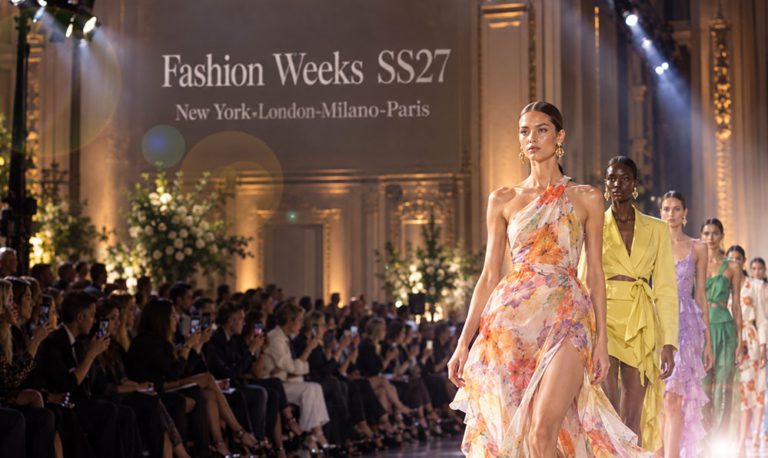
The four Spring/Summer 2027 Fashion Weeks (New York, London, Milan, Paris – September to early October 2026) offered a near-ideal laboratory. High-density calendars, global celebrity traffic, rapid hashtag formation and clear geographic shifts produced millions of data points. The analysis below is built exclusively on Onclusive Social and Onclusive Monitor extracts, confirmed front-row lists, and brand/celebrity query sets developed for the season.
Why trend analysis through social listening excels at detection
Fashion weeks generate two parallel realities: the physical shows and the conversation that surrounds them. Traditional coverage and social conversation rarely describe the same week. Analysis of trends using Social listening make this divergence measurable and turn volume, velocity and concentration into early indicators.
Key advantages when tracking trends using Social listening:
- Volume and reach surface what large communities actually discuss.
- Share of voice among a defined set of brands or personalities reveals concentration versus fragmentation.
- Hashtag rankings (using maximum values per tag rather than cumulative sums) highlight pairings that dominate specific windows.
- Day-by-day extracts catch acceleration and bleed from one city to the next.
- Cross-referencing social leaders against confirmed front-row attendance filters fan noise from real presence.
These elements together allow consistent identification of trends using Social listening across successive windows.
The methodology: Building and iterating a tracking system for trends using Social listening
A reliable process for capturing trends using Social listening rests on structured measurement and continuous refinement.
Core setup
- Defined measurement windows that cover the official calendar plus a short buffer (New York 9-16 September, London 16-22 September, Milan 21-29 September, Paris 27 September-7 October 2026).
- Separate query sets for houses, confirmed celebrities and pairings (celebrity × brand). Group names are excluded so individual performers are measured cleanly.
- Core metrics: social mentions, reach, unique authors, mainstream mentions, brand SOV, celebrity SOV, and hashtag rankings by maximum value.
- Parallel social and news dashboards.
- Validation against confirmed front-row and runway lists.
- Multilingual monitoring is essential, as conversation around the Fashion Weeks spans English, French and Italian alongside Korean, Chinese, Thai and languages from emerging social-media markets for fashion weeks such as the Philippines; capturing these languages in full is required to avoid systematic under-counting of the dominant fandoms and to produce accurate share-of-voice rankings.
The iterative enrichment loop that strengthens detection of trends using Social listening
Trends using Social listening are not captured by a static query set. As data arrives, new entities surface and must be integrated:
- New hashtags (brand-only, person-only or pairing tags) that rise in volume are added to the monitoring set and to the analysis keys.
- Previously untracked celebrity names, supporting creators or creative-director mentions that begin generating conversation are added to the personality universe.
- Emerging pairings are incorporated into the relevant query groups.
- Share-of-voice denominators and hashtag ranking extracts are updated so subsequent windows remain comparable.
This loop-detect, enrich the queries, re-run the analysis keys, validate against attendance-repeats across days and cities. It is what allows the system to surface accelerating trends rather than remaining limited to the initial seed list.
Once the trends have been detected, ranked and classified through this iterative process, the AI Sense capability within Onclusive Social can extrapolate from the structured data. It helps design a coherent typology of the most remarkable trends by identifying patterns, concentrations and divergences that would be harder to surface manually at this scale.
By connecting volume signals, share-of-voice shifts and hashtag accelerations across windows, AI Sense supports the move from raw detection to a structured, multi-level view of trends using Social listening analysis and assess future trends, in order to implement and anticipate PR, communications, and marketing strategies.
Case study: Analysis of trends using Social listening across the four SS27 fashion weeks
New York (9-16 September)
2.64 million social mentions, 147.1 million reach, 1.69 million authors and 26,149 mainstream mentions.
Calvin Klein captured 64.94 % of brand social share of voice among 123 measured houses, driven by Lingling Kwong. Ralph Lauren led digital-news SOV at 7.64 %. On the celebrity side Lingling took 40.29 % of social SOV while Love Pattranite led the news ranking at 12.17 %. These figures already illustrated a recurring social listening trend: Asian entertainment stars dominate social volume while Hollywood names dominate the newspapers.
London (16-22 September)
608,000 social mentions, 123.2 million reach, 358,000 authors, 5,709 mainstream mentions, AVE 284.7 million.
Burberry remained first on social (55.2 % SOV among 134 houses) but its monopoly had loosened. H&M (17.2 %) and McQueen’s London return (6.8 %) formed a clear second and third pillar. Bright Vachirawit (29.06 %), Koji Mukai (27.90 %) and Shuhua (17.20 %) occupied the top three celebrity social positions. None of them appeared in the news top twenty, which was led by Kelly Osbourne, Lila Moss and Marks & Spencer. Asia was effectively invisible in digital news-another clear social listening trend of the season.
Milan (21-29 September)
5.1 million social mentions, 104 million reach, 3.1 million authors, 15,393 mainstream mentions, AVE 345 million.
Moschino led brand social SOV at 29.3 %, followed by Gucci (15.3 %) and Tod’s (13.2 %). Tle Matimun (20.48 %) and Firstone Wannakorn (20.45 %) together accounted for more than 40 % of celebrity social share among 228 measured names. Digital news reordered the field: Prada 12.5 %, Gucci 8.8 %, Vogue World 7.6 %. Cardi B, Jennifer Lopez and Jannik Sinner led the news celebrity ranking. The Thai pairing that dominated social left almost no trace in the news extract, reinforcing the trends using Social listening observed in the previous cities.
Paris (27 September-7 October)
21.2 million social mentions, 154.1 million reach, 14.7 million authors, 26,404 mainstream mentions, AVE 1.12 billion.
Christian Dior took 45.04 % of brand social SOV among 101 FHCM houses, with Schiaparelli (9.74 %) and Chanel (9.10 %) a distant second and third. Lingling Kwong (24.31 %) and Orm Kornnaphat (22.59 %) together represented nearly half of celebrity social share among 479 measured names. Digital news again diverged: Dior 7.8 %, Chanel 7.6 %, Celine 6.3 %, with Rihanna leading the celebrity news ranking at 3.29 %.
Across the four cities the same trends repeated: social conversation was powered by a relatively small set of Thai drama stars and their pairings, while digital news continued to privilege Western and Hollywood names.
A granular typology of trends using Social Listening
Social listening does not invent trends; it detects, analyzes, evaluates, ranks and timestamps them. The SS27 data supports a clear typology of trends.
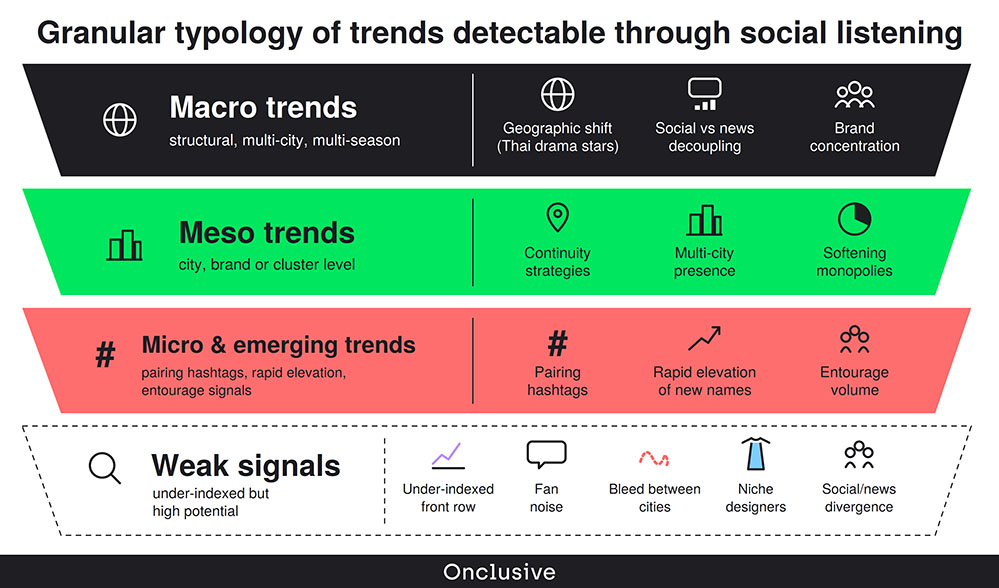
🌐 Macro trends using Social listening (structural, multi-city, multi-season)
- Geographic and cultural shift in ambassador power: Thai drama stars and their organised fandoms became the primary engines of social volume, displacing the previous K-pop-centric pattern.
- Persistent decoupling of social and news realities.
- Extreme concentration of brand social share of voice in a handful of houses (Calvin Klein in New York, Burberry in London, Moschino in Milan, Dior in Paris).
📊 Meso trends (city, brand- or cluster-level)
- Continuity strategies that scale: houses that maintained and activated established Thai ambassadors generated outsized social volume.
- Multi-city presence as an amplifier.
- Softening of former monopolies once secondary houses established measurable pillars.
#️⃣ Micro and emerging trends
- Pairing hashtags that dominate discrete windows and frequently outrank generic brand or person tags.
- Acceleration of specific new or newly elevated names inside a single week.
- Entourage and supporting creators generating measurable volume once the principal ambassadors are in place.
🔍 Weak signals among trends using Social listening
- Confirmed front-row attendance that remains under-indexed in social volume.
- Fan-noise tags that spike without corresponding confirmed presence.
- Bleed of high-volume pairings from one city into the next calendar window.
- Emerging or independent designers whose collections generate little aggregate social volume yet produce dense conversation inside niche communities.
- Divergence between a house’s social leadership and its news leadership.
The process, best practices and step-by-step path described here for detecting and classifying trends during Fashion Weeks are not limited to the fashion calendar:
The same structured approach (clean measurement windows, iterative query enrichment, multilingual coverage, parallel social and news dashboards, attendance or context validation, share-of-voice calculation inside fixed universes, and progression from macro signals to weak signals) can be applied to any domain where public conversation reveals emerging patterns.
It works equally well for economic and market trends, event and cultural monitoring, brand-specific market movements, innovation and technology adoption, sociological and cultural shifts, competitive intelligence, public-affairs issues, or category-level consumer behaviour.
In each case the core discipline remains the same: define the universe, capture conversation in the languages that matter, continuously enrich the queries as new entities appear, separate volume from validated presence, and organise the resulting signals into a clear typology that moves from structural trends to actionable weak signals.
Artistic and product directions (visible lingerie and bralettes, elevated sportswear, lace and sheer volumes, vintage prints, colour blocking, dark denim) are primarily observed on the runway. Trends using Social listening track the conversation intensity around the houses and people associated with those directions; pure aesthetic classification still requires complementary visual analysis.
Ready to turn conversation into clear, actionable trends-whatever the domain?
Use Onclusive Social to detect, rank and classify trends across fashion, markets, technology, culture or any sector that moves in public conversation. Start with structured monitoring, enrich your queries as signals appear, and let the platform surface the patterns that matter.
Operationalising analysis of trends using Social listening
- Maintain parallel social and news dashboards; never average them.
- Recalculate SOV inside fixed, documented universes so that percentages remain comparable across seasons.
- Rank hashtags by maximum value inside each window rather than cumulative totals.
- Flag every high-volume name or tag against the confirmed attendance list.
- Track pairing tags as first-class entities.
- Continuously enrich the monitoring queries and analysis keys with newly detected hashtags, celebrity names, pairings and creative-director mentions, then re-run the extracts.
- Archive day-by-day extracts so that acceleration and bleed can be reconstructed later.
- Use AI from social listening tools to extrapolate and develop typologies and assess future trends, in order to implement and anticipate PR, communications, and marketing strategies
Conclusion
Trends using Social listening, when built on clean windows, structured queries, dual social/news measurement, attendance validation and continuous iterative enrichment, convert the noise of event like Fashion Week into a ranked map of macro shifts, meso brand strategies, micro pairings and genuine weak signals.
The SS27 season demonstrated the method at scale: a clear geographic transfer of social power toward Thai drama stars and their fandoms, extreme concentration of brand conversation, and a durable gap between social platforms and digital news. Those distinctions are actionable for casting, content planning and early detection of the next cycle’s social listening trends.