
Introduction: Continuing our e-commerce narrative analysis series
This blog is the third in our detailed analysis series examining the e-commerce platforms landscape. Following our previous posts-
The 45% disruption, which showed how 45% of social commerce conversation originates from new entrants, not established platforms and Regional e-commerce platform dominance, which mapped regional variations in platform dominance across different markets-we now turn to one of the most counterintuitive findings in our data: in the age of social listening and distributed media, scale doesn’t equal narrative control.
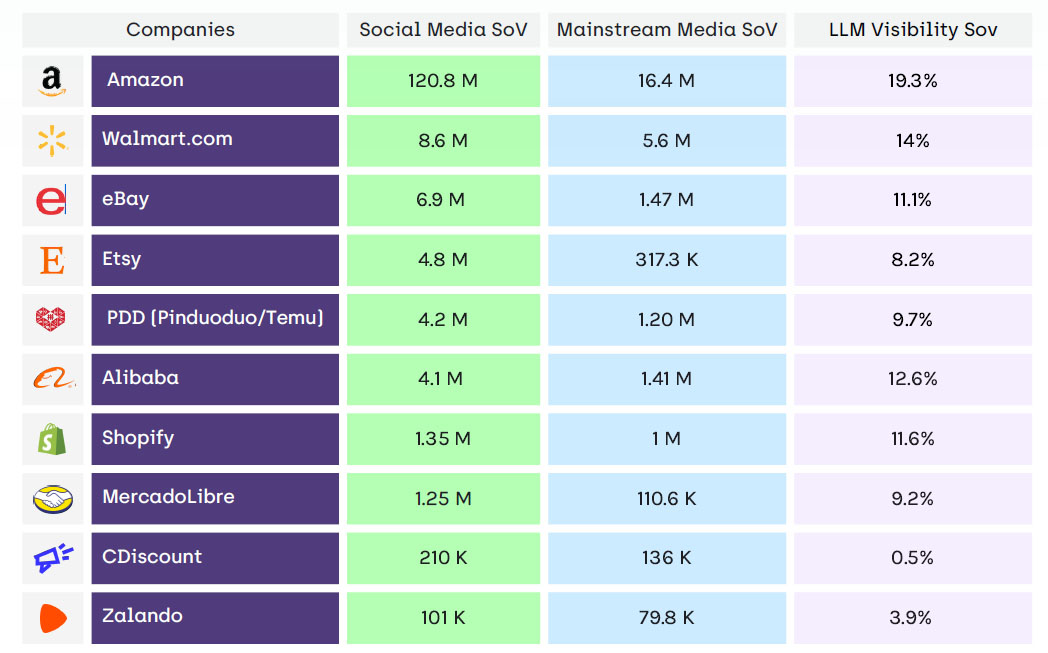
The data from our 12-month analysis (August 2025–July 2026) reveals a striking paradox. Amazon dominates with 120.8 million social mentions and 16.4 million mainstream media mentions. Yet a single policy decision by eBay-its January 13, 2026 Promoted Listings fee change-generated enough seller outrage and media amplification to reshape the conversation around eBay’s entire brand positioning for months.
For PR and communications professionals, this has a critical implication: scale doesn’t equal narrative control. In the age of social listening and distributed media, a company’s narrative share is no longer a simple function of its market scale. The story matters more than the volume.
All data informing this analysis is available in Onclusive’s E-Commerce Platforms Industry Scan 2026, which tracks 153.7 million mentions across 69 companies and 7 regions, identifying where e-commerce players create narrative gaps and competitive opportunities.
The data in the report is collected using Onclusive’s specialized tools: Onclusive Monitor for media monitoring and analysis (TV, radio, podcasts, print, and digital), and Onclusive Social for social media listening (discussion platforms, forums, blogs, and social media), GEO Analytics for Gen AI Visibility Share of Voice
Scale doesn’t equal narrative control: the data
Amazon’s dominance in raw mention volume is undisputed. The Onclusive E-Commerce Platforms Industry Scan shows:
• 120.8 million social media mentions (from posts, comments, conversations across Twitter, Reddit, TikTok, Instagram, and other platforms)
• 16.4 million mainstream media mentions (news, TV, radio, print coverage)
• 19.3% AI visibility share in large language models-higher than any other platform in the analysis
This scale reflects Amazon’s position as the undisputed leader in Western e-commerce, holding approximately 35-40% of US e-commerce market share. The platform’s ecosystem-comprising millions of sellers, vendors, and buyers-generates constant organic amplification through earnings announcements, regulatory scrutiny, strategic partnerships, and ongoing buyer-seller conversations.
Yet visibility does not equal control. Amazon’s sheer size means its narrative is fragmented across hundreds of topics: Prime membership debates, labor practices, anticompetitive concerns, AI applications, supply chain effects, and pricing pressure. This is precisely why scale doesn’t equal narrative control. The company’s voice, while loud, is dispersed.
eBay’s 30-day attribution shock: when policy becomes narrative
eBay’s social mention count-6.9 million across the same 12-month period-places it fourth among the platforms tracked, far behind Amazon and Walmart. Yet the narrative around eBay shifted dramatically on January 13, 2026. This case study perfectly demonstrates why scale doesn’t equal narrative control.
On that date, eBay implemented a fundamental change to its Promoted Listings attribution model. Here’s what changed:
Old model (pre-January 2026)
Ad fees were charged only if a buyer clicked on a promoted listing ad AND that specific buyer purchased that exact listing within 30 days. This created a clear, performance-based attribution: you paid fees only when your own ad drove a direct, measurable sale.
New model (effective January 13, 2026)
Ad fees are now charged if any buyer clicked on a promoted listing ad and any buyer (not necessarily the clicker) purchased that same item within 30 days. The definition of attribution expanded from ‘direct advertiser-to-buyer conversion’ to ‘any click + any subsequent sale of the same product within the window.’
The result: eBay sellers reported that promoted listing fees would increase dramatically-in some cases, doubling or tripling-because nearly every sale of a promoted item would now incur ad fees, regardless of whether that specific advertiser’s campaign drove the purchase.

Media and social reaction to eBay’s policy change
The backlash was immediate, widespread, and sustained:
• YouTube videos analyzing the policy change-including titles like ‘eBay’s 2026 Promoted Listing Change Is INSANE’-accumulated tens of thousands of views within weeks, with one video reaching 77,000+ views.
• Seller forums and communities erupted with detailed calculations showing estimated fee increases, with many sellers reporting they would withdraw from the Promoted Listings program entirely.
• The controversy spilled into mainstream media, with business publications covering the seller backlash as a story of corporate policy overreach in the gig economy.
• FTC complaints were filed by sellers alleging unfair and deceptive business practices, citing eBay’s failure to adequately disclose the attribution changes in advance.
• eBay’s own Seller Circle virtual event in November 2025 was dominated by angry seller questions about the incoming policy, with participants expressing deep concerns about ROI disappearing under the new fee structure.
In the context of our 12-month data collection window (August 2025–July 2026), eBay’s policy decision became the dominant narrative thread in seller-generated content and mainstream coverage. While Amazon continues to monopolize total mentions, eBay’s narrative became singular and urgent: a story of unilateral corporate action imposing higher costs on small business sellers.
This case perfectly illustrates why scale doesn’t equal narrative control. The ability to shape what people talk about and how they talk about it-narrative dominance-is not won through volume alone. It’s won through clarity of message, emotional resonance, and timing.

Need The Complete Data?
The insights in this blog are just the surface. Ready to discover the new e-commerce players that are making their mark?
Get access to all the data. Download the report “E-Commerce Platforms Industry Scan 2026.”
What this means for PR, comms, and marketing professionals
The Amazon-eBay contrast offers three critical lessons for anyone monitoring e-commerce narratives:
1. Scale is table stakes, not strategy
Amazon’s 120.8 million mentions prove market dominance, but they also demonstrate the risk of diffusion. When you lead across every dimension-market share, technology, seller network, buyer base-your message gets fragmented across competing narratives. This is why scale doesn’t equal narrative control for market leaders. For challenger brands and emerging platforms, this creates an opportunity. eBay’s policy shock reached a focused audience (sellers and their communities) and ignited coordinated, emotional response. Amazon’s scale makes that kind of focused narrative shock harder to achieve.
2. Policy decisions are media decisions
eBay’s Promoted Listings change was, on paper, an internal operational adjustment-a way to recalibrate how advertising attribution is calculated. But because it imposed direct, measurable costs on a specific community (sellers), and because it felt like an unilateral shift in the rules, it became a narrative event. Every policy change-fee structures, algorithm changes, content moderation decisions, term-of-service updates-is a potential media event. The communicators and PRs who understand this can prepare crisis narratives before the story breaks. Those who don’t will be caught reactive.
3. Sentiment and controversy concentrate attention
eBay’s story gained traction not because it was positive, but because it was negative and specific. Sellers understood exactly what was happening and why it threatened them. They amplified it through YouTube, forums, social media, and complaints to regulators. In the attention economy, controversy-especially transparent, well-documented controversy-wins. Amazon’s 120.8 million mentions are spread across largely positive coverage (new features), neutral coverage (quarterly earnings), and negative coverage (labor, antitrust). eBay’s narrative, by contrast, concentrated around a single complaint. This demonstrates why scale doesn’t equal narrative control-concentrated criticism often outweighs dispersed volume. For a challenger brand, this is the opening.
The implication for social media monitoring and competitive intelligence: if you’re tracking e-commerce platforms or any digital marketplace, don’t assume that the platform with the largest mention volume is winning the narrative war. Look deeper. Who is talking about each platform? What are they saying? Is the sentiment concentrated (risky for the brand) or dispersed? Is there a single dominant topic or many competing narratives?
How to monitor narrative control, not just volume
For PR and comms professionals using social listening and media monitoring tools, the Amazon-eBay story suggests three monitoring priorities:
• Topic concentration. Track not just total mentions, but whether mentions are concentrated around a few dominant topics or dispersed. Concentration signals narrative control (or narrative crisis). Dispersion suggests a fragmented story.
• Sentiment trajectory. A platform with 120.8 million mentions that includes 30% negative sentiment has a different risk profile than one with 6.9 million mentions, 80% of which are focused on a single negative event. A negative event that ‘spikes and spreads’ is different from a negative event that ‘spikes and concentrates.’ Monitor velocity and duration, not just volume.
• Stakeholder segmentation. eBay’s narrative was amplified most by sellers-a specific, organized stakeholder group. If you’re monitoring e-commerce, track mentions by stakeholder type: sellers, buyers, investors, journalists, regulators, influencers. A policy that inflames sellers will show up differently in seller forums than in mainstream media, but both matter.
Conclusion: Narrative control is the new competitive advantage
Amazon’s 120.8 million social mentions represent market dominance. But eBay’s January 2026 Promoted Listings policy change demonstrates a fundamental truth: scale doesn’t equal narrative control. In the age of social listening and distributed media, the ability to control what people talk about and how-narrative share-is a distinct competitive advantage, independent of scale.
For PR and communications professionals, this report offers a framework: don’t assume that the loudest platform is winning the narrative war. Look at topic concentration, sentiment trajectory, stakeholder organization, and crisis velocity. The platform that owns a single, urgent story often beats the platform that owns many dispersed stories.
The Onclusive E-Commerce Platforms Industry Scan draws on 12 months of social and mainstream media data across 69 e-commerce and marketplace companies. It’s designed precisely for this kind of analysis: not just ‘who gets mentioned most,’ but ‘who controls the narrative, and how.’